Friday, June 4, 2010

Black Hussars


Minden Miniatures Prussian Hussars by Der Alte Fritz (click pix to enlarge).

Here are some quick pictures of the first dozen Minden Prussian Hussars that I painted as the HR5 von Reusch, or Black Hussars, so called for obvious reasons. I will apply the textured basing tomorrow night, let it dry overnight, and finish the grassing on Saturday.


They look very nice charging through the hamlet of Altenzaum, which was created by Herb Gundt (HG Walls).

The horses come in two poses: legs bunched together and legs stretched with both depicting a charging horse. They actually look better if you mix one of each horse style on the stand. This conveys movement and action and sort of reminds me of Lady Butler's painting "Scotland Forever", showing the 2nd Dragoons Scots Greys charging at Waterloo.


Another view of the Black Hussars in situ.

Now that I've painted a few of these fellows, the rest of the batch (30 to 36 in total) should be easier to paint, now that I've figured out all of the painting pitfalls. The painting of the white edging on the shabraques (the "Van Dyking") was giving me fits at first as it was tedious painting all of that edging with a fine brush. Then it occured to me that I could simplify the process by first painting a white triangle tooth on the edge and then come back and dab in a dot of red inside the triangle. This gives the appearance of having painted the white edging by hand. It is much faster too. By the way, the Van Dyke edging is sculpted onto the shabraque, making the painting that much easier.

Monday, May 31, 2010

Field Bakery


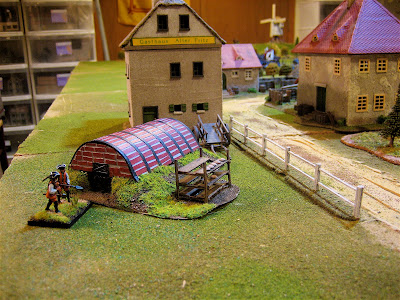
Prussian field bakery scratch built by Ed Phillips. Minden Pioneers are shown in the foreground. Buildings were made by Herb Gundt of H.G.Walls. The Alter Friz Gasthaus is the name of an actual gasthaus in the town of Hochkirk, Germany,

Someone had asked me about information on 18th Century field bakeries and I promised to post a picture of the generic field oven that Ed Phillips made. I was lucky to be the first one to see Ed as he unwrapped his collection of scratch built buildings and vignettes at this year's SYW Association convention. Little did I realize that these were all for sale (sort of like a bring and buy in the UK). So I snapped up the bakery and several supply wagons that Ed had also scratch built using balsa wood, bass wood, card stock and some Old Glory artillery wheels for the carts.

In the 18th century, the armies would transport wagon load of the black metal bands that you see in the picture above. Then they would build the oven either from local materials or bricks that they had carried along with them for that purpose. My thinking is that they used local materials rather than hauling heavy wagons full of bricks around the countryside. So the open top wagons carried the metal braces, probably covered with canvas to protect the metal from the weather.
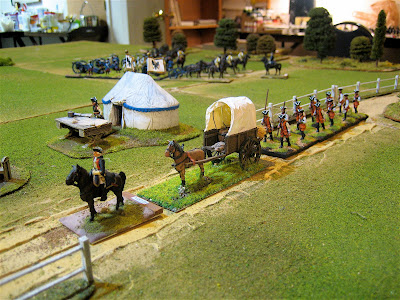

A company of Prussian pioneers marching into the camp. RSM general, Stadden dismounted Seydlitz in the camp background, scratch built wagon by Ed Phillips, and Minden pioneers. Tent vignette by HG Walls.

The Minden pioneer figures look like they will be useful for a variety of functions, aside from their intended use as pioneers. You have seen how I have converted them into artillery crew in previous blog postings. I could also see them as part of the bakery crew. The fellow with the shovel could be holding a large spatula full of bread, with a simple conversion of the shovel with some green stuff.
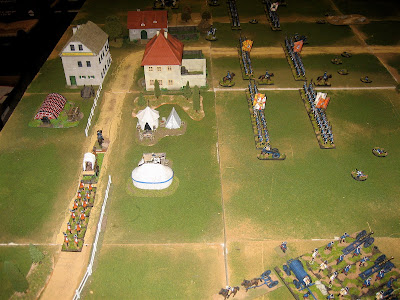

An aeriel view snapped by Baron von Munchausen in his hot air balloon (no, I don't have one. Yet. I hear that Eureka is going to make the Baron's balloon in resin one of these days).

Today was Memorial Day in the United States. That means that I get to stay up late the night before and paint, then sleep in late on Monday. Nice! Lady Emma Cuddlestone-Smythe was having some of her ladies over for tea, so Mrs. Fritz suggested that it was high time for Myself to tear down the wargame table that I had set up in her half (the larger half) of the basement and move all of my gear back into the smaller half, where we had the flood earlier in the year.

This project took several hours and I have to say that it brought a tear to my eye to have to take down the 6ft by 18ft table that was set up in Lady Emma's play room. The picture above shows my table back in its old room, with a smaller 6ft by 12ft table. I set up the 2ft square terrain tiles that I had made a few years ago and placed my Minden Prussian camp on the table. This will be the eventual size of the table that I will use for my Minden Project games at conventions, so it is good to see how many battalions and cavalry regiments I can fit on this table.

Herself did allow me to keep my painting table upstairs in the generally unused Dining Room, albeit with the table area tidied up quite a bit. So I cleaned off the painting table after finishing the basement cleaning project. Since I was on a roll by now, I decided to clean out the garage for good measure. I think that earned me some bonus points with Herself. I was generally pleased with the day's efforts.

Finally, we all gathered around the television this evening to watch the Stanley Cup Finals between the home town Chicago Blackhawks and the Philadelphia Flyers. I am really learning a lot about ice hockey as I watch more and more games, and I especially love the song "Chelsea Daggers" (or is that the name of the group) which is played everytime the Hawks score a goal. This is the same music used in the Amstel Light Beer commercials on television. The Hawks won 2-1 in a hard fought game and now lead the series 2-0. We are pleased in Hesse Seewald.


Carlstadter Liccaner Croats - Minden Miniatures - guard an Ian Weekley building.

And finally, I was able to finish the terraining of my two Croat bases this evening and have posted a picture above. They look much better once the stand is inked and the static grass is added. As I said in yesterday's posting, I 'm looking forward to completing the unit. I checked my inventory of Minden Austrians and found that I have enough figures for 2 Croat battalions, 1 grenadier battalion, and 2 musketeer battalions (with 2 more in transit right now).

I also plowed my way through a dozen Black Hussars, doing the Van Dyking of the shabraques this afternoon. This is the tedious part of painting hussars, but it should be clear sailing after this and I should be able to have the first dozen hussars done towards the end of this week. I think that I may have figured out a short cut for the shabraques: paint the "tooth" completely white and then come back and paint in a red diamond rather than painting the red diamond first, like I did, and then trying to edge the red tooth with thin white lines. It is the lining that drives one crazy. This other method would eliminate the lining step. We shall see how it works.

Sunday, May 30, 2010

Those Pesky Croats


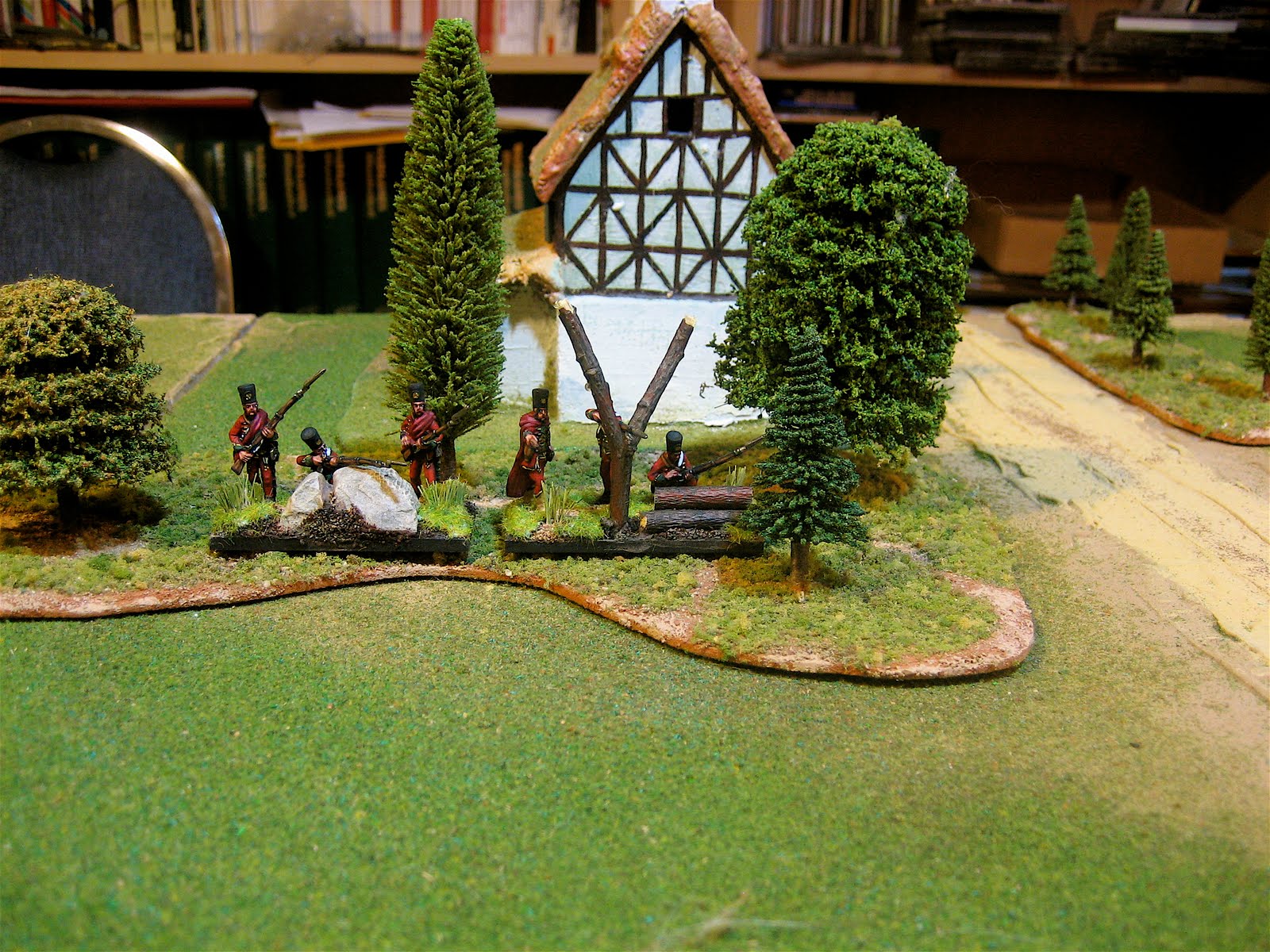
Minden SYW Croats "in situ" where they are most likely to be found: in cover.

I started on my Austrian army today by painting six Minden Croats from the Ottokaner Liccaner regiment. I had been painting the Prussian hussars and getting a little bit bleary eyed painting the shabraque Van Dyking, so I thought that I would take a short break and paint one Minden Croat. It was the fellow standing firing and I liked him so much, that I painted the officer with the cane and the kneeling loading fellow as well. That was enough for one stand, but wouldn't two stands look even better? Well, yes - so now I have six Croats in my Austrian army.


A view of the Minden Croats from the rear - click the pix to enlarge the view.


A side view of the Croats so that you can see the fellow behind the tree.


A close up view of the Croats.

I plan to return to the Black Hussars tomorrow, now that I've sort of gotten the Croat bug out of my system. However, I am really looking forward to finishing this battalion with 30 figures.

As for painting, I used a grey primer this time because the uniforms are predominantly red, and red doesn't cover black primer very easily. Once the figures were primed, I slapped on a coat of Reaper Paints "Blood Red" for the uniform color. Then I blocked in all of the equipment with black paint as this makes things like muskets and cross belts stand out better. This takes a little longer than if I had black primed everything, but then I would have needed two or three coats of red to cover the black.

Thankfully, Richard Ansell has strategically covered over most of the frogging and detail on these Croats with careful placement of things like the rolled up cape or the arm position and the musket, etc. Thus you don't have to paint much of the frogging at all. This is terrific! For the little frogging that you do paint, I black lined the areas first and then carefully painted a thin line of Dun Yellow from IWM/Ral Partha to finish off the figure.

All in all, these Croats are very dynamic and animated and are a simple joy to paint. I had always steered clear of painting Croats in the past, thinking that they would be hard to paint. But with these Minden figures, the details are a snap to paint. I give the figures my highest recommendation.

Saturday, May 29, 2010

Black Hussar (Minden) Sample Painted


My first painted sample of the new Minden SYW Prussian Hussars. This is of course one of the Black Hussars (H5 or von Reusch Hussars) Click the picture to enlarge the view.

This evening I primed the 18 Minden Prussian Hussars that I assembled yesterday and then pitched into painting my first sample. The sample figure is painted as one of the Black Hussars, which was a 10 squadron regiment that had 3 squadrons serving in Western Germany with Prinz Ferdinand's army, while the remaining 7 squadrons were primarily deployed in East Prussia to fight the Russians.

I always paint one figure to completion whenever I start on a new battalion or cavalry regiment. This allows me to get more familiar with the figure and how best to work with it (i.e. the order in which I should paint the various parts and equipment pieces etc). It also helps me experiment with some of the colors. In this case, I wanted a lighter brown horse so I tried some different shades and highlights in the lighter brown color spectrum before settling on something that I liked.

Here are some more pictures of the Prussian hussar, taken from different angles.


The figure was relatively easy to paint -- afterall, it is mostly black. The red and white "Van Dyking" that edges the shabraque was actually the hardest item to paint on this figure. Much of the braids and buttons on the dolman and pelise are artfully concealed by the positioning of the clothing items. The braid that is visible is detailed enough that you can either lightly dry brush white over it or actually paint in the white squiggles with your brush. I chose the latter option on this figure. For black highlighting, I mix in some flesh color paint with my black to get a very nice highlight that makes the uniform "pop" out at your eye. I learned this little trick from someone on The Miniatures Page a couple years ago.

I am really pleased with the way that this first figure turned out and I can't wait to start painting more figures tomorrow. While I have 17 more primed and ready to go, I think that I may work on a smaller batch of, say, 5 to 7 figures so that I can complete them over the weekend, get them based, and then take a final photograph for the blog.

I also grey primed eight of the Minden Croats (one of each pose) and will be tempted to paint a couple of these samples over the next couple of days so that I can see how they turn out. They are wonderful figures, as are all of the Minden figures.

Thursday, May 27, 2010

Prussian Cavalry Is Next!


The Bayreuth Dragoons (DR5) practice on the marchfeld under the watchful eye of their colonel. Minden Miniatures painted by Der Alte Fritz. GMB Designs flags. Click the pix to enlarge the view.

I have been working on the Bayreuth Dragoons over the past week, having finished a second batch of eight riders and bringing the regiment (DR5 in the Prussian cavaly establishment) up to twenty figures. Eventually the regiment will have 30 to 36 figures in the first five squadrons. Curiously, the Bayreuth Dragoons were one of several regiments that were organized with ten squadrons, rather than the standard five squadrons. So at a 1:20 ratio of castings to real men, I will eventually need about 60 dragoons. Hmm, I could also use them in one of the BAR games that we play, as a 5 squadron regiment of 60 figures at 1:10. Even though these are mounted two horse per base, rather than on single stands, the frontage for both set ups is the same at a one inch frontage.


A view of the dragoons from another angle.

And now, here is a picture of what many of you are looking forward to seeing: the Minden Prussian hussars in mirliton. I ordered a 36 figure regiment from Frank last week and received them in record time a couple of days ago.


Minden Prussian Hussars in Mirlitons await for the glue and epoxy putty to dry before advancing to the priming booth.

The Minden hussars are sculpted in a more animated pose than their heavy cuirassier and dragoon bretheren, and this seems apt and fitting for these wild and daring light cavalrymen. As a result, there are two new horse poses added to the range: one galloping horse with legs stretched out and one galloping with legs bunched. They ought to convey rapid movement when they are mixed together on a stand, one bunched and one stretched.

The sword arm is cast separately, but do not let this dissuade you from buying some of these beauties. Frank had Richard Ansell design them with a deep hole in the arm socket and a long cast on pin on the sword arm. You will not have to drill out any holes or add you own pins to the arm for fear of it (the pin) being too short. You will find that arm and socket provide a strong and comfortable fit that require minimal assembly.

I took a quick swipe across the torso with a flat file to expose more metal, for a better glue bond, and then did the same around the pin in the arm. Then I inserted a small ball of green epoxy putty into the arm socket for extra support, added super glue, and inserted the arm into the torso. It was as easy as pie to do. I would imagine that you could forego the extra step of using green stuff, but then again, I like to over engineer things a bit too much. Adding putty only adds another minute, if not seconds, to the assembly process.

I will let the figures dry and cure overnight and then prime them friday night. Thus, I will have 18 figures ready for painting over this weekend. Since it is Memorial Day weekend in the United States, I have a holiday on monday and thus some extra time to paint over the weekend. Hopefully, I can complete a half dozen or so of these hussars. Since I plan to paint them as HR5 von Reusch (the Black Hussars), the painting should go faster for this regiment.

One other thing to mention, Richard Ansell sculpted a lot of nice detail into the shabraque with raised lines depicting the "Van Dyke" style of edging on the shabraque. This should make the painting of the shabraque very easy to do.


I finished six more jagers this week, bringing the regiment up to 30 figures.

Finally, I painted six more jagers last weekend and finally had a chance to complete the basing the other day. The last two stands are seen on the front row, on the left of the unit as it faces you. I wanted to add a couple more stands with the rock wall motif so that I could create a standing vignette of jagers firing from behind a low stone wall. The frontage of the stand is the same as that of my regular infantry battalions -- 60mm per stand-- the extra depth in the stand gives the appearance of a more open order deployment of the jagers, as opposed to the more formal look of the infantry stands.

Well then, I am looking forward to painting some of the hussars over the holiday weekend and hopefully I will have some "work in progress" photos to post on Monday evening.

Thursday, May 20, 2010

The Prussian Army, So Far


The entire Minden Project Prussian army is on the parade ground for a review. Please click on the picture for a closer inspection of the troops. And do leave a comment with Der Alte Fritz if any particular unit deserves special mention, or conversely, has failed its inspection.

Last evening I decided to lay out more of my terrain squares on the wargame table and see how my Minden Prussian army would look on a 6ft by 10ft table. As of now, I have eight battalions of line infantry, 1 battalion of jagers, 3 heavy 12-pounder foot artillery pieces, and 4 light 3-pounder regimental guns. I only have a dozen Bayreuth Dragoons so far because I have concentrated on the artillery and infantry combat arms, so far this year.


A view of the Prussian right flank and the camp ground area behind the lines. On the left, you can just see the start of the field forge vignette (unpainted castings so far). Eventually, I will have a full camp area with tents, men at their ease, sutlers and camp followers, etc.

One of the benefits of this exercise is that it enables me to see how the whole project is coming together; to get a better idea of how well the various pieces fit together; provides an idea of what else needs to be done (cavalry!); and finally, it is simply mesmerizing to look at, which makes the whole exercise fun.

One of the things that really jumps out at me is that this army, as it is constituted right now, takes up most of the tabletop space. If I add another two foot square tile to the left flank, that will give me 12 feet of table length and provides a moderate amount of "open flank area" on the left for maneuvering and cavalry action. If I removed the temporary hill on the right flank, which serves primarily as a photo background, then that would give me two feet of open area on that flank as well. To put it another way, I don't think that I need any more Prussian battalions for a typical game on 6ft by 12ft table, which would be my standard table dimension for this army and project.


Here are some RSM Prussian hussars (HR4 Puttkamer) that are shown next to a Minden Prussian officer (a dragoon officer converted to an infantry officer) with an RSM aide on foot. This demonstrates how compatible the two ranges are. The hussars were painted over 20 years ago by Bill Biles of Lexington, Kentucky (one of the original owners of RSM Miniatures).

I plan to rebase these figures in my new style of basing, and that should improve the overall appearance of the figures. Note the difference in painting styles between the hussars from 1990 (which was state of the art painting at the time) to the Minden command stand that I painted. We did not use much shading, highlighting or multi-tone coloring on our figures back in 1990. Bill hand painted the intricate hussar shabraques using a dark blue ink pen.


Now of course I won't stop painting my beloved Prussians. In fact I recently placed an order for figures to fill out the second battalion of the IR49 Diericke Fusliers, another grenadier battalion, and a regiment of the new Prussian hussars that Frank announced (today) as being available for shipments. I will probably have three or four Prussian cavalry regiments in this army. However, a typical game looks like it should have no more than nine battalions, unless the other three of the dozen that I have planned for each side are used as off board reserves that arrive later in the game.

Or to put it another way, perhaps it is time to start painting Austrians. I hate to say that, but this is true.


A parting shot of the Prussian left flank with the Itzenplitz regiment (IR13) in front with its battalion gun deployed. In the second line, you can see IR49 Diericke Fusiliers and their battalion gun being prolonged by hand. I really like this picture with the close up of the two battle lines and the deployed and prolonged battalion guns. I think that more wargamers should add things like battalion guns and limbers to their SYW armies.

I currently have more DR5 Bayreuth Dragoons on the painting table. I finished the first dozen a month or two ago and have a second group of eight partially painted. Another ten dragoons need to be primed and ready for painting. With Memorial Day weekend coming up soon (May 31st) I hope to be able to finish the dragoons this month and then possibly start on some Austrian infantry in June.

Wednesday, May 19, 2010

Prussian Artillery Is Finally Based


Two 12-pounders with four crew, two artillery labourers, and a supply wagon to complete the battery vignette when it is deployed. The limbers are not shown in this picture. Figures are Minden Miniatures, gun models are from Berlin Zinnfiguren, and the wagon is from Front Rank. Click the pix to enlarge the view.

Last evening I finally decided to place all of my field artillery models on a 60mm wide by 120mm deep base made from MDF material (rather than the narrower 40mm wide base), and having done that, it was time to finally get some of my Prussian artillery based. My initial thinking is that my foot batteries will have two gun models so as not to overpower everything on the field, but I could make the battery 3 or 4 guns, as show below.


A mock up of a potential 3-gun battery. The extra 60mm frontage provides extra room at the back of the battery for a pair of wagon horses (detached while the wagon is unloading) and a horse holder. RSM limbers can be seen in the background, providing even more depth to the depiction of the battery and all of its accoutrements.

I kind of like the look of the three gun battery and the extra room available for some wagon horses. I may go this route as I get more figures and gun models painted.


Here is a little vignette that I made showing two artillery crewmen prolonging a light 3-pound regimental gun by hand, in front of its parent battalion, as the latter moves foreward.

I got the idea for the regimental gun vignette from a picture of some similar models in John Ray's Fulda Campaign collection. I figured that these guns could be given to battalions forming the second line of battle. Afterall, they can't fire the guns because their own men in the first line of battle would be in the way. So they hand prolong the guns as the second line moves forward in support of the first.


A closer view of the regimental gun vignette.

I used one of the Minden Prussian artillery crewmen and one of the generic pioneers in waistcoat to form the prolonging team. The battalion gun is an RSM 3-pounder (it is really a 20mm French Griveaval 12 pounder). There are no conversions in this vignette. I simply selected two figures that had hands positioned such that they appear to be carrying the gun trail. Then I glued the 3 pounder into their hands. I placed them on a semi round or oval base to indicate that it is a vignette rather than an integral part of the game. I could replace these guns with another stand of one gun in firing position, when the gun is ready and deployed for action.