Showing posts with label Napoleonics. Show all posts

Friday, August 1, 2025

My Peninsula War Terrain Circa 1810


Spain during the Peninsular War circa 1810

Click on the pictures to enlarge

I set up my Spanish terrain for Napoleonic games in the Man Cave last weekend and I have been adding little bits and pieces this week. My plan is to really take this terrain up a notch or two, striving for some model railroad style layout.

I want to thank one of my regular blog readers for donating a copy of the book "Setting The Table - Mediterranean Terrain". There are a lot of great ideas in the book and I will be working on some of the terrain bits that are shown in the book. One of my goals is to do a purpose-built terrain board for the Battle on the Coa River. I have to build up some of the boards to a height of 6-inches so I am not sure that these boards will be suitable for transport to conventions such as Historicon, but we shall see. The boards will have to be no larger than 6ft wide by 2ft long, otherwise they will be too unwieldy to handle.

Here are some pictures of some of the terrain pieces that I currently have. I made the large rock formations several years ago based on the techniques outlined in the Setting The Table book. Large chunks of tree bark are used to create the rock effect. I also made the road sections. The buildings are made by Herb Gundt and the war game figures are from Connoisseur Miniatures. The French cavalry are from Elite Miniatures. The rubber river sections are from Novus Designs, a company that has gone out of business. The water pieces look nice and grab your attention, but I think that a darker green or black color with lots of varnish would look more natural.

The table shown measures 6ft wide by 12ft long and it represents the type of smaller table that I plan to take around the convention circuit in 2026. You can achieve some amazing results when you add lichen to your table.


Here is a view of the whole table. The buildings in the foreground were made by Herb Gundt.

Spanish windmill made by Herb Gundt

I really like this picture of British light infantry clashing with the French on the bridge.

A few rocks were added to the scenery. I picked these rocks up while walking the dogs.

I like the look of the bridge that connects two pieces of mountain terrain.

Elite Miniatures 28mm Polish lancers trot down the road.
I like lancers - they are a weakness of mine.

I think that I have focused in on doing this game with 40mm figures and running it at the skirmish level. For larger level games (battalions and regiments) I will use 28mm figures.

I have some 40mm samples on order from Sash and Saber, Perry, and Battle Honours and I am looking forward to painting some of these figures. If that doesn't work to my satisfaction then I can always stick with my 28mm figures.

I briefly thought about doing this project with 54mm plastic figures, but it is probably time to give the 54s and double tables a rest for a year or two. I think that the novelty of my large games is beginning to wear off as I wasn't able to fill up my Little Wars and Historicon Hannibal games to the published ten players (although I had 8 players in the games and this proved to be the right amount of players for the game).

I do enjoy making my own buildings and the lure of Spanish buildings in 1/32 scale for 54mm figures is still appealing to me.

ccc

Wednesday, August 28, 2024

40mm Vistula Lancer 3D Printing


While at Historicon this year I found a company that sells 3D printed figures for the Napoleonic Wars. Since they are 3D printed figures, they can be scaled to a variety of sizes. I bought one 40mm Polish Vistula Lancer because it looked like a figure that I would enjoy painting. And indeed I did.

The figure is a bit brittle noting that the left foot broke off on the way home, whilst carefully stored in a cardboard box. Accordingly, I can't see jumping into 40MM Napoleonics and using any brand of 3D printed figures. There are a couple of other brands that also have the same problem, but I don't care to name the names because I don't know enough about the printing process to talk intelligently about it.

I have to say that these are very attractive looking figures and my mouth drools over the thought of looking at a 24-figure regiment of these Vistula Lancers. Fear not, I don't intend to jump into 40mm Napoleonics. I know that there are a few of you are doubting me on this and I completely understand why.

On the other hand, 54mm Napoleonics...


cc

Monday, January 31, 2022

Picture of the Week: LaSalle In Spain


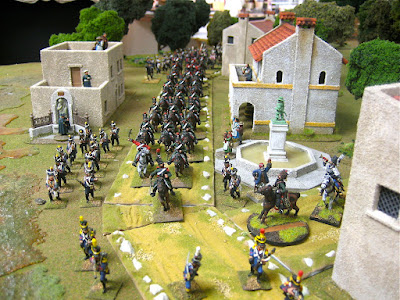
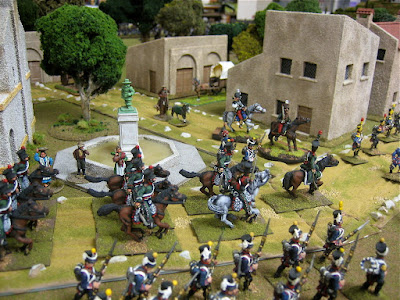
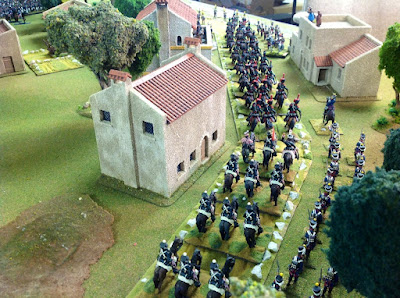
This week’s picture features a diorama that I set up in 2013. It depicts a column of French light cavalry and light infantry in Spain marching under the gaze of General LaSalle.

The figures are a variety including Elite Miniatures ( chasseurs a cheval), Old Glory light infantry and an assortment of civilians from Perry Miniatures. The buildings were scratch built by Herb Gundt.


After looking at these pictures it makes me want to haul the collection out of storage and set up a Peninsula game or two.

Saturday, March 19, 2016

Return of Marshal Soult - Part 2


The Battle of Rio Mondego Continues
Well let's see, when we last saw the intrepid brigade of Brigadier Alexander Sinclair at the Battle of Rio Mondego, it was close to being driven off of the front table and back onto the center table in our war-game  (originally played on Saturday March 5, 2016).

As always, click or double click on each of the pictures to see an enlarged view of the action.


Sinclair advanced the 45th (Nottinghamshire) Regiment onto the first table to relieve the beleagured 94th Regiment. The remains of the 94th are off camera to the right of the 45th.

It seemed like the French always drew the first fire card each turn, so the 45th  Regiment  received casualties almost immediately after it crossed the aisle onto the left-hand table in the game.

Eventually the French compel the 45th Regiment to retire back to where they came from. Mermet brought up his battery of 8-pounders to create more discomfort for the Red Coats.


Meanwhile, in the center of the table, the French division of Delabord was coming on in the usual style - l'ordre mixte.


Sinclair forms a new line to protect the road leading to the harbour at Cabo Mondego, where the Royal Navy transports await.
By the time that Sinclair had established a new line of defense on the center table, anchored by a small village on his right flank, it was readily apparent that victory would go to the French.


The Swiss Regiment Arrives (its first battle) - Elite Miniatures painted by John Preece for the collection of Bill Protz

The Swiss Regiment, shown above, entered its first battle as a wargaming unit, and thankfully, they did not come under fire.  They can observe the battle carnage that preceded them, shown via the casualties that are laying on the ground.

It was a fun and well-fought game by both sides, but at the end of the day, Marshal Soult (the Duke of Damnation) and his French prevailed over Major General Pettygree's outnumbered British army. As I mentioned above, the cards were not friendly to the British, who rarely drew the first firing card on any given turn, but sometimes it is just not your day.

My French opponent, General Mermet (Kurt B.) did a masterful job of utilizing his voltigueurs to great effect - they came after the British not just in single companies, but rather in whole clouds or swarms of skirmishers. My previous opponents had never used their skirmishers in such a matter (much to my relief), but Mermet knew what he was doing. On several occasions, I had to waste my first fire bonus on the skirmishers, rather than saving my fire for the columns of advancing formed infantry. The only way to drive them off was to advance towards them, forcing them to fall back. However, this then exposed the British to the fire of the French battalions.

I have no idea what was going on at the other end (right and center sections of our line) of the table. I gather that General Delabord smacked the Royal Horse Artillery around quite a bit and drove off all of the British cavalry. Delabord's French division was following up fast on the heels of the survivors. Pettygree's Red Coat infantry seemed to be holding its own in the center  (off to Sinclair's immediate right flank).


The Butcher's Bill

Here are the roster returns of Brigadier General Sinclair's brigade at the conclusion of the battle, once they were safely aboard the Royal Navy transport ships.


45th Regiment: 34 casualties out of its original strength of 72 figures (47% casualties)

94th Regiment: 48 casualties out of its original strength of 84 figures (57% casualties)

83rd Regiment: 17 casulaties out of its orginal strength of 84 figures (20% casualties)

5/60th Rifles: they were scattered to the winds, maybe 50% losses?

Grant's section of 9-pounders RA: 2 casualties out of 12 figures (17% casualties)

You can see that the 94th took a hard pounding from the French, as it was the unit deployed the furthest forward and was faced off against two or three battalions at a time. It was my plan that they should be sacrificed to delay or stop the French for a few turns in order to buy time for Pettygree's infantry to march down the road to Cabo Mondego. Then the 94th was to fall back to a prepared second line where the other two regiments would take on the French. The 45th came to the aid of the 94th and got mauled as well, losing 47% of its effectives. The 83rd Regt. was held in reserve, but still took 20% casualties.

Post-game, I rolled dice to see what the fate was for the casualties. On a D6, a roll of 1-2 was Dead; 3-4 was Wounded; and 5-6 Recovered. After the Dice Gods spoke their piece, the following results were achieved:

45th Regt. = 6 dead, 6 wounded and 10 recovered. 60 of 72 original figures survived to carry on and the 6 wounded would come back eventually. So killed represented only 8% of the orginal 72 figures.

94th Regt. = 8 dead, 13 wounded and 14 recovered (nice die rolling there!). So the killed represented 10% of the original 84 figures.

83rd Regt. = 7 dead, 4 wounded and 8 recovered or 8% of the original 84 figures died in the battle.

Thus the cumulative brigade totals, after recoveries and wounded, were 22 dead, 23 wounded and 32 recovered or about 9% of the original 240 infantry died at Rio Mondego. The wounded will eventually come back after a couple of months and rejoin their units. Were we to have another battle in a month or two, we would deduct the dead and wounded from the regiments at the start of the game.

We haven't played a BAR Napoleon game in several years and so I was glad to have the opportunity to bring the lads out onto the table once again. I hope that we get another chance to play some more Iberia games in 2016. One of our regular British players moved to Florida and with him went 4 or 5 British and Portuguese regiments, which severely depleted the forces that are available to General Pettygree. So unless some reinforcements arrive soon from Olde Blighty, the Duke of Damnation may soon be taking up quarters in Lisbon. We can't have that.

Never fear, Major General Pettygree and Brigadier Sinclair will march again, so be sure to come back here (probably in June or July of 2016) to see what happens next.


Sunday, March 6, 2016

Return of Marshal Soult in Iberia - AAR Part I


Marshal Soult


Marshal Soult, the Duke of Damnation, gave the British army of Major General Pettygree a bloody nose and a rough handling yesterday at the Battle of Rio Mondego in Portugal.

Map of the Iberian Campaign south of the Duro River - March 1810.

The previous game in our Iberian Campaign had been the Battle of Aveiro, just south of the Duro River and Oporto. Marshal Soult's French army had crossed the Duro and met the British army commanded by Major General Pettygree at Aveiro.

You can read the account of that battle by clicking on the link below:


While that battle was somewhat of a draw, the threat of Pettygree being outflanked and cut off from the south by a French Corps commanded by Mermet, caused the British to make an orderly withdrawal south, where they took up a new position south of the Rio Mondego river. Pettygree was ordered to march to Cabo Mondego where his army would meet up with the Royal Navy and be transported back to Lisbon.  As such, the British mission for the wargame was to retire all of their forces to the port at Cabo Mondego where they would board transports provided by the Royal Navy.

The initial table set up and terrain are depicted in the three following pictures. The advance guard of the British army, commanded by Brigadier General Alexander Sinclair (45th, 83rd, 94th and 3 companies of 5/60th Rifles plus Captain Grant's two-gun section of 9-pdrs of Royal Artillery) was tasked with stopping or delaying the attack of two French division under the commands of Mermet (left wing of the French army) and Delabord (center).

A makeshift earthen redoubt was occuppied by the British 4th Regiment, which was tasked with guarding the two bridges across the Rio Mondego. The river was not fordable in the center table, hence the importance of holding the bridges open until Pettygree's army could pass.

The Coast Road to Cabo Mondego - you can see the main body of Pettygree's army marching toward you. 

General Pettygree (right) watches as the French division of Merle advances on the near side of the Rio Mondego. Brigadier General Sinclair's advance guard of the British army has deployed a regiment (94th Foot) of infantry and two companies of 5/60 Rifles in the copse of trees.

Sinclair elected to deploy one regiment of foot - the 94th (Scotch Brigade) on the lefthand table to delay the French advance. His remaining two regiments (45th and 83rd) were posted in reserve on the center table along with Grant's battery of RA. The 45th Regiment can be seen below, nearest to the table edge, while the 83rd was kept in reserve near the port of Cabo Mondego to keep the road open to the rest of the army.

The port of Cabo Mondego can be seen in the center background. The Royal Navy transports would be waiting here for Pettygree's army.
All of this quiet was soon erupted as the French division of Mermet surged across the table towards Sinclair's position.


The 94th faces off against Mermet's division, deployed in l'order mixte formation with  a center battalion deployed in line, flanked by two battalions in colomns of divisions. Voltigeur's preceded the French attack.

The British countered by throwing their own light company out in front of the 94th, but these lads were chased off by a squadron of French Chasseurs a Chavel.

Things are starting to look desperate for the Red Coats as the left wing of the 94th bends back. Actually, it was trying to create space so that the 45th Regiment could advance on its left flank so as to present a frontage of two battalions instead of one against the French.

You will notice that we left the casualties where they fell during the battle - something that demonstrates the advantage of using single mounted figures on sabots (movement trays). You can follow the course of the battle by looking at where all the casualties are.

Another view of the 94th Foot

Mermet brought up four 8-pounders, but these were initially screened by their own troops.

Mermet also sent several battalions to try to outflank the 94th on its right, which was protected by two companies of 5/60 Rifles. This part of the Rio Mondego was fordable.


I will post Part II of the battle report tomorrow so come back and visit us again.

Wednesday, January 6, 2016

Perry French Napoleonics For Sale


Perry French Napoleonics - plastic 28mm. Click pix to enlarge

French 28mm Napoleonics For Sale
I am posting some pictures of two French Napoleonic battalions, 24 figures each, of Perry plastic figures that are up for sale. The figures were painted by Alexander Akers and I am posting them for sale on my blog for Alex since we seem to get a fairly large amount of page hits on this blog. Alex is asking $5.00 per figure so the full set of 48 figures comes to $240.00 plus applicable postage.

Alex is a really good painter and has a few Golden Demon awards as evidence of his prowess.  Better yet, I can personally vouch for his painting skills as I use Alex to paint some of my own Minden figures to bulk up my Austrian forces.

The figures are well painted and they are attractively based and terrained to give them a nice finished appearance. At $5.00 per figure, this is really good value as I would personally sell them for significantly more if they were mine.

Take a closer look by clicking on each picture to see the well detailed Perry plastics and Alex's nice brushwork and basing. If you are interested, then send me an e-mail at: altefritz1740@yahoo.com and I can hook you up with Alex to make the final arrangements.


Close up of the command stand


Rear view of the Grenadier base.

Grenadier (left) and Voltigeur (right) stands.

Close up view of the Voltigeur base.

Next Item For Sale - WW1 Anzacs for Gallipoli

Alex also sent me some 28mm Anzacs in Gallipoli kit for sale. I will post pictures tomorrow. There are 13 painted and singley based figures and maybe another dozen unpainted. I think that they might be Woodbine Design figures. There are also five figures that look like Deutsch Africa Korps 28mm single figures painted. All of them are painted to a very high standard and are perfect for a small skirmish game force or an Indiana Jones style game in the Middle East.


Friday, January 16, 2015

Heading Into A 3-day Weekend or Oh Be Joyful!

My latest acquisitions from E-Bay.

Americans have a national holiday this weekend (MLK Day) so most of us have a three day weekend.

Hmm, what can I do to take advantage of the extra time?  Normally, I would hunker down in the Man Cave for three days and not be seen again until Monday evening. However, just 5-weeks from my wrist surgery it is still a little too tender to do much figure painting. I can go in 15-20 minute spurts, but that is all. So while I would love to finish off those dozen Volontaires de Saxe that are sitting on the painting table, it would be a minor miracle if they were completed.

If it's a miracle, it's a Kalinsky 10 point O miracle, Colour Sargent Bourne.

Aye, and backed up with a bit of pain threshold.

So I still have not answered the question of how to spend this time. As I cast my eyes around the Man Cave, what do they settle on but this?


Trenton! It seems like this would be the perfect time to play the first solo test of the scenario. With a little bit of negotiating with Mrs Fritz ( I have a surplus of favor chits in the ledger), I envision the conversation going a little bit like this:

Me: "well my Dear, it's off to the Man Cave with me! I've got the Battle of Trenton to fight and General Washington is depending on me."

Her: ( rolling her eyes) " Chin chin and all that, do go on playing with your Little Men."

Me: " what ho?" thinks I . This is turning out better than I had imagined. "why thankee, Dearest."

Her: "Just as long as you remember that you have to take Lady Emma Cuddlestone-Smythe and four of her friends to the cinema on Sunday to see "Paddington Bear."

Me: (thinking to myself) well that wasn't all bad.


Thursday, January 15, 2015

Napoleon Statue Collection


Today's mail brought a little present that I bought myself on E-Bay: a nice statue of Napoleon Bonaparte (see picture above) standing in his famous pose with hand buried in his waistcoat. The white bust shown in the picture was a Christmas gift from Mrs. Fritz in 2013. 

Over the past few years I have started collecting statues of Napoleon. They come in all shapes and sizes and I have ten of them so far. Whenever I see a statue or bust, I buy it, provided that it is not some expensive antique running thousands of dollars. We try to keep things real here in Hesse Seewald. My one parameter is that the collection will not include war game figures and must be at least 54mm toy soldier size or larger.

Part of my Napoleon collection can be seen on the bookshelves in my library, in the picture below.


The Napoleon collection started with a Royal Daulton Toby Jug, or Character Jug, of the Duke of Wellington (gasp!). The handle on the Wellington jug had a miniature Napoleon. I then found an actual Napoleon jug in an antique store and that really got the collection going. Next, I found a pair of 12-inch tall porcelains from Germany and added a couple of small busts here and there. 


I have also added some framed pictures of Napoleon in my library. A trip to Paris ten years ago produced  a deck of playing cards in which all of the face cards have pictures of either Napoleon as King and Josephine as Queen, and various French marshals as the Jacks. So I removed all of the face cards from the deck and took them to a picture frame shop and had the cards framed. It turned out rather nice (see below).


I also found a set of six cheese plates, one of which included Napoleon, so I bought the whole set just to get the one plate, shown below. Another antique store find was a pair of wax silhouette rounds of the Emperor and Empress and these were posted on the wall to fill a narrow space next to a window. I later cut out a picture of a younger Napoleon and had the frame store put him in a round frame that augments the silhouettes. See below.


I'm always on the lookout for more Napoleonic items. If you have any that you want to part with, contact me and we can work out a transaction. My Holy Grail item is the limited edition Royal Daulton Napoleon Toby Jug that was produced in the early 1990s. I've been looking for one of these for a very long time.


Thursday, December 11, 2014

Waterloo, The Movie

This evening I watch the classic Waterloo movie featuring Rod Stieger and Christopher Plummer as I continue my convalescence from wrist surgery. My copy was distributed by Castaway Collections and it was produced (pirated?) in China. The color in this DVD is much better than my old VHS COPY.

This version seemed to have a few more minutes of footage that I had never seen before so perhaps this is the "British Version" rather than the shorter "American Version ". I think that I bought my copy from Belle and Blade at Historicon .

My left hand gets tired so these posts will be short by necessity. My right paw is totally useless right now as I can't grip anything without getting a stab of pain. I tried to hold a paint brush just for grins, but it was no go. I can't use my computer because I can't use the mouse. The iPad works because I can touch type with the left hand but my finger tips start to hurt after about a minute.

Tuesday, September 3, 2013

British 45th Foot - 1809


British 45th Regiment (Nottinghamshire) added to my Peninsula Brigade.


I have been working on another British Napoleonic regiment to add to my brigade for our Iberian Campaign with Major General Pettygree. The figures are all from Elite Miniatures and the flags are my usual choice - GMB Designs. Through the Labor Day weekend, I have built the regiment up to 60 figures (or 600 men at our 1:10 ratio) and I have another company of 12 figures nearly completed. The regiment will eventually be 84 figures strong (or 840 men). 

I have decided that the regiment is of sufficient strength to have the finished component board ships and sail to Portugal, where they will be temporarily assigned to the Lisbon garrison. Eventually, they will join Alexander Sinclair's brigade which includes the 83rd and 94th Regiments and three companies of the 5/60th Rifles. The latter two regiments are part of Pettygree's army, currently deployed near Aveiro, south of the Duoro River. Once I paint the other 24 figures, the regiment will be completed, as will be the brigade. Three regiments in a brigade seems like enough figures to me.

While I have many more unpainted British figures (enough to add one British and one Highland regiment and one Portuguese regiment), I will probably leave them alone for awhile and wait to see how the campaign carries on. For one thing, I do not want to paint an endless number of redcoats. My original plan was to keep my force at one brigade and I would like to stick to that plan. Mind you, painting 90 Connoisseur Highlanders as the 42nd Regiment is a very tempting prospect as I love Highland regiments.

You might have noticed that I terrained the bases on the 45th, whereas my other two regiments have metal bases painted green, in a kind of Old School theme. However, it was always my intention to terrain all of my troops so I thought that I would break the ice by finishing off the bases on the 45th as I complete the painting of the same. This is better than putting off the task for another day -- that usually leads to nothing happening. I also applied the spackle compound and grit to the 83rd and the next step will be to dab brown ink onto the base, let it dry, then dry brush flesh color, and finally, add the static grass. I have chosen a dried out looking grass since the troops will be in the Peninsula, and I think that the effect is very pleasing to the eye.

This post is my 108th post of the year: a new record for this blog. The previous annual high posts was 107. I have surpassed that level with four months remaining in the year, so undoubtedly the records will continue to be broken.

Monday, August 19, 2013

Battle of Aveiro in Portugal - British Right Flank


One section (2 cannon) of Royal Artillery 9-pdrs open up on the French. A company of 5/60th Rifles and the 5th Regiment (in the trees) provide support. All figures are from Elite Miniatures. (Click to enlarge pix).

On August 3, 2013 we convened in Brown Deer, Wisconsin to resume our Iberian Campaign between Major General William Justinian Pettygree and Marshal Soult (the Duke of Damnation, Himself) near the village of Aveiro, just south of the Douro River in Portugal. A very good battle report is provided on the Campaigns in Iberia blog:


My brief report will post some of the pictures that I snapped of the British relief column, on the right flank of the British defensive position in Averiero. As I recall, Brigadier General Kinch had marched north from Lisbon with the intention of linking up with Pettygree's two brigades of infantry and one brigade of light cavalry. The Duke of Damnation had apparently stolen a march on Pettygree and was descending on Kinch's position with two full divisions of French infantry and gobs of cavalry. Kinch was to hold on until relieved, or withdraw from the town, at his discretion, if it meant saving his brigade from destruction.

My role, as Brigadier General Alexander Sinclair, as one of the two infantry brigades in Pettygree's main army, was to advance from the right flank (the French left) and intercept any French forces to my front. Brigadier Peter Young's brigade (5th and 9th Regt.s) and Paget's light cavalry brigade was deployed to my left and those two brigades were to make the primary thrust to relieve Kinch's brigade in Aveiro.

A view of the wooded area on the British right flank. The French would be advancing from the right hand side of this picture, just beyond the iron support pole. The rest of the British team await the appearance of the French.

The French left comes over the ridge, with a screen of chasseurs a cheval covering their front.

The French brigade advances forward. They don't see anything yet, or do they? Note that the chasseurs have now formed into close order squadrons. 


The French chasseurs see the vanguard of Paget's light cavalry brigade arriving on the field to their left.


Sinclair's brigade is screened by a company of the 5/60th Rifles and the light company of the 2/83rd Regiment. They find a company of French voligeurs in the woods.


Sinclair's 2/83rd, commanded by Lt. Colonel Charles Gordon, had hoped that the French columns would pass his front without seeing him, allowing him to strike the French brigade in the flank. However, the French have spotted the 83rd and they begin to deploy their battalions into line formation to meet the British threat (to front and flank).
Brigadier Young's brigade (5th and 9th regiments) attack the front of the French brigade, which is now formed with a dangerous bend in their battle line. This is not a good situation for the French.

General Pettygree has a little surprise waiting for the French: a six gun battery of Royal Horse Artillery 6-pdrs prolong over the ridge and open fire on both French infantry and their supporting squadrons of dragoons on their right flank. Pettygree appears to be having FUN.

Towards the end of the battle, the French left hand brigade of infantry decided that it would be best to disengage as best they could. Their chasseurs a cheval covering their front while the infantry battalions fell back to the back table.

Lt. Colonel Gordon was content to watch les Crapauds retire without moving his regiment closer and risking needless casualties. When your foe is doing what you desire of him (in this case, retreating) it is best not to intefere in his plans. So the 83rd was content to herd the French off the battlefield with no more loss of life. In a campaign, where casualties reduce your effectiveness in the next game, there is a time to attack and a time to hold back.

Sinclair's activity was limited in this game. His skirmishers and supporting section of Royal Artillery, commanded by Lt. Harry Pearson, did most of the damage to the French. The French commander in this sector appeared to be protecting the left flank of the main French assault on the village of Aveiro, so he did not advance up the British held ridge to his front or be overly aggressive, i.e. rash. He played his hand the correct way, in Sinclair's opinion.

Tomorrow is always another day.

I have no idea of what happened in Aveiero as it was too far away from Sinclair's position. I have heard that Brigadier Kinch held off the French attack for several hours, before finally retiring from the village. The French brigade, though, was badly mauled in the attack, as was Kinch. Both of the brigades in this sector had casualties approaching 40-50%, from what I could tell from a distance. It was a very bloody affair.