Showing posts with label Austrian Army SYW. Show all posts

Monday, March 6, 2023

Austrian Artillery at Mollwitz


I worked on some close up pictures of units on my game table for my Mollwitz game. I thought that the Austrian artillery pictures were particularly good. The equipment and figures are Minden Miniatures. The ammo wagon is the Russian wagon (frankly the Austrian and Russian wagons look nearly the same) and the team of limber horses is driven by an Austrian train driver. The two fellows carrying a wooden box are from one of the  Civilian Ag Workers set.

Moving the camera away from the ammo wagon reveals more of the battery in action. Notice how the figure and equipment bases blend in with the Cigar Box Battle Mats green mat. Nice coincidence on my part.


Close up of the Austrian cannon and crew. In the first picture you can see the Austrian limber teams positioned well behind the cannons. I think that adding limbers and ammunition wagons adds  a lot to the visual look of a Wargame army.


If you own some Minden Austrian and Prussian armies then head on over to the Fife and Drum Miniatures web store and start rounding up your recruits today.


Fife & Drum web store

Coming next: the Savage Swann Inn in the town of Mollwitz.

Monday, May 30, 2022

Playing Around With My Terrain - SYW


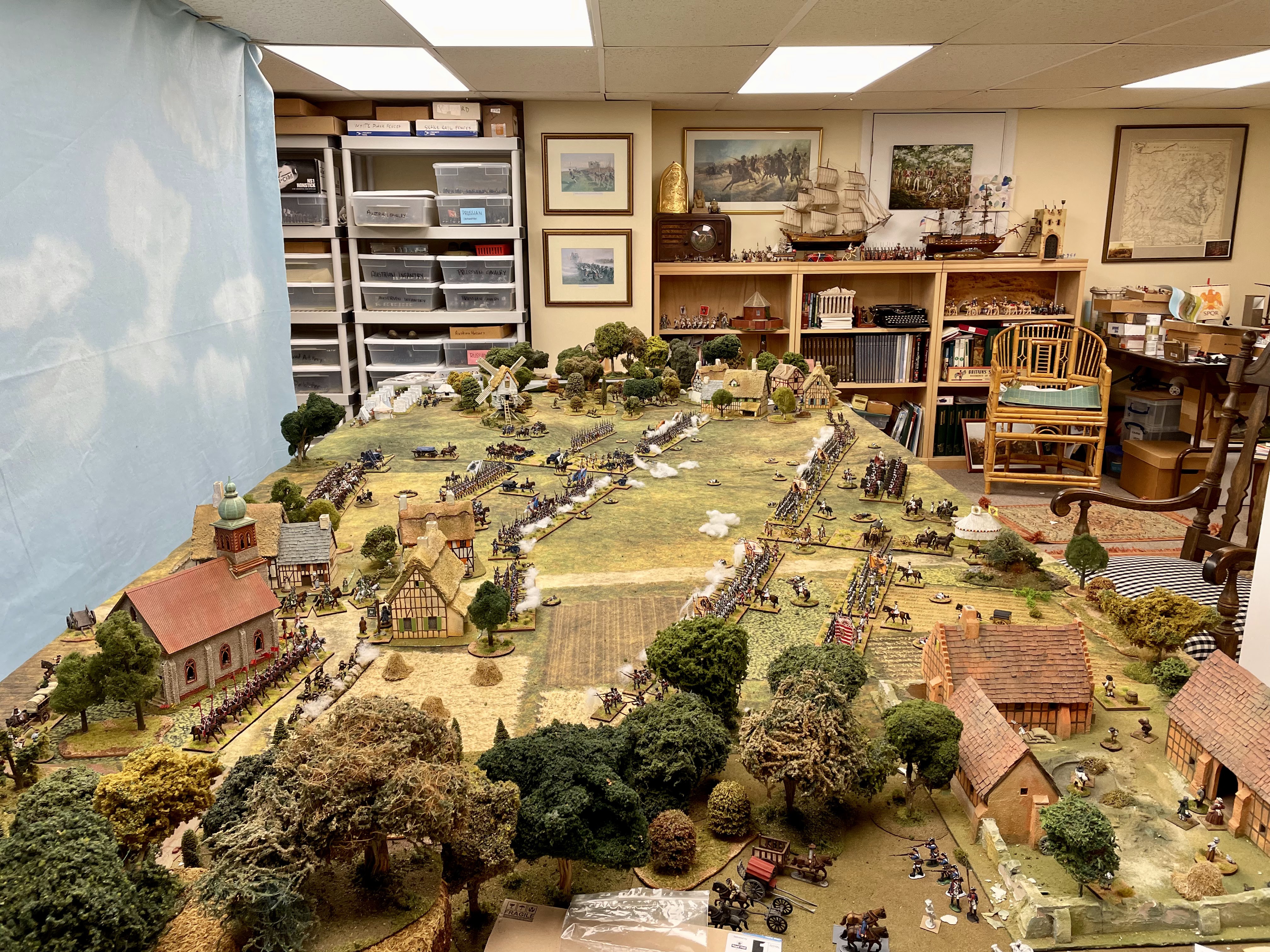
A view of the Man Cave at Schloss Seewaldt


CLICK ON ALL PIX TO ENLARGE


I have spent a good part of Memorial Day (today) down in the Man Cave where it is nice and cool. Outdoors the temperature is a hot and humid 80-90 degrees Fahrenheit. I took the dogs out for a short walk and they were panting, evidencing that they had had enough and wanted to return home and get some water.

That said, I spent a bit of time rearranging the terrain that I have set up on my wargame table. I wanted to have the same terrain, but from a different perspective, so I shifted the line of troops from a horizontal axis across the table and set the battalions at a diagonal axis from end to end.


Here are the "before" and "after" pictures of the troop deployments showing the effect of the shift. It almost tells a completely different story.


The troops are deployed on a straight horizontal axis on the table.


The troops have shifted slightly to a diagonal axis on the table.

I added some casualty figures and smoke to the tableaux to illustrate an active battle engagement .


The view from the Austrian side of the table.
Note the staff meeting at the center edge of the table.


A closer view of the firefight: Prussian Jagers try to fend off the Croats who 
protect the left flank of the Austrian battle line.


The view from the Prussian side of the table.
Note how the Prussian diagonal positioning results in both flanks 
secured by villages or woods.


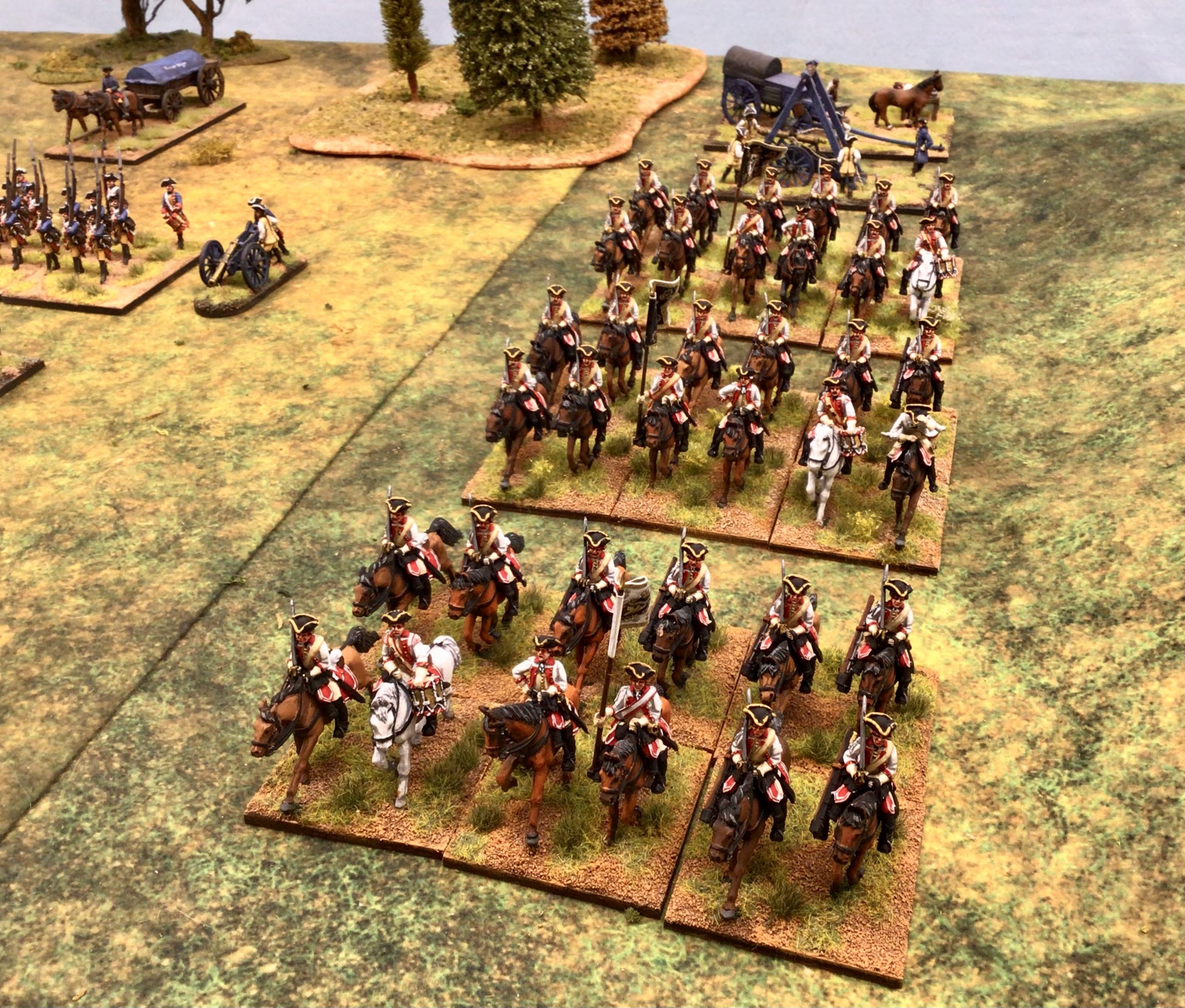
Well, it's back to the painting table now. Yesterday I finished the painting and basing of 36 Bayreuth Dragoons wearing the pre-1745 white coats of the Prussian dragoon regiments. Okay, I was going to save the pictures for a separate blog post, but here is a teaser of how the new figures look:


Prussian dragoons wearing the pre-1745 white coats.
This is the Bayreuth Dragoon (DR5) regiment.

I put the regular Minden Prussian dragoon figures on the more dynamic, cantering, horses from the Fife and Drum Miniatures AWI range. The flags are from GMB Designs.


Tuesday, October 29, 2019

New Ferdinand of Brunswick & Croat Mounted Officer Pictures


Croat Officer (left) and Ferdinand of Brunswick (right)

CLICK ON ALL PICTURES TO ENLARGE


The latest batch of new Minden Miniatures SYW figures includes two personality figures: Prince Ferdinand of Brunswick (commander of the Allied army fighting the French in western Germany) and a dashing looking Croat officer. The new product codes for each figure are PER-017 for Ferdinand and PER-018 for Mr. Croat. The links to the figures in the Fife and Drum Miniatures web store are given below:


The inspiration for the mounted Croat officer came from a picture in one of the Osprey books that had an image of the Croat wearing his fancy, fur-lined cape. I knew that I really wanted to add this figure to the Minden range. I also felt that I needed a figure to command my Austrian light infantry forces. I could have painted him in the regimental uniform of one of the Croat regiments (red coat, blue coat, brown coat or white coat), but I felt that his station as a brigadier in my army merited the coat of a general Austrian officer.

Rear view showing the Croat's cape.
Ferdinand of Brunswick was already available as a dismounted figure in the Minden figure range (PER-001 Prussian Staff Officers). However, as the commander of the Allied army of Hanoverian, Hessian, British and Brunswick troops, I felt that Ferdinand should be available as a mounted figure too. I painted Ferdinand in his regimental uniform of the IR5 Prussian regiment.


Next Up: Russian Horse Grenadiers. I will post painted samples of the Russian Horse Grenadiers within the next couple of days. Here is a taster:

Left to Right: trooper in Summer waistcoat, trooper in regular coat, musician, officer, and  standard bearer.


Monday, May 13, 2019

War of Austrian Succession - Austrian Army Project

Luzan Regiment shown with 32 figures in two ranks plus a row of file closers.


I have embarked on a new 18th Century painting project: building an Austrian army for the War of Austrian Succession with battalions sized at either 32 or 40 figures. I had been experimenting with basing 32 figure Austrian battalions (so that they would be the same number of figures as my new Prussian battalions) on deeper bases, but the same frontage as before. 

This started when I painted a battalion of Austrians in a firing line, which required deeper bases to protect the extended musket and bayonet. The extra depth of the stand made it possible to add a third rank of file closers (NCOs, officers and drummers). The end result looks realistic to me (see the next two pictures below).

Two ranks of musketeers and some NCOs and drummers behind them.


War of the Austrian Succesion Austrian Army
The War of the Austrian Succession (1741-1748) Austrian army has a different look from its Seven Years War (1756-1763) counterpart, a look that makes it more colorful. For starters, many of the infantry regiments had colored waistcoats and turnbacks in the facing color. For example, the Deutschmeister and the Baden-Baden regiments had dark blue cuffs, waistcoats and turnbacks. The Luzan and the Wied regiments had green cuffs, waistcoats and turnbacks. However, in the SYW, the regiments no longer had colored turnbacks, using white instead, and most no longer wore the colored waistcoat. The drummers' uniforms were in the reverse colors with white cuffs.

Really Cool Looking Flags
At the start of the WAS, the Austrian army was still using flags of Charles VI, the father of Maria Theresa. Charles died in 1740 and while it was customary for new flags to be issued bearing the cypher of the new monarch, the Austrian army of 1741 did not have time to change its standards.

There were a variety of designs including horizontal stripes bordered with flames of alternating red, yellow and black; also flags that had a checkerboard pattern of red and white around the edges of the flag. Another flag pattern had a green field with the Austrian eagle and coat of arms in the center and the edges were bordered with red and white flames.

My newly painted Deutschmeister regiment has the red and white striped flag, which I hand-painted over an image that I captured from Pinterest.


Deutschmeister Regiment with old style flags
Close up of the stripped flag


The first battalion of my Deutschmeister Regiment sports a white Colonel's Color and an orange-yellow regimental flag


An example of the flag with the checkerboard pattern.

Front view


Austrian Senior General


sss

Thursday, April 11, 2019

Austrian Flags of the War of Austrian Succession


Captured Austrian Colors at the Battle of Hohenfriedberg in 1745.
Richard Knotel, artist

One of the attractions of building armies for the War of the Austrian Succession is the variety of unusual flags that were carried by the Austrian army during this period (1741 to 1748). The famous print by Richard Knotel depicts the Bayreuth Dragoons parading all of the captured Austrian colors after the Battle of Hohenfriedberg in 1745. Instead of the familiar SYW Austrian flags with the yellow field and alternating red, yellow and black flames, we can see some flags bordered in a checkerboard pattern or triangles rather than flames.

It is these different flags that has drawn me towards the period and the decision to build and paint my own WAS Austrian army that is distinct from my Austrian SYW army. Yes that is correct, Fritz now has two Austrian armies.

The death of the Austrian emperor Charles VI was the event that triggered the War of the Austrian Succession in 1741. His daughter, Maria Theresa, inherited the thrones of Bohemia, Hungary and Austria as the queen of each of those lands, but Salic Law prevented her from having the title of Emporess of the Holy Roman Empire ("HRE"). In order to get around the Salic Law restriction, it was Maria Theresa's plan to have her husband, Charles of Lorraine, to be elected the new Holy Roman Emperor.

Her enemies (Bavaria, France, Prussia and Saxony, among others) started the war that threw a spanner in the works and so the Elector Charles Albert of Bavaria was crowned as the new HRE Charles VII (not to be confused with the late Austrian Charles VI) in January 1742.

Some silly law required Austria to remove all imperial insigna from its flags, including the colors black and gold. Thus new flags were issued to the army in 1742. 

The Flags of Charles VI
We are getting a little bit ahead of the story, so let us go back to Charles VI of Austria and his flags. It was common practice that when a monarch died, new colors were issued to the army that bore the royal cypher of the new monarch. In this case, the old flags prior to 1740 has the initials "CVI" on them to indicate Charles VI. Normally, new flags bearing the initials "MT" for Maria Theresa would have been issued to replace her father's flags.

However, time and money (the lack there of) delayed the replacement of the flags and so many Austrian regiments went in the field bearing the old CVI flags. John Ray has given me permission to post two pictures of Austrian flags from his collection (images are copyright of John Ray and may not be used without his permission) and these depict flags that were likely from the time of Charles VI, but still in use during the WAS.


War of Austrian Succession flags from the collection of John Ray
(C) John Ray


The striped flag as shown in the Richard Knotel drawing. Flag and figure from the collection of  John Ray.
(C) John Ray
 John states that "my view remains, that flags possibly as far back as the late 17th Century may have been carried. Not in quantities as many were ravaged by war and time wear. However, given most hobbyists only show two flags to represent the many within a regiment, it is not inappropriate to use the last of the older flags a regiment may still of had.

Dr. Stephen Summerfield in his book "Austrian Infantry of the Seven Years War" concurs that Charles VI flags were still in use during the early part of the WAS. His book provides a nice variety of flags illustrations from the reigns of Leopold I (early 1700s) and Charles VI. So if you are interested in using some of these early flags in your Austrian army, then this book is worth having in your reference army.

Flag Sources for Wargamers
The actual Charles VI flags, alas, are not readily available for wargamers from the companies that provide paper flags for wargame armies. One vendor, Pete's Flags, did two sheets of WAS flags, but the company doesn't seem to be trading any longer. Hopefully I am wrong about this and if anyone of my readers has information to the contrary or contact information, then please provide the information in the comments section of this blog posting.

Nigel Billington has copies of the M1743 model flags and a couple of the Charles VI flags in his reprint of the book "Uniforms of the Seven Years War - Austria, Uniform Reference No. 2" . My recollection is that the original book was published by Greenwood & Ball in 1975, authored by J. Braithwaite.

The pictures shown below were found in a google search on the internet. I believe that they are images of Pete's Flags. The standard bearer figures look like Front Rank Austrians.


An attractive set of flags. The striped flag is from the Charles VI era and the green flag is the M1743 flag.
(c) Pete's Flags 2015

The green flag clearly shows the CVI initials of Charles VI
(c) Pete's Flags 2015


Mid-period 1743 Flags

In 1742, the Bavarian Elector Charles Albert was elected Holy Roman Emperor, so because the House of Hapsburg no longer held this position, it had to remove all imperial devices from its military flags, including the colors yellow and black in the flames pattern.

Dr. Summerfield indicates that on October 19, 1743 all German and Hungarian regiments would carry a liebfahne with a white field and the Madonna in the center, and an ordinairefahne with a green field, edged with red and white flames on the flag. The flags resembled what we commonly refer to as the "Hungarian" flag, however in this case, all regiments carried this new flag, called the M1743 flag.

Summerfield also notes that as long as existing flags were serviceable they were not replaced by the new pattern flags. The picture below is from the New York Public Library Collection, which is available on line. Again, Summerfield's book is a good reference source as it has seven illustrations of various M1743 flags.


The model M1743 regimental "ordinairefahne" with the "MT" initials.
New York Public Library
Late Period M1745 Flags
HRE Charles VII died in 1745 and his replacement was Franz I (Charles Francis of Lorraine), the consort of Maria Theresa.  Consequently, all of the imperial insignia could be restored to the Austrian flags.

The new flags are the ones that we are familiar with as used by the Austrians during the Seven Years War. The M1745 liebfahne was white bordered in black, red and white triangular flames. On one side it had the Madonna and on the reverse side was the was the Austrian coat of arms - the black double eagle.

The M1745 ordinairefahne had the familiar yellow field, bordered with alternating black-yellow-red flames and the double eagle insignia on both sides.

Here is an image of my new basing system for my WAS Austrian army. This is the Luzan Regiment and you can see that it carries the M1745 liebfahne. GMB Designs provided the flag.
Conclusion
I hope that this article is helpful to anyone with an interest in the Austrian army, or anyone who would like to build a WAS Austrian army.

Here is a work in progress of the Deutschmeister Regiment. I hand painted the flags.
The figures are Minden Austrians painted by Scott Alexander.


Sunday, February 24, 2019

Minden Austrian Horse Grenadiers


Minden Austrian Horse Grenadiers painted as D31 de Ligne Dragoon regiment's horse grenadiers.

CLICK ALL PIX to enlarge
De Ligne Horse Grenadiers


Yesterday I completed the basing of a 12-figure squadron of the new Minden Miniatures Austrian Horse Grenadiers, painted as the de Ligne Dragoon Regiment. Each dragoon regiment had a squadron of elite horse grenadiers and it was not uncommon for the horse grenadier squadrons from several regiments to be formed into one ad hoc regiment of "elite" cavalry. The Austrian Cuirassiers' equivalent of the horse grenadiers were called "Carabiniers."

It is my plan to eventually add the Austrian Carabiniers to the Minden range too so that I can have a converged regiment of elites from the Dragoons and Cuirassiers.


De Ligne Horse Grenadiers with hand painted standard using an image from the Royalfig website.

I chose to paint my first unit of Minden Austrian Horse Grenadiers in the uniform of the D31 de Ligne Dragoon regiment. I have always liked that regiment's uniform of green coat and red facings, thinking that it is perhaps one of the handsomest uniforms of the Seven Years War era.

Below are some pictures of the new Product Codes for the Horse Grenadiers to refer to when you order any of the figures from the Fife & Drum Miniatures web store

Web Store Link

MAC-007 Austrian Horse Grenadier Command Pack with horses

MAC-008 Austrian Horse Grenadier Troopers pack with horses.
 I have also painted and based a sample of the new Minden Prussian Mounted Jager courier and added him to the web store Here

The new Product Code is MPC-019:

MPC-019 Mounted Jager
The new Minden Prussian mounted jager courier shown with a dismounted hussar (from the Zieten personality set PER-004) posed as if he is about to be handed an important dispatch. The hussar does not come with the mounted jager.


Thank you for taking a look at these painted samples of the new Minden Austrian cavalry. Please feel free to leave any comments in the Comments section below.


Thursday, November 15, 2018

Los Rios Regt. in Austrian Service


A ground level view of the Los Rios regiment - first battalion.


CLICK On ALL PICTURES TO ENLARGE

Yesterday, I finished the painting and basing of a new battalion for my SYW Austrian army. The battalion has 42 figures allocated across five bases that are 60mm frontage and 80mm depth. Normally I go with a depth of 40mm, but I wanted the battalion to match up with the Austrian regiment Lacy (2 battalions) in firing line, which had bases of the same dimensions.

The deeper stands allow me to add in a third row of file closers. Drummers were supposed to be positioned on each flank of the battalion while a row of NCOs with pole arms keep the rank and file in line.

Los Rios battalion seen from the front right flank.
Los Rios was a regiment based in the Austrian Netherlands (Belgium and Luxembourg) and it came into Austrian service in 1725. You can read the regimental history by clicking on the link to Kronoskaf.


The regiment had a uniform of green facings and until 1762, a green waistcoat, which makes it rather unique in the Austrian army of the SYW. So of course I had to have this regiment in my Austrian army to give it more variety in appearance. In an endless see of white cloth, the regiment really stands out from the other regiments.

The battalion is in the marching pose and with the extra depth of the base I was able to add a third rank of file closers consisting of drummers, NCOs and officers. I have the option of removing one of the stands if I want to use a smaller 32 to 34 figure battalion, compared to my new Prussian battalions that have 32 figures.
Here you can clearly see how the file closers create the illustion of a third rank of figures.

My original intent was to have a 40-figure battalion (8 figures per stand), however, by placing one figure on each stand in a third rank, this resulted in several stands having a configuration of 4 figures in the front rank, 3 figures in the second rank, and 1 NCO figure in the third rank. That second rank with only 3 figures did not look right to my eye, so the easiest solution was to simply add another figure (the nineth figure on the stand) to the stand in order to have 4 figures in the front rank and 4 figures in the second rank.

A front view of the battalion. The file closers are less noticeable from this angle.

Front view of the Los Rios first battalion. You can tell that it is the first battalion of the regiment because it has the white Inhaber's colour as well as the colored orange regimental flag.

Same as the picture above, only a little bit closer in view.
I will undoubtedly paint the second battalion of the regiment because I usually paint both regiments in my Austrian and Prussian tabletop armies. I really like the look of the battalion on the deeper base as the third rank of file closers really sets it off in an attractive manner.

BREAKING NEWS!

This morning I received pictures of the new greens sculpted by Richard Ansell. The new batch of figures will include four French heavy cavalrie wearing bearskin hats, four French foot grenadiers in bearskins, and 4 Austrian horse grenadiers wearing bearskin hats. It was a bad month to be a bear apparently.  

You can see pictures of the new figures by clicking on the link to the Fife and Drum Miniatures forum:


I usually post pictures of new Minden SYW and Fife & Drum AWI figures on the forum a few days before they are posted on my blog. I would encourage readers to click on the link to see the new swag. However, if you are not a forum member, you will have to sign up before you can see all of the new goodies. There are very few rules on the forum, i.e. no requirement to post anything or comment on any of the news posts. So if you want to be one of the lucky few who get an early preview of new figures, then why not sign up for a free forum membership?

The new figures are rounded out with some personality figures for the French army, includeing Lt. General Chevert and Marshal de Broglie plus a French kettle drummer to use in your Minden cavalry regiments.

Tuesday, December 5, 2017

Leuthen 260th Anniversary Today

The Battle of Leuthen - December 5, 1757


December 5th marks the 260th anniversary of Frederick the Great's masterpiece victory over the Austrians at the batle of Leuthen -- December 5, 1757.

Aficionados of the era will recall that after an early success at the battle of Prague in May 1757, Prussian fortunes reached a nadir after a string of defeats at Kolin, Moys and Breslau. The Austrians had even captured the Silesian capital of Breslau and victory in the SYW seemed to be within their grasp.

Then in a span of thirty days, Frederick pulled his chestnuts from the fire beginning with a stomping of the French and Reichs Armee at Rossbach on November 5, 1757 followed up by Frederick's forced march back to Silesia where he defeated the Austrians at Leuthen on December 5, 1757. By the end of the 1757 year, Frederick was once again the master of his realms in Silesia and Saxony and his enemies were in a severe state of disarry.

I try to play a Leuthen game every year, but did not have the time to stage the game on its anniversary date due to many life events and a busy season filling miniatures orders for Fife & Drum and Minden Miniatures. So I will post a few pictures of my Leuthen game from last year for your viewing pleasure.

Zieten leads the advanced guard into battle on the Austrian left.

Opening attack formation on the Austrian left wing.

The Prussian Brummers move forward to the Juden-Berg

The Prussian Guards finish off the Wurttembers holding out in Sagschutz


Austrian infantry redeploys from a south facing to an east facing to meet the Prussian attack.

However, the Austrian battle line begins to bend as the Prussian attack en echelon hits the Austrian right flank with continuous attacks.

Austrian reserves defend the town of Leuthen

The stalwart Rot Wurzburg regiment defends the Leuthen churchyard