


The FG Miniz crowd funding project surpassed the €10,000 stretch goal, so this means that the hussars will go into production along with the field artillery , grenadiers and musketeers.
Thanks to those of you who gave a financial assist to this project. I have connection with the company, I just like the look of their figures.
Showing posts with label 1806 Project. Show all posts
Showing posts with label 1806 Project. Show all posts
Friday, April 19, 2013


Your Help Is Needed for 1806 Prussian Hussars
The Indiegogo project to crowd fund an exquisite range of 28mm 1806 Prussians is in its final hours -- about 25 hours left at the time of this writing. The project has reached its initial target of €7,000 and also hit the first stretch goal of €9,000, which unlocks the Prussian artillery and gun crew. Now the next stretch goal of €10,000 is within sight -- we need less than €500 to hit this level.
What will happen? This would unlock the Prussian Hussars and make all three basic combat arms available to subscribers. The goal is within sight and your contributions are needed NOW. If you have any interest in the 1806 Prussian army, one that is greatly under served in the Wargame figure market, then now is the time to make the final push of €500. Any contribution will make a difference and you can get on the bandwagon with a minimum contribution of €25.
1806 Prussian Funding Site
http://www.indiegogo.com/projects/28mm-1806-1807-prussian-army?c=home
Click on the link above if you wish to make a contribution. I have no ownership interest in this project, but having seen the initial infantry figures, I am a big believer in what the company, FG Miniz, is attempting to do. We are sooooo close to unlocking the hussars.
I thank you for indulging me on this project . The picture below is a bit distorted due to the limitations of posting this via my iPad rather than on my home computer. But if you go to the campaign site you can see better quality pictures. If the link provided above is not active, then copy and paste the URL to your search engine and that should do the job.
Fritz

What will happen? This would unlock the Prussian Hussars and make all three basic combat arms available to subscribers. The goal is within sight and your contributions are needed NOW. If you have any interest in the 1806 Prussian army, one that is greatly under served in the Wargame figure market, then now is the time to make the final push of €500. Any contribution will make a difference and you can get on the bandwagon with a minimum contribution of €25.
1806 Prussian Funding Site
http://www.indiegogo.com/projects/28mm-1806-1807-prussian-army?c=home
Click on the link above if you wish to make a contribution. I have no ownership interest in this project, but having seen the initial infantry figures, I am a big believer in what the company, FG Miniz, is attempting to do. We are sooooo close to unlocking the hussars.
I thank you for indulging me on this project . The picture below is a bit distorted due to the limitations of posting this via my iPad rather than on my home computer. But if you go to the campaign site you can see better quality pictures. If the link provided above is not active, then copy and paste the URL to your search engine and that should do the job.
Fritz
Friday, March 22, 2013
1806 Prussian New Figure Range
There is a new 28mm figure range covering the 1806 Prussian army in the works. The company is called FG Miniz. They are funding the range via an Indiegogo campaign which you can access by clicking on the link below:
FG Miniz Prussian Army of 1806
I have to say that I really like the look of these figures and putting my money where my mouth is, I've invested around €300 to help these guys out. Their goal is to raise €7,000 by the end of April and they are at €4,700 at the time of this writing. It won't take too much more to push the project across the finish line, so if you think that you might have an interest in t 1806 Prussians, click on the link and join for as little as €25.
One of the good things in favor of the campaign is that the initial sets of grenadiers and musketeers are already in production so you are guaranteed of getting your figures no matter what happens to the fund raising campaign.
I hope that some of my readers will join me in this Prussian campaign.
Der Alte Fritz

Wednesday, December 30, 2009
1806 Playtest Results

General von Schmettau, division commander of the Prussian army, meets with his staff in the village. Buildings and tents by Herb Gundt. Figures are mostly Elite Miniatures, except for von Schmettau and the hussar ADC which are from the Foundry range.
Keith, Bill and I did a moderate sized play testing of the BAR Napoleon rules on Tuesday afternoon and I was pleased that some of the important changes seemed to work under actual game conditions. The outcome of the game did not really matter as we were mostly interested in trying a few things out, being less concerned about winning or losing the battle.
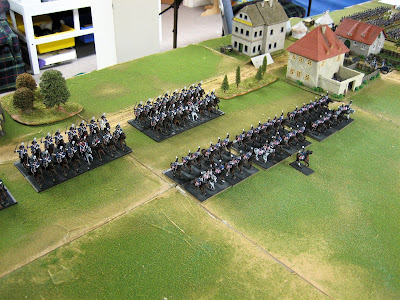
Brigade of Prussian dragoons: DR3 von Winning (Elite Miniatures) in the front line and DR5 Koningen (Imperialist Miniatures) in the second echelon. I haven't had time to base the dragoons yet, so they are still in black primer on metal stands.

Prussian (left) versus French (right) dragoons encounter each other in melee.
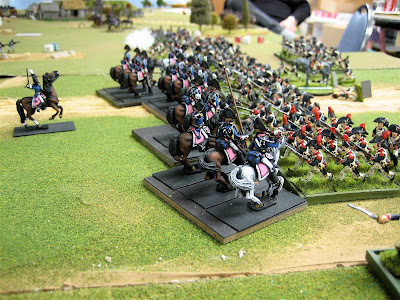
Two squadrons of von Winning Dragoons attempt to break through a French battalion in line.
The cavalry versus cavalry melee rules are basically the same as thosed used in our SYW BAR rules, so there were no big changes here except for a few modifiers to reflect the different types of troops. The cavalry melees went off without a hitch.
The biggest change though was cavalry versus infantry melees: we borrowed an idea from In The Grand Manner and employed the "breakthrough" rule, i.e., cavalry does not melee with infantry, it only determines whether or not it can break through the infantry. So Bill obligingly kept one of his French infantry battalions in line, while I charged two squadrons of von Winning dragoons into his line. Bill still had his first fire bonus of +5, which really stung the Prussian dragoons, but they passed their morale check and barreled into the French line of infantry. Now I had to roll three D6 and get a score of 10 or better to break through the line. Alas, I rolled a combination totaling "9" and so I failed to break through the infantry line.
We then assumed that the dragoons had succeeded in breaking through and assessed the damage to the infantry. Initially, each cavalry figure breaking through killed one infantry man (with no saving throws for breakthrough casualties). We decided that this let the infantry off too easily without enough of a penalty. So we bumped up the casualties to "two" infantry for each cavalryman passing throught the line and liked these results better. The French line took a morale check, and failed, therefore routing away. The dragoons rolled pursuit and failed to pursue or else did not want to pursue, I can't recall which one. At any rate, we rather liked this phase of the game and will keep it in the rules.
The infantry skirmish rules seemed to work well. We just roll a D6 and assess the damage on short, medium and long range fire with scores of (4,5,6), (5,6) and (6) required to hit, respectively. This was easy to do as far as we were concerned.
Here are a few random pictures from the game:
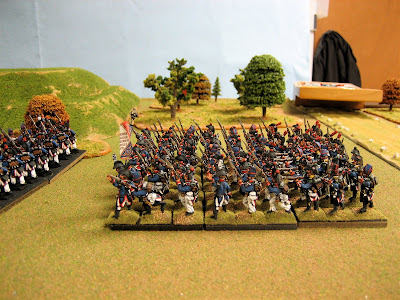
French battalion in close column of divisions.

Prussian 6-pounder foot artillery battery.
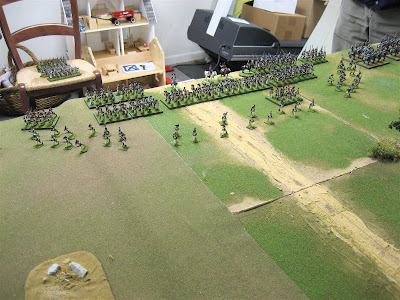
Bill's brigade of French infantry - these are mostly Dixon figures in bicorn.
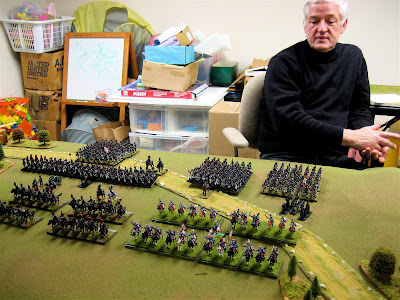
Keith's infantry brigade is preceeded by a light cavalry brigade, an example of combined arms attack in the Napoleonic era.
Well, that is all for now. I have a few little things to tweak in the rules, but I think that they will easily handle a larger battle once we get more figures painted. I had six battalions of Prussians, two dragoon regiments, one cuirassier regiment, and two SYW hussar regiments recruited into the 1806 army for this game.
The French had 8 battalions, one dragoon, one cuirassier, one chasseur regiment and some drafted SYW French hussars in mirliton.

Brigade of Prussian dragoons: DR3 von Winning (Elite Miniatures) in the front line and DR5 Koningen (Imperialist Miniatures) in the second echelon. I haven't had time to base the dragoons yet, so they are still in black primer on metal stands.

Prussian (left) versus French (right) dragoons encounter each other in melee.

Two squadrons of von Winning Dragoons attempt to break through a French battalion in line.
The cavalry versus cavalry melee rules are basically the same as thosed used in our SYW BAR rules, so there were no big changes here except for a few modifiers to reflect the different types of troops. The cavalry melees went off without a hitch.
The biggest change though was cavalry versus infantry melees: we borrowed an idea from In The Grand Manner and employed the "breakthrough" rule, i.e., cavalry does not melee with infantry, it only determines whether or not it can break through the infantry. So Bill obligingly kept one of his French infantry battalions in line, while I charged two squadrons of von Winning dragoons into his line. Bill still had his first fire bonus of +5, which really stung the Prussian dragoons, but they passed their morale check and barreled into the French line of infantry. Now I had to roll three D6 and get a score of 10 or better to break through the line. Alas, I rolled a combination totaling "9" and so I failed to break through the infantry line.
We then assumed that the dragoons had succeeded in breaking through and assessed the damage to the infantry. Initially, each cavalry figure breaking through killed one infantry man (with no saving throws for breakthrough casualties). We decided that this let the infantry off too easily without enough of a penalty. So we bumped up the casualties to "two" infantry for each cavalryman passing throught the line and liked these results better. The French line took a morale check, and failed, therefore routing away. The dragoons rolled pursuit and failed to pursue or else did not want to pursue, I can't recall which one. At any rate, we rather liked this phase of the game and will keep it in the rules.
The infantry skirmish rules seemed to work well. We just roll a D6 and assess the damage on short, medium and long range fire with scores of (4,5,6), (5,6) and (6) required to hit, respectively. This was easy to do as far as we were concerned.
Here are a few random pictures from the game:

French battalion in close column of divisions.

Prussian 6-pounder foot artillery battery.

Bill's brigade of French infantry - these are mostly Dixon figures in bicorn.

Keith's infantry brigade is preceeded by a light cavalry brigade, an example of combined arms attack in the Napoleonic era.
Well, that is all for now. I have a few little things to tweak in the rules, but I think that they will easily handle a larger battle once we get more figures painted. I had six battalions of Prussians, two dragoon regiments, one cuirassier regiment, and two SYW hussar regiments recruited into the 1806 army for this game.
The French had 8 battalions, one dragoon, one cuirassier, one chasseur regiment and some drafted SYW French hussars in mirliton.
Monday, December 28, 2009
1806 Game Is On Again

A brigade of 1806 Prussian infantry, featuring IR23 von Winning in the foreground, supported by IR19 Prinz von Oranien in the background. Additional supports include a 6-pound battalion gun and two five-man groups of scheutzen to provide some skirmish capabilities. All figures are Elite Miniatures.
We rescheduled the play test game for the 1806 Project for Tuesday December 29, 2009 at Schloss Fritz. Bill Protz and Keith Leidy will provide the opposition and probably command the French forces (8 battalions, a battery of 6 guns and 3 cavalry regiments). They might have as many as 10 battalions, depending on how the game ebbs and flows.
I will command a mixed force of Prussians (6 battalions, 6 guns and 3 or 4 cavalry regiments) and some Russians (2 battalions and maybe 4 horse artillery pieces). I was busy basing up the Russians this evening, gluing them to their 3/4 inch square bases and then affixing them to magnetized movement trays, holding 12 figures on five stands.
I am looking forward to seeing how the the new changes to the BAR Napoleon rules work out under game conditions. We have adopted the "Breakthrough" concept from In The Grand Manner with respect to infantry versus cavalry melees; i.e. the two do not melee, they simply roll dice to see if a breakthrough is affected by the cavalry. The infantry will not be able to make any saving throws for casualties caused during the breakthrough process. So this provides the infantry with a significant incentive to form square.
I will command a mixed force of Prussians (6 battalions, 6 guns and 3 or 4 cavalry regiments) and some Russians (2 battalions and maybe 4 horse artillery pieces). I was busy basing up the Russians this evening, gluing them to their 3/4 inch square bases and then affixing them to magnetized movement trays, holding 12 figures on five stands.
I am looking forward to seeing how the the new changes to the BAR Napoleon rules work out under game conditions. We have adopted the "Breakthrough" concept from In The Grand Manner with respect to infantry versus cavalry melees; i.e. the two do not melee, they simply roll dice to see if a breakthrough is affected by the cavalry. The infantry will not be able to make any saving throws for casualties caused during the breakthrough process. So this provides the infantry with a significant incentive to form square.
Sunday, December 27, 2009
French 1806 Pictures

Two sections of French 8-pounders ready to fire. Elite Miniatures guns and crew. Front Rank limbers in the background.
What do you do when you have the big game table set up and no game to play? Well, you set up some figures for a photo shoot. So that is what I did this afternoon. Click the pix to enlarge the view and check in on the progress that I have made with my French army circa 1806.

French limbers deploy behind the firing line. I will eventually add more supply wagons. You can see an Essex French caisson on the left side of the photo.
Eventually, the French artillery battery will have six artillery pieces (4 x 8pdrs and 2 by howitzers) and a limber for each gun model. I may add some unharnessed caissons and position them directly behind the artillery piece, followed by the limber models. Yes, they take up a lot of space on the table top.

French battalion deployed into line. Skirmishers are still attached to the parent battalion.

Both battalions of the 12e Regiment de Ligne deployed in column of divisions with the two voltigeur companies deployed forward to skirmish.
OK, here's the nub of it all. Take a closer look at the picture above and try counting all of the figures that comprise this "cloud of skirmishers". One regiment can deploy up to 24 skirmishers by sending out the two voltigeur companies that are in the regiment. Now you start to get a feel for how this might have looked to French opponents. There are scads of them coming right at you, followed up by two columns of infantry.
Now multiply this picture by a factor of two because you will command a brigade of 2 regiments or 4 battalions and you will be able to throw out a skirmish screen of four companies from each brigade. That is 48 voltigeurs screening the advance of your brigade. This is why I like to wargame at 1:10, especially for Napoleonic wargaming.


Here you can see the intervals between the "grand divisions" that comprise the French column. There is enough of a gap to allow for a speedy change of formation to square, to repel cavalry, or to deploy into line so that the maximum number of muskets can get into the fire fight. The voltigeurs would then fall back and take their place on the left flank of each battalion. The grenadiers are always found on the right hand flank of the column or line.

The heavy French cavalry, epitomized by the spectacular cuirassiers, now arrive on the field and prepare to finish off the opponent or provide a shock attack on their battle line.

French battalion deployed into line. Skirmishers are still attached to the parent battalion.

Both battalions of the 12e Regiment de Ligne deployed in column of divisions with the two voltigeur companies deployed forward to skirmish.
OK, here's the nub of it all. Take a closer look at the picture above and try counting all of the figures that comprise this "cloud of skirmishers". One regiment can deploy up to 24 skirmishers by sending out the two voltigeur companies that are in the regiment. Now you start to get a feel for how this might have looked to French opponents. There are scads of them coming right at you, followed up by two columns of infantry.
Now multiply this picture by a factor of two because you will command a brigade of 2 regiments or 4 battalions and you will be able to throw out a skirmish screen of four companies from each brigade. That is 48 voltigeurs screening the advance of your brigade. This is why I like to wargame at 1:10, especially for Napoleonic wargaming.


Here you can see the intervals between the "grand divisions" that comprise the French column. There is enough of a gap to allow for a speedy change of formation to square, to repel cavalry, or to deploy into line so that the maximum number of muskets can get into the fire fight. The voltigeurs would then fall back and take their place on the left flank of each battalion. The grenadiers are always found on the right hand flank of the column or line.

The heavy French cavalry, epitomized by the spectacular cuirassiers, now arrive on the field and prepare to finish off the opponent or provide a shock attack on their battle line.
The cavalry is still very much a work in progress. I have painted 40 dragoons and 32 cuirassiers and 24 chasseurs a cheval for the French, so far. I want to have a lot more light cavalry since I will be wargaming at the brigade and division levels. Hence, not much need for heavy cavalry at this point. On the otherhand, who could resist painting some of the fashionable cuirassiers and dragoons in the French cavalry establishment? I for one, could not resist the temptation.
Tomorrow: the 1806 Prussians
Saturday, December 26, 2009
1806 Game Postponed

Prussian forces defend the town of Altenzaum. Click the picture to enlarge the view.
We had to postpone today's play testing of the BAR Napoleon rules at Schloss Seewald today due to the weather conditions and a series of unfortunate events that seemed to plague all of the participants. Hesse Seewald eventually had twelve inches of snow today, which would have made travel very difficult. So we postponed the game around 9AM after several conference phone calls.
As for the events, Randy's father was in the hospital, my back was aching rather badly, but it was still serviceable (and I'm happy to report that the basement is completely dry now) and then later in the day, Bill reported that his son was ill and in the emergency room. Mrs. Fritz had to rush off to the ER as well for a condition, but fortunately things turned out well for her. Finally, I heard that Stokes Schwartz's wife, the Grand Duchess, had a nasty fall down the stairs in Stollen Central. It seems that bad news was hitting everyone here in the midwestern US.
Meanwhile, the basement was sufficiently in good order and so I allowed myself a little bit of painting time to make up for all of the hard work on Christmas Day. I hauled out some Minden Prussian musketeers and started applying paint to the first battalion of 30 figures that will eventually comprise the IR1 Winterfeldt Regiment. Since I have most of this week off from work, I hope to be able to finish the first battalion this week, get based and flagged, and ready for a photoshoot by the end of the week.
As for the events, Randy's father was in the hospital, my back was aching rather badly, but it was still serviceable (and I'm happy to report that the basement is completely dry now) and then later in the day, Bill reported that his son was ill and in the emergency room. Mrs. Fritz had to rush off to the ER as well for a condition, but fortunately things turned out well for her. Finally, I heard that Stokes Schwartz's wife, the Grand Duchess, had a nasty fall down the stairs in Stollen Central. It seems that bad news was hitting everyone here in the midwestern US.
Meanwhile, the basement was sufficiently in good order and so I allowed myself a little bit of painting time to make up for all of the hard work on Christmas Day. I hauled out some Minden Prussian musketeers and started applying paint to the first battalion of 30 figures that will eventually comprise the IR1 Winterfeldt Regiment. Since I have most of this week off from work, I hope to be able to finish the first battalion this week, get based and flagged, and ready for a photoshoot by the end of the week.
Tuesday, December 22, 2009
Getting Old
Der Alte Fritz is really feeling very old today as arthritis seems to have chosen this moment to rear its ugly head once again. This time I have shooting pains in my right wrist, which puts a little bit of a crimp in my painting. It will eventually go away and come again on another day. Usually it hits me in the back sometime in January. It must have something to do with the Winter Solstice. I will keep it short this evening as hitting the shift key on the keyboard hurts a little bit.
I am currently working on the third squadron of the DR3 von Irwing Dragoons for my 1806 Project. Some of the gang are coming over to my home on Boxing Day so that we can give the BAR Napoleonic rules another playtest. I blocked in the blue coats, grey on the breeches and dark red brown on the faces and probably have another evening's worth of color blocking before I can start some highlighting. I have to get these figures done before Friday so that I have time to terrain the bases.
I am currently working on the third squadron of the DR3 von Irwing Dragoons for my 1806 Project. Some of the gang are coming over to my home on Boxing Day so that we can give the BAR Napoleonic rules another playtest. I blocked in the blue coats, grey on the breeches and dark red brown on the faces and probably have another evening's worth of color blocking before I can start some highlighting. I have to get these figures done before Friday so that I have time to terrain the bases.
Thursday, December 3, 2009
November Painting Totals
November was a fairly good month for painting, as I closed out the month with 105 Olley Painting Paints. As you might recall, you allocate one point for each infantry and equipment piece and two points for every mounted figure (since it includes two parts - the horse and the rider). I seem to be averaging just over 100 points per month in 2009, so I was right on target.
Let's look at the details.
4 x Front Rank French Limber Teams for 1805-07 (7pts per set)
4 x Mounted ADC's (2 pts each)
1 Old Elite French Carabinier
6 French artillery crew
2 French howitzers
Total French 1806 Points: 45 points
4 x Prussian Mounted ADC's for 1806 (2pts each)
1 x DR3 Dragoon sample (2 pts)
2 x 6pdr cannons
10 x Prussian artillery crewmen
Total Prussian 1806 Points: 22 points
12 x dismounted Black Hussars
13 x Crusader Mounted Bosniaks
Total SYW Prussian Points: 38 points
I started some Foundry dismounted von Kliest horse grenadiers (a dozen) and nearly lost my will to live because they are ugly misshapen figures that I abhored painting, but I needed them in order to have some dismounted cavalry to use in our Light Troop game on Saturday. I don't seem to have the same aversion to the mounted von Kliest Foundry figures, but the foot troopers look like they came from the Isle of Doctor Moreau. They will be included in the December totals.
Looking Ahead to December
Next week it will be back to the 1806 Project as I shift over to the Prussian army. Painting 1806 Prussians is very similar to painting the SYW variety, so in my book, it is practically the same thing (do you hear that Bluebear Jeff?). I plan to have a rules play test on Boxing Day (December 26th) and so I want to add a couple of squadrons of Elite Miniatures Prussian Dragoons, painted as DR3 von Irwing. These are the lads that sport the pink facings and turnbacks. I painted one sample figure last week and really liked the way that he turned out. They should look spectacular with 24 or more figures painted. The other item in the que is a battalion of 1806 Prussian grenadiers in the march attack pose. I've been looking forward to putting the brush to these figures too.
After that, it looks like some more Minden Miniatures figures - another squadron of Austrian cuirassiers or perhaps the start of my "Minden Project" for 2010.
m
Let's look at the details.
4 x Front Rank French Limber Teams for 1805-07 (7pts per set)
4 x Mounted ADC's (2 pts each)
1 Old Elite French Carabinier
6 French artillery crew
2 French howitzers
Total French 1806 Points: 45 points
4 x Prussian Mounted ADC's for 1806 (2pts each)
1 x DR3 Dragoon sample (2 pts)
2 x 6pdr cannons
10 x Prussian artillery crewmen
Total Prussian 1806 Points: 22 points
12 x dismounted Black Hussars
13 x Crusader Mounted Bosniaks
Total SYW Prussian Points: 38 points
I started some Foundry dismounted von Kliest horse grenadiers (a dozen) and nearly lost my will to live because they are ugly misshapen figures that I abhored painting, but I needed them in order to have some dismounted cavalry to use in our Light Troop game on Saturday. I don't seem to have the same aversion to the mounted von Kliest Foundry figures, but the foot troopers look like they came from the Isle of Doctor Moreau. They will be included in the December totals.
Looking Ahead to December
Next week it will be back to the 1806 Project as I shift over to the Prussian army. Painting 1806 Prussians is very similar to painting the SYW variety, so in my book, it is practically the same thing (do you hear that Bluebear Jeff?). I plan to have a rules play test on Boxing Day (December 26th) and so I want to add a couple of squadrons of Elite Miniatures Prussian Dragoons, painted as DR3 von Irwing. These are the lads that sport the pink facings and turnbacks. I painted one sample figure last week and really liked the way that he turned out. They should look spectacular with 24 or more figures painted. The other item in the que is a battalion of 1806 Prussian grenadiers in the march attack pose. I've been looking forward to putting the brush to these figures too.
After that, it looks like some more Minden Miniatures figures - another squadron of Austrian cuirassiers or perhaps the start of my "Minden Project" for 2010.
m
Saturday, November 14, 2009
French Limber Team

French artillery limber circa 1805-06 from Front Rank Miniatures. Click pix to enlarge.
I finished my first of eight French artillery limber teams that I purchased from Front Rank Miniatures about a month ago. I started Friday night and finished the team (7 Olley Painting Points) on Saturday afternoon and started the basing process, which takes several steps. Here you can see the semi-finished product before I apply a coating of brown ink on the base, dry brush some tan paint, and then apply the static grass.
I used some sheets of polystyrene that were laying about the workshop and cut them to a dimension of 7 inches long by 2-1/4 inches wide so that I would have enough extra space to attach an artillery piece to the limber. I do not glue my cannons and crew to a single stand, but rather keep the cannon standing free without a base and I put the crewmen on 3/4 inch square metal bases, finished off with spackle compound, paint and flock. So when it is time to move the gun model, I can simply attach it to the limber and take off!
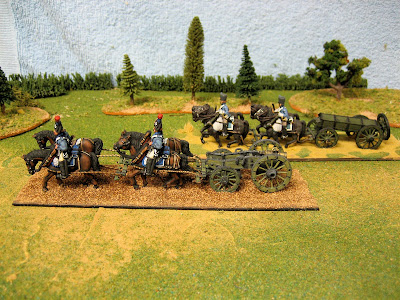
Here is the Front Rank limber with an Elite Miniatures French howitzer hooked up for a ride. In the background, you can see either a Dixon or Essex (I can't recall which of the two made it) French caisson team.
It seemed a rather daunting task to assemble all of the parts for painting and then carefully glue them onto the plastic base, but the whole process turned out easier than I had imagined it to be. I went back and forth in my mind as to whether I might want to use only two horses and one rider, or go with the four horse and two rider team. However, after painting the whole team and finding it relatively easy to affix to the base system, I have decided to go with the full four horse team. Each one of my French guns will have a similar limber. The battery will be comprised of six gun models (2 howitzers and 4 8-pounders), their respective limbers, and one ammunition caisson team.

Four of the six guns that will make up one of my French line artillery batteries.
I used some sheets of polystyrene that were laying about the workshop and cut them to a dimension of 7 inches long by 2-1/4 inches wide so that I would have enough extra space to attach an artillery piece to the limber. I do not glue my cannons and crew to a single stand, but rather keep the cannon standing free without a base and I put the crewmen on 3/4 inch square metal bases, finished off with spackle compound, paint and flock. So when it is time to move the gun model, I can simply attach it to the limber and take off!

Here is the Front Rank limber with an Elite Miniatures French howitzer hooked up for a ride. In the background, you can see either a Dixon or Essex (I can't recall which of the two made it) French caisson team.
It seemed a rather daunting task to assemble all of the parts for painting and then carefully glue them onto the plastic base, but the whole process turned out easier than I had imagined it to be. I went back and forth in my mind as to whether I might want to use only two horses and one rider, or go with the four horse and two rider team. However, after painting the whole team and finding it relatively easy to affix to the base system, I have decided to go with the full four horse team. Each one of my French guns will have a similar limber. The battery will be comprised of six gun models (2 howitzers and 4 8-pounders), their respective limbers, and one ammunition caisson team.

Four of the six guns that will make up one of my French line artillery batteries.
So there you have it - the start of the limber building process. I was afraid to tackle this project, but as is so often the case, once you start on a project, it is not as difficult as you might have imagined it to be. I am currently cleaning and getting two more limber teams ready for the primer and hopefully should have them finished by the end of this coming week. The French artillery battery should look downright awesome once all of its elements are in place: guns, crew, battery officer and ADC, limber teams and caissons.
En avant!
En avant!
Thursday, November 12, 2009
General Gudin & Staff

General de Division Gudin (center) and his staff including Generals de Brigade Petit (left) and Gautier (right) along with their aides de camp. Elite Miniatures figures. Click the pix to enlarge the view.
I have been spending the last several days working on the command figures and staff officers for my 1806 French and Prussian armies. I had set up all of my forces on my wargame table so that I could see how they look all at one time. This also highlights what is missing and what needs to be painted next. After doing this exercise, it was clear to me that I needed to paint an aide de camp for each officer.
My basing system uses a round base for the division and brigade commanders and a rectangular base for the staff. This way, when I look at the figures on the table, I can instantly pick out the Big Kahuna from the staff at a glance. The long pieces of wood that you see on each stand is where I will glue on the name tag for the particular general. The ID tags will be printed out in a nice looking font and glued to the wooden placque with white glue.

French light cavalry commander for Davout's III Corps in 1806, Generale de Brigade Vialannes and his ADC. Elite Miniatures figures (French Guard Chasseurs a Cheval command figures).
Eventually, I will have Gudin's 3rd division of eight battalions of 72 figures, one division battery of foot artillery, and to cap it off, the corps' light cavalry brigade. This was commanded by Vialannes, who was not viewed positively by Davout and later transferred out of the corps. I may change history a little bit and promote Colonel Exelmans of the 1er Chasseurs a Cheval to the command of the light cavalry brigade. The brigade will consist of the 1er, 2eme and 12eme regiments of chasseurs plus one battery of horse artillery.
My basing system uses a round base for the division and brigade commanders and a rectangular base for the staff. This way, when I look at the figures on the table, I can instantly pick out the Big Kahuna from the staff at a glance. The long pieces of wood that you see on each stand is where I will glue on the name tag for the particular general. The ID tags will be printed out in a nice looking font and glued to the wooden placque with white glue.

French light cavalry commander for Davout's III Corps in 1806, Generale de Brigade Vialannes and his ADC. Elite Miniatures figures (French Guard Chasseurs a Cheval command figures).
Eventually, I will have Gudin's 3rd division of eight battalions of 72 figures, one division battery of foot artillery, and to cap it off, the corps' light cavalry brigade. This was commanded by Vialannes, who was not viewed positively by Davout and later transferred out of the corps. I may change history a little bit and promote Colonel Exelmans of the 1er Chasseurs a Cheval to the command of the light cavalry brigade. The brigade will consist of the 1er, 2eme and 12eme regiments of chasseurs plus one battery of horse artillery.
I will post pictures of the Prussian general staff tomorrow. I am also working on additional artillery crews for both the French and the Prussians and hope to be able to post some pictures of the larger batteries within a few days.
Sunday, November 8, 2009
1806 Update
I took a little break from painting figures this weekend and spent some time finishing off the bases of all of my command figures for both French and Prussian armies. That worked out to 15 different bases needing spackle, brown ink wash, a dry brushing of tan paint, and finishing off with some static grass.
Each brigade will have one brigadier general on a round base plus one Aide-de-Camp on a rectangular 1-inch by 2-inch wooden base. The shape of the base will instantly identify the stand as either that of a commander or that of his ADC. Each figure will eventually have his name printed out on a piece of paper and glued to the base. Thus the gamer will know who his command figure represents, and who knows, maybe over time, some brigadiers will perform incredible feats on the battlefield, while others may turn out to be cowards, slackers or poltroons (or all three!).
Setting the command figures and the brigades out on my home table top also gives me a better idea of what I need to do to get the army into game shape. The French are doing fairly well as I now have General de Division Gudin and his ADC painted, as well as those of his two brigadiers Generals de Brigade Petit and Gautier plus their ADCs. The French light cavalry commander, General de Brigade Jacquinot and his ADC in hussar mufti are completed and based, but my heavy cavalry command figure of d'Hautpoul needs his own ADC. I can see that I also need to paint an artillery commander and an assistant.
On the Prussian side, I have three infantry brigadiers, one division commander and one cavalry commander. However, all of the Prussian generals need ADCs. So I spent some time this afternoon selecting the appropriate figures to use for Prussian ADCs and then doing the prep work so that I can prime them later this week. I have yet to select names for the Prussians, other than Blucher, who will command the Prussian cavalry in 1806.
The command stand basing looked so good (and thank you again to Frank Hammond for teaching me his method of applying static grass to bases) that it had me thinking about creating some "vignettes" to place around the battlefield. These will include such things as men and horse casualties, a prisoner of war stand, a vivandiere or two, etc. So I will eventually be working on these items as well.
Finally, I opened up the packet of Front Rank French artillery limber teams and attempted to assemble one of the sets (I bought 8 of them). I made a number of mistakes in the assembly, the first being gluing the limber trail (center pole) upside down. It wasn't apparent to me untill I tried to glue on the front harness bracket that attaches to the limber trail pole. So I filed it down a little bit to make the fit better. I should work out all right. It looks like the most difficult step in the assembly process will be the limber traces that connect the harness to the limber. Front Rank provides some pieces of copper wire (steel plated). You are instructed to cut the pieces to the "proper length". It would be helpful if FR would give you a precise measurement for the "proper length". You then insert one end of the wire into a little notch on the horse and bend a loop in the opposite end of the wire. The loop is then supposed to fit around a horizontal bracket on the limber, afterwhich, you close the loop with pliers. This will be the hard part. I will let you know how it turns out later in the week after I get the pieces painted.
Each brigade will have one brigadier general on a round base plus one Aide-de-Camp on a rectangular 1-inch by 2-inch wooden base. The shape of the base will instantly identify the stand as either that of a commander or that of his ADC. Each figure will eventually have his name printed out on a piece of paper and glued to the base. Thus the gamer will know who his command figure represents, and who knows, maybe over time, some brigadiers will perform incredible feats on the battlefield, while others may turn out to be cowards, slackers or poltroons (or all three!).
Setting the command figures and the brigades out on my home table top also gives me a better idea of what I need to do to get the army into game shape. The French are doing fairly well as I now have General de Division Gudin and his ADC painted, as well as those of his two brigadiers Generals de Brigade Petit and Gautier plus their ADCs. The French light cavalry commander, General de Brigade Jacquinot and his ADC in hussar mufti are completed and based, but my heavy cavalry command figure of d'Hautpoul needs his own ADC. I can see that I also need to paint an artillery commander and an assistant.
On the Prussian side, I have three infantry brigadiers, one division commander and one cavalry commander. However, all of the Prussian generals need ADCs. So I spent some time this afternoon selecting the appropriate figures to use for Prussian ADCs and then doing the prep work so that I can prime them later this week. I have yet to select names for the Prussians, other than Blucher, who will command the Prussian cavalry in 1806.
The command stand basing looked so good (and thank you again to Frank Hammond for teaching me his method of applying static grass to bases) that it had me thinking about creating some "vignettes" to place around the battlefield. These will include such things as men and horse casualties, a prisoner of war stand, a vivandiere or two, etc. So I will eventually be working on these items as well.
Finally, I opened up the packet of Front Rank French artillery limber teams and attempted to assemble one of the sets (I bought 8 of them). I made a number of mistakes in the assembly, the first being gluing the limber trail (center pole) upside down. It wasn't apparent to me untill I tried to glue on the front harness bracket that attaches to the limber trail pole. So I filed it down a little bit to make the fit better. I should work out all right. It looks like the most difficult step in the assembly process will be the limber traces that connect the harness to the limber. Front Rank provides some pieces of copper wire (steel plated). You are instructed to cut the pieces to the "proper length". It would be helpful if FR would give you a precise measurement for the "proper length". You then insert one end of the wire into a little notch on the horse and bend a loop in the opposite end of the wire. The loop is then supposed to fit around a horizontal bracket on the limber, afterwhich, you close the loop with pliers. This will be the hard part. I will let you know how it turns out later in the week after I get the pieces painted.
Saturday, October 31, 2009
21e Regt. de Ligne

Two battalions of the 21 Regiment de Ligne. Elite Miniatures painted by Der Alte Fritz
I finished the last four voltigeurs, this evening, that I needed to complete my second full regiment of French line infantry for my 1805-1807 project at a 1:10 ratio. As shown above, these are Elite Miniatures figures with all of the soldiers in the "at the ready" pose. The two battalions of the previously-painted 12e Regiment de Ligne are all in the "advancing" pose. Thus, when I start removing single casualties during a game, I will remember which regiment the figures belong to by way of their pose. These two regiments complete Petit's Brigade in Gaudin's 3rd Division of Davout's III Corps.
Note that I have not gotten around to basing the figures yet. I will terrain the individual bases with spackle compound and gravel and flock to finish them off.
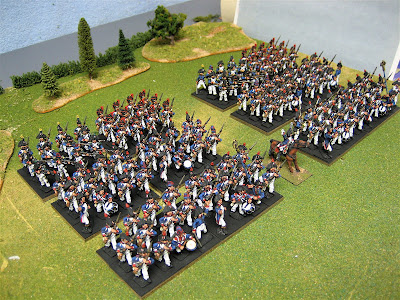
Another view of the 21e Regiment de Ligne. Click all pictures to enlarge the view.
I also have one battalion of the old Elite figures painted (which will become the 25e Regt. de Ligne) and one battalion of Dave Alsop-sculpted Legere figures. The second battalion of the "old Elite" figures for the 25e Regiment de Ligne are already primed in black primer and are ready to paint. These will be a joy to paint, after slogging through the second battalion of the 21st. I did not like painting the "at the ready" pose for some reason - the figures just did not inspire me. However, the old Elite figures are little gems and I look forward to working on them.
For the month of October, I ended up with 89 Olley Painting Points - all of them infantry figures this month. That included 72 French line, 2 eagle bearers, 1 "old Elite" carabinier in the Napoleonic genre. In the SYW, I painted 8 Stadden Prussian grenadiers for the Reisengarde regiment and 6 Stadden AWI artillery crew that were painted as Prussian artillerist.
We have our annual SYW light troops game on December 4th or 5th and so I suppose that I should work on adding more dismounted hussars and freikorps dragoons, but I would much rather work on the 1806 project.
m
Note that I have not gotten around to basing the figures yet. I will terrain the individual bases with spackle compound and gravel and flock to finish them off.

Another view of the 21e Regiment de Ligne. Click all pictures to enlarge the view.
I also have one battalion of the old Elite figures painted (which will become the 25e Regt. de Ligne) and one battalion of Dave Alsop-sculpted Legere figures. The second battalion of the "old Elite" figures for the 25e Regiment de Ligne are already primed in black primer and are ready to paint. These will be a joy to paint, after slogging through the second battalion of the 21st. I did not like painting the "at the ready" pose for some reason - the figures just did not inspire me. However, the old Elite figures are little gems and I look forward to working on them.
For the month of October, I ended up with 89 Olley Painting Points - all of them infantry figures this month. That included 72 French line, 2 eagle bearers, 1 "old Elite" carabinier in the Napoleonic genre. In the SYW, I painted 8 Stadden Prussian grenadiers for the Reisengarde regiment and 6 Stadden AWI artillery crew that were painted as Prussian artillerist.
We have our annual SYW light troops game on December 4th or 5th and so I suppose that I should work on adding more dismounted hussars and freikorps dragoons, but I would much rather work on the 1806 project.
Monday, October 26, 2009
Old Elite French - 1806 Project

Original Elite Miniatures French in bicornes, circa 1805-1807. This is the first battalion of the 25e Regiment de Ligne. (click the pictures to enlarge the view). Painted by Der Alte Fritz.
I have been slogging away at the painting of my French infantry for the 1806 Project at a 1:10 ratio of figures to actual men. As of today I have 5 battalions at 72 figures each completed. A sixth battalion has five of the six companies finished, needing only the voltigeur company to complete the unit. And yes, I know that the French had 9 companies per battalion during this period, only changing over to six companies in 1808.
I am painting Gudin's 3rd Division in Marshal Davout's III Corps circa 1806. The division will eventually have two infantry brigades of four battalions. The first brigade will have the 12e and 21e regiments de ligne and will consist of figures from the current range of Elite Miniatures French in bicorne chapeaux. These figures were redesigned by Peter Morbey some years ago, I don't know when. The 12e de Ligne are all "advancing" poses while the 21e de Ligne are all in the "at the ready" pose. I liked painting the advancing pose, but for some reason, I really dislike painting the "at the ready pose" for some reason. I guess that the figures don't inspire me, and when you are painting 72 figure battalions, you need to be inspired to paint that lot!
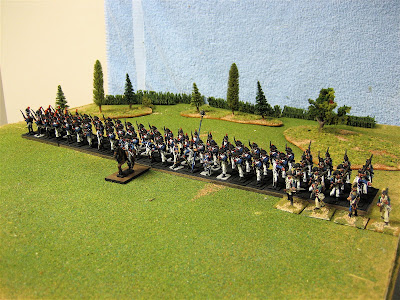
The 1/25e de Ligne in line formation. Old Elite Miniatures.
The second brigade of infantry will consist of the 25e de Ligne using the original old Elite Miniatures figures, which are shown in these pictures. The second battalion will consist of either more old Elite French, if I can find another 144 of the figures, or more likely, the new Eureka Miniatures French infantry from their French Revolution range. I really like the original Elite figures and wish that Peter Morbey hadn't redesigned the range to make them taller and a bit more cartoonish. Even more troubling is that the old figures are not easy to find. I think that I have about tapped out my source for these figures.
So if anyone has any of the old Elite French infantry in bicornes, and you are interested in selling them, then give old Fritz a call and he would be most happy to take them off of your hands at a really nifty markup to what you paid for them. I will take them painted in any condition or unpainted (preferred).
My next post will discuss the Russian part of the project. Here is a taster picture of one of the units that I have painted so far (on temporary bases until I figure out how to base them).
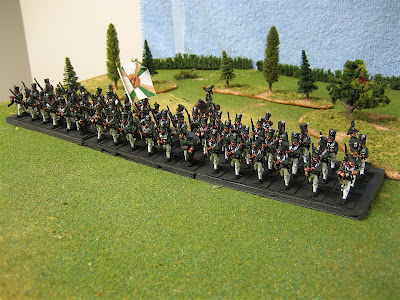
Old Glory Russians designed by the late Dave Alsop. These figures were never released to the public for sale, but I bought approximately 900 of them. This might be my main project for 2010. Who knows? Find out tomorrow.
I am painting Gudin's 3rd Division in Marshal Davout's III Corps circa 1806. The division will eventually have two infantry brigades of four battalions. The first brigade will have the 12e and 21e regiments de ligne and will consist of figures from the current range of Elite Miniatures French in bicorne chapeaux. These figures were redesigned by Peter Morbey some years ago, I don't know when. The 12e de Ligne are all "advancing" poses while the 21e de Ligne are all in the "at the ready" pose. I liked painting the advancing pose, but for some reason, I really dislike painting the "at the ready pose" for some reason. I guess that the figures don't inspire me, and when you are painting 72 figure battalions, you need to be inspired to paint that lot!

The 1/25e de Ligne in line formation. Old Elite Miniatures.
The second brigade of infantry will consist of the 25e de Ligne using the original old Elite Miniatures figures, which are shown in these pictures. The second battalion will consist of either more old Elite French, if I can find another 144 of the figures, or more likely, the new Eureka Miniatures French infantry from their French Revolution range. I really like the original Elite figures and wish that Peter Morbey hadn't redesigned the range to make them taller and a bit more cartoonish. Even more troubling is that the old figures are not easy to find. I think that I have about tapped out my source for these figures.
So if anyone has any of the old Elite French infantry in bicornes, and you are interested in selling them, then give old Fritz a call and he would be most happy to take them off of your hands at a really nifty markup to what you paid for them. I will take them painted in any condition or unpainted (preferred).
My next post will discuss the Russian part of the project. Here is a taster picture of one of the units that I have painted so far (on temporary bases until I figure out how to base them).

Old Glory Russians designed by the late Dave Alsop. These figures were never released to the public for sale, but I bought approximately 900 of them. This might be my main project for 2010. Who knows? Find out tomorrow.
Friday, September 25, 2009
1806 Project Update
I have been on a Napoleonic roll of late, with regard to my painting production, and one thing that I have learned is that sometimes you just need to go with the flow and paint what you feel like painting. How is that for some good old country advice?
This month (September) I completed a 72-figure battalion of the original Elite Miniatures French in bicornes and they will eventually go into service as the 25e Regiment de Ligne in General Gudin's division of Davout's III Corps in 1805 to 1807. Now all I have to do is find another 60 or so more of these figures so that I can paint the second battalion of this regiment. So if anyone has some of the old Elite figures, painted or unpainted, drop old Fritz a message and he'd be happy to take them off of your hands at an outrageously high price. What a deal! Failing finding more of these figures (and I will post some pictures over the weekend), I could use the 72 figure Eureka French Revolutionary War French in bicornes as the sister battalion for the 25e de Ligne.
As of now, I have 4 battalions of French in bicorns, one battalion in the spray primer booth, and two more of the new Elite French figures in an advancing pose that need to be cleaned and primed. So I am half way home on the French infantry since Gudin had 8 battalions in his division.
After I finish some more infantry, it will be time to turn my attention to the cavalry. I currently have 40 dragoons and 40 cuirassiers completed as well as 24 chasseurs a cheval. This chasseur regiment has 20 more figures to add at some point - they are the new Elite Chasseurs. I also found 36 of the old Elite chasseurs, which are noticeably smaller in size. For some reason, I like the older figures better. So if anyone has some extra or unwanted old Elite chasseurs, you know the drill, give me a call.
I was going to post some pictures this evening, but Blogger seems to be a bit fiddly tonight and won't let me upload the pictures for some reason. Hopefully, this will sort itself out in another day.
On the reading front, I just finished James Arnold's "Crisis in the Snow" which covers Napoleon's Eylau campaign in the winter of 1806-07. This was a very enjoyable book to read as Mr. Arnold has a nice prose style of writing that keeps you interested, doesn't overwhelm you with minutia, but gives you plenty of interesting tidbits and anecdotes. For some reason, Eylau has not been covered very well by the historical writing community. James Arnold's excellent book fixes that problem. I am looking forward to his pending companion book about the Friedland campaign in 1807. I liked this book so much that I also bought his two books covering the 1809 campaign, sight unseen, from On Military Matters in New Jersey. I'm looking forward to some quality reading in the near future.
This month (September) I completed a 72-figure battalion of the original Elite Miniatures French in bicornes and they will eventually go into service as the 25e Regiment de Ligne in General Gudin's division of Davout's III Corps in 1805 to 1807. Now all I have to do is find another 60 or so more of these figures so that I can paint the second battalion of this regiment. So if anyone has some of the old Elite figures, painted or unpainted, drop old Fritz a message and he'd be happy to take them off of your hands at an outrageously high price. What a deal! Failing finding more of these figures (and I will post some pictures over the weekend), I could use the 72 figure Eureka French Revolutionary War French in bicornes as the sister battalion for the 25e de Ligne.
As of now, I have 4 battalions of French in bicorns, one battalion in the spray primer booth, and two more of the new Elite French figures in an advancing pose that need to be cleaned and primed. So I am half way home on the French infantry since Gudin had 8 battalions in his division.
After I finish some more infantry, it will be time to turn my attention to the cavalry. I currently have 40 dragoons and 40 cuirassiers completed as well as 24 chasseurs a cheval. This chasseur regiment has 20 more figures to add at some point - they are the new Elite Chasseurs. I also found 36 of the old Elite chasseurs, which are noticeably smaller in size. For some reason, I like the older figures better. So if anyone has some extra or unwanted old Elite chasseurs, you know the drill, give me a call.
I was going to post some pictures this evening, but Blogger seems to be a bit fiddly tonight and won't let me upload the pictures for some reason. Hopefully, this will sort itself out in another day.
On the reading front, I just finished James Arnold's "Crisis in the Snow" which covers Napoleon's Eylau campaign in the winter of 1806-07. This was a very enjoyable book to read as Mr. Arnold has a nice prose style of writing that keeps you interested, doesn't overwhelm you with minutia, but gives you plenty of interesting tidbits and anecdotes. For some reason, Eylau has not been covered very well by the historical writing community. James Arnold's excellent book fixes that problem. I am looking forward to his pending companion book about the Friedland campaign in 1807. I liked this book so much that I also bought his two books covering the 1809 campaign, sight unseen, from On Military Matters in New Jersey. I'm looking forward to some quality reading in the near future.
Sunday, July 19, 2009
BAR Napoleon Playtest

A Prussian square, artillery at the corners and some skirmishers: all are essential elements of Napoleonic warfare and wargaming. Click the pix to enlarge the view. Elite Miniatures figures.

French voltigeur company deploys into skirmish order in the light woods. Elite Miniatures figures and The Terrain Guy game mats. Please click all pix to enlarge the view.
On Saturday July 18, 2009 we conducted our first official play test of the Napoleonic variant of Bill Protz's Batailles de l'Ancien Regime ("BAR"), which we unofficially call BAR Napoleon. We had four players for the game with 5-6 battalions per side, 2 heavy cavalry regiments and 2 light cavalry regiments per side, plus a battery of 4-5 guns each. Bill and Earl commanded the French while Mike T. and Der Alte Fritz commanded the Prussian side.

The French 51e de Ligne advances in colonne serre formation (column of open companies or grand divisions) with some Baden Jagers screening their front.

The French 51e de Ligne advances in colonne serre formation (column of open companies or grand divisions) with some Baden Jagers screening their front.

Prussian heavy cavalry brigade, lead by General von Blucher, was comprised of 40 dragoons (DR5 Konigen Dragoons) and 36 converged cuirassiers from three different regiments (that I bought at the Historicon Flea Market - Bring & Buy- in 2008). Figures are from Imperialist Enterprises, now sold through Outland Games in Dayton, Ohio.

Mike T.'s Prussian infantry brigade supported by two 6-pound sections of artillery. IR5 von Kliest is the nearest battalion. All figures are from Elite Miniatures.
Since this was only a playtest, and we were seeking to try out various aspects of the rules, the course of the game action and a description of what happened are not really significant, although a few tabletop miracles and humourous events did occur throughout the game. Suffice it to say that the French lined up on one side of the table, while the Prussians did the same and both sides advanced to the center of the table to secure the first bragging rights of the 1806 Campaign.
The game table was bifurcated (how is that for a big word?) by a large wooded area in the center of the table. From the Prussian point of view, the light cavalry battle occurred to the right of the woods; the main infantry battle took place to the left of the woods, in the very center of the table; and a large cavalry fight took place on the wide open left hand side of the table, fought between the French dragoons and cuirassiers against an equal number of like troops for the Prussians.
The game table was bifurcated (how is that for a big word?) by a large wooded area in the center of the table. From the Prussian point of view, the light cavalry battle occurred to the right of the woods; the main infantry battle took place to the left of the woods, in the very center of the table; and a large cavalry fight took place on the wide open left hand side of the table, fought between the French dragoons and cuirassiers against an equal number of like troops for the Prussians.

The light cavalry battle to the right of the central woods. Three squadrons of Prussian hussars, supported by two 6-pound horse artillery guns with crew, take on the French light cavalry (5 sqds) and a battalion of infantry. Two more squadrons of Prussian hussars and a battalion of grenadiers are just out of the picture. The picture is a little blurry because I did not use my tripod for this shot, as I usually do. Pictures without tripods are a waste of time.

A closer view of the French 12e Chasseurs a Cheval (2 squadrons of 12) from Elite Miniatures. Note the light cavalry brigade commander to the left on the round base. Brigade commanders are always mounted on round bases, while regimental colonels and ADCs are mounted on rectangular bases.

The columns of French infantry and their supporting artillery were moving forward in the center, so I decided to go at them at full tilt and hope that my one battalion of musketeers could crash into the whole lot before they could shake out into a battle line. I move up to point blank range and then hoped to get the first movement card.

Sometimes bold moves pay off. This time it appears that they would not. The French got the first first movement card, enabling them to deploy their artillery, and they also got the first firing card, giving them the first fire into my battalion of IR19 musketeers. Here is what was left of IR19 after taking a "double shot" of cannister from 4 French guns. I was not a big fan of the new "double shot" rule, to say the least.

IR19 survived the French cannister and charged home and put all of the French artillerists to the bayonet. Huzzah! Now you see IR19 von Winning (appropriate name as it turned out) advancing to support IR19's success. The French 51e de Ligne counterattack in column formation.

IR23 von Winning regiment gets attacked from the front by the 51e de Ligne and on the flank by the 24e de Legere. Miraculously, von Winning drove off both attacks, not once, but twice during the course of the game. Poor die rolling by your opponent can often bail one out of a tight spot, so it would seem.

The French 24e Legere regroups and comes back a third time, this time with success as IR23 von Winning found a battalion of the 12e de Ligne (top of the picture) advancing through their rear and they fall back.
The Cavalry Battle

Bill (left)advances the 20e Regt. de Dragoons forward to protect the right flank of Earl's (right) infantry. The Baden Jagers (Pontoonier Miniatures) provide a skirmish screen against some Prussian scheutzen doing the same.

This is what Bill saw in front of his dragoons and jager screen: Prussian infantry supported by Prussian dragoons and cuirassiers.

Cavalry commander von Blucher rolled a Poor charisma rating prior to the great cavalry melee, so the Prussian players let Blucher wander off on his own since he would add a -1 to the morale of any unit that he might be attached to. This was done via a D6 die roll, with 1 being the worst and 6 being the best (+2 to morale).

IR5 von Kliest got slaughtered by two squadrons of French dragoons because the infantry was in line formation. So this part of the rules appeared to work just fine. As a result, the other two Prussian infantry battalions commanded by Mike T. went into square for the rest of the game. The Prussian squares await the outcome of the cavalry melee (top of the picture) between the French and Prussian dragoons. Prussian cuirassiers squadrons are seen within supporting distance of the melee, which the Prussians won.

Another view of the dragoon melee and the Prussian squares, who watch some French cuirassiers, off camera to the right, advancing forward.

More of the dragoon melee. Blucher can be seen in the background while his French cavalry commander counterpart is seen in the thick of the melee at the bottom of the picture.

Three squadrons of French cuirassiers now move into melee position. Elite Miniatures cuirassiers.

French cuirassiers (left) close upon the Prussian dragoons (right).
A Few More Random Pictures

This looks bad for the Prussian grenadiers, n'est-ce pas? Mais non, les hussards recule! Earl's hussars were roaming around the Prussian rear table and found a juicy flank to charge into. The trouble was, the hussars were still disordered or unformed from a previous melee and so the Prussian grenadiers were actually able to win the melee and drive off the hussars. I will take hot dice and luck any day over sound tactics. Hee, hee, hee.

Bill's two battalions of Dixon 25mm French infantry fit in well with the other figures. They are smaller than the Elite Miniatures, but as you can see from the various pictures, one doesn't notice the size difference when fielding 72 figure units.

Some of the older Dave Alsop sculpted Old Glory limited edition French, painted as legere unit, seen operating in a colonne serre formation.

French voltigeurs stream over the crest of the ridge in advance of the first battalion of the 12e de Ligne regiment. Some old Elite French chasseurs can be seen on the right. They have just finished mopping up the Prussian light cavalry on the far right of the table.
n
The playtest seemed to work fairly well. The infantry versus cavalry melee worked the way that I had hoped, but I would like to see an even more decisive result in favor of the cavalry as long as the infantry remains in line formation. I want the players to have lots and lots of incentive to form square in the presence of enemy cavalry.
The skirmisher firing rules worked nicely. One simply throws a D6 for each skirmisher and hits on a score of 4-6 (short range), 5-6 (medium range) and 6 (long range). The opponent rolls saving throws as usual in these rules. With respect to skirmishers screening infantry and receiving fire, we decided that the firing unit can fire at the screened target (line or square) and simply allocates the hits to as many skirmishers cover the front of the unit, with the remaining hits allocated to the line or square unit. The skirmishers are easier to save via saving throws, the regular infantry fall easier.
I didn't like the double shot cannon firing. If you chose to double shot your guns, you doubled the number of hits. Maybe this might work for cannister, but not for round shot.
We also decided that infantry in column needs more of a melee modifier so we upped this from a plus one to a plus three during the course of the game.
So for a first effort, I thought that the rules gave us a nice game that captured the essential elements of Napoleonic warfare. I am encouraged by the start and look forward to the next playtest somewhere down the road.
I didn't like the double shot cannon firing. If you chose to double shot your guns, you doubled the number of hits. Maybe this might work for cannister, but not for round shot.
We also decided that infantry in column needs more of a melee modifier so we upped this from a plus one to a plus three during the course of the game.
So for a first effort, I thought that the rules gave us a nice game that captured the essential elements of Napoleonic warfare. I am encouraged by the start and look forward to the next playtest somewhere down the road.
Subscribe to:
Posts (Atom)
