Friday, October 7, 2016

Day 5: Hochkirch


We visited both Maxen and Hochkirch today and I want to have two separate threads on each battle to do them justice. We also visited Freiburg but much of the battlefield is covered with suburban sprawl and development, so it is not as interesting as the other sites.

The village of Hochkirch.

Hochkirch was fought in October 1758 and saw Frederick's army nearly getting captured en masse by the Austrian surprise attack at dawn. The Austrians attacked the Prussian position from four or five different directions in converging columns of attack across a ten mile long front. This new tactic was a complete departure from the traditional style of linear warfare. 

The Der Alter Fritz Gasthaus is closed and out of business.  There is a business opportunity for someone here.😄

The tower of the Hochkirch church, which can be seen for miles from the town.

Entryway into the church courtyard, held to the very last man by Major Langen and the Margraf Karl regiment (IR19) a 2nd battalion.

Christopher Duffy (wearing the tie) explains what happened here.

The Bluttgasse where many an Austrian and Prussian died during fierce fighting for the village.

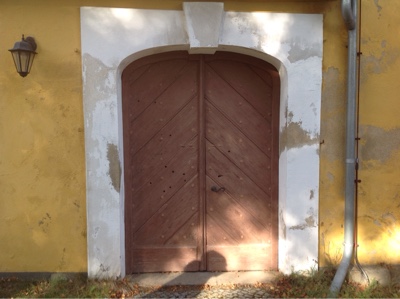
Langen's Gateway, where the Prussians made a sortie to escape.

Yes, those holes in the door are bullet holes. There are also six 12-pounder round shot buried in the walls of the church.

Inside the churchyard 

Three 12-pound shot were used for decoration on this wall.

Charles Grant (the Wargame rules author) points out the way to Tod Kershner (Age of Reason rules author)

The view outside of town towards the Prussian camp positions.

Entry to the church

Inside the village

Langen's Gateway.

Monument honoring Langen and his men

Fritz

Thursday, October 6, 2016

Day 4: Kolin

Austrian victory monument at Kolin

We left Prague this morning and headed east for the short trip to Kolin, the site of Frederick's first defeat by the Austrians.

The short summary of the battle goes like this: after the Prussians defeated the Austrians at the battle of Prague in May 1757, there were 35,000 Austrian troops bottled up inside the city's walls while the remainder of the army was scattered all over the countryside. It was a dark day for the Habsburg monarchy as it's very existence was on the line. General Leopold Daun was given the task of collecting all available Austrian soldiers into a new army and to rescue Prague from the Prussians.

Daun was able to assemble a significantly sized army well to the east of Prague, and as he gathered in more troops he tried to bait Frederick into pursuing him and split the,Prussian army into halves: one army under Marshall Keith besieging Prague, and the other army under Bevern keeping an eye on Daun.

Daun now changed his strategy from falling back from Prague into an advance on Prague. News had reached him that Prague was running short on supplies and would soon be forced to capitulate to the Prussians. As Daun advanced west towards Prague, Bevern's force of approximately 13,000 men retreated towards Prague. Frederick perceived that things were starting to get serious, so he sent reinforcements to Bevern and gradually raised the total to about 34,000 troops. Daun's army now numbered 54,000 men. Oddly enough, Frederick underestimated the size of Daun's army whereas Daun overestimated the size of Frederick's army. Daun believed that Frederick had the major portion of the Prussian army with him.

The two armies faced off with the wet and marshy Beczvarka Stream separating the two. The Austrian position was too strong to attempt a frontal attack, so Frederick endeavored to march around the Austrian left flank and roll its army up from the flank.

His plan was for the attacking wing of his army to march to the village of Krechor, then wheel right and attack the Austrians from east to west. Daun anticipated this move, after all , he could see everything that the Prussians were doing from his vantage point atop the high ground that ran parallel to the Kaiserstrasse.

Here is a panorama shit over three pictures from the view point of the Austrians atop Krechor Hill ( from left, center to right in that order below)


Hulsens attack was from left to right along the line of the trees leading to Krechor village.

Krechor Church

Krechor village

The Swedish fort situated to the west of Krechor village 

Lunch break at the Slati Slunce Inn above and below.

The battle of the Cauldron reached its critical moment atop the small rise in the ground shown above. The Austrian De Ligne Dragoons (DR31) came thundering over the rise and rolled up the Prussian infantry, which was moments away from breaking open the Austrian center.


Wednesday, October 5, 2016

Day 3: Lobositz


The Lobosch Hill at Lobositz, infested by Croats in 1756, but a very quiet place today.


Messes Bunger, Rubottom and I checked out of the Hotel Otto this morning ( after another brief stop at the Berliner Zinnfiguren store - Hey! The hotel is only one block away from  BZ, why do you think that we picked it as our place to stay?) and taxied to Tegel Airport where we met up with the rest of the Duffy Trip crew at 11am. There are twenty of us on the trip with representatives from Sweden, Germany, Italy, Canada, the UK and the USA, many of whom are familiar faces from trips of yore. 

Boarding the bus at Tegel. John Curran on the left and Ken Bunger on the right.

We departed Tegel around 11:30pm and headed south on the autobahn for Dresden and our ultimate destination of Prague, in the Czech Republic. Our first stop was the battlefield of Lobositz, site of the battle fought in 1756. Christopher Duffy briefed us along the way about the topography in the theatre of war, which provided a better understanding of why campaigns were fought in certain parts of Germany.

Travel by coach: you can just make out the Elbe River on the left.

I endeavor to learn something new on every battlefield tour and what I learned is that initially Frederick had no specific plans or strategy at the outset of the SYW. He believed that Saxony was ready to fall in with the Austrians, whereas in fact, Saxony wanted nothing more than to be a neutral power in the coming war. Once he invaded Saxony and had bottled the Saxon army up in the camp at Pirna, his objective was nothing beyond the capitulation of the Saxon army before the Austrians, French and Russians could mobilize their armies and intercede in the theatre of war.

Hans von Winterfeldt, he egged on Frederick to launch a pre-emptive invasion of Saxony in 1756.

And since Frederick had no specific plans or strategy, it was hard for the Austrian commander Marshal Ulysses von Browne to divine what Frederick was up to. Thus Browne's objective was to rescue the Saxon army from the trap at Pirna and bring it over to the Austrian side.

 
The Elbe River valley between Aussig and Lobositz. Croats positioned on the opposite or left blank, did an effective job of whittling down a regiment of Prussians that passed this way whilst guarding a supply convoy. happily, no shots were fired today, other than those from cameras.

The two armies collided almost by happenstance at Lobositz, just across the Saxon border with Bohemia. From Dresden, we followed one of the main routes into Bohemia along the Elbe River, via the towns of Aussig and Lobositz.

Lobositz was really a reconnaissance in force by the Prussians. Marshall Keith had found  von Browne's army there and Frederick brought up more of the army from Pirna to add a little more punch to his forces. Von Browne really had no interest in having a battle, settling instead on a delaying action.

The town of Lobositz. I almost got run over by a car as I stood in the road taking this picture.


The Homolka Mound. Frederick placed his artillery on the rise on the left where there is an open notch between two clumps of trees.


The line of the Morellanbach lies where you see the church steeple and the line of trees. Von Browne positioned most of his army behind this boggy ground.


The gist of the battle is this: Frederick's army poured out of the Elbe River valley and they could not see the Austrian positions due to the dense fog that morning. Von Browne's right flank (commanded by Lacy) rested on the Lobosch Hill, which was clogged with vineyards and infested by Croats. von Browne's center was held by his cavalry, as the center was really the only logical ground on which to employ cavalry. His left flank was posted behind the Morellanbach steam, out of harms way.

Frederick launched his cavalry into the fog to find the enemy and soon his cuirassiers came steaming back with many an empty saddle. The Austrian cavalry got caught up in the counterattack and received rough handling by the second line of Prussian cavalry. The Prussian 12-pounders on the Homolka Mound opened up on anything that they could see as the fog began to lift. Over on the Austrian left, Lacy's Croats and grenadiers were gradually pushed off the Lobosch Hill by Bevern's Prussian left wing. Once the Lobosch Hill was cleared of the enemy, the Austeian right wing was compromised and had to withdraw from Lobositz and join the rest of von Browne's army on the far side of the Morellanbach. Neither general had any incentive to continue the fighting and so the battle ended there, in somewhat of a draw.

Some pix of the Theresianstadt fortress are shown below, a fine example of Vauban style fortifications.


As the sun set and the sky opened up with rain, we arrived in Prague and checked into our hotel, eager for some rest, a good meal and looking forward to seeing Kolin tomorrow. 

Tuesday, October 4, 2016

Day 2: at the Berliner Zinnfiguren Store


Tuesday morning came around much too quickly, but with 7-8 hours of sleep I feel that I have adjusted to the time zone differences. I had a nice breakfast of meat, cheese and croissants with orange juice at the hotel, figuring that Ken Bunger would show up. When he didn't, I decided to hightail it down to the Berliner Zinnfiguren store, just a block down the street from my hotel, and get a head start on Ken in the search for literary treasures.

An amusing fantasy airship hanging from the rafters.

Mr.Bunger at work in the 18th Century section of the book shelves.


A view of the front entry from the inside. The walls were lined with shelves full of painted flats.

Some First Legion brand of Prussian toy soldiers.


Some fabulous flats - Prussian Hussars. Can you identify the regiment?


Baron von Munchausen, of course.

More Prussians...


Large flats: 60-70mm?

I am in awe of the painting talent displayed in this carriage vignette.


After about a thirty minute head start, I called Ken and told him to meet me down at the bookstore. I turned around and there was Richard Rubottom from our tour too. I found three or four books full of pictures of the Saxon army of the SYW and a color booklet on Augustus the Strong. That should provide a clue about one of my next projects.

Ken showed up within minutes of my calling him and he made a beeline straight for the 18th Century section and he soon had acquired a stack of books. He found a set of maps for the Prussian General Staff collection of books and gave it to me, thank you very much. One nice thing about Berliner Zinnfiguren , they will ship your books home to you so that one doesn't have to lug them around every one of Frederick's battlefields .

Richard, Ken and I then took a break from books to get some lunch. We then all split off our separate ways, I'm headed to Charlottenburg Palace this afternoon.

Day One In Berlin


I arrived at Berlin Tegel early in the morning at 7 am and it was still dark, but the airport was still a busy hive of activity. Collected my luggage and cleared customs easily and then headed to my hotel, just a block away from the Berliner Zinnfiguren store. Alas, it was closed today because it is a national holiday in Germany today: Reunification Day, to celebrate the end of the division of the country into East and West.

I met up Ken Bunger at the hotel for breakfast, after which we we headed to Unter Den Linden to see the German History Museum in the former Zughaus or armoury of the Prussian army.

Here are a few photos of the museum:

Frederick the Great's Uniform


Statue of Marshal Schwerin 


The courtyard of the Zughaus 


Frederick during times of peace.


Potsdam Giants


Prussian infantry uniform

H

Sunday, October 2, 2016

On the Road to Berlin


My flight is about to take off, but I will be blogging regularly about the Christopher Duffy tour. So come on back and I will see you tomorrow in Berlin

Jim

Saturday, September 24, 2016

Fife & Drum Hiatus for October 2016

The Fife & Drum and Minden companies will go on a month's hiatus for the entire month of October 2016. I will be on the Christopher Duffy tour of SYW battlefields for the first half of the month, and Mrs. Fritz does not plan to make any trips to the post office while I am gone. I plan to keep the business in hibernation for the rest of October so that I can catch a much needed break from the business side of things and recharge my batteries. I really really need this break.

Accordingly, if you need Fife & Drum or Minden figures before October, then I strongly suggest that you send in your orders before the close of this month. Otherwise, you will have to wait until November before I can ship any orders out.

I will leave the on-line shopping cart system active during my absence, but any orders received in the interim will probably not be shipped until early November.

During the interim period, I expect that we will have the greens completed for the SYW Russian infantry and I will post those on this blog when I get them.