Monday, December 5, 2016

Battle of Leuthen: Opening Moves


The Prussians deploy their infantry in echelon. Click to enlarge.


I woke up at 5AM and couldn't go back to sleep so I thought that I might as well go downstairs to the game room and start my Leuthen game. I think that when you are trying to recreate an historical battle that a few special rules need to be implemented for the game.

For example, I gave the Prussians the first move AND the first fire on Turn One in order to simulate the surprise nature of the Prussian attack against the Bavarians and Wurttemburgers posted on the Austrian left flank.

I allowed the Prussian Brummers to move at the speed of light artillery to simulate their quick handling and movement during the battle by Colonel Moeller.

I finished six game turns today and it looks like it will take one to two more days to finish the game. Suffice it say, the Prussians have the upper hand at this point as they are on the verge of winning the large cavalry melee on the Austrian left near Sagschutz. A single battalion of Wurttemburgers - Prinz Ludwig, appears set to die to the last man as it has held on and refused to run away despite losing 18 of 30 figures through turn six.

The battery of Brummers has been moving forward each turn and wreaking havoc on a battalion of Hungarians to their front on the Prussian left wing. The Brummers have been supported by two squadrons of Black Hussars, who spied an opportunity to charge into the flank of the Austrian artillery battery of 6-pounders, and they did so. Hidden behind the Black Hussars, on the other side of the Sophienberg, lies Driessen's brigade of Prussian cavalry. The have not been committed to battle yet, because Lucchesi's Austrian cavalry has not appeared on the table. I'm freezing Driessen's command in place until the Austrian cavalry enters the table - this simulates the actual battle.

I will give a more complete report tomorrow along with lots and lots of pictures, but the day is drawing near its end and I must get some sleep.


Sunday, December 4, 2016

Day Before Leuthen - the Gathering of the Forces


Prinz Moritz von Anhalt-Dessau reviews the Itzenplitz regiment as it marches towards Neumarkt on December 4, 1757. All pictures feature Minden Miniatures soldiers and artillery equipment. Click on all pix to enlarge.

Another version of the same picture from a ground level view.
On December 4, 1757 the Prussian war machine geared up for a march from its Parchwitz camp, heading south along the Glogau-Breslau highway, arriving at the town of Neumarkt (midway between Parchwitz and Leuthen). There, they quickly swept aside a contingent of Austrian hussars and Croats, capturing the Austrian field bakery in the process.

Campaign map illustrating the Prussian departure point of Parchwitz, settling on Neumarkt on the night of December 4, 1757. Likewise, the Austrian army embarked from Breslau, crossing the Schweidnitzer-Wasser and settling in a new position near Leuthen.

The second battalion of Itzenplitz marches behind its regimental 3-pounder.
The Austrians, meanwhile, had resolved to coil out of the entrenchments at Breslau and head north to the Katzbach to stop Frederick's advance. This was a case of too little, too late, for as we have seen, the Prusssians were already across the Katzbach and zeroing in on Neumarkt. Duffy indicates that Prince Charles had no intention of staging a battle with Frederick, but rather, was seeking more advantageous Winter quarters for his troops. He left most of his heavy field artillery behind in Breslau and sited his field bakery at Neumarkt, ahead of the Austrian army.

The Austrians built 14 or 15 bridges across the Lohe river (see map above) and another 5 across the Schweidnitzer-wasser to supplement the one stone bridge at Lissa. The objective for the first day's march was the high ground south of Neumarkt called the Pfaffendorfer-Berg. As noted above, the Prussians already occuppied the Pfaffendorfer-Berg.

The Austrian columns were badly organized and one would not give way to the other when it came to crossing the pontoon bridges. Add in a cold rain shower all day and the result is an Austrian army that only made it as far as the crossing of the Schweidnitzer-wasser by day's end. By this time, it was clear to the Austrian senior command that a battle with the Prussians was imminent. The Prussians were joyous that the Austrians had ventured out of the Breslau entrenchments and out into the open fields where the ground favored the Prussian battle plans.

Tomorrow: the Battle of Leuthen begins and I will fight it out on the table top as a solo wargame.

Saturday, December 3, 2016

The Parchwitz Address - December 3, 1757


The Parchwitz Address in miniature. Click picture to enlarge.


The Parchwitz Address, illustrated by Richard Knotel. (click to enlarge)

On the morning of December 3, 1757, Frederick summoned all of his senior officers to his headquarters at Parchwitz to impress on them what was at stake (Duffy). His address has been scribed in many variations, but Christopher Duffy indicates that the following is the most reliable version of what has become known as The Parchwitz Address:

The enemy hold the same entrenched camp at Breslau which my troops defended so honorably. I am marching to attack this position. I have no need to explain my conduct or why I am set on this measure. I recognise fully the dangers attached to this enterprise, but in my present situation I must conquer or die. If we go under, all is lost. Bear in mind, gentlemen, that we shall be fighting for our glory, the preservation of our homes, and for our wives and children. Those who think as I do can rest assured that, if they are killed, I will look after their families. If anybody prefers to take his leave, he can have at it now, but he will cease to have any claim on my benevolence.

Prussia's Glory by Christopher Duffy (page 133)

Frederick was asking for the support of his army. He was an austere and unforgiving individual, and he allowed himself this display of emotion just once in his life, and when it mattered most. The officers dispersed to their commands and

loud rejoicings resounded through the Prussian camp. The veterans, who had won so many victories under the king's leadership, now shook one another by the hand, and promised to stand by each other to the end. They made the young soldiers swear to go straight for the enemy, disregarding all opposition.

Prussia's Glory (page 133)

Friday, December 2, 2016

The Fifth Day of Leuthen - Things Are Heating Up Now

Prussian artillery train hauling 12-pound Brummers to Parchwitz. (Minded Miniatures) - click pix to enlarge.

The Prussians
On December 2, 1757 things began to heat up in both camps what with Zieten arriving from Glogau with the rest of the "Breslau Army" into Frederick's camp at Parchwitz. The combined Rossbach and Breslau armies included 48-1/2 battalions, 133 squadrons, and 78 heavy field pieces, including 10 fortress 12-pounders (the Brummers) bringing the Prussian army up to 39,000 men.

Prussian powder wagon, part of the artillery train, with crew marching behind the wagon. (Minden Miniatures)


Frederick never employed the positive side of his man-management to better effect than in these early days of December 1757. In terms of motivation, his army was the best he had ever led into the field. A veteran wrote that this little force was "made up almost entirely of genuine native Prussians, for most of the foreigners had deserted, and those that remained had taken on our national character." Their guiding principle was an extraordinary attachment to their king and their fatherland, and if ever troops may be compared to Spartans and Romans, it must have been the Prussians of that time.

The units of Bevern's army had expected a typical tongue-lashing, but the king sensed that this was not appropriate. When he talked to the officers, his conversation turned on how well they had done in the past times. He walked among the soldiers, chatting with them in terms they understood. There were distributions of extra rations, and wine to help  to revive flagging spirits. For the time being he kept these people in a separate encampment, but he encouraged the men of the "Rossbach" army to come across to their lines and talk about the events of November 5th. All of this helped to turn discouragement into thoughts of revenge.

Frederick's solicitude extended to the generals. The king, unlike the Austrians, was notoriously stingy in dispersing praise and rewards, and something altogether out of the ordinary must have compelled him to proclaim a mass promotion on December 1st -- Driesen and the princes Ferdinand of Prussia and Friedrich Eugen of Wurttemberg were advanced to lieutenant generals, and eleven of the colonels became major generals.

Prussia's Glory (pages 130-131) Christopher Duffy

The Austrians
The Austrian high command held a meeting to debate strategy for the coming battle with the Prussians. The best course of action would have been for the Austrian army to occupy the Breslau defenses, however, they decided to march out of camp and march towards the Katzbach. They decided to leave much of their heavy artillery in Breslau, presumably for a speedier march. It was decided to reinforce Lignite with 1,000 more men and build up a command of Croats, hussars and Saxon light dragoons at Newmarket, on the highway to Parchwitz. Duffy indicates that the real reason for the advance towards Frederick was a concern that the Prussians would cut off the supply line back to Bohemia.


mmm

Thursday, December 1, 2016

The Fourth Day of Leuthen: December 1, 2016

On December 1, 1757 it was reported that 30 squadrons of Prussian hussars arrived from Glogau, representing the first of the troops that Zieten was assembling in that city. The rest of the force would arrive tomorrow - December 2nd - and include ten of the massive fortress cannon: 12-pound Brummers, so named after their deep throated boom.

A Saxon fortress gun at Koenigstein Castle near Dresden gives you the impression of what a Brummer might have looked like. The picture was taken in October 2016 during the Christopher Duffy (in front next to the wheel) tour of Fredrician battlefields. I am on the far right in green coat and tan baseball cap.

Schematic drawing of the Brummer - provided by Christian Rogge, who created the illustration


These thick barreled pieces on their massive carriages could take heavy charges which would wreck the ordinary 12-pounders, and the Prussian gunner Captain von Holtzendorff testifies that "thiswas the first time that the Austrians had been exposed to the shot of the Brummers. They were inclined to regard us as barbarians who had broken international law, and the prisoners directed the most bitter reproaches against the Prussian gunners for having deployed these pieces, which devoured everything in their path, and shot them up without a Prussian being in sight.:

Prussia's Glory - page 156 - Christopher Duffy

The Brummer battery of ten guns played an important role in the battle of Leuthen, so I did an inventory of my painted Prussian artillery, discovering that I only had one gun model. So today, I painted two more Brummer models to use in the Leuthen war-game.

Minden Prussian 12-pounder in front and 12-pound Brummer in the background.

A pair of Brummers "in situ" prepare to fire on the Austrians. Cannon models are Minden Miniatures.

The first picture above compares the conventional Prussian 12-pounder with a 12-pound Brummer. Note the significant difference in barrel sizes.

The second picture shows a pair of Brummers on their artillery crew stands, as used in my wargame armies. I don't glue down the cannon models to the bases so this allows me to substitute cannon models as needed for a particular wargame scenario. The models are part of the Minden Miniatures artillery equipment range.

DAF

Wednesday, November 30, 2016

The Road to Leuthen: November 30, 1757

Saxon Garde du Corps escorting a VIP (Dresden museum)

I just realized a little coincidence in the timing of this year's Leuthen Day anniversary, which falls on Monday December 5, 2016: the actual battle of Leuthen was also fought on a Monday on December 5, 1757. Make what you want of that, but since I am recreating the battle as a wargame on the same day and day of the week, it seemed significant or karmaic to me.


Historically, there does not appear to have been anything of significance happening on November 30, 1757. I would imagine that Frederick was giving his troops a much needed rest after marching over 180 miles from Saxony to Parchwitz in 15 days. Presumably, Frederick was  waiting for the rest of Zieten's forces to assemble in Glogau and march to join the army in Parchwitz, on the Katzbach.

One can imagine that the Austrians were dithering over what to do, as was their want as long as Prince Charles of Lorraine was in command of their army. Charles is an illustrative example of the foibles of allowing nepotism, rather than merit, to determine who should command the army. I wonder how events would have changed had Leopold Daun (the victor at Kolin) been in command rather than Charles. Maybe not too much of a difference as Daun had failed to grasp the importance of the Katzbach stream as a defensive position

The only piece of information that I can find for November 30th is a mention of the Austrian roster return of that day indicating that the average strength of its Cuirassier and Dragoon regiments was a feeble 377 horse and men. [Prussia's Glory, page 134]. With respect to the size of the overall army, Charles, in a letter to Maria Theresa, put the number of healthy and available troops at 50,000. As Duffy says, this figure is "astounding" as it was far less than the 65,000 to 90,000 troops that historians have traditionally attributed to the Austrian army at Leuthen.

Duffy explains that approximately 18,000 to 21,000 men were detached from the army, posted at various places including Schweidnitz (6,000), Breslau (6,000), Lignitz (3,000), Beck's corps of 3,500 posted east of the Oder River,  and Kalnocky's force of 2,000. The number of verifiable detached troops was at least 18,000. 

By comparison, Frederick's army is reliably estimated at 39,000 men and horse, comprising 29,900 infantry, 9,800 cavalry (48 battalions and 120 squadrons) and 71 heavy pieces of artillery: 10 of the 12-pound Brummers, 39 ordinary 12-pounders, 13 light 24-pounders and 8 howitzers. Thus 39,000 Prussians were attacking an Austrian army of around 50,000 or an Austrian advantage of 1.3x the Prussian army. Accordingly, the odds of Prussians versus Austrians was a lot closer than the figures usually stated in the history books. One can imagine that Prussian or German historians of the 19th Century might have inflated the size of the Austrian army so as to make Frederick's victory at Leuthen even more impressive.


finis

Tuesday, November 29, 2016

The Road to Leuthen: November 29, 1757


The battlefield of Leuthen, in a quiter moment before the troops arrive. Click all pix to enlarge the view.
I spent nearly eight hours yesterday clearing off the Sudan terrain from my game table and replacing it with Winter terrain for the SYW in Silesia (Leuthen).


Lobetinz (foreground) anchors the left flank of the Prussians and Sagschutz, near the post in the background, is where the Wurtemburg and Bavarian forces were deployed. They would face the first wave of the Prussian attack.

A picture of me at Leuthen, to the south of the town. If you click on the picture to enlarge the view you can just make out the church towers of the Catholic Church (left) and the Protestant Church (right). Very flat terrain, perfect for cavalry action.


I should have mentioned yesterday that the Prussians were busy crossing the Katzbach stream at Parchwitz on November 28th. This was important because of the geographical nature of the Katzbach, which while narrow, had steep embankments that made crossing very difficult for an army. The Katzbach basically cut Silesia into two halves. Had the Austrian army moved forward from Breslau to take up a position along the Katzbach, they would have been in a good position to deny Frederick a march on Breslau.

Below is an excellent campaign map of the Leuthen Campaign that we will be referring to again over the coarce of the run up to the battle of Leuthen on December 4th: 

Map from "Prussia's Glory" by Christopher Duffy


By an oversight Charles and Daun had made very little provision to cover the Glogau-Breslau highway, which crossed the Katzbach by a little wooden bridge outside of Parchwitz. This post was held by Colonel Gersdorf and his force of 500 Croats, hussars and German cavalry, and on the same November 28th it was surprised and overthrown by Frederick's advance guard of 4,000 troops, which enjoyed a superiority of eight to one. The Austrians were not given the time to burn the bridge, and Gersdorf's command was driven through the town and scattered, with a total loss of 43 Croats, 6 hussars and 76 German cavalry.

On November 29th Charles responded by placing Major General Luzinsky at Newmarkt with a small blocking force (above), but the main Austrian army still hung back outside Breslau, and the enemy still had a free hand. Charles merely wrote to Vienna that he hoped that 'the Prussian movements will declare themselves in two to three days time, so that we can take such measures as are most advantageous to Your Majesty's service. In this we shall bear in mind the Kingdom of Bohemia.' The last remark was significant, for it indicated that Charles was still worried about the security of his left or southern flank [DAF: influenced by Marshal Kieth's earlier raid into Bohemia on November 26th, designed to draw off Austrian forces that were blocking Frederick' route of march from Dresden to Parchwitz] 

Frederick was therefore left undisturbed in his bridgehead at Parchwitz, and his "Rossbach Army" received a reinforcement from Glogau in the shape of three battalions. A convoy bearing ammunition and flour arrived with them and Frederick was now able to set up a field bakery in the Schloss at Parchwitz.

- from "Prussia's Glory" by Christopher Duffy, pages 128 to 129.

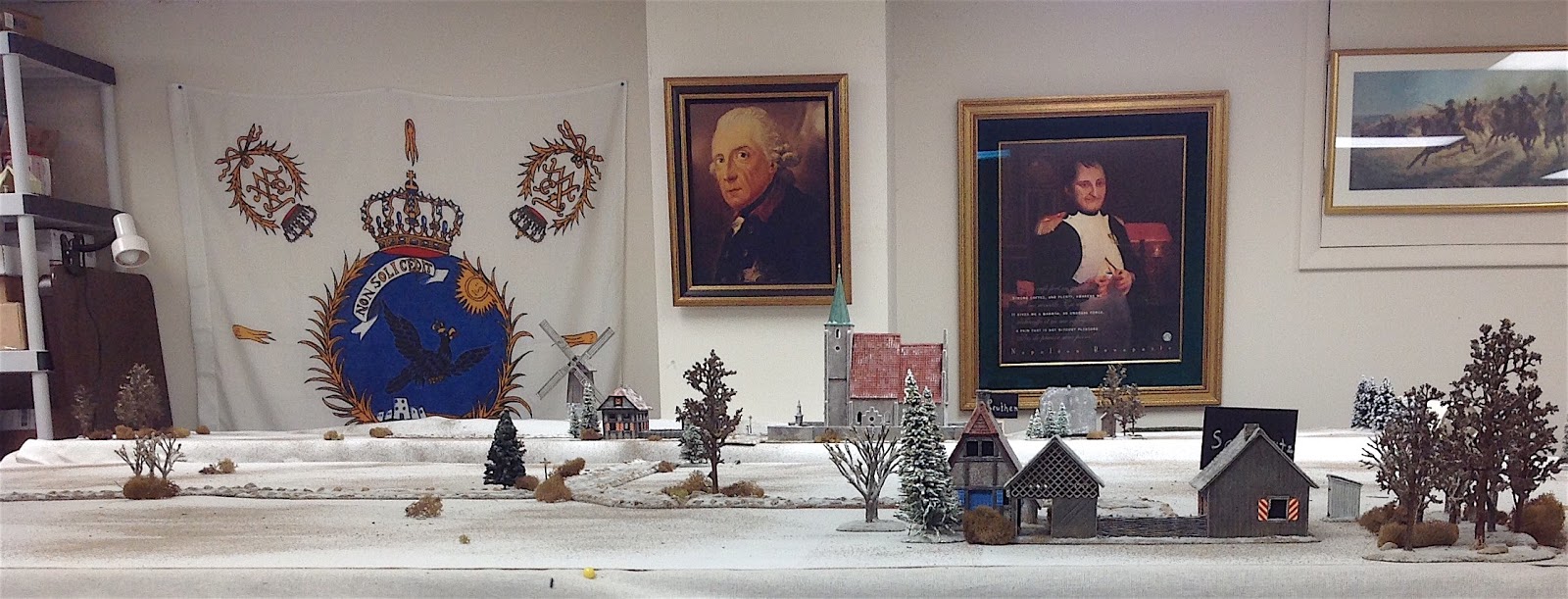
Below is a picture of the Leuthen battlefield, as presented on my war-game table:

Leuthen battlefield viewed from Sagschutz in the east towards Lobetinz in the west.