Showing posts with label SYW. Show all posts

Friday, April 4, 2025

Seven Years War Assn Convention This Weekend


I couldn't make it to this year's Seven Years War Association convention this year. I thought that I would therefore post several pictures of my SYW collection of Minden Miniatures instead.

Camp Life

Here are some pictures of the Prussian camp that I set up last Autumn. They show some scenes in and around the camp.

Prussian dragoon on scouting assignment, Minden figure converted from a Minden lager.

Blacksmith or farrier. The wagon is from Berliner Zinnfiguren

Picket duty outpost with Prussian dragoons

Prussian pioneers marching off to work

"Your papers please"


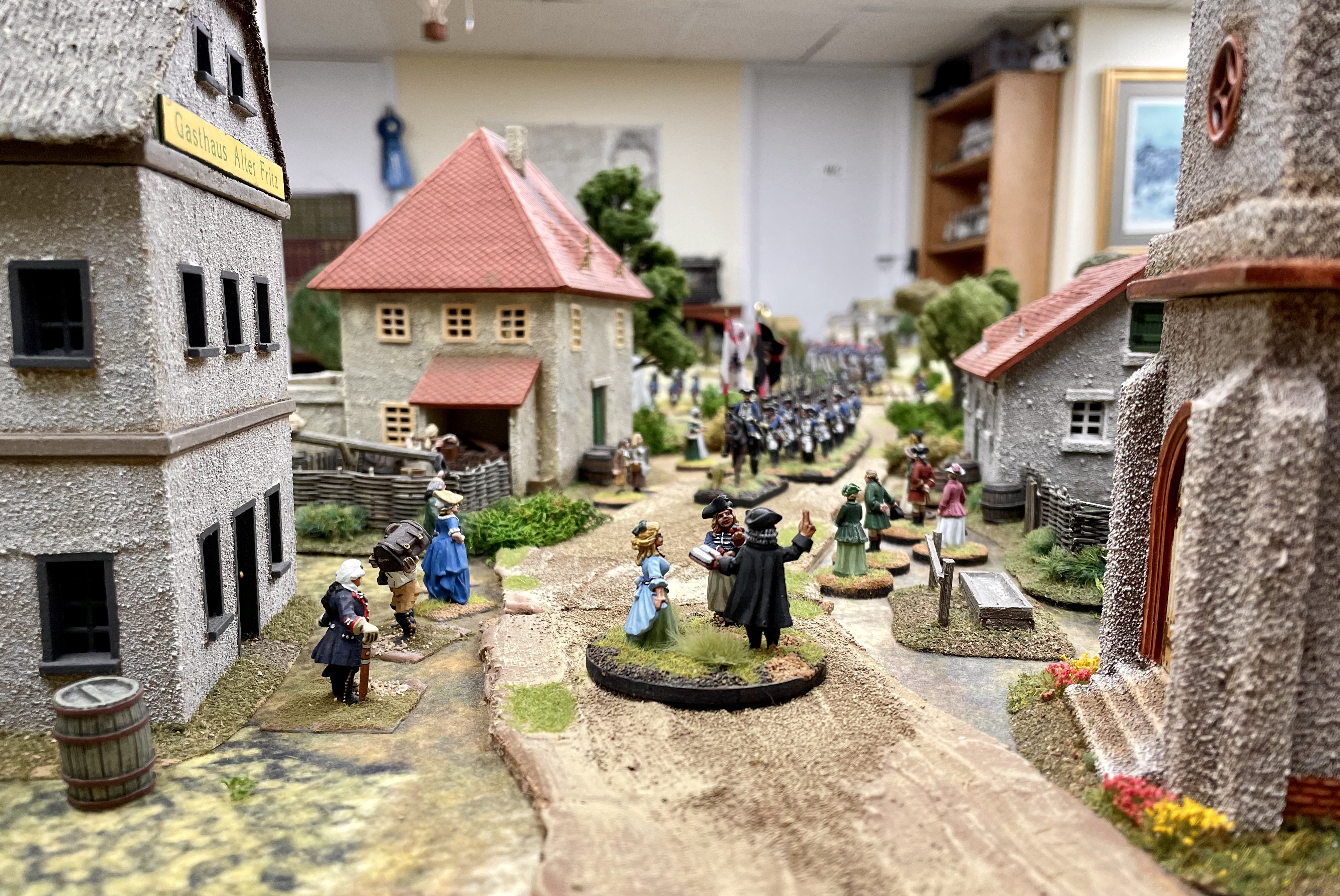
Some of the towns and villages in Silesia

Ian Weekley buildings from the 1980s still look good by today's standards.
I like that the cut and fit of the models are not "perfect", giving them a 
more realistic appearance.


Another view of the Ian Weekley village. I have found that using a mass of buildings
positioned in various angles make for a good look. I learned this trick from seeing
some of the dioramas in the German Army Museum in Dresden.

Here is the larger town in the area. Buildings were made by Herb Gundt.
I made the roads and the figures are Minden Miniatures, of course.

Yet another table in my Silesian villages set up on two 6 x 12 feet tables in my basement.
The church was the first building that I ever made, circa 1988. Not bad for a first effort.
Materials are plywood, a ping pong ball, and individual roof tiles cut out of cardboard.
That was a grueling task (gluing the roof tiles onto the church).

As Phil Olley would say, "every war game table should have a windmill on it."

The fourth village on the game table. I like to put my villages in the corners
of my game table so that they are out of the way where the battle occurs.
This particular village is long and narrow, much like one would see in Silesia.
The town buildings were often erected along the main road rather than grouped
together. These are mostly Herb Gundt buildings with one Ian Weekley model.

My game table philosophy is to put my villages in the corners of the game table so that they do not interfere with the war game battle. Most of the time my scenarios do not involve fighting inside towns as SYW battles tended to be fought on open ground, rather in the villages. Of course there are exceptions to this, however, I have found that buildings can ruin a good war game because they bog down the action and generally do not produce a good game.

Roads should be laid out in diagonal patterns to avoid the same old same old table top look. I don't like to see every road in straight parallels to each other. Diagonally placed roads have a more realistic look to them. I learned this little trick from my friend Keith Leidy.

Trees look good on the table top and undoubtedly some of the action in real battles were fought in wooded areas, but they interfere with the flow of a good war game. In the SYW, fighting in wooded areas tended to be done by light troops such as Croats, Frei-korps and specially recruited light infantry regiments.


c

Tuesday, August 13, 2024

A Peaceful Village In Silesia, Circa 1758


The Prussian Red Hussars (H7) come marching into Frobeldorf.
Is the captain's name Ned and is he the pride of the regiment?
 Minden Prussian hussars and some Blue Moon and Minden civilians

Another view of the March of the Red Hussars.
Buildings by HG Walls.


Click on all pictures to enlarge


I have been working on my terrain for the SYW era group of German villages located somewhere in Silesia. The pictures in this post depict the little hamlet of Frobeldorf, which has suffered from the depredations of marauding Russian light cavalry and Cossacks. They have made an appeal to King Frederick II of Prussia to protect them and save them from the bad guys: the Russians. Boo, hiss!

When I set up the four villages on my game table, I realized that I needed to have more civilians on the table, so I painted 20 Minden civilians and converted the pioneers into civilians by painting the latter in civilian clothing colors. I am also working on some of the Ratnik civilians, but I find these to be more difficult to paint due to all of the extra nic-nacs and accouterments that they have. I also found a box of Venture/Suren Miniatures civilians that I forgot that I had and I will be placing an order for some more Old Glory 18th Century civilians to add into the mix. The more the merrier I say.

Minden agricultural workers cutting down the grain.

The grain fields were made for my Pickett's Charge project, but I had 28mm vignettes in mind when I made them. I used a coir material door mat for the grain and sprinkled it with coir cuttings that I clipped off of the door mat.

I find that if I stoop over and crank my aged knees into the down position, then I can view the various villages and vignettes from "the ground level". This point of view almost makes the little men come alive and if you squint your eyes just a little bit then a sense of realism is seen. Good stuff. Good idea.

Here are some ground level pictures that I recently snapped:

Minden Bosniaks and Black Hussars on the march.

Looking down the main street of Gross Kammin. Buildings by HG Walls. Roads by Der Alte Fritz
and some Foundry, Perry and Minden civilians.

The Heroic Zeiten personality from the Minden Miniatures figure range.
This is one of the best figure sculpts every made by Richard Ansell.

Prussian camp scene. John Ray made the officer and servant vignette and 
the two camp followers are Foundry figures.

Prince Ferdinand of Brunswick vignette from the Minden Miniatures figure range.

My next terrain project will be to make some green agricultural fields for my 18th Century villages. I also want to make some "backyard" terrain pieces, such as the ones that Troop of Shew (Alan Steward) made for his Normandy WW2 terrain. He includes things like flower and vegetable gardens, an out house and general yard clutter. Each small terrain vignette tells its own story.

This picture shows some of Alan's work. This is THE ULTIMATE in war game terrain modeling.

Normandy terrain vignettes by Alan Sheward.

Very inspirational to say the least.

Next up on my painting table are another 8 Prussian Yellow Hussars that I need to finish in order to complete a squadron of 12 such figures. These figures are the newer hussars with shouldered swords pose that can be used for hussars at rest or trotting into position or prior to a charge. While I like the Minden charging hussar poses, I prefer the shouldered sword pose for its durability.

I am starting to get adjusted to painting smaller 28mm figures as compared to the large 54mm figures that I had been painting over the past twelve months. Once you get the hang of it, Minden Miniatures are a joy to paint.

I hope you agree.


And finally, Bella the Golden Retriever asks that you leave some comments in the comment section of this blog post. Bella says, "My favorite human is much happier when people leave comments, so please do so. He will give me some liver treats if you do."


Thursday, December 1, 2016

The Fourth Day of Leuthen: December 1, 2016

On December 1, 1757 it was reported that 30 squadrons of Prussian hussars arrived from Glogau, representing the first of the troops that Zieten was assembling in that city. The rest of the force would arrive tomorrow - December 2nd - and include ten of the massive fortress cannon: 12-pound Brummers, so named after their deep throated boom.

A Saxon fortress gun at Koenigstein Castle near Dresden gives you the impression of what a Brummer might have looked like. The picture was taken in October 2016 during the Christopher Duffy (in front next to the wheel) tour of Fredrician battlefields. I am on the far right in green coat and tan baseball cap.

Schematic drawing of the Brummer - provided by Christian Rogge, who created the illustration


These thick barreled pieces on their massive carriages could take heavy charges which would wreck the ordinary 12-pounders, and the Prussian gunner Captain von Holtzendorff testifies that "thiswas the first time that the Austrians had been exposed to the shot of the Brummers. They were inclined to regard us as barbarians who had broken international law, and the prisoners directed the most bitter reproaches against the Prussian gunners for having deployed these pieces, which devoured everything in their path, and shot them up without a Prussian being in sight.:

Prussia's Glory - page 156 - Christopher Duffy

The Brummer battery of ten guns played an important role in the battle of Leuthen, so I did an inventory of my painted Prussian artillery, discovering that I only had one gun model. So today, I painted two more Brummer models to use in the Leuthen war-game.

Minden Prussian 12-pounder in front and 12-pound Brummer in the background.

A pair of Brummers "in situ" prepare to fire on the Austrians. Cannon models are Minden Miniatures.

The first picture above compares the conventional Prussian 12-pounder with a 12-pound Brummer. Note the significant difference in barrel sizes.

The second picture shows a pair of Brummers on their artillery crew stands, as used in my wargame armies. I don't glue down the cannon models to the bases so this allows me to substitute cannon models as needed for a particular wargame scenario. The models are part of the Minden Miniatures artillery equipment range.

DAF

Tuesday, November 29, 2016

The Road to Leuthen: November 29, 1757


The battlefield of Leuthen, in a quiter moment before the troops arrive. Click all pix to enlarge the view.
I spent nearly eight hours yesterday clearing off the Sudan terrain from my game table and replacing it with Winter terrain for the SYW in Silesia (Leuthen).


Lobetinz (foreground) anchors the left flank of the Prussians and Sagschutz, near the post in the background, is where the Wurtemburg and Bavarian forces were deployed. They would face the first wave of the Prussian attack.

A picture of me at Leuthen, to the south of the town. If you click on the picture to enlarge the view you can just make out the church towers of the Catholic Church (left) and the Protestant Church (right). Very flat terrain, perfect for cavalry action.


I should have mentioned yesterday that the Prussians were busy crossing the Katzbach stream at Parchwitz on November 28th. This was important because of the geographical nature of the Katzbach, which while narrow, had steep embankments that made crossing very difficult for an army. The Katzbach basically cut Silesia into two halves. Had the Austrian army moved forward from Breslau to take up a position along the Katzbach, they would have been in a good position to deny Frederick a march on Breslau.

Below is an excellent campaign map of the Leuthen Campaign that we will be referring to again over the coarce of the run up to the battle of Leuthen on December 4th: 

Map from "Prussia's Glory" by Christopher Duffy


By an oversight Charles and Daun had made very little provision to cover the Glogau-Breslau highway, which crossed the Katzbach by a little wooden bridge outside of Parchwitz. This post was held by Colonel Gersdorf and his force of 500 Croats, hussars and German cavalry, and on the same November 28th it was surprised and overthrown by Frederick's advance guard of 4,000 troops, which enjoyed a superiority of eight to one. The Austrians were not given the time to burn the bridge, and Gersdorf's command was driven through the town and scattered, with a total loss of 43 Croats, 6 hussars and 76 German cavalry.

On November 29th Charles responded by placing Major General Luzinsky at Newmarkt with a small blocking force (above), but the main Austrian army still hung back outside Breslau, and the enemy still had a free hand. Charles merely wrote to Vienna that he hoped that 'the Prussian movements will declare themselves in two to three days time, so that we can take such measures as are most advantageous to Your Majesty's service. In this we shall bear in mind the Kingdom of Bohemia.' The last remark was significant, for it indicated that Charles was still worried about the security of his left or southern flank [DAF: influenced by Marshal Kieth's earlier raid into Bohemia on November 26th, designed to draw off Austrian forces that were blocking Frederick' route of march from Dresden to Parchwitz] 

Frederick was therefore left undisturbed in his bridgehead at Parchwitz, and his "Rossbach Army" received a reinforcement from Glogau in the shape of three battalions. A convoy bearing ammunition and flour arrived with them and Frederick was now able to set up a field bakery in the Schloss at Parchwitz.

- from "Prussia's Glory" by Christopher Duffy, pages 128 to 129.

Below is a picture of the Leuthen battlefield, as presented on my war-game table:

Leuthen battlefield viewed from Sagschutz in the east towards Lobetinz in the west.


Thursday, January 22, 2015

Museum in Berlin


Frederick the Great
The Uniforms of the Prussian Army under Frederick the Great from 1740 to 1786

About the book

824 pages (linen bound with a protective cover, it comprises two volumes in a slipcase), ca. 1500 colour photographs and illustrations, Format: 29.5 cm x 26 cm

The authors

Daniel Hohrath, with additional contributions from Judith Zimmer and Elisabeth Boxberger

Price

€ 129,90

ISBN

978-3-902526-51-9 (English)
978-3-902526-50-2 (German)

Saturday, October 26, 2013

Deutsches Historisches Museum in Berlin

Exsquisite Book from Verlag Militaria

Someone recently asked me for information about places to visit whilst on a trip to Berlin and the first thing that came to my mind was paying a visit to Potsdam (accessible via the local tram or bus from Berlin) and spending time at Frederick's palace of Sans Souci.


Next on my list would be a visit to the Deutsches Historisches Museum in Berlin, located in the old royal arsenal building, also known as the Zeughaus. While searching for information on this museum, I stumbled across this book that was published a few years ago, one that I have been meaning to purchase, but never got around to it. It features the SYW militaria collection at this museum. Check out the link below to the publisher's web site (Verlag Militaria) for more information on how to order the book.

Finally, no trip to Berlin would  be complete without a visit to the Berliner Zinnfiguren store to view the extensive collection of SYW flats and military history books. See the direct link to the store's website in the left hand column of this page.

I will leave it up to your own Google skills to find out where these three sites are located, but they would be my recommendations on places to visit while in Berlin.

About the book

824 pages (linen bound with a protective cover, it comprises two volumes in a slipcase), ca. 1500 colour photographs and illustrations, Format: 29.5 cm x 26 cm

The authors

Daniel Hohrath, with additional contributions from Judith Zimmer and Elisabeth Boxberger

Price

€ 129,90

ISBN

978-3-902526-51-9 (English)
978-3-902526-50-2 (German)

Content

This work represents a new basis for the study of the Army of the Prussian King Frederick the Great; it is an indispensable standard work for anyone interested in the military and cultural history and the crafts of that era. It depicts the uniforms of an army whose military successes laid the foundation for the rise of 18th century Prussia as amajor European power, and which, like its royal commander became the military ideal for all of Europe. Their particular style and the grandeur of their equipment were widely copied, and – uniquely for that day – collected by Frederick’s successors for posterity. The result of those efforts is the world’s best collection of 18th  century uniforms, now in Berlin’s Deutsches Historisches Museum, located in the old Royal Arsenal, the Zeughaus. Here, for the first time, all of the more than 200 items are presented and described individually and in detail, with high quality colour photographs and precise measurements.

Many of these original pieces were previously unknown, or had been seen only in drawings or poor quality old photographs. Supplementing these illustrations are photographs of items from other European collections. The total of some 1500 photographs shows an almost complete series of fusiliers’ and grenadiers’ caps, along with such items as cuirassiers’ coatees and hussars’ dolmans, sabretaches, caparisons, cartridge boxes and hats. There are also several uniform coats, including one worn by King Frederick himself.
In addition, this work includes a complete reproduction of the Lace Pattern Book of 1755, a manuscript containing the original embroidery and braid patterns of over 100 Prussian regiments, which is kept at the Deutsches Historisches Museum.

Finally it contains reproductions of the portraits of a large number of Prussian Army officers of the Seven Years’ War period, many of them previously barely known; most are from the Field Marshals’ Hall of the Prussian Military Academy in Groß-Lichterfelde. Also shown are drawings and black-and-white photographs of items from the old Zeughaus Collection that have since been lost.
The text includes explanations of the uniforms and their development, and short histories of each regiment in the Old Prussian Army. It is prefaced by historical essays on the Army of Frederick the Great and the history of the Zeughaus Collection, and includes an in-depth examination of the materials, designs and production methods of the uniforms and trimmings, from the point of view of modern textile conservation.

Thursday, December 27, 2012

Battle of Lobositz: Dec. 27, 2012

Cavalry clash at Lobositz. Prussian blue dragons (Suren) and blue hussars (Stadden) in melee with the Saxon Rutowski regiment (Elite Miniatures). Click pix twice to enlarge the view.


This afternoon we refought the battle of Lobositz (October 1, 1756) using the Charles S. Grant scenario that is found in his book titled, "The Wargame Companion". The game was played with three Prussian players (Der Alte Fritz himself, Keith L., and Chuck the Lucky) and two Austrian players (Bill Protz and John M.) and it was staged in the basement man cave of DAF. Mrs. Fritz kindly prepared a lunch of chili and pumpkin bread, which was served around 1 PM. Keith L. kept our tummies full with some wonderful chocolate chip oatmeal cookies that were baked by his wife, Donna (AKA, "the World's Best Baker").

Both sides had 8 battalions of regular infantry and the Austrians were allowed to augment their forces with two units of light infantry (72 Croats on the Lobosch Hill and 24 Arqubusiers de Grassin in the wolf pits in the center of the field). The Grant scenario provides for about 10 battalions per side, but I thought it best to trim the rosters down a little bit as I did not want to overwhelm the players with the masses of figures that required movement. Both sides had 20 squadrons of cavalry, but the Prussians had more armoured cuirassiers. Artillery pieces were 5 for the Prussians  and 4 for the Austrians.

The following game map, copied from "The Wargame Companion" by Charles S. Grant, illustrates the table layout for the Grant family version of Lobositz. The Prussians were advancing onto the table from the top of the map, between points "C" (Homolka-berg) and "A" (Lobosch Hill). Point "B" is the town of Lobositz, adjacent to the Elbe River, which cuts across the lower right hand corner of the map. Point "D" is the only passable ford across the Morellanbach Stream, which runs diagonally across the lower left corner. The Austrians were located behind the Morellanbach, around Lobositz village, and on the Lobosch Hill.

Lobositz game map created by Charles Grant (senior) for his original Lobositz scenario wargame, (map is from "The Wargame Companion" by Charles S. Grant.

In our wargame, we used the same basic table set up, although our table was 15 feet long by 6 feet wide with two back tables (2ft by 15ft) that provided extra depth to the battlefield.

Pre-battle situation. Prussian artillery is located on the Homolka-berg (middle left). Part of the Morrellanbach Stream and the village of Sullowitz can be seen in the right corner. The Lobosch Hill is at the far end of the table.

Prussian Vanguard approaches the field - initial starting position. They are deployed on one of the "back tables". The aisle space does not exist in terms of the battlefield area. Troops move from one table to the next without penalty.

Village of Lobositz on the back table. The blue terrain is the Elbe River. Austrian cuirassiers  deploy in the center of the Austrian battle line.

Austrian right wing showing regular infantry deployed near the hamlet of Welhotta. Croats defend the Lobosch Hill.

Some of the special ground rules for the game:

1) it takes two game turns to cross the Morellanbach. Any unit doing so emerges on the other side in a "disordered" condition. It may not fire muskets whilst in the Morellanbach. 

2) the Elbe River is not fordable; it may only be crossed at the bridge.

3) on the Lobosch Hill, light infantry may move about without any penalty to movement. Regular line infantry will be "disordered" during any turn in which it moves on the hill. If it doesn't move that turn, it is not "disordered".

4) the Homolka-berg may not be scaled from its front due to the height and steepness of the hill. It can be assailed from the west side though.

5) the Austrians have a pair of "wolf pits" that they can deploy in the center of the field; however, these are not placed on the table until spotted by the Prussians.

6) any Austrians deployed behind the Morrellanbach will not be visible until Turn 4 or if any Prussian unit is within line of sight under the current weather conditions.

7) weather conditions: the field is covered in an early morning fog. On game Turn 1, visibility is only 12"; increasing to 24" on Turn 2; and 36" on Turn 3. Beginning Turn 4, the fog has lifted and is no longer a factor in the game.


Prussian vanguard emerges from the valley in order to deploy on the plain in front of  Lobositz.

Austrian infantry deployed behind the Morellanbach is sighted by two squadrons of Prussian hussars.

Turn 2: Prussian mass of cuirassiers (7 squadrons in the front line, and 6 squadrons in the second line) advance towards Lobositz, supported by the first Prussian infantry brigade (3 btns).

At this point in the game, I found that I was really busy moving my cavalry command around the field, and so I had little time to take very many more pictures. I believe that Bill took a lot of pictures of some of the individual melees and he will post them on the Campaigns in Germania blog later.

My massive brigade of Prussian cuirassiers was moving unopposed across the center of the table for the first three turns, as the fog prevented either side from seeing much of the field. As the fog lifted, the Austrian and Saxon cavalry advanced to meet the Prussin threat. The double line of Prussian cuirassiers appeared to be unstoppable in the center. Over on the right, my dragoons and the Garde du Corps (3 squadrons) were winning melee after melee and whittling the Saxon cavalry down.

It was then that the unthinkable happened: I watched six squadrons of my cuirassiers engage their Austrian counterpart in the center. I lost the first round of melee by only one casualty (15 for me versus 14 for the Austrians). The side with the most casualties in that round of melee takes a morale test, needing a "6" on two D6 dice plus modifiers to pass morale. Normally, this is a rather matter of fact thing to do. The losing side usually gets pushed back six inches and then both sides pitch into it again on the next turn.

I rolled a "4" on two D6. Even with a few modifiers, there was no way that I could add enough positive factors to move my score up to a "6". As a result, my entire contingent of cuirassiers routed back towards the Prussian lines. In most instances, this is the end of it, as pursuit is difficult to achieve for heavy cavalry. However, you guessed it, the Austrians rolled their dice and the score indicated that they would pursue the Prussian heavies. Not good, so far, if you catch my meaning. I still had one more chance to escape with only the casualties suffered. I rolled a single D6 to determine what speed my horses would run in the rout. They rolled canter speed.  I only had to travel faster than the Austrian pursuers to escape. Again, Lady Luck failed me as the Austrians rolled to travel at the gallop.

I was doomed.

Or more specifically, my six squadrons of beautiful Prussian cuirassiers were doomed, for once the Austrian cavaly touched my routing figures, they were all removed permanently from the game. In one fell swoop I lost 72 cuirassiers. Yikes!

All I could do was laugh. Afterall, if you are going to spin, crash and burn, then do it in the most spectacular manner. :)

I turned to my colleagues and said, "well lads, it is time for you to win the battle, I'm spent." I think that everyone, including the Austrian players, were gobsmacked by this turn of events. We took a break for lunch and once we were refreshed, we returned to the wargame to play out the rest of the battle.

The Prussian left wing staged a succesful assualt of the Lobosch Hill. I had to chuckle to myself when I heard the Prussian commander say, "those Croats are impossible to dig out of that damned hill!"

Prussian infantry rout the Croats off of the Lobosch Hill.
It was soon 4:30PM, our agreed upon ending time. So we halted the game in order to assess the outcome.The Prussian held the Lobosh Hill on the left and had four battalions, nearly untouched, on the plain below. In the center, there were maybe 3 or 4 squadrons of Prussian cavalry and the heavy battery of 12 pounder atop the Homolka-berg. It was a very thin line of defense. On the Prussian right, three Austrian battalions had advanced across the Morellanbach stream and were heading towards the Homolka-berg, which was only defended by a single Prussian battalion.

We decided that neither side had a meaningful advantage on the table top. We therefore called the game a draw. Presumably, the Prussians would have retired back up the valley towards Saxony, while the Austrians would undoubtedly cross the Elbe River and lick their wounds and recover for a new fight. Neither side had enough offensive power to finish off the other side.


I have to say that this was one of the most enjoyable wargames that I have ever played in, even though it featured one of the biggest failures that I have experienced during a game . There was plenty of bad dice rolling all around, which resulted in several extreme outcomes in the probability distribution, but these made the game that much better, in an odd sort of way.

You don't believe me, here is some proof, shown in the picture below:

One of Bill Protz's dice rolls. They really were that bad! Each set of dice represents the base firing number for groups of 20 figures. You add modifiers to this initial roll of dice, so typically you would hope to roll something in the 8 to 12 range on two D6 to inflict maximum casualties on your opponent.

I had several consecutive save situations where I had 12 saving throws and only saved 1 figure in the whole lot.


This is the third time that our group has gamed Lobositz, and each time we have had a truly enjoyable game with a lot of ebb and flow to the cavalry battle as well as great feats of valor for both sides.  I give the scenario my highest recommendation and hope that I have been able to entice you to give it a try.


The following section provides some historical background to the battle. The excerpt is taken from the Clash of Arms game titled "Lobositz".


Historical Background (excerpt from Clash of Arms board game Lobositz)
August 29, 1756: The Seven Years War erupts in Europe. The Prussian army led by King Frederick II (later "the Great" to his admirers) invades Saxony. "Blitzing" through the neutral Saxon electorate he hopes to open a path to Austria’s rich Elbe River valley in Bohemia. The Saxon army does not directly resist the invaders but withdraws into a fortified encampment on the Elbe River around Pirna, there awaiting rescue by the Austrians. The Prussian invasion grinds to a halt here; Frederick has no choice but to lay siege. Meanwhile in northern Bohemia, the Austrian army under Field Marshal Browne gathers its strength in preparation for the relief of its new ally. 

Retaining the initiative King Frederick split his army, leaving half to keep the Saxons penned in Pirna, while he marches with the rest into Bohemia in search of the Austrians. On the morning of October 1, they stumble onto Browne’s army deployed around the little town of Lobositz on the Elbe River. A close fought, ten hour struggle ensues, with charge and counter-charges made across fog masked fields, hills and vineyards before culminating in a street fight amidst burning buildings. Finally, at darkness, the Austrians withdraw in good order, conceding the field. 

Although a small battle by Seven Years War standards, the action at Lobositz was significant for having delayed the Austrian relief effort enough to force the Saxon surrender at Pirna. Of greater significance, the Prussians learned that their enemy “was no longer the same old Austrians” they had previously faced, and a quick victory could not be expected. Lobositz would be the first of many battles in a war to last seven bloody years.


Thursday, December 20, 2012

Tilting at Windmills

Minden Miniatures Frederick the Great (center) and Prinz Ferdinand (standing on the deck of the wind mill). The two round stands are RSM mounted generals. Windmill scratch-built by Herb Gundt. (click to enlarge)

I was scrolling through some of my photo albums in iPhotos this afternoon and I realized that I had assembled quite a collection of windmills over the years. As Phil Olley would say, "every wargame needs to have at least one windmill." Obviously, I agree with Phil when it comes to windmills. There is something about them that just makes the terrain look a little bit better. All of the windmills shown on this page were scratch-built by Herb Gundt.


Closer view of the figures.
German windmill for my Winter Terrain/Leuthen set up. Also by Herb Gundt.
The rounder winter windmill is more common in Saxony and Silesia and in fact, somewhere, I have a number of pictures of the real thing, in situ, that I photographed on one of the Christopher Duffy tours, in 1994 and 1998. Some people think that I only went on these tours to photograph potential terrain pieces for Herb Gundt to build. They would be partially correct on that score.

When we visited Hochirk in 1994, everyone was telling me that I needed to take lots of pictures of the church so that Herb could build a model. So I walked around the church, taking detailed pictures every 10 yards or so in order that I would capture it all on film, and then send it to Herb to model.

Below, you can see a more recent addition to my windmill collection: a Spanish windmill to use in our 1809 Peninsula Campaign that will start in 2013.


Spanish windmill, also by Herb Gundt

Saturday, December 8, 2012

Over the Hills and Far Away

37th Foot at the Battle of Minden in 1759


The 18th Century is back on my mind as we move away from the Napoleonic wars for awhile and get back to more SYW gaming in our group. Our next battle will likely be the battle of Lobositz, fought between the Austrians and Prussians in 1756. The game will be fought over the Christmas holiday. So soon I shall be clearing off the wargame table of AWI terrain and troops and start the "terra-forming" of the Lobositz terrain and the setting out of the Austrian and Prussian troops (hint, hint, pictures to come over the next couple of weeks).

Obviously the picture of the 37th Foot repulsing what look to be the French Carabiniers, and doing it in fine style I might add, has nothing to do with Lobositz, it does fit in nicely with my posting of the words to the song "Over the Hills and Far Away". This has been a popular song for the British soldier of all ages and eras and it would appear to have its origins in the Marlbourian wars, given its references to Queen Anne and Marlbourough himself.

It has always been one of my favorite songs, so here are the words. Sing it the next time you encounter the French -- it is guaranteed to drive them crazy.

Over the Hills and Far Away

Hark! Now the drums beat up again,
For all true soldier gentlemen,
Then let us 'list and march I say,
Over the hills and far away.

Chorus 

Over the hills and o'er the main.
To Flanders, Portugal, and Spain,
Queen Anne commands and we'll obey.
Over the hills and far away.

All gentlemen that have a mind,
To serve the Queen that's good and kind,
Come 'list and enter into pay,
Then over the hills and far away.

Chorus

Here's forty shillings on the drum,
For those that volunteers do come,
With shirts, and clothes, and present pay,
Then o'er the hills and far away.

Chorus

No more from sound of drums retreat,
While Marlborough and Galway beat,
The French and Spaniards every day,
When o'er the hills and far away.

Chorus

The 'prentice Tom he may refuse,
To wipe his angry master's shoes,
For then he's free to sing and play,
Over the hills and far away.

Chorus

Come on then boys, and you shall see,
We every one shall captains be!
To whore and rant as well as they,
When over the hills and far away.

Chorus

We then shall lead more happy lives,
By getting rid of brats and wives,
That scold on both the night and day,
When over the hills and far away.

Chorus