Sunday, July 10, 2011

Spanish Buildings by HG Walls


The 83rd (Dublin) Regiment forms up for inspection in a remote town in Spain. Click pix to enlarge.


83rd Regt. (Elite Miniatures) and HG Walls bespoke buildings. Click pix to enlarge.

I finished the third company of the 83rd Regiment last evening, along with two standard bearers (who are awaiting their new GMB Designs flags, recently ordered) and thought that I would show them off in front of some of the Herb Gundt buildings that were made circa 1992-94. I haven't decided yet on how to finish the bases, verdant green or dusty/arid style?

I have one more centre company in primer that I will start on today, which would give me four companies of 12-figures, or 48 figures plus two ensigns and a mounted officer. I would have two more centre companies and two flank companies to add after that in order to complete the regiment. Hmm, I just might have most of this done by the end of July at this pace.


Aerial view of the Spanish town, showing 9 buildings made by Herb Gundt and one Battlements resin building (top right corner) from Ian Weekley. Click pix to enlarge.

The photo above gives you an idea of what I have in my Spanish Peninsula collection of buildings. These were all made for me by Herb Gundt in , I'm guessing, about 1992-94. They have been in storage since at least 1995 and had not seen the light of day until a couple of days ago. Even though I had sold my Peninsular War Napoleonics back in 2007, I had an inkling that I would regret it if I sold these buildings too. It turns out that I was right.

None of the roofs are lift-off-able, but that is OK for our wargaming purposes. They are also sized more for the older true 25mm figures that were on the market in the late 1980s and early 1990s, before "28mm" became the standard. So they are a little smaller than some of Herb's current works, but again, that is OK with me. It is just that if I have Herb make more buildings, I should probably give him one of these buildings to use in gauging the size of any new buildings, so that they are all compatible. I have in mind adding a cantina and a windmill in the future.


Close up view of one of the narrow streets in the village.


Closer view of the town church. (This picture does not enlarge for some reason).

The current collection also includes a lot of individual wall and gate sections that I can use to make a wide variety of enclosures around the various houses. I can probably make 2 to 4 smaller villages out of this lot, which should suit most of our wargaming needs in the future.

Saturday, July 9, 2011

More Recruits for the 83rd Foot

I completed the first two companies of 12 figures last weekend and have a decent start on the third company and the colour party. So I should have about 40 figures completed by the end of this weekend.

Now that I have a few figures done, I am starting to think about how the regiment should be organized. The initial plan is to have 6 centre companies of 12 figures (72 in total) plus a 8 figure colour party (two ensigns, two colour sergeants and four drummers) for a centre company total of 80 figures. Then there would be two flank companies, comprising the grenadier and light companies with 12 figures each, for a grand total of 104 figures in the regiment.

Now that is a lot of figures by any reckoning, especially given that we are using a 1:10 figure to man ratio. That means that I will initially have a full strength regiment with 1,040 effectives, which is far more men than any regiment would have had in the Peninsula. The idea is that there will be an attrition of the regiment over the course of the campaign through casualties, sickness, desertion, etc. (see our Campaign Attrition post for the details). My sense though is that a British regiment in Spain would probably have no more than 600 men, or 60 figures, at any time. If I wanted to employ the actual 10 company organization, then that might translate into 6 figure companies (6 x 10 = 60 figures) plus maybe 4-6 figures in the colour party, just for show.

Using 60+ figures might be a better option for several reasons: (1) it means fewer figures to paint, and (2) the need to deploy the regiment in two ranks, instead of three, means that the regiment's frontage will be huge no matter how many figures are eventually used.

On the other hand, the advantage of starting with 104 figures include (1) it would look really, really cool! , (2) it is the number of lead castings that I actually have on hand, and (3) the regiment will inevitably reduce to a more manageable size through attrition.

Let's look at the frontage issue. I am basing the figures on 3/4" metal stands and attaching them to magnetized movement trays made from MDF and magnetic sheet. For a 12 figure company in two ranks, the 6 figure frontage would be at least 4.5" (the actual base is closer to 4.75"). Thus the six centre companies that I had originally planned on painting would occupy a space of at least 27". Add in the two flank companies and the total frontage expands to 36", or one foot, in length. Now we have a 20 foot long table at General Pettygree's house, but still, a yard's worth of frontage takes up a lot of space. In contrast, a French battalion of 72 figures in three ranks only takes up 18" of frontage when deployed into line.

Let's suppose that I reduce the regiment to 10 companies of 8 figures, or 80 figures. I have enough castings on hand to create all 10 companies at a smaller size. The company stand would thus have a frontage of 4 figures or 3" in width. Thus 10 companies in line occupy a space of 30", which appears to be a more manageable figure. Also, 80 figures is closer to the theoretical strength of a brand spanking new regiment, but still a bit large.

If I went for the 60 figure regiment at the start, using 6 figures per company over 10 companies, would produce a regimental frontage of at least 22.5". Let's round that up to 24" for argument's sake. Thus the options are as follows:

104 figures = 36"
80 figures = 30"
60 figures = 24"

I'm thinking that the third option is probably the most playable and it would still look good. However, I think that I will keep painting the figures as if I were sticking with the first option. Given that the magnetic movement tray system gives me the flexibility to change the organization to any size, simply by changing the size of the movement tray, it probably makes sense to paint the maximum number of figures and then sort it out later. Also, there is nothing to say that we have to use all of the figures in a particular game. Maybe the scenario calls for a couple of companies of the 83rd going on a mission with a company or two of 95th Rifles, while the rest of the regiment remains at the barracks.

*******
Terrain Items

Later today I will post some pictures of the Herb Gundt buildings that he made for me in the early 1990s. They look pretty nifty. I have 8 Gundt buildings plus one larger church and cemetary that he made, plus one Ian Weekley resin Spanish building that I painted. Herb also made a lot of wall sections, so I can make any number of enclosures around each building for added flexibility.

*****
Closing in on 300,000 visitors

I would expect that we will hit the 300,000 milestone at some point today. As of last night we were within about 200 clicks of reaching that level. Wow, that is really impressive and I want to thank everyone who has taken the time to visit my potpouri of ideas, thoughts and pictures over the past three plus years. Update: as of 11AM CST in Chicago, the count was up to 299,940 so we only need 60 more hits to reach 300,000. I only wish that there was some way to identify who the magic visitor was so that I could make a gift to him or her in some fashion, a painted general or something like that.

*****
More SYW Figures Upcoming
After I finish the next two companies of the 83rd (48 in total), I shall go back to painting some of the Minden SYW figures that are accumulating in my Closet O' Lead, notably some Austrian dragoons and hussars. Plus, the new Minden Prussian and Austrian high command figures should be arriving within a week or two and I imagine that I will drop everything and tackle those figures immediately, upon their arrival.

Thursday, July 7, 2011

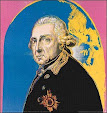
King Frederick Arrives From Minden


Frederick the Great - Minden Miniatures - shown on the new standing horse. Photos by Frank Hammond. Figures sculpted by Richard Ansell.

Well this really made my day - the announcement that the Austrian and Prussian senior generals and staff are now available from Minden Miniatures. Click Here.

I immediately bought two sets of everything with the Austrian and Prussian figures grouped into sets as follows:

Austrian Foot Command (3 senior officers on foot)

Austrian Mounted Command (Charles of Lorraine, Nadasty, and von Loudon)

Ferdinand of Brunswick (4 dismounted generals and staff officers)

Prussian High Command (4 figures: Frederick, Seydlitz, Ziethen and a dismounted ADC)


Ferdinand of Brunswick and three staff officers.

Just looking at the Prussian officers and staff on foot immediately conjures up all kinds of vignette possibilities. For example, you could combine the above group with one or more of the Minden hussar horseholders or the civilian horseholders to create a little staff meeting. Maybe add small table made from bass wood or balsa and card, print out a miniature map and spread it over the table and, Voila! Instant vignette.

Frank Hammond (Mr. Minden Himself) also announced that he has a standing horse available, in addition to the trotting horse, but you have to specifically request the standing horse when you order one of the mounted regimental colonels or else it is assumed that you wanted the walking or trotting horse. Regrettably there is no standing horse with saddle and horse furniture that one could use for vignettes, but perhaps this will be added later along with the pending 18th Century civilian range that is in the works. No problem, just make your own horse furniture with paper and green stuff and you are good to go. I will show you how to do it within a couple of weeks.

I am looking forward to adding the new Minden bling of personalities to my ever growing Minden Austrian and Prussian armies. This stuff is better than anything else on the market. Thank you Frank, and thanks to the talented Richard Ansell for sculpting these masterpieces.

Monday, July 4, 2011

Company A of the 83rd Foot


Several views of my first 12 figures for the 83rd Regiment. Figures are all from Elite Miniatures. (click to enlarge).

I got at least one company of 12 figures painted over the holiday weekend, and hopefully will have a second company completed by Tuesday evening, given that I have the next two days off from work.

I've pretty much decided that the first regiment will be the 83rd Regiment of Foot, which was part of Colville's brigade (along with the 94th and 5th regiments) in Picton's Third Division of Wellington's Peninsular army. I don't know if I will ever paint the other two regiments in the brigade, but if I eventually choose to add more redcoats, then these will be the lads that I add.

I sent off an order to GMB Designs Flags yesterday, and now that they have a web site with a shopping cart feature, ordering flags is easy peasy and so all things are tickety-boo for now.

Happy Fourth of July


ACW re-enactors traditionally lead off the Lake Bluff parade with Old Glory.

This morning I took Lady Emma Cuddleston-Smythe and her friend Lady Cecily Penshurst to the annual Lake Bluff, IL July 4th parade. It was a very hot day with the morning temperatures in the mid 80-degrees Fahrenheit, but it sure beats getting pelted by rain. The parade typically is lead by a company of Union ACW re-enactors, who stop at every intersection of streets and fire off a volley. Very stirring stuff for both wargamers and non-gamers.


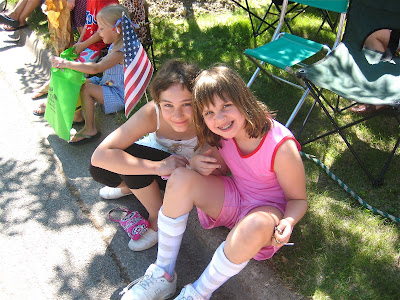
Lady Cecily (left) and Lady Emma (right) enjoy the parade

Methinks that the Ladies Emma and Cecily only pretend to enjoy the parade, as they seemed to be more focused on gathering up all of the candy that is thrown from the passing parade floats. There was a company in the parade advertising their fitness club and they were handing out free bottles of water, which proved to be a Godsend since we had not brought any water of our own.

The parade always includes some of the rediculous:


Shriners motorcycle patrol


A bear riding a Segway cycle.


The famous Lake Bluff Precision Drill Lawn Mower team ( a parody of the Shriners's motor cycle routine).


The annual theme of the Lawn Mower team focused on some of our wayward politicians in the US Congress. Ahem.


The lads were wearing plastic pig snouts. Note the newspaper headline on the lawn mower.

And it always includes marching bands and Pipe Bands, which I particularly like. It almost makes me want to go home and paint some Black Watch Highlanders.


One of two Highland bands that participated in this year's parade.

We had a fun time, but we finally had to bug out after about an hour, as we were baking in the hot sun and wanted to find some cool water for refreshment. Sometimes a small cup or bottle of water is the greatest treasure that one could find.

Afterwords, we headed home and Mrs. Fritz offered to take Ladies Emma and Cecily to the beach for the afternoon, meaning that yours truly will be heading off to the basement to paint figures for awhile.


A view of the clutter on my painting table today. It's not very tidy so I will have to do something about that soon, as I'm running out of space. You can see the first company of the 83rd Regiment of Foot in the middle of the table, with the second company in the foreground, waiting their turn to get their uniforms from the quarter master.

I am off to the painting table now. I will post some pictures of the first company of the 83rd Regiment, later this evening. So do come back later.

BTW, we are within a thousand page hits of reaching the 300,000 milestone. Thank you everyone for your continued support of my blog. I only wish that there was some way of figuring out who the 300th thousand person was.

v

Sunday, July 3, 2011

A Short History of the 83rd Regiment of Foot

Here is an excerpt of the regimental history of the 83rd Regiment of Foot taken from the web site of the Royal Irish Rangers, an amalgamation of the 27th, 83rd and 87th regiments in 1968. The 83rd does not seem to have a separate name (e.g. a county name or a nickname such the The Buffs, etc.), so if this becomes my Peninsular regiment, I don't know what I would call it. Does anyone have any ideas?

I took another peak at my stock of GMB flags and discovered an error; I did not have a flag for the 88th Connaught Rangers, but rather I had the 20th, 27th and 2/83rd. The 20th doesn't seem to have played an important role in Wellington's army, the facings of the first dozen figures painted are probably too bright of a yellow to use for the 27th (Inniskillings), so by default, that sort leaves the second battalion of the 83rd as my choice, or some other regiment with similar facings. They could still become the 88th by virtue of ordering new flags from GMB. This would entail painting a silver button color rather than a gold button color on the figures. I am holding off on this until I decide the name of the regiment. I think that I may reorder the flags anyway (as my old ones look like Grahame used a different technology in the start up days of his business, i.e. the newer flags look much sharper and natural in their color and shading, compared to the set that I have), so they could still end up being the 88th.

The first dozen figures are nearly complete, along with a mounted officer.

********************
History of the 83rd Regiment (courtesy of the Royal Irish Rangers web site)

The 83rd Regiment was raised in Dublin by Colonel William Fitch and soon saw active service in the West Indies. Thereafter they remained in garrison in Jamaica for seven years, losing many casualties from yellow fever. The 83rd had returned to Ireland and raised a 2nd Battalion to meet the expansion of the Army required by the Napoleonic Wars. In 1805 the 1st/83rd landed at Cape Town and swiftly overcame the resistance of the small Dutch force, then remained as garrison of the Cape of Good Hope until 1818.

The 2nd/83rd joined the Peninsular Expeditionary Army in Portugal in 1809. They- had before them five years of stiff campaigning with long marches up and down the length of Spain and Portugal and eventually across the French frontier, gaining twelve battle honours. One of their earliest battles but certainly the bloodiest was "Talavera". The battalion suffered in casualties over half its strength including the Colonel killed and many taken prisoner, not to be released for five years. Sergeant Major Swinburne was commissioned in the field for gallant conduct. He eventually retired as a Lieutenant Colonel some 44 years later, much honoured by The Regiment.

There followed the battle of Busaco in 1810, the storming of the fortresses of Ciudad Rodrigo and Badajoz in 1812 and the engagement at Fuentes d' Onoro (referred to by the soldiers as "Fountains of Horror"). At Badajoz Sergeant Hazlehurst saved the life of Captain Powys, the first man through the breach, by laying about him with his halberd. Hazlehurst served right through the Peninsular campaign being awarded twelve clasps to his Peninsular medal.

"Salamanca", "Vittoria", "Pyrenees", "Nivelles", "Orthez" and finally "Toulouse" were the further honours won by 2nd/83rd. 83rd’s march since their early days had been "Garry Owen".

********

I rather like it that their regiment song was Garry Owen. Harry Flashman talks about hearing this tune played by a number of infantry and cavalry regiments over the course of his travels, of course including Custer's U.S 7th Cavalry regiment. So it would appear that the use of Garry Owen might be somewhat common. Hmm, I could call it the Garry Owen Regiment.

Saturday, July 2, 2011

Campaign Attrition System

I draw your attention to Bill P.'s Major General Pettygree blog, which has posted the following campaign attrition system that we will be using to govern our campaign in Spain. It is simple to use and involves minimal record keeping:


********

New Easier Attrition System

My former system was laborious and complicated. This one will be easier! After a game throw 1D6 per unit that had losses.

1. You HOLD the field or the game is a draw recover:
1= 70%, 2= 75%, 3-4= 80%, 5= 85% and 6= 90%.

2. RETREATING FROM the field recover:
1= 60%, 2= 65%, 3-4= 70%, 5= 75% and 6= 80%.

Modifiers: (Minimum result = 1. Maximum result = 6)
Poor supply situation, July or August, poor quality soldiers -1. (only one can be used)
Arty., Engineers, Cavalry and Elites +1 (only can be used)
Captured prodigious amounts of supplies +1
-----

KIA-MIA-In Hospital Box:
Miniatures that remain casualties are placed in this box and don't come back - usually. Some will eventually return as replacements,escapees or from hospital.
-----

Reinforcements should be added before the next game.
Throw 2D6 for a big unit and 1D6 for a small one. The result is the number of replacements arriving from the homeland or back from hospital; (the KIA-MIA-In Hospital Box)
------------------

A system like the above needs to be generous so units don't become skeletal too soon and it needs to be easy on the record keeping side of things. This might do it.
----------

******

Of course now I might have to give some thought about collecting figures to build up a medical staff and have an infirmiry at the regimental barracks.

I also direct your attention to the slide show presented by Joe Dever of the Coruna demonstration game by messers Ringrose and Browning. The details and the hundreds of little vignettes are probably the best that I have ever seen, and I'm not exagerating. This collection is as impressive as the famed Bill Gaskin Peninsular collection. Click the link to TMP and then click on Joe's links to his photoshop slideshows.

Click Here