Wednesday, September 8, 2021

Punic Wars Spanish Helmet Query


The first of my Punic Wars Spanish infantry arrived the other day and I will be cleaning and preparing them for primer later this week. However, I am a bit perplexed by the style of headgear that some of the Spanish soldiers wore. The helmets have something that resembles a havelock sun covering that hangs down the sides of the helmet and also seems to cover the neck.

I’m trying to figure out if this item is some sort of horsehair decoration or some intricate metal smithing of brass for a brass helmet. You can find pictures of the headgear in question at the top of this page.

Somewhere I read that these Spanish helmets were made from sinew, which might suggest that the helmets were woven rather than fashioned out of metal.

If anyone can shed some light about these strange looking helmets, then please leave your input in the comments section below.


Monday, September 6, 2021

Painted HaT Samples


HaT Carthaginian Veterans (left) and Roman Hastati (right)


I finished painting four samples of the HaT Punic Wars Roman and Carthaginian figures over the weekend. I am happy to say that the figures were easy to paint and that this will give the project some legs for a smooth take-off.

The pictures above and below feature two Carthaginian Veterans wearing captured Roman chain mail and shields, red tunics and bronze helmets and leg greaves.

The two Roman Hastati wear white tunics, a small breast plate and bronze helmet. To economize, the Romans only wore one leg greave, on the forward left leg. Hmm, interesting.


I washed the figures in warm soapy water before applying a coat of Vallejo Grey spray primer. I really like the coverage that the Vallejo primer has and I will be using this brand of primer going forward.

The paints were largely from Reaper Master Paints, P3 and some black "craft paint", the latter purchased at Michaels Stores. I gave the skin an undercoating of red-brown and then used the Reaper Tan Skin triad (I only use the shade and the main color, usually not using the highlight color in the triad). The Roman tunics used the P3 paints Menoth White triad, although I discovered that I was out of the Menoth White highlight color, which ticked me off to no end seeing that I had just purchased a dozen P3 paints via the internet. I forgot to order the white highlight, which has more of a creamy white color to it.

Any article of equipment gets a black undercoat for starters. Then I apply some Reaper Leather Brown over the black to paint the spear shafts and shoes. The brass bits start with the black undercoat and get a coat of Vallejo Old Gold. Any time you paint metallic colors you should absolutely paint the item black before applying the metallic color.

Last evening I primed ten more Roman Hastati figures and ten more Carthaginian figures. I started on the Romans this morning and should have these done within a day, assuming that I get allocated some painting time from Herself. I try to not overdo it with painting details or extensive shading and highlighting because the purpose is to get these painted fast and onto the table.

I have made an important decision regarding the size of my infantry units. They will all be 16 figures based in two ranks. This is because each box of HaT infantry figures has 16 soldiers in it so it is easy to have one box equal to one infantry unit. The figures take up a frontage of 14-inches, in two ranks. So while the number of figures in each unit is smaller than what I would typically use, say 24 to 36 figures, the eye is fooled by the large size of the figures (54mm) and the big bases, both of which make the unit look quite large. 

Three units of infantry with 16 figures each.
Click picture to enlarge

I can do a little bit of tweaking on my rules ("Age of Rome") so that the units don't get slaughtered in melee so quickly, compared to my horse and musket period rules. Age of Rome rules use the same mechanics as my SYW and AWI one page rules.

I set up a sample table with some mock units, unpainted at this stage, to give me an idea of how they will look. I experimented with a three rank system, but I didn't like the way it looked. I'm not going for historical accuracy (whatever that is), but rather going by what looks good.

I received one of the elephants I ordered yesterday and another one is on its way. I also have five boxes of various Carthaginian/Spanish allies on order, scheduled for arrival later this week. These will include two boxes of African/Libyan heavy infantry, two boxes of Spanish allies infantry, and one box of Carthaginian light infantry. Including the Veterans unit that I am currently painting, this gives me six infantry units and two elephants to start my Carthaginian army. After these are painted, then I will order some more Romans and paint an equal number of them vis a vis the Carthaginian army. After that, I will tackle the cavalry for both sides: one light and one regular/heavy cavalry unit of 16 figures. And then after that, add some more infantry units for both sides.

By the way, the buildings shown in these pictures were made by Herb Gundt many, many years ago. Even though they were made for 28mm figures, they look fine as a backdrop for any games that I play with these armies. After all, the armies are going to be fighting in the open and not in the built up areas.


Saturday, September 4, 2021

My Next New Project - Oh The Insanity!


I am still trying to get over the post convention "blahs", which inevitably happens when one has been spending the past twelve months working on a project (in this case, my Saratoga Project for the annual Seven Years War Association Convention, held this past August).

I have not had the motivation to pick up the brushes for awhile, post convention, although I have powered my way through the painting of 18 Minden Prussian Guard Grenadiers (GG). The GGs will eventually expand to 40 figures. This latest push will see a total of 24 Guards completed. That is a little bit of progress on the painting front. I can feel that the ice is slowly melting.

One sure fire solution for the blahs is to embark on a new project. That's right, do the same thing that caused you to contract the blahs in the first place! LOL. 😄  That said, I find that a new project is usually the tonic for what ails me. 

There is a certain excitement to choosing a new historical army or armies to paint. It starts with browsing through some of your military history books and getting interested and excited about the chosen historical era. Next comes the choosing the size, scale and scope of the project. Once you have established some parameters of the project, the really fun part begins:  pouring through online catalogs of figures that will populate your new armies. Then comes the actual purchase of the figures: should I purchase everything that I need in one go? Or should I purchase one of the armies at a time or buy a few units of each side?

The Next Great Project Is Unveiled

So here it is, Hannibal and the Second Punic War. "What's this Fritz?" I hear everyone thinking. "Why aren't you doing some kind of project that involves tricorn hats?" I have always had an interest in Hannibal and there were a number of times that I almost took the plunge into the period with 28mm figures. Lately I have been reading Dan Jones' excellent book called "Crusaders The Epic History of the Wars for the Holy Lands." I will read anything that is written by Dan Jones (The Plantagents; The War of the Roses, etc.).  I suppose that my current read got me into a sword, spear and shield frame of mind and so it was an easy leap to the Punic Wars.

So here goes:

Project:  Hannibal and the Second Punic War.

Figure Scale:  1/32 (54mm) toy soldier scale.

Figures:  HaT Industrie hard plastic Republican Romans and Carthaginians.

Unit sizes: either 16 or 32 figure infantry units  and 12 to 16 cavalry units. And of course, elephants!

Scope (army sizes): 8 units of infantry which equates to two players commanding 4 units. 2 to 4 units of cavalry commanded by a third player. This results in a six player game with three players per side.

Players in the Game: three players per side for a total of six players in the game.

Research Inspiration: Tactica rules book and Warhammer's Hannibal and the Punic Wars book.

The HaT figures come 16 to a box of infantry and 4 figures in a cavalry box, selling for about $15.00 per box.  This means that I will need to buy two boxes of foot figures to make one unit of infantry and four boxes of cavalry to make one cavalry unit. The elephants come one per box and I have already purchased the two "Nellies" that I plan to have in my Carthaginian army.

This is very economical and allows me to do the whole project at a reasonable cost. I suspect that the purchase of wood bases from Litko will likely cost more than the actual cost of the figures.


Roman Hastati and Velites


Carthaginian heavy infantry

I have a pair, each, of Roman Hastati and Carthaginian Veterans primed and ready to paint. I like to paint several samples from each army before I get into the general painting of the armies. I should have the samples painted over this weekend and will post pictures on this blog of the results. Sometimes you find that after painting some samples that the figures or the painting of the figures just doesn't appeal to you. For this eventuality I only bought two boxes of Romans and six boxes of Carthaginians, plus two elephants.

I think that I will enjoy building up these armies with the 1/32 scale or 54mm toy solder size. It is similar to the 1/32 Dervish army that I painted in early 2020. I like the look of the large figures and they are very easy to paint. I can use my existing terrain of trees and maybe the Sudan fort that I scratch built. Most of my battles will be in Italy or Spain so the terrain will be green rather than a sandy desert. I suppose that I will have do Zama somewhere down the road.

I will have to keep the size of the armies small since the figures take up a bit more table space. I could also divide the 32-figure infantry units into 16-figures and keep the cavalry at 12 figures. There will be two elephants regardless of the number of units in the game. I mean, come on, who doesn't like elephants?


Saturday, August 28, 2021

The Gremlins Are Gone - Problem Fixed

My end of the Fife and Drum Miniatures website is working again so I will be able to get all orders shipped by Monday August 30, 2021. 

Thank you for your patience in dealing with the tech gremlins.


cheers,


Jim

Friday, August 27, 2021

Web Store Gremlins Are At Work

 Hello everyone. I am having a problem with the host of my webstore for Fife and Drum Miniatures and may not be able to ship some of the orders for awhile. 

The webstore appears to work and if an order is received using PayPal, then PayPal sends me a copy of your order. If you use a credit card though, I only get a notice from my provider of credit card services that I have received an amount of money, but it does not tell me who the purchaser is or what they ordered.

So bottom line, I can currently ship PayPal orders but I can not ship credit card orders until the server glitch is fixed.

If you have submitted a credit card order in recent days, then please send me an email with your information (name, address and items ordered) and I can probably mail your order.


altefritz1740@yahoo.com is my email address

Hopefully, the issue will be fixed by the end of the day, but it has been ongoing for the past two days.


Jim


Sunday, August 22, 2021

What’s Wrong With This Picture?


How many uniform and other errors can you spot in this picture? Leave your answer in the Comments section below. 

Good luck and happy hunting.

Monday, August 9, 2021

Seven Years War Association Convention Review


Major General Benedict Arnold directs Enoch Poor's brigade of New Hampshire regiments
 into the fray at Freeman's Farm.

CLICK ON ALL PICTURES TO ENLARGE

The Seven Years War Association convention was held this past weekend at the Ramada Lodge in South Bend, Indiana. I had a wonderful time presenting the Freeman's Farm game on Friday and Saturday afternoons, but I have to say that I am completely knackered afterwords and several days later, I am still feeling the effects of a lot of hard work. However, as always, it is completely worth the effort doing double duty as a game host and a vendor of figures at the show.

I heard that the attendance was over 100 people through Saturday which is a very good turn out by the members considering all of the Covid angst that we have all gone through over the past year. My congratulations and compliments go out to the two convention organizers, Ken Bunger (vendors) and Alex Burns (game masters). Ken did a good job of coaxing the usual vendors to the show (as if we needed much prodding) while Alex assembled a great line up of games. There were 34 games spread over the three days of the convention: Thursday evening, Friday and Saturday. Game themes included 12 SYW, 2 WAS, 9 AWI, 3 FIW and 8 "Other" taking place in the 18th Century. Adding the WAS, SYW and FIW together, what I consider the "Frederician Era" games totaled 17 games compared to 9 for the runner up, AWI period. The SYWA convention covers the complete era of linear warfare from post English Civil War through the American Revolution. Personally, I alternate AWI and SYW game scenarios from convention to convention so I will probably be hosting a SYW game next year.

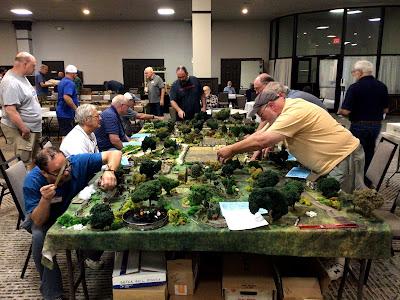
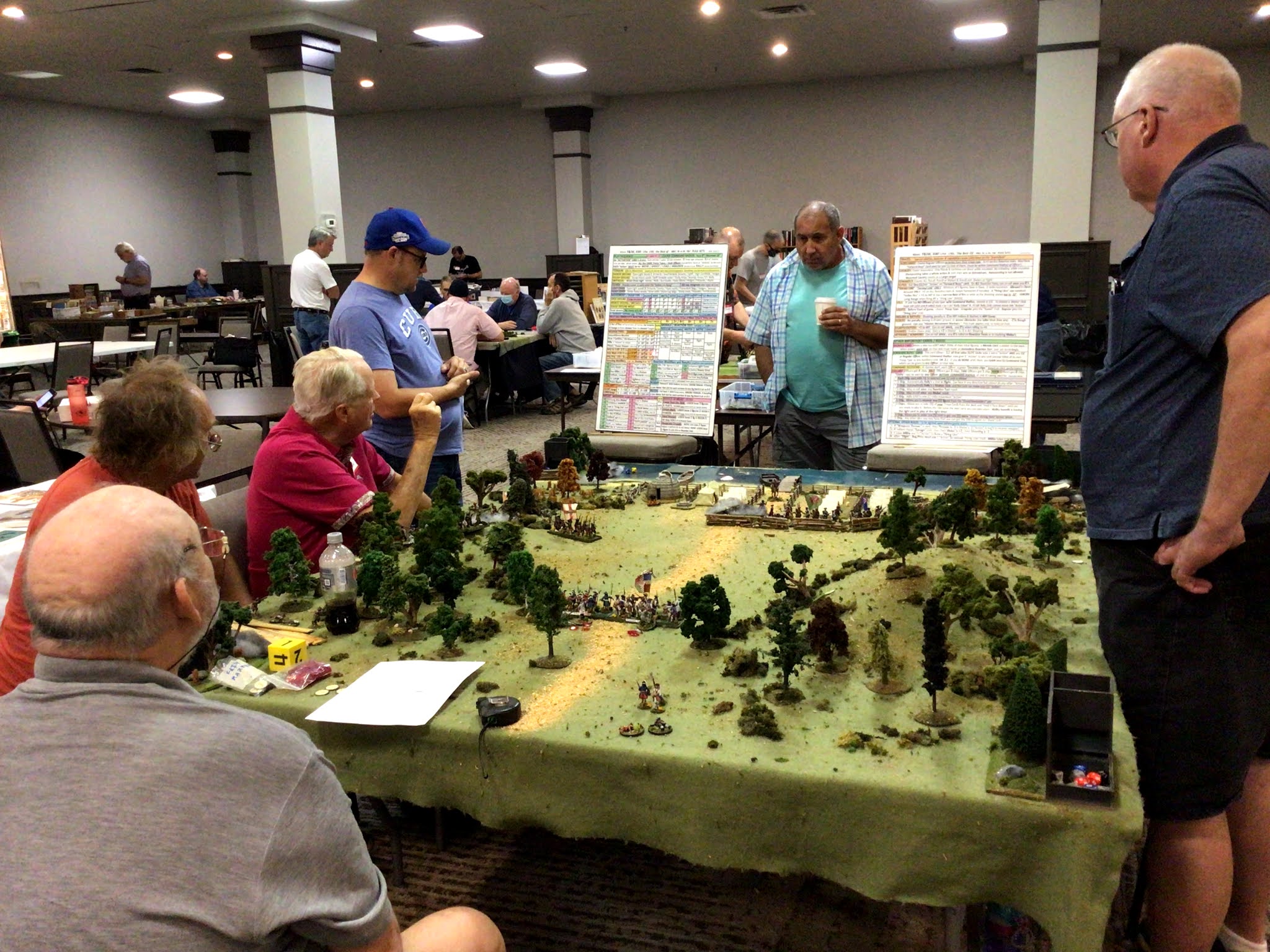
Here are some pictures of a few of the games at this year's convention.

Alex Burns' SYW game featuring huge 1:5 ratio regiments of infantry and cavalry  with 15mm figures.

Jeurgen Olk's Sugar Wars game in the Caribbean area.

Bob Moon (in red shirt) hosting one of his attractive French and Indian War games with 40mm figures.
I particularly like his use of dice towers, camouflaged in each corner of the table.

John the OFM, tankard in hand, discussing the merits of ale over still pot whiskey
with one of the  militia officers at  Freeman's  Farm


One of the FIW games featuring Black Powder rules.

My Freeman's Farm game saw the British winning the first game and the Americans the second.

In addition, we had seminars presented by Jim McIntyre (the development of light infantry theory in the 18th Century), a panel discussion about historical wargaming and its future and how to reach out to "young people", and finally, a presentation by Dr. Chris Juergen about the deployment of Hessian troops early in the AWI.

It appeared that every game was full so that indicates a high percentage of participation by the attendees. Both of my games had the full complement of players, and in fact, I had to squeeze in an extra player into both games so that all those who were interested could play in the game.

Here are several more pictures of Jeurgen Olk's Sugar Wars game. His armies have an eclectic mix of figures from Fife and Drum, Crann Tara, Front Rank and many others.


The traveling Witch Doctor does his sermon from the back of a wagon.
The building is from Miniature Building Authority.

An assortment of locals man the barricades.

And now for something completely different, pictures from my Freeman's Farm AWI game:


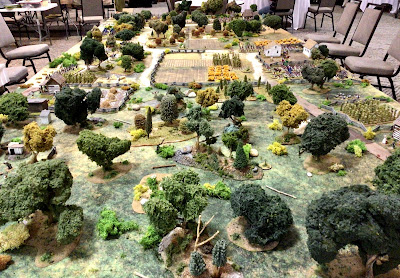
My Freeman's Farm table set before the game action begins.


Another view of Freeman's Farm. Note how the different sizes and colors
 of the trees provide a sense of realism to the scene. Most of the trees were scratch-built by Herb Gundt and RB Bases. The various K&M Trees were based by Tony Adams. The game mats are from Cigar Box Battle Mats. A few twigs and stones from Mother Nature, sourced from my backyard, are scattered about the forest floor area.


I like to place vignettes of the various farms in the corners of the game table where they won't impede the movement of troops, but they add some delightful color to the game presentation. Here are a few examples:


A view of the Coulter Farm.


Freeman's Farm. The British brigade of Hamilton is about to go tip toeing through the wheat field .

Simon Fraser's brigade of grenadiers and light companies marches past the McBride farm.

Some of the Minden agricultural workers figures are doing their job
cutting down the hay and stacking it in the adjacent field.

My John Carroll personality figure provides some intelligence about the approach of Burgoyne's army.
The blacksmith shop was scratch-built by Ed Philipps.


Let's get on with the pictures of the game{s} in progress.


Brigadier General Hamilton's brigade marches through Mr. Freeman's farm in search of the American army.

The 2nd New Hampshire Regiment from Poor's Brigade await Hamilton's attack.


The 2nd and 4th New York regiments from Poor's Brigade, defend the center of the Continental  line.

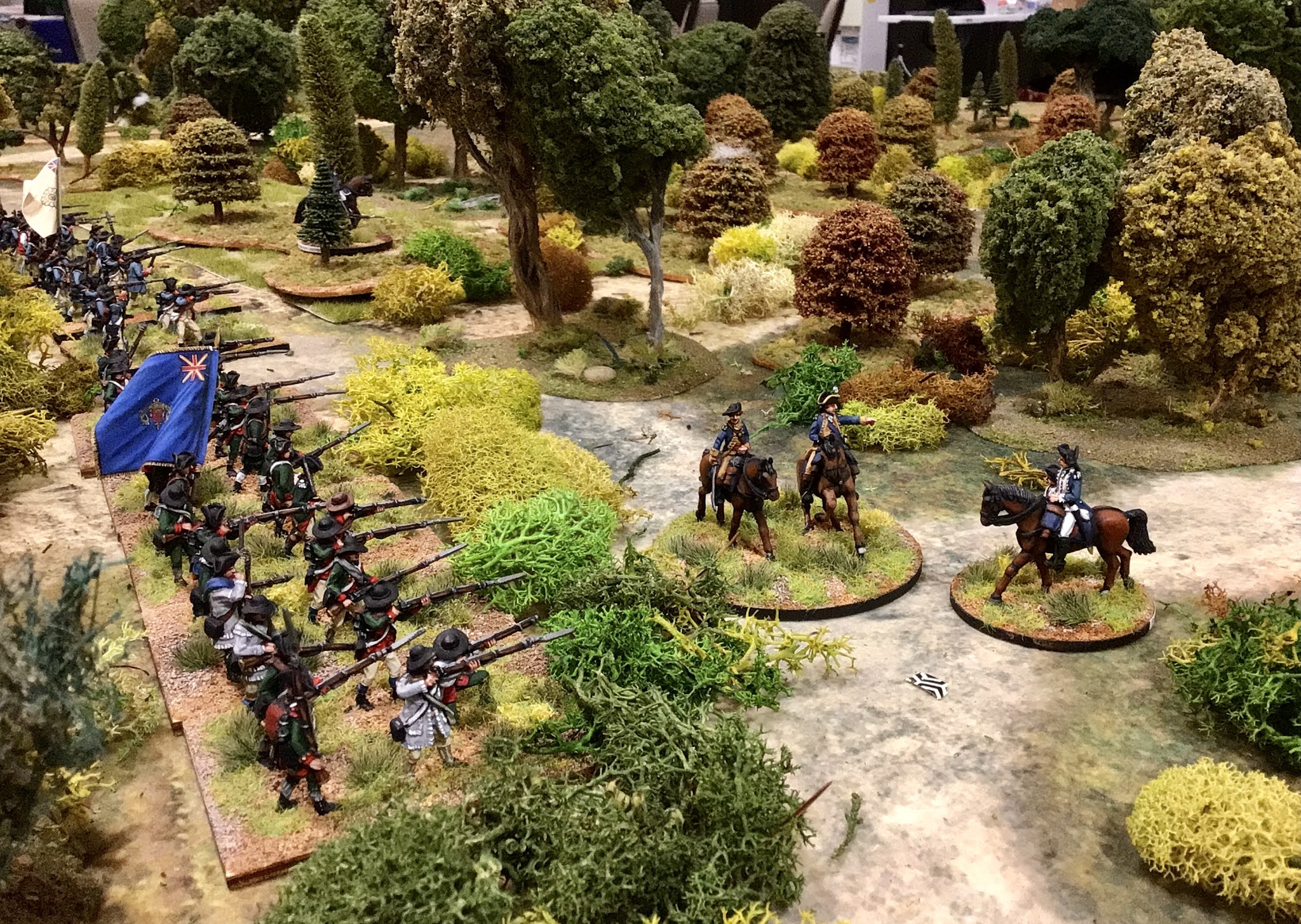
Major General (large circular stand) meets with Brigadier General Poor (left rear) and Colonel Daniel Morgan (right rear) to deploy their troops to stop the British attack.

Benedict Arnold (left ) and Daniel Morgan (right) from Fife and Drum Miniatures.
Arnold is the AC-001 Brigadier General figure and Morgan is the AC-003 General in Hunting Shirt figure.
I placed Arnold on the "heroic horse" that comes with the Minden Seydlitz personality figure. Arnold's ADC is actually the British General in Round Hat figure, painted Continental Blue rather than British Crimson.


Hamilton's British regiments attempt to break the American center in the woods.


Meanwhile, Simon Fraser's grenadier and light companies attempt to turn the American left flank at Coulter's Farm.


The players are getting into the spirit of the game. My rules are so easy to learn that the game practically goes on autopilot by the end of the second turn. I just stand around and answer questions and start the next game turn sequence.


American militia on the right flank emerge from the woods in an attempt to turn Hamilton's left flank.

Hamilton's British regiments seem to advance in the center with minimal casualties.
Not a good sign for the Americans.

Fraser's elite companies press the American left, who give ground begrudgedly.

The British scored a convincing win in the first game as they smashed through the American center with relative ease. The American left had no choice but to retire from the field, while the militia in the forest on the American right flank were holding their own. I decided to get rid of the small round skirmish stands that the British had as they were too powerful relative to their size (they needed a 1 or 2 on ) D10 dice. Each skirmish figure rolled on D10 and in one instance, all four skirmishers scored a hit against one of the Continental regiments. Now a formed regiment is often tossing four dice when it fires and it didn't make a lot of sense for four skirmishers to have the same fire power as 16 to 20 formed troops. I also reduced each of the British line regiments by one stand, thereby reducing the British units from 40 figures to 32 figures. These changes  resulted in a more balanced game in my second game.


I like this picture of General Arnold and the New Hampshire Brigade of Enoch Poor. The variety of tree types and colors plus a little bit of lichen here and there provides a look of realism, especially if you stoop to the table level and view things from ground level. Also notice the variety of figure poses in the Continental regiments. I used regulars in coats, men in hunting shirts, and some of the American militia figures (painted in regimental coats) in the Fife and Drum Miniatures figure range.


All in all, in was a successful convention for the attendees and for me as a game host.  I got an invite from the head of HMGS to stage my Freeman's Farm game at next year's Little Wars convention in April 2022. Lots of compliments came my way for the table layout and I must say that I agree with them, I had been painting figures and working on terrain since October 2020 and it seems that everything came together quite nicely. 

I did break one of my own rules, which is to not be painting figures at the last minute for the game commitment. I could very easily have used American regiments from my Philadelphia Campaign army to fill out the ranks, but I wanted to have a uniformity of basing for the Northern Army at Saratoga. I used bases measuring 60mm frontage by 80mm depth for the eight units in this army. Each American unit had 30 figures while the British had 40 figures on 80mm frontage by 40mm depth bases.

My Fife and Drum Rules for the American Revolution were a success and I have been using them, with some tweaks here and there, for nearly 30 years. The rules are printed on one side of a single 8-1/2 by 11 inch sheet of paper. The mechanics for firing, melee and morale are the same, which makes it easier for a person to master the rules in a few short turns. I want my convention gamers to be able to focus on their tactics rather than worrying about the rules. The rules address this issue and result in a fun game for the participants.


zzz


zzzz