Thursday, August 4, 2016

Rules for Engagement 1898 Omdurman Campaign


I found this interesting excerpt in a book titled, Khartoum Campaign 1898 by Bennet Burleigh, in which the author discusses the preparations that the British army made for its campaign to capture Khartoum/Omdurman in 1898. While Kitchener was the overall commander, he delegated command of the British brigade in his army to Major-General William Forbes Gatacre, who brought his command into such a great state of fitness and preparedness that it was able to march 140 miles in a week.

Click on the link below to read the on-line version of the book:

To prepare for eventualities, and clench the special training he had bestowed upon his men, Major-General Gatacre issued a printed slip of notes, or hints, to his men. I give the salient points of that production:—

"1. As the strength of a European force lies in the occupation of and in movement over open ground, which gives it advantage of fire, so the strength of a dervish force lies in fighting in depressions of the ground, or in a jungle country out of which they can pour suddenly and quickly their thousands of spear-armed warriors, who, unless checked by a murderous fire, constitute a grave danger, even to a perfectly disciplined force.


"It follows, then, that a force halted for the night must always be protected where possible by a zereba, which will check under fire the attacking dervishes.


"2. That a cleared zone be prepared along outer edge of the zereba.


"3. That a force, when moving, should march at a respectful distance from jungle cover.


[Pg 25]"4. It should have the ground in its front and on its flanks searched out by cavalry, mounted infantry, or native levies.


"5. That when mounted troops have found the enemy, they must invariably clear the front of the infantry to enable the latter to use their rifles.


"6. That brigades must be so trained that each battalion and individual soldier must know how to get into the best formation with the least possible delay for meeting the attack of the spearmen, who, it must be remembered, can move at least three times as quickly as a British soldier can double.


"To carry out the above, a high standard of training and steadiness is required, and battalions must be provided with a liberal supply of cutting tools, felling axes, hand axes and bill hooks to enable them, the instant the battalion marches into bivouac, to cut down small trees or strong branches of prickly trees with which to construct a thorn fence.


"Piquets must be withdrawn at dusk, otherwise they might get surrounded and cut off, or, in falling back, would possibly suffer from the defenders of the zereba.


"The protection of the zereba against surprise must depend on the vigilance of its sentries and piquets which line the fence, and whose strength will naturally depend on the proximity of the dervishes to the force. With reliable information, and the ground properly reconnoitred, a patrol of ten men per company, patrolling constantly and noiselessly along the inner edge of the zereba, is adequate, so long as the enemy's dem is say 15 miles distant (a day's march); when nearer than[Pg 26] this, the strength of the piquets to remain awake and under arms will depend upon the circumstances of the moment.


"All night duties of this nature should be found by companies, so that portions of the line along its whole length shall be on duty. Words of command and orders must be given in a low tone; there must be no shouting and no fires burning till the hour arrives for making the morning tea. Men should always be allowed to smoke, but should be warned of the danger of fire in zereba by a cigarette or match-end thrown into dry grass.


"Officers must sleep immediately behind their men; a certain number will always be on duty.


"All, officers and men, must sleep in their clothes, boots and accoutrements, and each man must have his rifle with him. None but sentries' should be loaded, and bayonets should not be fixed, even by the patrols, except when there is expectancy of attack. Under no circumstances should men sleep with their bayonets fixed, or serious accidents will occur.


"And here, one word about 'alarms.' I do not refer to the assembly by bugle sound, but what is ordinarily called a panic, in other words a disgraceful absence of discipline and self-control, which, while ruining the reputation of the corps concerned as a reliable battalion, may be the cause of serious mischief, and must be disastrous to the confidence the General Officer places in its officers and men.


"One of the great advantages accruing to an army on service is the close association of the officer with the[Pg 27] man; each learns something from the other, and the officer will, in after years, appreciate the value of the habit he gets into of talking to his men and of storing up in his mind all sorts of dodges and hints, which assist troops in the field to make themselves comfortable; more than this, it is in the field only that the officer can get the opportunity of instilling into the men's minds the necessity for deliberation under fire, the high standard of the regiment, its past history, its superiority in everything to all other regiments in the division, and his confidence in his men to maintain such a standard of excellence. In many expeditions it has happened that shots have been fired at nothing, night after night, thus disturbing the whole force; such bad habits must be firmly checked."


kkll

A Surprise At the Oasis of El-Dubie


The company of Sikhs at the point lead the patrol towards the oasis


We last saw the scouting patrol moving ever so slowly and carefully towards the Oasis of El-Dubie, its mission being to find and recover the body of Colonel Barlow. As the column closed within site of the Oasis they spied what looked like civilians milling about the desert water well. Everyone was on edge as they moved in for a closer look.

Here is what the patrol found at the Oasis of El-Dubie:

Who could that be in the red tunic with his arm in  a sling?

An Arab wearing a red headscarf emerged from the mud hut followed by two burly henchmen, each holding an arm of what appeared to be a hostage. The henchmen wore the brightly colored cloth patches of the Mahdi's Ansar warriors, so caution was taken.


The Arab waved at the patrol as if to indicate that he wanted to talk to the British. The man in the red tunic raised his one good arm over his head and waved to the column.

Colonel Fred Burnaby, the leader of the patrol, looked through his spyglass and exclaimed:

"Good God, it's Barlow, and he's alive!"

(more of the details in our next posting tomorrow)

Wednesday, August 3, 2016

The Scouting Patrol

The head of the patrol column with one company of Sikhs deployed on the point in skirmish formation.

Colonel Sinclair's patrol column of infantry was surrounded by three layers of protection designed to tripwire any potential Dervish ambush while it made its way towards the Oasis of El-Dubie.


The first ring of protection was the company of Sikhs who were deployed in skirmish order at the head of the column.

The second ring was formed by elements of the Camel Corps, which deployed behind the Sikhs as well as on both flanks of the column.

The 21st Lancers formed the third layer of protection, deployed on the flanks and rear of the column, but not as distant as the Camel Corps troopers.

The general idea was for either the infantry on the point position tor the mounted camel corps on the far outside layer tripping the ambush wire. If the Dervish broke through the first tripwire, then the ring of 21st Lancers would be available to buy enough time for the Sussex Regiment to deploy and fend off any serious attacks on the column.


Overhead view of the column depicting the layers of protection.
Behind them comes elements of the Camel Corps deployed along the flanks of the column.


Next in line are four companies of the Sussex Regiment.

The pack camels with supplies come next.


Looking at the column from the rear.
And finally, bringing up the rear are more of the 21st Lancers.


The infantry companies appear to be fairly well protected from any potential Dervish ambush. However in the Sudan, things are not always the way they look. A quiet and peaceful landscape may be full of unpleasant surprises for the unwary.


All the while, the column is being observed by Beja riflemen hidden in the thickets of Acacia trees and behind rocks. Their commander orders the Beja to let the British column pass unharmed.


dd

Tuesday, August 2, 2016

Barlow's Square


Barlow's square contracts as its losses pile up. Note that a troop of the 21st Lancers has taken refuge inside the square after losing a melee to the Dervish - it was the only safe place to go. CLICK PHOTOS TO ENLARGE.

In reviewing some of the photos that I took of the Battle of Tokar, I thought that those of Barlow's square were particularly good and worth a second look. My favorite picture in the series is the one that I posted at the top of the page, as the square began to contract as the losses began to mount up.

A picture of Barlow's full square early in the game:


Barlow's full square early in the battle, consisting of Royal Marines, Sailors and the Black Watch Highlanders (all figures shown are Britains and John Jenkins Designs figures.


The fate of Colonel Barlow's square
The last stand of the Black Watch at Tokar.

Some people have wondered, what happened to Colonel Barlow? Did he perish along with many of his men? That was the conventional wisdom once the remnants of the brigade made it back to the fortified camp at Dongala. However, Major General Pettygree wanted to find out for certain, so he ordered Colonel Sinclair to form a reinforced patrol of horse and foot to make another attempt at reaching the Oasis of El-Dubie. Pettygree's thinking was that perhaps the Dervish would take less notice of a smaller patrol than they would if a whole brigade of the Imperials marched back to the oasis.

The rescue patrol

The picture above illustrates the composition of the rescue patrol.

4 companies of the Sussex Regiment (khaki)
1 company of Sikhs (red coats)

5 Camel Corps mounted troopers - for scouting purposes
1 squadron of the 21st Lancers (approximately 12 figure)


Return or revisit this blog over the next several days to find out what the column found.

Saturday, July 23, 2016

Battle of Tokar July 23, 2016


The first game turn commences as the British gain a free move.

A long view of the center game table.

My new basing system for toy soldiers: sticking the figures to MDF bases with tacky mounting putty reduces the number of figures that have to be moved each turn.

We fought our first battle in the Sudan using 54mm toy soldiers for the first time in what proved to be a unique experience for all of us. The large figures provide a new perspective on wargaming that is quite evident in all of the pictures posted on this thread. Please double click each picture to enlarge the view and look at all of the details up close

Major General Pettygree in full 60mm splendor with his escort of Skinner's Horse (figures are from King & Country )

The British Nile River Column had established a base camp at Dongala on the Nile and had orders to advance on the town of Tokar and capture the water wells at El-Dubie.


Two squadrons of the 21st Lancers provide support to the British squares.


Petty rides between the squares and reviews the troops prior to the battle.

I spent several hours the night before cutting up pieces of sticky mounting putty and attaching it to the bottom of many of the figures on the table, but not all of them. The figures were then mounted on temporary MDF wooden bases in groups of 6, 8 or 10 figures in order to reduce the amount of time consumed by moving individual figures all game.

We had problems keeping the horses standing upright throughout the game as the slightest touch seemed to knock them over dominoes style. One of the players stopped trying to pick them up and keep them on their hooves, preferring to lay the horses on their sides on the ground. I need to come up with a solution for mounting the horses to MDF bases for future games.


Winston Churchill, ever seeking the spot light, leads the charge of the 21st Lancers against the Beja.

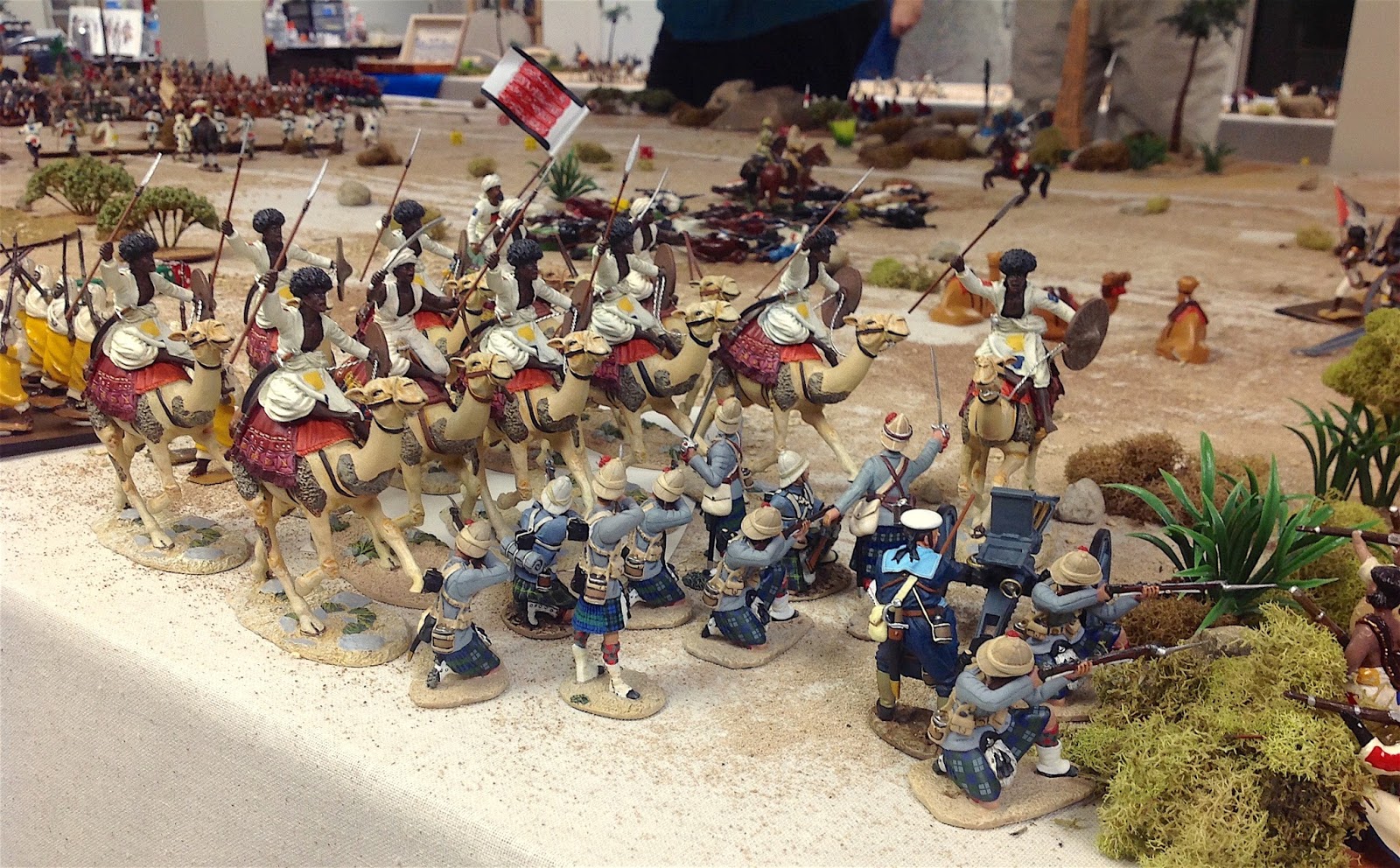
The 21st Lancers prepare to charge the Yellow Flag hoard of fierce Beja (Fuzzy Wuzzies) warriors and Ansar dressed in jibbahs with brightly colored patches.

Turn 2 and the Dervish get right down to business and charge the 21st Lancers.
 Early in the game, the British squares were making good progress in their advance on Tokar and the El-Dubie Oasis. With Barlow's square leading the way on the right, and Sinclair's brigade following on the left, in tandem the two brigades could support each other with fire. However, Sinclair got distracted by Beja riflemen and a swarm of Arab desert levies that were piling up casualties on his brigade. So Sinclair stopped the forward movement of his brigade and engaged the Arabs, but in doing so, became separated from Barlow's brigade and could not support Barlow when the Dervish cavalry swarmed all over him. I believe that had Sinclari (me) kept pace with Barlow, then the outcome of the battle could have been quite different.


Later in the game, the same group of Beja (now significantly reduced in numbers) charges at the camels of the Camel Corps.
 As it was, Sinclair was busy driving off the Green Banner Desert Arabs, nearly wiping them out, and then a Red Banner of fierce Beja suddenly appeared on this left, while simultaneously, another banner of Arabs suddenly appeared on his right. Sinclair reasoned that if he moved forward to support Barlow, then both brigades could get cut off from the base camp along the Nile.

Another view of Colonel Sinclair's brigade square.

The second British square was comprised of the Marines, the Naval Brigade and some Gordon and Black Watch Highlanders. They are advancing on the Oasis of El-Dubie to capture the water wells.
 Bill P. is the owner of the second brigade of British soldiers - I don't recall the name of his brigade commander so I am just going to call the commander Colonel Barlow

Dervish horsemen converge on Barlow's Brigade, which begins to contract due to casualties.

A band of Ansar over run a 7 pounder of the Royal Artillery late in the game.
Like sharks smelling blood in the water, more and more Dervish cavalry descend upon Barlow's brigade and look to swarm over it.

Some elite Dervish cavalry of the Khalifa launch a charge into Barlow's square and break through
Barlow's brigade was overwhelmed by a sudden onrush of Dervish cavalry and foot. The surviving Marines and Sailors fell back from the broken square and attempted (successfully) to form a new rally square.

However, this left the remaining Gordons - only ten of them - to fend for themselves, as they made a heroic last stand in the Oasis of El-Dubie. This reminds me of the last stand at Maiwand.


The Last Stand of the Gordons at El-Dubie. Quite a stirring and heroic picture.


While Barlow's brigade was in trouble, General Pettygree ordered Sinclair to fall back to the encampment and the protection of the artillery, both on share and from the river gunboat.


So in the end, it was readily apparent to all that the Dervish had won a convincing victory over the Imperials. One brigade was nearly destroyed and Sinclair had lost almost half of his brigade during the fighting withdrawal back to the camp. Undoubtedly, the newspaper headlines were not going to be kind to General Pettygree and his commanders. One suspects that Fleet Street would play up the heroic Last Stand of the Gordons and celebrate heroes rather than dwell on the loss.

Concluding Thoughts About the Game

We used a Colonial variant of Bill Protz's "Batailles dans l'Ancien Regime" or "BAR" for short. All eight players were familiar with the rules and so the game moved along very smoothly, even with several hundred single figures that had to be moved. I was glad that I had used the adhesive putty to mount a number of Dervish and British figures onto movement bases.


The Dervish started the game with approximately 470 figures versus 248 for the British. There were some comments on TMP and on my blog that the Dervish needed a higher ratio of figures to the British contingent, something like 3 to 1 or higher. This is not the case in BAR though, as the rules produce quick and bloody results, which means that an advantage in the size of forces can result in crushing the opponent with relative ease.

I wiped out the Green Flag command early in the game, and so we recycled that command into the game again. Thus the Dervish added another 50 or so figures to their original number. The British needed all the machine guns and cannon and men that they could get their hands on.

One unusual thing happened to me during the game: all three of my machine guns jammed on the same turn, but then all three jams were cleared on the next turn. Really bad dice were mitigated by really good dice.

Please feel free to leave any comments and thoughts that you might have about this game, as I'd love to hear what you think about it.

It is late at night right now and I have to get to bed, but I have more pictures and need more time to tweak the story a bit more, so come back again tomorrow and catch up on the changes.

We all had a blast playing this game. I bet that I hadn't played a game with toy soldiers since I was about 10 to 12 years old. This was the first time that my collection of 54mm figures had ever been in a battle, so it was fun to see them all fighting it out for the first time.

Rest assured that there will be more toy soldier battles in the future and that Pettygree and Sinclair will march again.

UPDATE

Please check out the Campaigns of Major General Pettygree to find out what happened to Colonel Barlow's brigade at the battle of Tokar:

http://generalpettygree.blogspot.com/2016/07/54mm-battle-of-tokar.html


Friday, July 22, 2016

Lancers, Lots of Them Captain

Vintage Britain's Regiments of All Nations: converged unit of Indian Lancers,  Egyptian Lancers and British Lancers.


One more day to go until we launch the grand toy soldiers in the Sudan game. The final rosters for the game look something like this:

Dervish infantry - 396 figures
Dervish camels - 28
Dervish horse.  - 70

Dervish Total.    - 474 figures

British & Allies   - 200 foot formed in two brigades of 100
Lancers.            -48 formed into four squadrons of 12 horse

And possibly a surprise appearance or two for the British.


The British have established a substantial base at Dongola and now that they have had a build up of forces, Major General Pettygree, commander of the River Column, has decided that it is time to implement the next phase of the campaign and seize the water wells at the Oasis of El-Dubie.

The Mahdi has dispatched his most trusted commander, the Khalifa, the organize an attack on the British base at Dongola and drive the unbelievers into the murky Nile River.

We will have 8 players in the game: 6 Dervish He-Devils and 2 British players ( Bill P. & Me).

There should be gobs of pictures taken during the game so be sure to check in on the blog and see what is happening .

Thursday, July 21, 2016

Two Squares Are Better Than One - 3 Days to Go!


1st Brigade Square - Trophy Miniatures - Sinclair's Brigade

Two squares of British with machine guns on the corners and cavalry watching the flanks makes for a formidable defense against the Dervish (CLICK ON ALL PIX TO ENLARGE THE VIEW)
I decided to clear off my game table for yet a third time and see what the table would look like with two squares of British faced off against the Dervish. I also wanted to check out the spacing required for the squares to make sure that we have enough maneuvering room for the forces.

We are down to three days before the epic toy soldiers in the Sudan game takes place and I am getting very excited about the game. The pictures of two squares on the table should give you an idea of what the game might look like.

Here you can see two squadrons of lancer cavalry protecting the flank and rear of the British squares.


Hot air balloon view from overhead. This demonstrates how two squares can support one another with  rifle fire and machine guns. You can see how vulnerable the corners of the square are, which is why the machine guns are placed there. However, the adjacent square offsets the weakness of the corner by providing covering fire. Squadrons of Lancers patrol the flanks to keep the enemy away from the rear and corners.
The picture above reminds me a bit of the aeriel views shown during the movie Waterloo, when the French cavalry are surging around the British squares. This time it is angy Dervish who are doing the surging.


Two bands of Dervish launch an attack upon the squares.
Some reinforcements arrived in the mail today, for both sides. The Dervish received nine mounted horsemen to augment the cavalry while the British received a brace of machine guns to man the corners of a square. I hope that those guns don't jam!

A brace of machine guns arrived today to reinforce the British: Gatling Gun (left) and Maxim (right)

Some new Dervish cavalry that have recently joined the Mahdi (from Trophy of Wales).
A view of the game tables and my game room. I think that the Union Jack flag gets one in the mood for a good  old fashioned Colonial Bash with big 54mm toy soldiers.


Another pictue of the Trophy square. Note the dismounted camels in the center that represent the baggage that follows the square. They also provide a barrier in the event that the Dervish break into the square.


Come back tomorrow for more pictures.