Showing posts with label Russian Cavalry. Show all posts

Sunday, September 15, 2024

SYW All-Cavalry Battle Part II - the Heavies


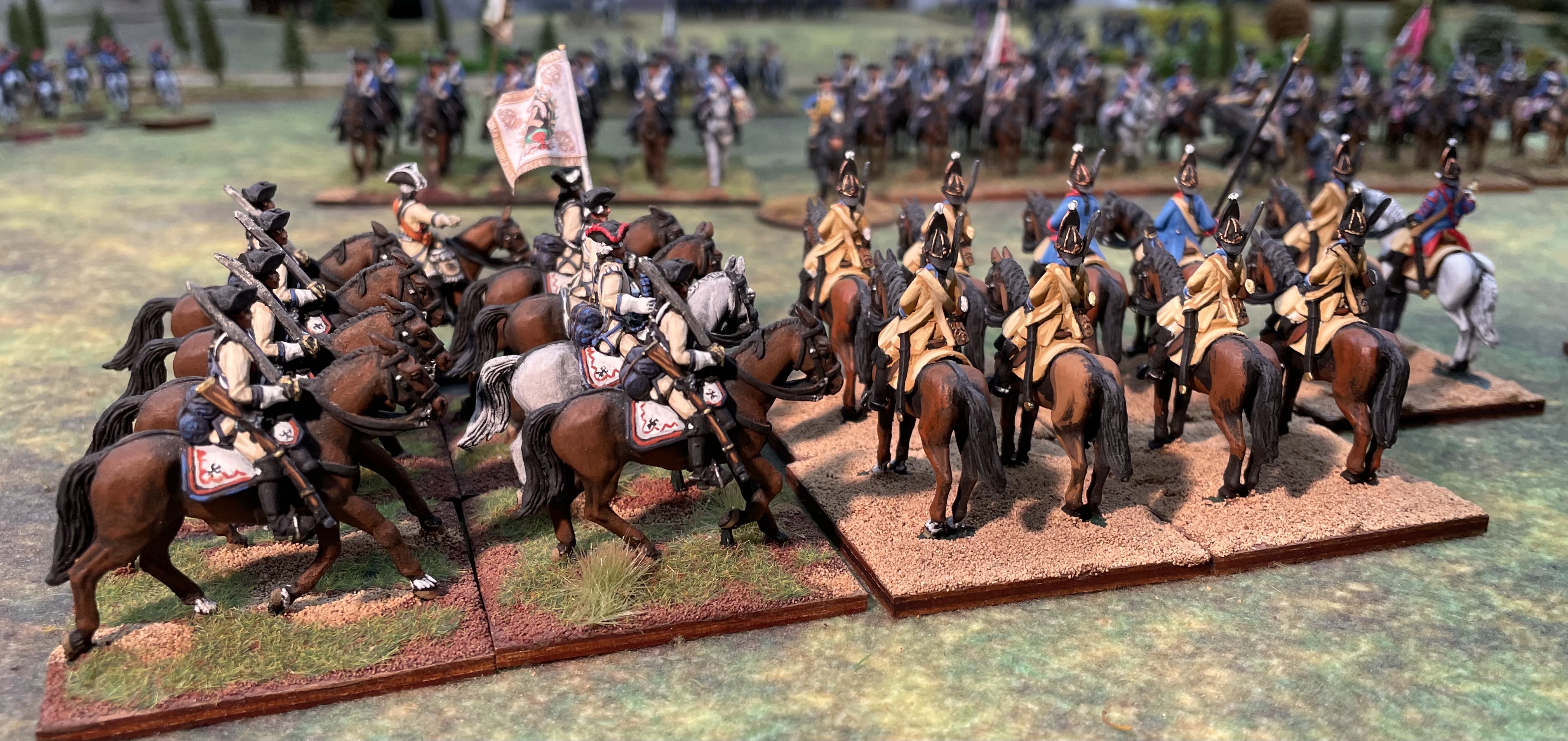
Prussian cuirassiers (backs to camera) and Russian cuirassiers (facing the camera)
chop, hack and thrust one another in a grand melee. Minden Miniatures exclusively.


CLICK ON THE PICTURES TO ENLARGE


I finally got around to finishing my SYW battle that featured only cavalry and no infantry. In Part I of this report, the Prussian and Russian light cavalry forces came to blows in a meeting engagement. The Prussians were able to drive back the Russians and take possession of the key land feature called the Kammin Heide.

The Cavalry Rules

One of the benefits of staging an all-cavalry battle is that it gives your cavalry melee rules a good work out. I haven't used my Der Alte Fritz rules in quite awhile so it took me awhile to remember what to do mechanically and discover why I made the rules the way they are in the first place.

I did not like the way that my cavalry melee rules with respect to (1) the sequence of charging and counter-charging; (2) some of the morale elements; and (3) the rallying and pursuit mechanics in the rules. As a result, I developed a number of tweaks to the rules that I feel should make for a better game, going forward. After I make all of the rules changes, I will post a new version on the Fife and Drum Miniatures web site so that readers can download copies for free.

Notable and likely changes will include charge declarations without the need to roll for morale to see if the squadron will actually charge. Both sides should just automatically go into melee when one side or the other declares a charge. The only exception will be if the defending cavalry unit has been "caught at the halt" position.

My original rules only allowed for one round of melee in order to speed up this part of the game. However, for an all-cavalry game, melee is all that the squadrons can do so I increased the number of melee rounds in a melee to two rounds of combat. After that the possible outcomes are (1) tie, both units retire a full move back to their own lines and are disordered for a full turn, (2) loser routs and winner rolls a D6 to see if it will pursue, or (3) winner halts in place and becomes disordered for a full turn, unless it is rallied by a leader.

In order to rally, I now allow a squadron of cavalry to remain in place, neither moving or charging, for one turn after which it returns to a good order state. Units can also attempt to rally by moving a leader into contact with the unit and attempting a rally dice roll (it's about a 50-50 chance of success) so most players will likely opt to rest their cavalry for a full turn and not risk the possibility of a rout if it attempts to use the dice rally mechanism in the rules.

The Heavy Cavalry Battle Report

Part II of the cavalry battle featured the arrival of the heavy cavalry brigades for both armies, so we are talking dragoons, horse grenadiers and cuirassiers in this battle. The Prussians started the battle with the terrain advantage since they held the high ground and were well positioned to bottle up the arrival of the Russian heavy cavalry. The map believe depicts the terrain features and locations of key locations on the tabletop terrain. This is the light cavalry map and I apologize for not having a similar map for the heavy cavalry action.


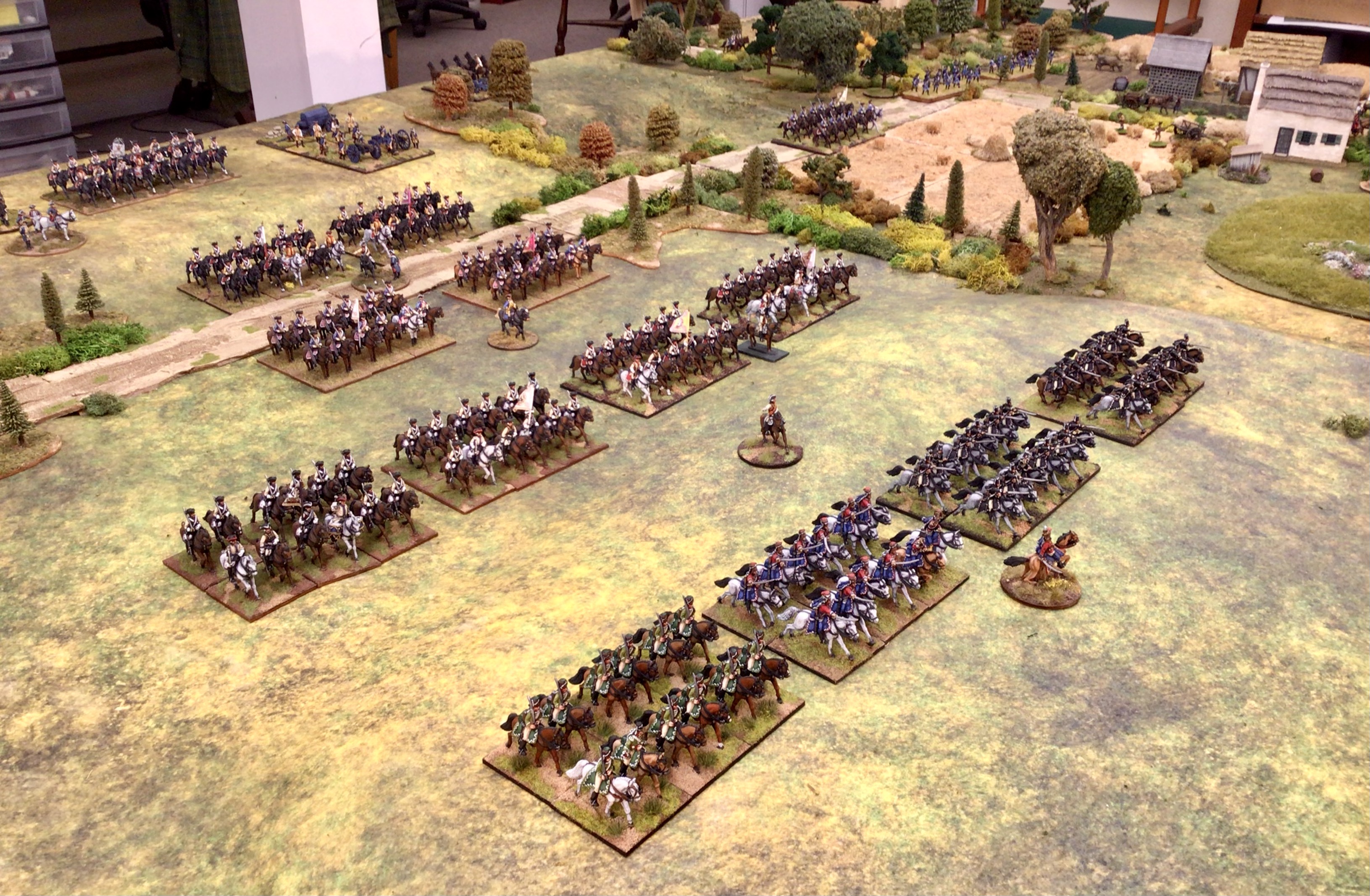
The Prussians begin the game with their dragoons deployed on the high ground called the Kammin Heide. They are supported by a second line of cuirassiers hidden behind the ridge. There are a few remnants of light cavalry hussars milling around the flanks of the Prussian position. The Prussian cavalry commander, yes Him, is Lt. General von Seydlitz. His plan is to lure the Russian cavalry onto the Kammin Heide and then surprise them with a counter attack from the hidden Prussian cuirassiers.

The Russian heavy cavalry is entering the table on the hill where the remnants of their hussars and Cossacks are shown on Map 1.


I place a couple of light infantry units on the table for both sides, but these were 
really placed there "for looks only" and did not contribute to the battle.
Here we have some Prussian Frei Korps troops, using a mix of Mindens, 
Fife and Drum Hessians and some AWI Continentals, converted by paint.


The initial deployment of the Prussian heavy cavalry regiments. Hussars in the first line
 (right hand side of the picture), dragoons in the second line and a third line of Cuirassiers


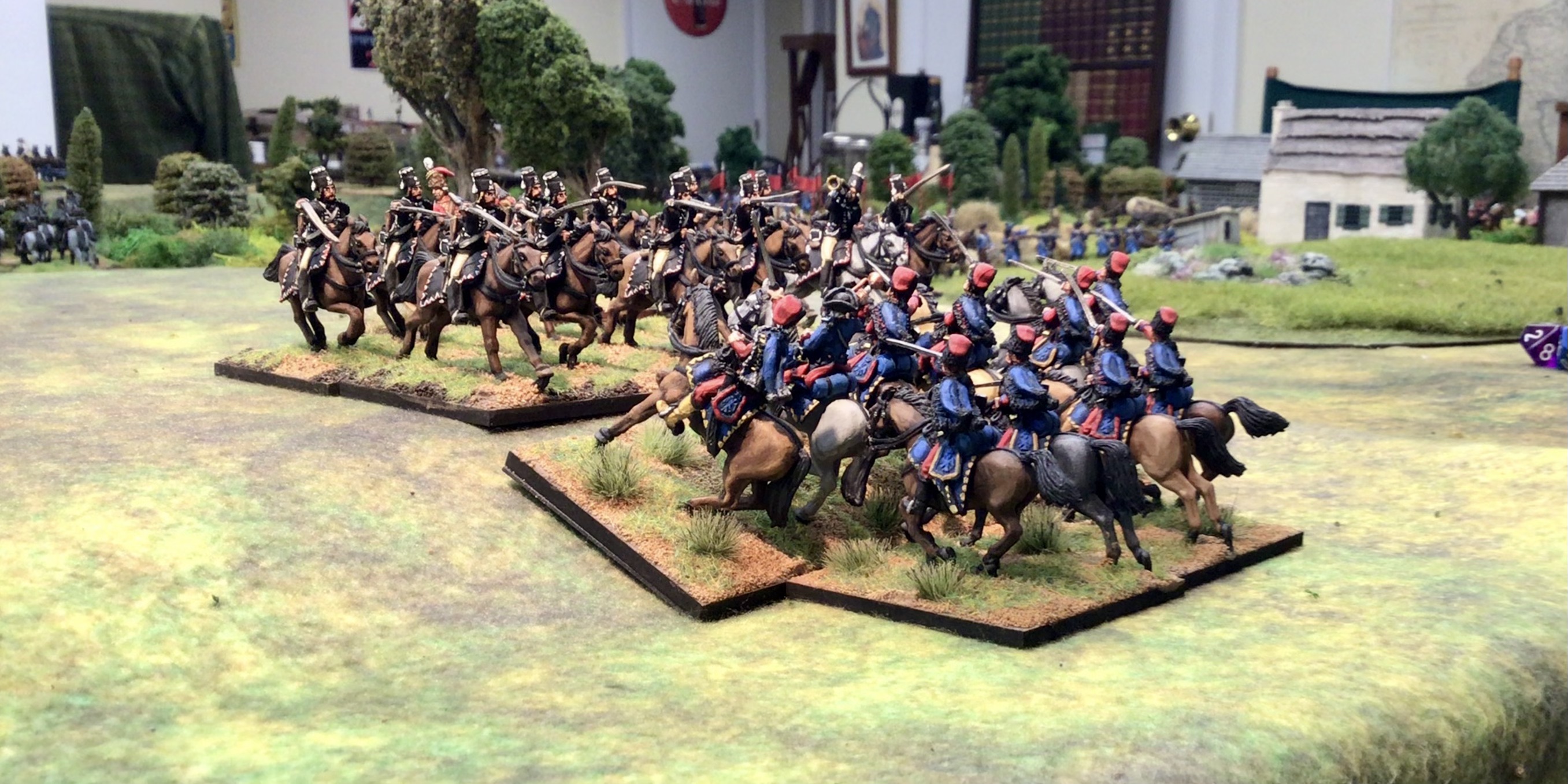
Some left over light cavalry from the previous game: Prussian Black Hussars (L)
and Russian Yellow Hussars (R)

Russian Horse Grenadiers and Cuirassiers charge

Russian cuirassiers provide support to the Horse Grenadiers

But wait! Prussian CR8 Seydlitz Cuirassiers seemingly come out of nowhere
and charge into the flank of the Russian Horse Grenadiers. This demonstrates
the advantage of winning the initiative die roll at the beginning of each turn.

Closer view of the Prussian flank charge.

We get even closer.


It's a bad day for these particular Russians as they get cut down by
the Seydlitz CR8 cuirassiers.


Prussian dragoons advance at the trot looking for someone to melee with.

Many individual squadron melees erupt all over the Kammin Heide.
Such action is typical of cavalry melees in my rules. The Black Hussars in the 
right foreground have Lt. General von Zeiten attached to the squadron to give
them a morale boost (one extra D10 in a morale dice throw).

Russian Cuirassiers finally seem to have an advantage over their foe: cuirasses vs no cuirasses.

Alas, the worst possible melee morale throw. All that the Russian cuirassiers
needed was anything but a "ten' (or double zero) on just two of the three dice.

Post melee, some of the Prussian squadrons have to fall back towards their own
lines, in disordered status, where they will recover in two turns.


Some of the non-viable Prussian squadrons have been removed from the table. Now there is 
a more open look to the battlefield. When a cavalry unit is down to only two stands
 (out of six to start with in a squadron) then it is removed from the game.


Russian heavy cavalry squadrons fall back to reform, hoping to deter the 
Prussian cavalry from making any further attacks.

After ten game turns I decided that the cavalry of both sides was knackered and ready to call it a day. The butcher's bill saw the Prussians losing 34 of 60 figures from their squadrons engaged, and they also had 24 more cuirassiers that were held back in a third line and were unengaged in the battle. The Russians registered 36 casualties out of a starting total of 84 figures and all of their forces were engaged.

At the end of the day it looked like neither side was in good enough condition to carry on the cavalry battle, although the Prussians had a substantial reserve of 24 cuirassiers that they could have committed to a renewal of the battle. Doing a little bit of free kriegspeiling in my head, it seemed reasonable that even as bold a cavalry general as von Seydlitz would have decided that further charges would not result in any significant gain. Thus von Seydlitz, who held the initiative in the battle, decided that his cavalry had done enough for the day. The Russians were likely grateful to see an end to the cavalry battle, but they were confident that they still had enough viable squadrons to stop the Prussians. So they too broke off the fight and reformed on top of their hill.

Perhaps some Russian and Prussian infantry will come up and renew the battle on the 'morrow. Who knows?


cc

Tuesday, July 11, 2023

New Minden Russian Cuirassier Greens


I am excited to announce that the greens for the SYW Russian cuirassiers are finished and are on their way to Griffin Moulds to get the figures into production. My thanks go out to Steve Barber for sculpting the figures and keeping to the style of Richard Ansell's Minden sculpts.

The Russian cuirassiers include an officer, standard bearer, trumpeter and trooper. The three command figures will be sold in one pack and the troopers will be available in a pack of three figures.

My thinking is that Russian Cossacks will be next on the docket and these additions should complete the Minden SYW Russian figure range.

SYW Russian Cuirassier


Russian cuirassier musician


Russian cuirassier standard bearer


Russian cuirassier officer


Friday, October 9, 2020

Showdown With Some Cossacks

Russian Cossacks catch some Prussian Jagers out in the open.
 

The is a story about the demise of the ill-fated Prussian Jager regiment at the hands of some Russian Cossacks near Spandau. The following excerpt comes from Kronoskaf's history of the Prussian Jager zu Fuss;

Prussian Jäger History

In 1756, the unit took part in the invasion of Saxony and was present at the blockade of Pirna between September 11 and October 16. On December 1, the unit received a reinforcement of 46 men.

On February 5 1757, the unit was organised into two companies. On March 1, it received a further reinforcement of 3 officers and 100 jägers; bringing its total strength to 300 men. On November 22, the unit took part in the Battle of Breslau where it was deployed en potence to protect the right flank. On December 5, at the Battle of Leuthen, the unit was deployed on the left in the first line of the infantry centre. 

In the Spring of 1758, the unit took part in the invasion of Moravia and, from May to July, in the Siege of Olmütz where it was deployed in General Mayr's Brigade, on the opposite bank of the Morava to cover the road to Silesia. During the retreat from Moravia towards Silesia, the unit was attached to the rearguard and took part in several actions. On October 10, the unit took part in the Battle of Hochkirch where it was initially deployed in Manteuffel's Corps, in the village of Lauske, on the extreme left flank of the Prussian positions. 

On October 10 1760, the unit was decimated by the Russians at Charlotteburg. 

In 1761, a new unit of 4 companies was raised in Berlin and Wittenberg.

On July 21 1762, the unit took part in the Battle of Burkersdorf where it was posted on the right wing in the woods to the south-east of Hochgiersdorf.

I set up a vignette of this action on my game table, but the outcome was substantially different. As Bugs Bunny would say, "aren't I a little stinker?" The Russian Cossacks are RSM figures that I have mounted on Minden light hussar horses. This demonstrates the complete compatibility of RSM and Minden figures. The Jagers are Minden figures, of course. In this instance, the Jagers have managed to retreat into the somewhat questionable light cover, but will it be enough to stop being skewered by the Cossack's lances?


Russian Cossacks catch the Prussian Jagers, who have retreated into the woods.

In this instance, the cavalry rides to the rescue in the nick of time. The Prussian Ziethen Hussars (H2) have emerged from behind the woods and have caught the Cossacks in the flank. It's a trap!

The Prussian Ziethen Hussars hit the Cossacks in the flank!


But wait, there's more! The Bosniaken lancers also come out of hiding and hit the other flank of the Cossacks , who are likely doomed (he, he, he, he).

The Bosniaken arrive and charge into the left flank of the Cossacks .

The Bosniaken were often brigaded with the Black Hussars during the Seven Years War. Click the link below to view the Kronoskaf history of the Bosniaken.


A good day for the Prussians.

Fritz's Painting Table

I plan on moving more Bosniaken up near the top of my painting queue because I only have one squadron of 12 figures and normally have two 12-figure squadrons in my cavalry regiment. My Ziethen Hussars are in the same position so they need 12 more figures in their regiment.

The painting mojo ebbed away at the conclusion of the Sudan Project battle a couple of weeks ago. It is not easy painting 28mm figures after painting the larger 54mm plastic toy soldier figures nonstop since March 2020. I am forcing myself to work on some Prussian infantry and power my way through the painting wall. I figure that the more 28mm figures I paint, the sooner the painting mojo will return.

So here is what is in the painting queue at the moment. These are units that are either primed or partially painted:

  1. IR1 Winterfeld Prussian musketeers (42 figures)
  2. H7 Yellow Hussars (12 figures)
  3. Saratoga British regiment (36 figures)
  4. Bosniaken lancers (12 figures)


xxx

Thursday, September 24, 2020

Minden Russians On Parade Review


Minden SYW Russian Musketeers on parade.
(click all pictures to enlarge )


The Sudan Project is winding down and I wanted to get some SYW troops onto the game table. So the table was cleared of Khartoum (which was actually moved to its own 6ft by 7.5ft table) and Dervish figures; and then I set out all of the figures in my Minden Miniatures SYW Russian army.


Russian generals and staff are trying to figure out which road to take.


Russian musketeer brigade with its ammo wagon.

Minden SYW Russian artillery crew and cannons.


Minden Russian Musketeers wearing their green coats (front battalion only).

Minden Russian grenadiers wearing their green coats.

Minden Russian Horse Grenadiers in Summer waistcoat
order (right) and in regular uniform coat (left)

Close up view of the Russian Horse Grenadiers wearing just their waistcoats.
Their blue coats would have been left with the baggage train. Officers, however, continued
to wear the blue uniform coat.


Russian Cuirassiers. These are actually Minden Austrians painted in Russian colors.

One good reason to display all of the units in a particular army in your collection is to see what might be missing and require painting. The Russian parade made it apparent to me that I needed to add 1 to 2 Observation Corps musketeer battalions, one battalion of Russian grenadiers in summer waistcoats, 1 to 2 more battalions of line musketeers wearing waistcoats and a similar number wearing green coats. And finally, the cavalry inspection revealed that the second squadron of the Yellow Hussars needed to be painted. A few more 3-pound battalion guns would look nice too.


It looks like I have my work cut out for me over the next several months.

Thursday, December 12, 2019

Russian Horse Grenadiers in Summer Waistcoats


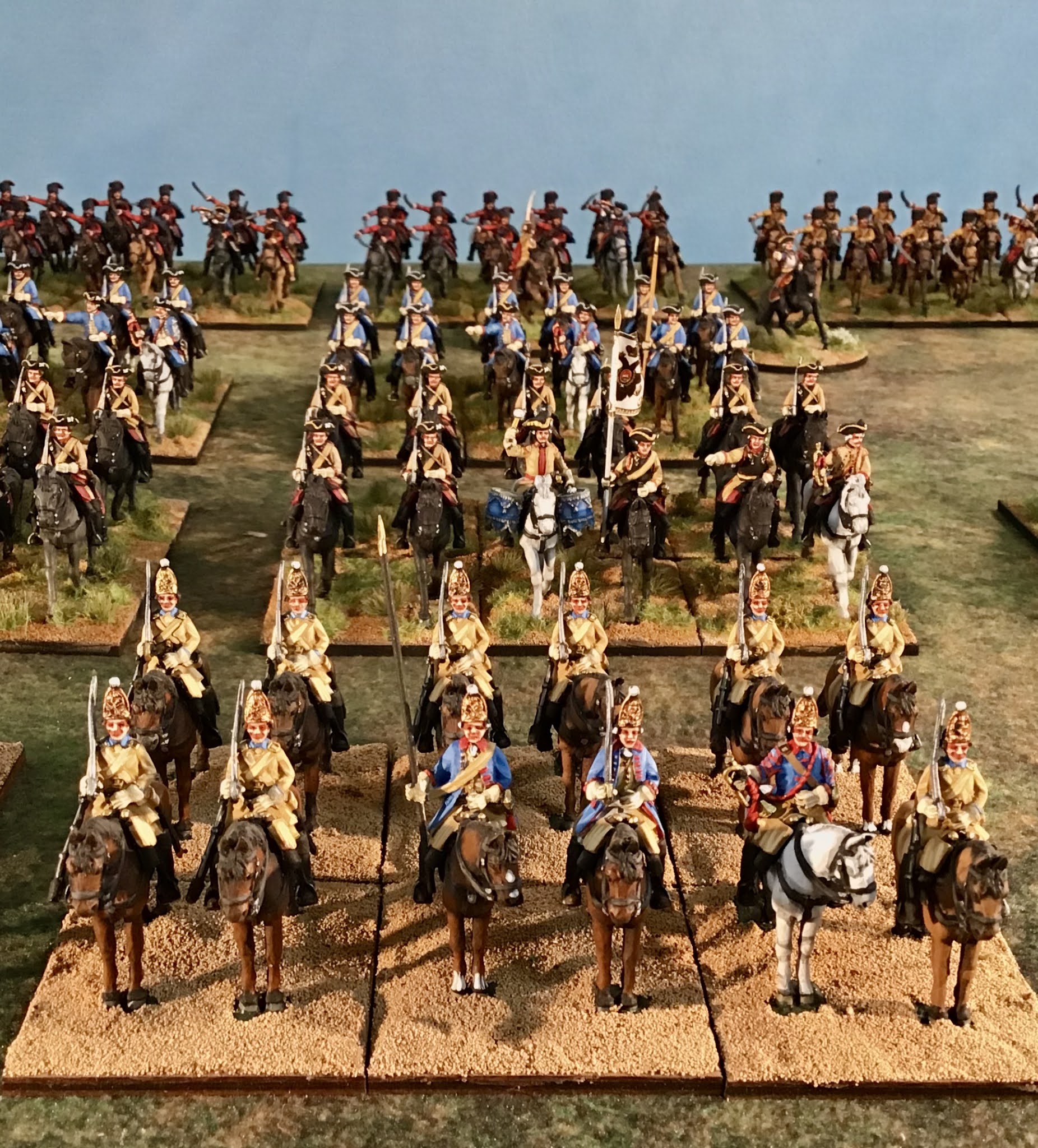
Russian Horse Grenadiers in Waistcoats. The officers always wore their blue coats.
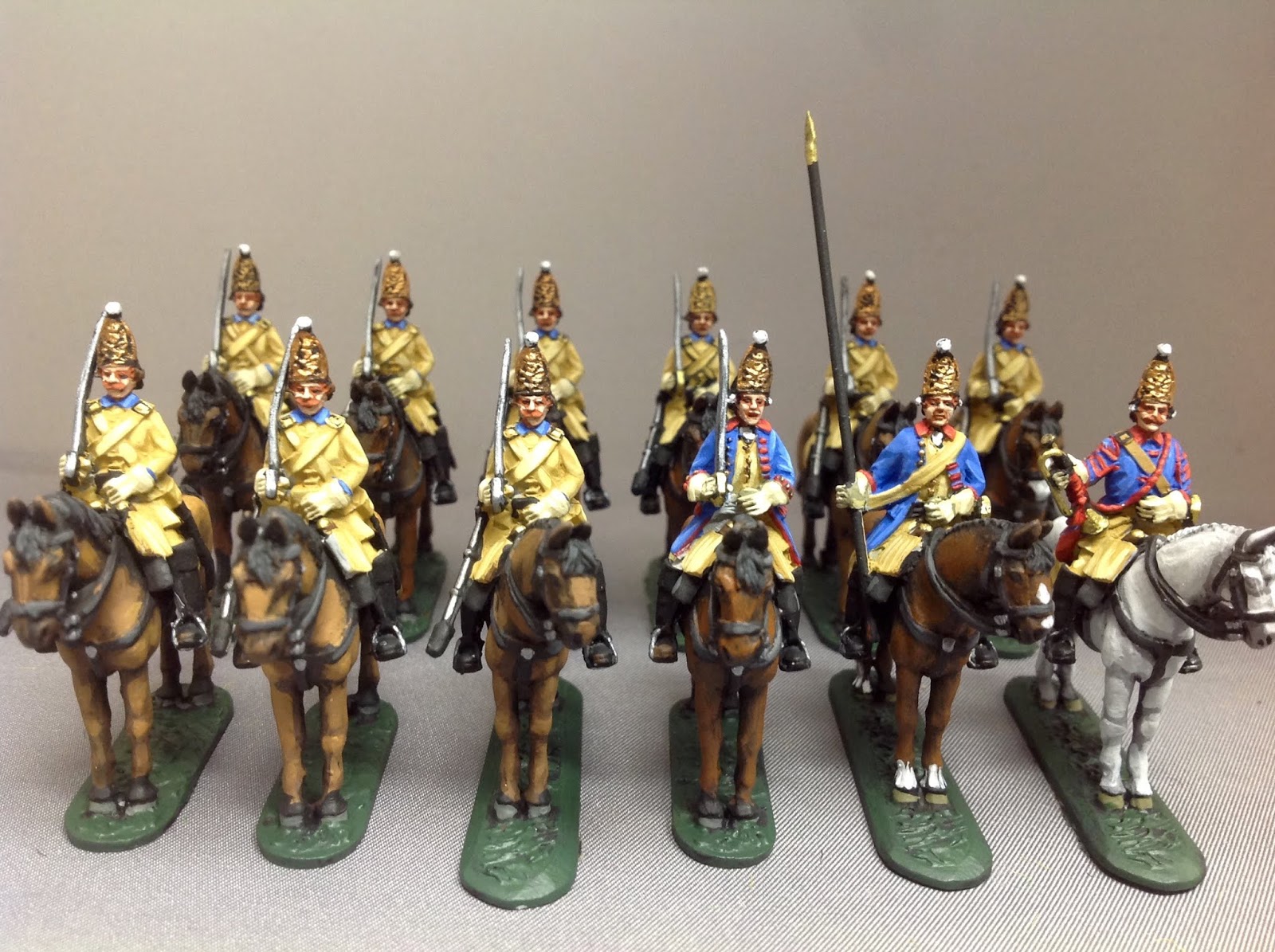
I finished painting a 12-figure squadron of the new Minden Russian Horse Grenadiers in Summer waistcoats. The regiment can be made using one pack of MRC-006 Horse Grenadier Command (officer, standard bearer and musician) and three packs of MRC-008 Horse Grenadiers in Waistcoats (3 per pack). If you are more interested in the rank and file wearing blue coats, then select MRC-007 Horse Grenadiers to fill out your unit.

The buff colored waistcoat with blue cuffs and collar is an attractive uniform and provides a nice contrast to the regular blue coats worn by the horse grenadiers and dragoons. During the Summer campaign season all of the cavalry shed their coats and fought wearing the sleeved waistcoat, even the cuirassiers.

The officers and musicians always wore their regular blue coats regardless of the season, I suppose to make them easier to see by the rank and file cavalrymen.


I ordered some 2-inch square bases from Litko and will have to wait until they arrive before I can attach the horse grenadiers to the bases, two horse per base, or a 1-inch frontage per horse.

So which regiment are these fellow? It doesn't matter, they can be any regiment because all horse grenadiers wore the same uniforms and there were no regimental distinctions.


Sunday, November 3, 2019

New Minden Russian Horse Grenadiers


New Minden Russian Horse Grenadiers Samples


I have been busy painting samples of all of the new Minden Miniatures SYW figures that were recently added to the range. Today I present pictures of the Russian Horse Grenadiers. The new product codes for the figures are as follows:

MRC-006     Russian Horse Grenadier Command (3 figures w/ horses)             $18.00

MRC-007    Russian Horse Grenadiers in Regular Dress (3 figures w/ horses)   $18.00

MRC-008    Russian Horse Grenadiers in Waistcoats (3 figures w/ horses)        $18.00


The three figures on the left comprise the command pack MRC-006, the second figure from the right in waistcoat comprises the MRC-008 pack of three figures, and the figure on the far right is the MRC-007 pack.


Information about the organization and formation of the Russian Horse Grenadiers can be found on the ever-reliable Kronoskaf web site:


The horse grenadier regiments were formed in 1756, just before the start of the Seven Years War. Six former dragoon regiments were converted to horse grenadier regiments. Five of the six regiments fought in the SYW. While the regiments had a nominal organization of 5 squadrons, typically only 3 squadrons were "at the front" while the other 2 remained at the depot as garrison troops.

Kronoskaf notes that the horse grenadier regiments had two 3-pound cannon that were served by men from the Russian artillery, but usually fielded one cannon on campaign.

In late 1758 (sometime after the battle of Kunersdorf) the horse grenadiers replaced their helmets for tricorn hats, thus resembling Russian dragoons save for the color of the horse furniture -- fawn yellow or buff for horse grenadiers and blue for dragoon regiments


The first picture, below, shows the command pack for the horse grenadiers. The officers and musicians in the regiment always wore their regulation cornflower blue coats, in Summer as well as the rest of the year. The rank and file horse grenadiers would shed their blue coats during the Summer campaign season and wear the long-sleeved waistcoat.

Russian Horse Grenadier Command Pack - Product Code  MRC-006

The next picture depicts the standard horse grenadier uniform with the cornflower blue coat. There are three figures with horses in the pack (despite there being only one figure in the picture - I haven't painted the others yet, but will soon). The product code for these figures is MRC-007.


The third pack of Russian Horse Grenadiers (MRC-008) contains three rank and file horse grenadiers wearing just their long sleeved waistcoats. The waistcoats were a buff color and were adorned with blue collars and blue cuffs. The waistcoat opened down the center and was secured by eye-hooks rather than buttons.


The horse grenadier figure in just the waistcoat is not commonly seen in other SYW Russian figure ranges. Wargame Foundry is the only range that comes to mind with regard to having the Summer kit figure in its range. I think that the figure is rather handsome and will look very nice in a unit with buff troopers and cornflower blue officer, standard bearer and musician.


I use 12-figure squadrons in my SYW armies, so in the coming weeks I will paint one squadron wearing the regulation blue coat and a second squadron wearing the summer waistcoat.

Cuirassiers and Cossacks are in our plans in the not too distant future.