Showing posts with label AWI; Fife and Drum Miniatures. Show all posts

Sunday, August 9, 2026

Trenton Game Report


Washington crossing the Delaware River to attack the Hessian garrison at Trenton


Yesterday Earl K and Bill P. of our Fab Four wargame group convened at Schloss Fritz to play my Battle of Trenton. The fourth member of the Fab Four, Keith L., was a combat casualty and couldn't attend.


The Fab Four (minus one) playing the Battle of Trenton


Earl and Bill played the American side, as division commanders Sullivan and Greene, respectively, while I handled the command of the Hessians (boo, hiss!). The Trenton scenario accommodated 8 players at Historicon with each player commanding a brigade of three American regiments or a regiment of Hessians. For this game, I scaled the game down so that each player commanded a division of three brigades. My wargame "regiments" of 30 figures represented a "brigade" in this game rather than a regiment. Because the American forces were scaled down I reduced the three Hessian regiments down from 50 figures to 40 figures.

We used my Fife and Drum rules for the game and the players understood the rules by the end of the second turn. I have been using my Fife and Drum rules since about 1994 so they are battle tested and have stood the test of time. These rules are FREE to download at the Fife and Drum Minitures web store. Click on the link below to access and download the rules. There is also a file that includes "designer notes" that provide some additional background for how to play the rules.

Free AWI Rules


Here are some of the game pictures. I will let the captions tell the story. Click on all of the pictures to enlarge them for better viewing.


The quiet town of Trenton in the dawn hours of December 26, 1776
Things are about to heat up as the Americans form up for the attack.


Fermoy's American brigade forms up to attack the Hessian flank.


The Hessian Rall Grenadiers conducted a fighting retreat towards the safety
of the Bordontown Bridge. Alas, they didn't make it.


Glover's Continental brigade of Massachusetts troops fight their way into 
the town and attempt to cut off the Hessians' only avenue of retreat at 
the Bordontown Bridge.


Lord Sterling's Virginia troops attack down Queen Street which is defended
by two companies of the Rall Grenadiers . Meanwhile, two oblivious civilians
are shoveling snow (lower left).


South of the town, the von Knyphausen fussier regiment fends off the
attacking Continentals. Eventually they are surrounded and have no
choice but to surrender and lay down their weapons.


The Rall Grenadiers make a last stand in front of the Bordentown Road bridge.
They eventually routed and ran across the bridge and into the welcoming arms
of part of Glover's brigade where they surrender.


The Americans attacked at dawn, but contrary to history, Colonel Rall had called his troops to arms and so the Hessians were formed up in the town and ready to fight. The Americans outnumbered the Hessians nearly 3 to 1 and the outcome was never in doubt. The Hessians were required to fight it out for at least four game turns before they could make any attempt to retreat across the Bordentown Road Bridge to safety. The Hessians held off the Americans for eight turns before they capitulated.

The Hessian fusilier regiment von Lossberg defended the eastern side of the town but they were cut to pieces by the Americans. The Rall Grenadiers split up into two wings: the left wing defended the River Road and King Street while the right wing defended Queen Street. The von Knyphausen fusiliers deployed on the open fields to the south of the town and kept two brigades of Americans at bay until the last turn (turn 8) of the game. They were cut off and likely would have surrendered. The Rall Grenadiers performed a splendid fighting withdrawal from the center of the town to the Bordentown Roae Bridge. However, American troops had a big advantage in numbers over the Rall Grenadiers, who eventually routed.

All in all, it was a cracking good fight with the Hessians selling their lives dearly as they fought inside the town. You never know how fighting in built up areas is going to turn out in a wargame, but this one played out easily which made it all the more fun.

A big thank you goes out to the Fab Four inaugurating my new and improved game room. This time I swear that I will keep the game room neat and tidy.


Miss Bella (aka "Trouble on Four Legs") welcomes you to the newly updated game room.


The seating area of my game room.


With the 250th anniversary of American independence, I plan on hosting many more AWI games in the Man Cave. I might even revive the South Carolina Campaign to generate new battles in the South.

Saturday, July 4, 2026

Fife and Drum Miniatures Challenge Coin


Since it is the 250th Anniversary today of the Declaration of Independence I want to introduce the Challenge Coin that I will be handing out to players in my games at Historicon. These are 1.75-inches in diameter and are colored in enamel. The front side features the Fife and Drum logo and the reverse mentions the anniversary of the United States.

Post-Historicon I plan to give away free coins to Fife and Drum and Minden customers for all orders of $50.00 or more. If these are well received then I will make another challenge coin with the Minden logo.

Happy July 4th Holiday to all of my blog readers.


Jim

Tuesday, June 30, 2026

British Artillery Vignette for AWI


Minden Miniatures Agricultural Workers Set figures carrying ammunition 
from a British ammo wagon

I am working on several vignettes to include in my Historicon games in July. The components of the ammunition cart vignette are not all painted or based yet, but I wanted to show a work in progress photo.

It is difficult taking good pictures on winter terrain. Everything is too dark even though I am using extra lights to improve the lighting.


British battery of 6-pound guns


vvv

Sunday, June 28, 2026

Lt. Colonel Charles Mawhood


Lt. Colonel Charles Mawhood
Fife and Drum Miniatures


Here is a picture of the command stand for the British commander at the Battle of Princeton, Lt. Colonel Charles Mawhood (pronounced "Ma-Whooo-D"). One of the books that I read mentioned that his dog accompanied him into battle. 

The mounted officer is the Fife and Drum Miniatures Briish mounted officer wearing a round hat. The dog is from one of the Perry Miniatures AWI vignette sets of figures.

I have not done the snow basing for the command stand yet.

Click on the link to the brief biography of Mawhood on wikipedia.

Charles Mawhood Wikipedia bio

ccc


Saturday, March 14, 2026

How I create an AWI regiment - 2nd New Hampshire


The 2nd New Hampshire regiment at Trenton 1776
Fife and Drum Miniatures

I recently finished my eleventh American regiment for Washington's army at Trenton in 1776. It is the 2nd New Hampshire regiment commanded by Colonel John Stark (he of fame at the Battle of Bunker Hill).

I eschew having my AWI regiments consist of all the same or similar poses in the regiment. Why? Because an irregular, casual regiment with a mix of uniform colors and types, plus a multitude of figure poses creates the right look for American Continental armies of the American Revolution.

Using my new off-the-painting-table 2nd New Hampshire I thought that I would show you how I mix up poses and uniform styles (conventional military jacket, hunting shirt, and civilian militia clothing) to create a unique and diverse looking wargame regiment for the AWI.

Continental Regulars poses

Fife and Drum Miniatures American Continentals figures in assorted poses
suitable for a firing line of figures.


The uniforms of almost every Continental army regiment would typically be a mix of soldiers wearing uniform coats of blue or brown color; a variety of colors for trousers/pants and vests/waistcoats. In fact, it was common for different companies in a regiment to have different uniforms. This could be due to what color of coats were available (if any at all) when the company was raised, or whether a company had just received new replacement uniforms for the coming year or they were wearing last year's uniform jacket. Trousers and waistcoats could be white, tan, khaki, brown, blue or something else. That being the case, why not paint some of the figures with brown coats and some with blue coats? The same holds true for trousers. So you could have two Continentals standing side by side wearing the same blue coat, but one of them wears white/grey trousers and waistcoat while the other wears brown trousers with his blue coat. Mix and match the colors to your heart's content.

Hunting Shirts

Hunting shirt clad Continentals on the left, and Morgan's Riflemen on the right.


The Fife and Drum Miniatures figure range has Continentals in both marching and firing line poses. These can be augmented with figures from the Morgan's Rifles set of figures. The former have tricorn hats and the latter wear round hats. Hunting shirts were worn early in the war before a system of uniforms and cloth colors was established. They might also be worn by troops along the frontier or in the Southern Colonies, where state governments did not have the funds to outfit their regiments in uniform coats.

My 2nd NH regiment has five figures wearing hunting shirts. I wanted to have a few of them, but not too many because I want the regiment to be predominantly clad in jackets.

Militia or Civilian Clothing

American militia figures in round hats, loading and firing muskets.

The two kneeling firing figures in the picture above are cast wearing a sleeveless waistcoat and long-sleeved shirts. I painted the shirt the same color as the vest as a "conversion with paint" to give it the appearance of a long-sleeved jacket. Note also the mix of light blue, one green and one brown jacket in the set


American militia wearing round hats, advancing.
Note the one figure wearing a brown coat versus the light blue coat of the other figures.

American militia in round hats, firing. There is also one figure wearing a tricorn hat.
Note that two figures have brown coats and three figures have light blue coats.


These figures are the same pose from the Armed Civilian pack of  figures.
They are cast wearing waistcoats and long-sleeved shirts. I simply painted the shirts the
same color as the waistcoat to give it the appearance of a jacket.


Putting It All Together 

After all of the figures are painted it then becomes a simple task of mixing up all of the different poses onto your figure bases. For the most part, no two figure poses are side by side in the pictures.


Blue uniform coast, hunting shirts and brown uniform coats in the same unit.

I wanted the majority of the figures to be wearing round hats rather than tricorn hats.


The final result is a rag tag looking American regiment that seems informal and has a diverse number of figure poses.

That's my style.

Monday, February 23, 2026

Introducing the Rall Grenadier Regiment at Trenton


Hessian Rall (not von Rall) Grenadier Regiment at Trenton in 1776.
Fife and Drum Miniatures figures in 1/56 scale (approximately 28mm)


Click on all images to enlarge

I have been very busy with my Trenton 1776 Project, accumulating a lot of painted Continentals - ten regiments as a matter of fact. At an average wargame figure size of 30 figures per regiment, that is 300 figures in my newly painted Trenton Winter Army. I decided to paint entirely new American and Hessian armies for Trenton and base the stands in Winter snow, rather than using my existing armies with their green grass bases.

A couple of weeks ago I finished 20 Hessian Jagers and while there were only about 60 Jagers in total at Trenton, I decided that the Hessians needed a few extra figures in their wargame army so that I could have at least two Hessian game players versus four (maybe five) American commands. As a result I painted 20 Jagers which equates to 200 men using my standard figure to man ratio of 1:10.

Rall Grenadiers (top) and American Continentals )bottom). 

Next I turned my attention to the Hessian regular regiments. The army will have the Rall Grenadiers, (50 figures)  and the von Knyphausen and von Lossberg fusilier regiments (40 figures each). Poor Colonel Rall apparently didn't qualify for "von Rall" status, just "Rall".

Grenadiers are more interesting to paint so I started with them:

The Rall Grenadies pose in the town of Trenton. I have ten figures on each stand.
Buildings, trees, fences and roads were made by Herb Gundt.

Fife and Drum Miniatures Hessian grenadiers in firing line poses (first and second ranks).
I use a deeper base for firing line units to protect the extended muskets. 60mm deep by 80mm long.

So as of today I have 20 Jager, 50 Rall Grenadiers and two 6-pound cannons, each with four crewmen. I can swap out the cannons for Prussian 3-pounders. I don't want the artillery on both sides dominating the tabletop game.

And finally, I finished the personality and command stand for Colonel Rall.

Colonel Rall at Trenton.  I used the von Knyphausen personality figure and the 
Hessian Jager officer holding a telescope for the command stand, which is 
approximately 40mm round. We are looking up King Street towards the Continental
artillery in the distant background.


For my fusilier regiments I plan to paint one unit marching using the Minden Prussian fusilier figures and one unit of fusiliers in a firing line pose. The latter will be conversions using AWI torsos and SYW fusilier heads. If there is enough interest, I might add the Hessian fusiliers to the Fife and Drum figure range.

ccc 

Tuesday, April 15, 2025


Freeman's Farm war game staged at the Seven Years War Association convention
several years ago. Fife and Drum figures, of course.

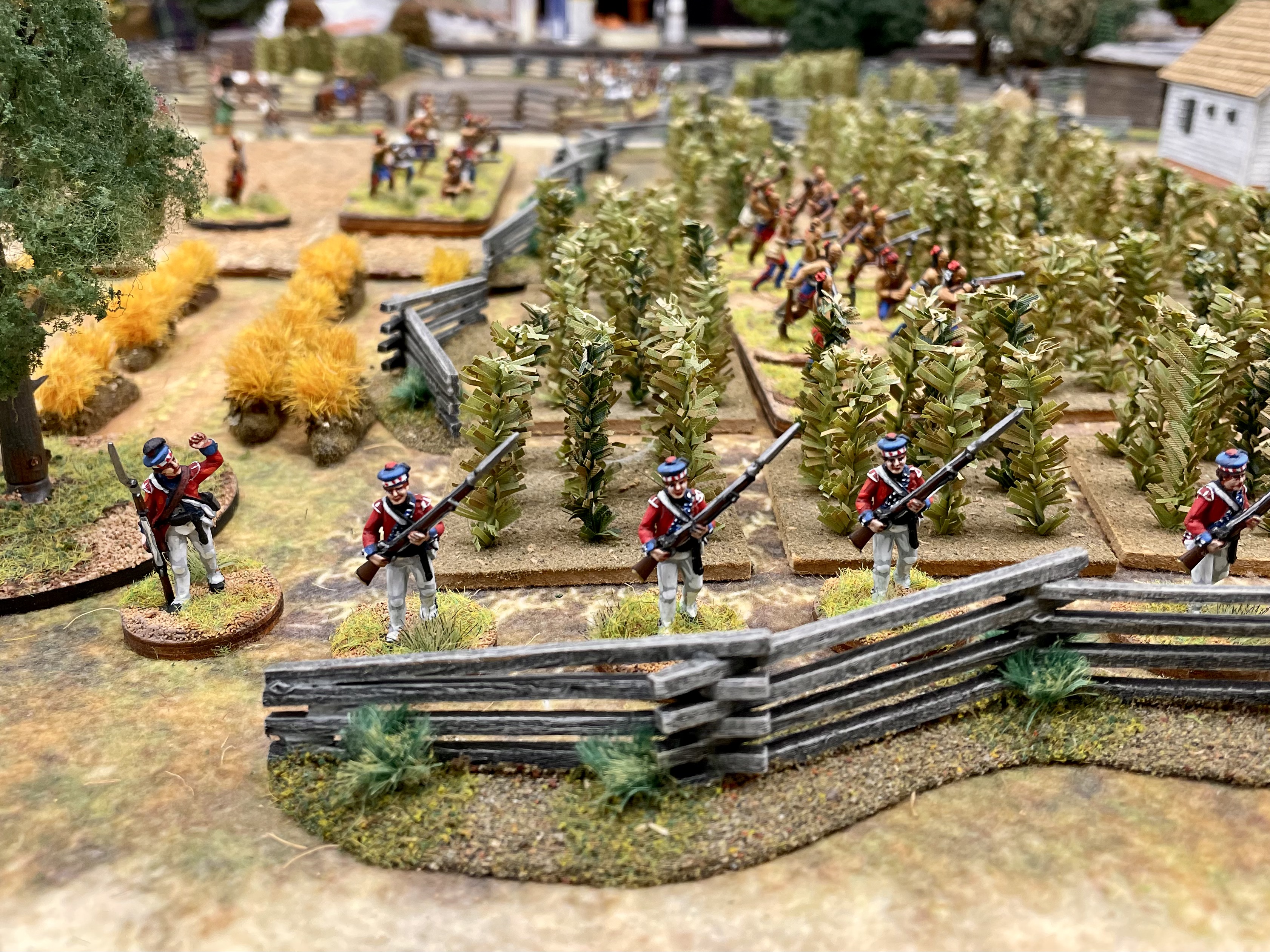
I have been reluctant to take down the AWI terrain from our recent skirmish game that we played several weeks ago. The table terrain looks really good and it may well be one of my best efforts ever (or at least in my top ten). I staged several pictures of Saratoga British and their Indian allies on the table. They are shown below:

British flank company troops wearing the cut down jackets and hats
worn by Burgoyne's troops in the Saratoga Campaign of 1777.

Highlander flank company men. I paired one firing and one loading figure together.

More Highlanders on the edge of a cornfield

The Crown's Loyalist troops (Boo, hiss; or huzzah, depending on your point of view)
These are mostly American militia figures painted with green coats and buff facings.
The officers come from the British Fife and Drum figures.


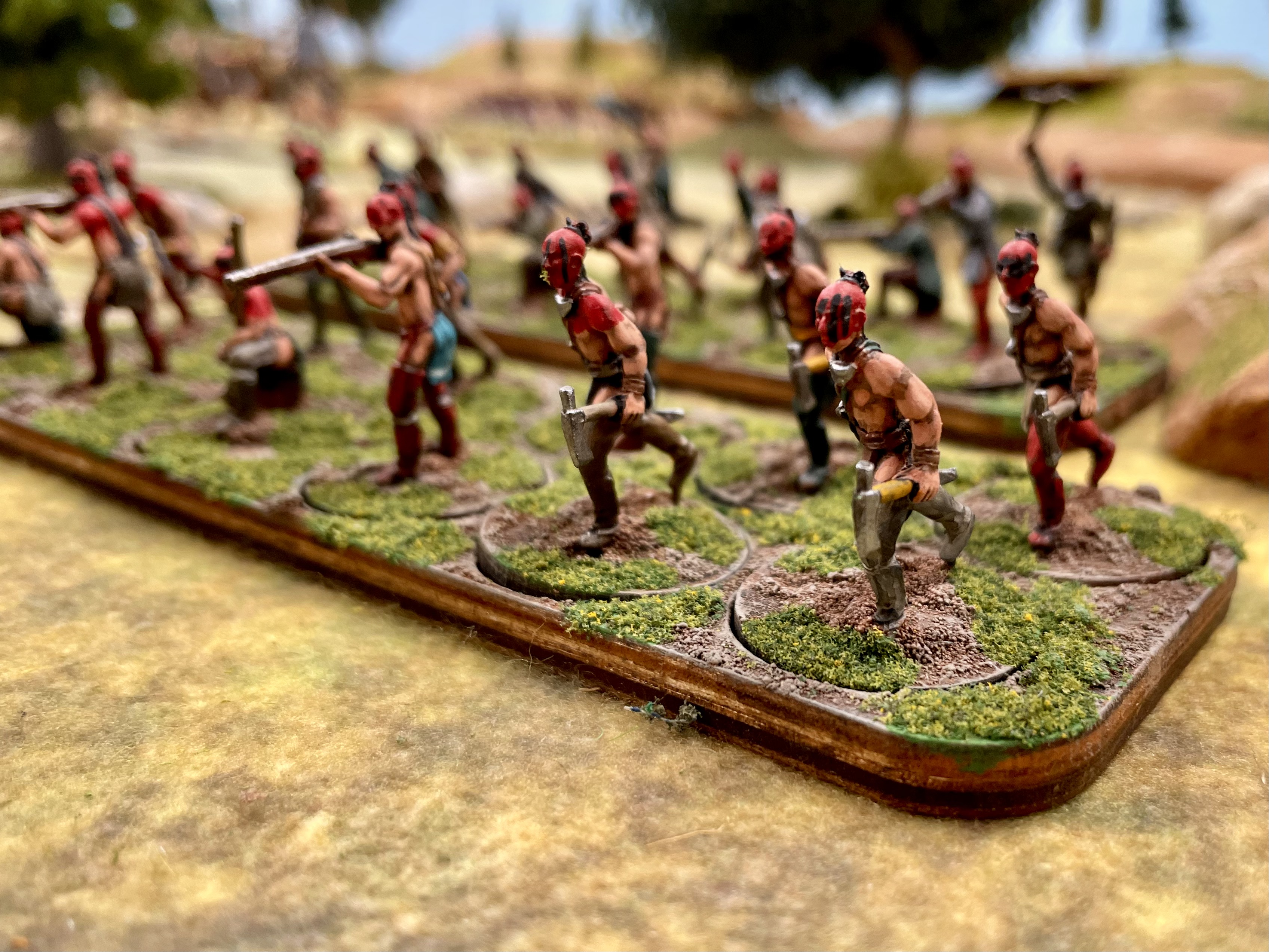
Burgoyne's Mohawk allies. These were the last figures that Richard Ansell sculpted for me.


Indians taking cover in a cornfield. I like how this picture turned out.


More Mohawk allies, this time wearing hunting shirts.

British line infantry in Saratoga uniforms


Daniel Morgan's riflemen at Saratoga. These figures were sculpted to specifically be
Morgan's Rifles.


American militia. Sorry about the poor lighting in this picture.


New Hampshire regiments

Daniel Morgan directs his riflemen during the opening stages of Freeman's Farm

American Militia fight it out with some Brunswick troops

Brunswick grenadiers converted from FD Hessian grenadiers

Desperate action up close on the skirmish line.

Freeman's Farm terrain

More Freeman's Farm terrain

One of the New Hampshire or Massachusetts regiments.


General Burgoyne and his staff and senior officers

Benedict Arnold, back when he was one of the good guys at Saratoga.


ccc