Wednesday, January 27, 2021

The Saratoga Project: Brunswick Troops


Fife and Drum Miniature Hessian Musketeers wore uniforms
that were similar to those of the Brunswick soldiers.

Part II of the Guide to the Saratoga Project describes the organization and uniforms of the German troops that were in Burgoyne's Canada Army.

Burgoyne's army consisted of about 4,400 British troops and 4,700 German troops at the start of his campaign. The German contingent was comprised largely of hired soldiers from the Duchy of Brunswick in Germany. There was also a smaller German contigent from Hesse Hanau. The Duke of Brunswick's son, Carl Wilhelm Ferdinand, was married to George III of Britain's older sister. This facilitated the rental of Brunswick regiments to the British cause in North America.

The Hesse Hanau musketeer regiment, including its grenadier company, was stationed at Fort Ticonderoga,  and did not participate in the fighting at Saratoga. The von Barner light battalion was composed of musket armed chosen men from the Brunswick musketeer regiments plus one company of rifle armed jagers.

The table below provides information about the uniforms of the Brunswick musketeer regiments. All regiments had blue coats and white small clothes (waist coat and breeches) and white hat lace. The term "Facing Color" refers to the colors of the lapels, collar and cuffs. Hat Lace is simply the color of the tape around the edges of the cocked hat. The pompom was a decorative ball of yarn atop the cocked hat.

Brunswick Musketeer Regiments

Regiments          Coat Color     Facing Color   Buttons   Pompoms/center 

Prinz Friedrich    Blue                Yellow            White      Yellow/White                

von Riedesel        Blue                Yellow            White      Yellow/White                

von Specht           Blue                Red                Yellow       Red              

von Rhetz             Blue                White            Yellow       White/Yellow   


Other Regiments           

von Barner            Blue                Black**        White              White            

Jaegers                 Green              Red                White              Green ***      

Hesse Hanau        Blue                Red *              White            White                     

Footnotes

*    the Hesse Hanau regiment had red lapels with white button lace

**  the light infantry battalion had no lapels; yellow aigulette on the right shoulder

*** the Jagers had green waist coats and buff colored breeches, white aigulette on right shoulder


Regimental Drummers

All musicians wore a yellow coat with shoulder epaulettes in white. There were no chevrons on the sleeves save that of the senior drummer in the regiment. The facing colors varied from regiment to regiment, as follows:

Light Blue - Prinz Friedrich and von Riedesel

Red - von Specht

White - von Hetz

Coat Details

Uniform coats were dark blue with red turn backs. The cuffs were of the looser Swedish Cuff style rather than the tight Prussian cuff. The lapels had only four buttons: one on the top, then a pair of buttons in the middle of the lapel, and one button on the bottom of the lapel.

Small Clothes

All regiments wore white waistcoats and white breeches. The Brunswickers adapted the British style of "overalls". The overall was a single leg with gaitor buttons at the ankles near the bottom of the cloth, thereby negating the need for the soldiers to wear separate leg gaitors. There is some conjecture that the Brunswick soldiers wore stripped overalls made from mattress ticking. This is incorrect as the overalls were made from the linen colored spare tents provided by the British. The striped overall look originates from the John Mollo book on uniforms of the American Revolution and the error has perpetuated itself into many a uniform plate. The only Brunswick soldiers that wore striped ticking overalls were the Prinz Ludwig dismounted dragoon regiment.

Officers

Brunswick officers were armed with sword and carried spontoons. There is some speculation that the pole arms for officers and NCOs were left in storage in Canada and that they carried firearms. Officers were distinguished by a waist sash of a silver and yellow mix as well as with a gorget around their necks. Their hats hat silver lace and a black cockade on the front.

Brunswick NCOs were distinguished by an ash cane that hung from the second button from the top on the righthand lapel. They had metalic lace on the collar, lapels and cuffs. Their cocked hats had black and white pompoms and hat tightener cords. Those NCOs carrying firearms wore a belly box for cartridges on their front waist.

Grenadiers

Brunswick grenadiers wore the same uniform as the musketeers in the regiment, save for the ubiquitous miter hat. The grenadier company from each of the four Brunswick regiments were converged into one grenadier battalion.

Hessian Grenadiers from Fife & Drum Miniatures- uniforms were similar 
to those of Brunswick grenadiers.

Grenadier Miters

                            Miter Plate        Miter Bag                             Pompom

Prinz Friedrich     Silver            Yellow w/white piping          Yellow/white

von Riedesel         Silver            Yellow w/white piping           Yellow/white

von Specht            Brass             Red w/white piping               White

von Rhetz              Brass             White w/ red piping               Red

Hesse Hanau        Silver            Yellow w/white piping            Red /yellow


Hessian Grenadiers from Fife and Drum Miniatures. Their uniforms
are similar to those of Brunswick grenadiers.

Fife and Drum Miniatures is currently working on Brunswick musketeers and grenadiers to be added to the product range. Their expected arrival is approximately late April 2021. In the meantime, I use the F&D Hessian figures as stand ins for Brunswickers. The principal difference between Brunswickers and Hessians is that the former wear one-piece overalls and the latter wear gaitors.


Thursday, January 21, 2021

The Saratoga Project: Guide To Burgoyne's Army


British 9th Foot at Saratoga
(Fife and Drum Miniatures)

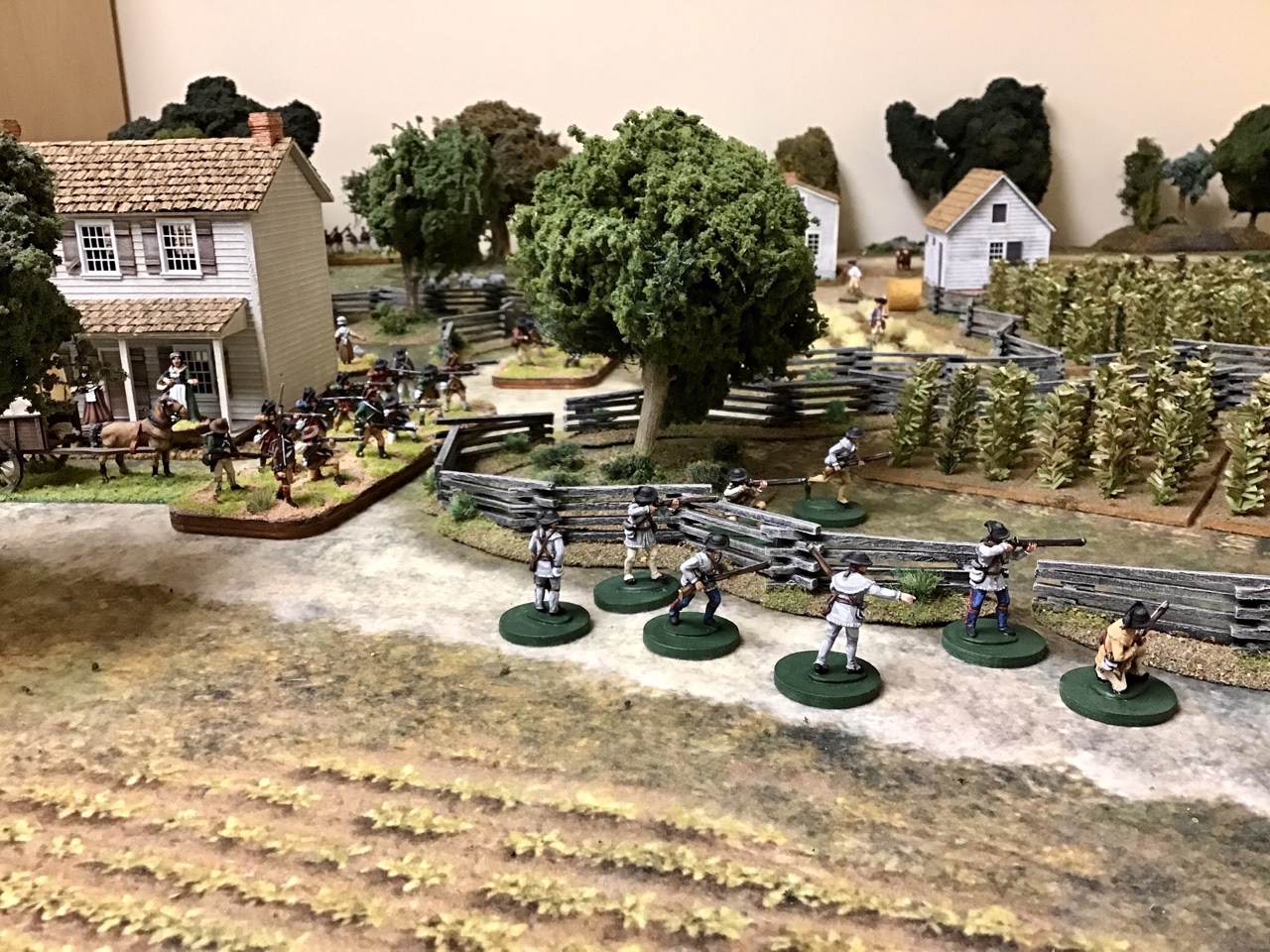
My lack of blogging in recent weeks does not indicate a lack of hobby related work during the first few weeks of 2021. Quite the contrary, my paint brushes have reactivated favorably and I have made a good dent in my planned project for 2021: The Saratoga Project in 1/56 Scale. The 1/56 scale figures are approximately 30-32mm in height and of course they will all be Fife and Drum Miniatures figures.

As of today, my British Saratoga army includes: 9th/20th/21st/62nd Regiments of Foot; two stands of 8 light company figures; three stands of 8 grenadiers. The line regiments will have five stands of 8 figures, or 40 in total. The converged light and grenadier battalions will each have six stands of 8 figures, or 48 in total.

My first inspection of the armies at Saratoga indicates that I can do the British army with a moderate number (for me, at least) of figures at my planned figure to man ratio of 10 to 1. This ratio means that one casting represents 10 actual soldiers. I like to organize my war game armies around historical orders of battle, if they are available. For this purpose, I used the Osprey Campaign Saratoga 1777 book, authored by Brendan Morrissey. As an example, if the British 9th Regiment of Foot had 398 officers and men during the campaign, then I would round up to 400 men and field a war gaming unit of 40 castings.

I will use my existing American regiments augmented by Morgan's Rifles.

The project will also include the necessary troops to fight Oriskany, Hubbardton and Bennington, so this includes Mohawk Indians and Brunswick troops. By the way, Brunswick musketeers and grenadiers are the next new figures in the queue of the Fife and Drum Miniatures Saratoga figure range. These will likely be available by May 2021.

Converged British Light Infantry

Converged British Light Infantry

Converged British Grenadier Battalion


Reference Material

A good place to start is the finding of a good reference books with the orders of battle for all of the armies. Fortunately, Osprey Publishing has "Saratoga 1777, Turning Point of a Revolution". The book, authored by noted war gamer and historian Brendan Morrissey, provides a nice summary of the whole campaign and specific battles, and also provides detailed orders of battle around which a war gamer can build his/her own table top army.

If you are interested in a deeper dive into the Saratoga campaign, then I would recommend the following books:

  • Campaign to Saratoga - 1777,  by Eric Schnitzer and illustrated by Don Troiani, (2019 Stackpole Books - publisher)
  • Saratoga, A Military History of the Decisive Campaign of the American Revolution, by John Luzader, (2008 Savas Beatie - publisher)
  • Saratoga, The Turning Point of America's Revolutionary War, by Richard Ketchum, (1997 Harold Holt -publisher)
  • Uniforms of the British, German and American Armies at Saratoga, by Brendan Morrissey is a very detailed description of uniform details and regimental organization for the units that fought at Saratoga. The information can be found on the Perry Miniatures web site (under the Articles pull down menu).  Click on the adjacent link  to find the three articles. Perry Miniatures "Articles"
  • Campaign Book #7, The War of Independence in the North, "We Have Always Governed Ourselves, by Greg Novak (1988 Ulster Imports - Publisher, out of print). 

Eric Schnitzer is the head Park Ranger, historian-interpreter at Saratoga National Historical Park, having served in that role for more than 20 years. Don Troiani is well-known for his accurate historical and military paintings. John Luzader has served with the National Park Service with an expertise on the battle of Saratoga.


62nd Foot


21st Foot


Burgoyne's British and German Army

Lt. General John Burgoyne's Canada Army numbered approximately 9,500 officers and men and consisted of troops from Britain, Brunswick and Canada. There were two brigades of British soldiers with 4,000 men; the Brunswick contingent with 3,500 men; and 1,900 headquarters and unassigned troops. The following order of battle for Burgoyne's army is sourced from Brendan Morrissey's book on the Saratoga Campaign (Osprey).

The numbers in parentheses indicate the total number of officers and men in that particular regiment or formation.

Advance Guard - Brigadier General Simon Fraser

24th Foot (391)

Converged British Grenadiers (631)

Converged Light Companies (611)

Corps of Marksmen (102) 

Royal Artillery - 

  • four 6-pounders - Captain Thomas Jones
  • four 6-pounders, four 3-pounders, two 5.5-inch howitzers - Captain Ellis Walker


1st Brigade - Brigadier General Henry Powell

9th Foot  (398)

47th Foot (detached to guard bateaux on Lake George) (380)  

53rd Foot (left behind at Fort Ticonderoga ) (391)

2nd Brigade - Brigadier General James Hamilton

20th Foot  (383)

21st Foot  (393)

62nd Foot  (377)

NOTE: due to detachments, the 9th Foot joined the 2nd Brigade commanded by Hamilton during the two battles of Saratoga.

Artillery 

  • RA - Major Griffith Williams (267)
  • Hesse-Hanau Artillery - Captain Georg Pausch (103)
  • Attached infantry - Lt. George Nutt (155)
  • Artillery Park - 3 brigades

Headquarters

General staff and ADCs (17)

Prinz Ludwig Dragoons (dismounted) - Lt. Col. von Baum (307)

King's Loyal Americans - Lt. Col. Ebenezer Jessup (150)

Queen's Loyal Rangers - Lt. Col. John Peters (150)

Canadians/Bateauxmen - Capt. Monin / Capt. Boucherville (300)

Indians (500)


The Brunswick Contingent - Major General Friedrich von Riedesel

The Brunswick contingent constituted the Left Wing of Burgoyne's Canada Army and was organized into three brigades: Advance Corps (von Breymann), 1st Brigade (von Specht), 2nd Brigade (von Gall) and the Hesse Hanau artillery (Pausch).

Artillery - Captain Georg Pausch

4 x 6-pounders Hesse Hanau artillery brigade

Advance Corps - Lt. Colonel Heinrich von Breymann

Grenadier Battalion - companies from the Rhetz, Riedesel, Specht and Prinz Friedrich regiments (456)

Light Battalion - Major Ferdinand von Barner - chosen men from the same regiments as above (398)

Jager Company - Captain Carl von Geisau (124)

Artillery - Lt. von Spangenburg (2 x 6pdrs and 2 x 3pdrs)

1st Brigade - Brigadier General Johann von Specht

Regiment von Rhetz (535)

Regiment von Riedesel (537)

Regiment von Specht (536)

2nd Brigade - Brigadier General Wilhelm von Gall

Regiment Prinz Friedrich (533) - detached to Fort Ticonderoga

Regiment Erbprinz of Hesse-Hanau  (546)


In war game terms, my Brunswick contingent will have the converged grenadier and light company battalions, the Jager company, two sections of artillery and four battalions of musketeers (omitting the detachement at Fort Ticonderoga). As of this writing, only the jagers are painted and I plan on using my Minden SYW Prussian artillery crew figures manning British 6-pounders and 3-pounders. I can draft some of the Fife and Drum Miniatures Hessians into my Brunswick contingent until the Brunswick figures go into production, probably in May 2021.


What Is Ahead?

I plan on adding uniform information for both British and Brunswick regiments, to be posted on this blog. I will also post orders of battle for the forces at Hubbardton, Bennington and Oriskeny in the near future. Finally, I will post pictures of the British and Brunswick regiments as they are painted. Hopefully, by mid to late Summer 2021, I will have the necessary forces to game all of the battles that comprise the Saratoga Campaign of 1777.


Thursday, December 31, 2020

Bye Bye 2020!


I suppose that I should use the phrase “ in these uncertain times” somewhere in this post, but it’s become trite and I am tired of hearing it. 2020 had some of the obvious lows related to the pandemic. We also lost our beloved hound, Tiberius, to cancer, but that was quickly offset with the new member to our family: Augustus (“Augie the Doggie) in February and the later addition of Bella in October. It is a joy (well, it has its moments) to have dogs around the house and I’m proud of Augie for stepping up and taking Bella under his wing. The two animals are the closest of friends.

Lelia had a bit of difficulty adjusting to virtual school, but in the end, she passed with flying colors by earning an A in Music and a B in an extremely hard US History course. Even I, the household’s history expert, was taken aback by how hard some of the history class assignments were at Oakton Community. College.


THE GOOD STUFF


Looking back, there was a lot of good stuff happening that made it easier to get through 2020.


1) Phil Olley’s Virtual Wargames Club was a much needed tonic for the spirits as people from all corners of the world met every Saturday to talk wargaming and painting projects for a couple of hours. I already knew some of the members via their blogs and presence on the internet, so it was great to meet them sort of face to face, which made getting to know them even better. It was also great making new friends in the VWC. All in all, a big plus.


2) The 54mm Sudan Project.: my “COVID Project” entailed doing something completely different as I ventured outside of the 18th Century and went on an expedition in the Sudan to fight The Mahdi. I must have painted nearly 500 to 600 plastic toy soldier figures for the project. Perhaps the most satisfying part of the project was the need to build my own 54mm buildings to create the walls and city of Khartoum. I hadn’t attempted to scratch build my own buildings since the 1980s, so there was a bit of a learning curve required to ramp up the production. I must give a big Thank You to the members of the VWC for their suggestions and ideas for the buildings. I’m particularly indebted to Tidders ( Kingdom of Wittenberg blog) for his many tips that enabled me to “crack the code” in building construction techniques. Then we capped off the project by actually playing a Wargame featuring the Dervish attack on Khartoum. This was one of only two in person Wargames that I played during the COVID-19 era this year. Boy oh boy, did we have some fun there!


3) Fife and Drum Miniaturess rolled it its Saratoga figure range in late 2019 to early 2020 as RichardAnsell continued to churn out an impressive number of new figures over the past year. The Mohawk Indians, Morgan’s Rifles, and personality figures for Washington, Greene, Cornwallis and Howem(;sounds like the name of a law firm, doesn’t it?) were added to the range during 2020. There will be some interesting surprises that I will roll out in 2021, but I can’t let you in on the secret just yet. 😈


4) The aforementioned addition of the two hounds this year was fun and loving, and occasionally difficult, but well worth the time invested and the return of love from our dogs. As I type this blog, little Bella, the Golden Retriever, is sleeping at my feet. Actually, she is sleeping on my feet.


5) Mrs. Fritz has continued to build on her stand up story telling performances via Zoom and she has started a related business venture which is getting its legs in 2021. I am so proud of her and her fearless ability to stand up in front of a crowd and tell a person story.


6) We are all healthy and Covid-19 free. The introduction of three new vaccines, as of today, give all of us hope that we will defeat this virus and return to a normal life by the end of the 2021 year.


7) I had lots and lots of free painting time to help me get through the mental part of the pandemic; at least I did until Bella the Puppy came along and turned me into a dog sitter instead of a figure painter.

So on the balance, the good outweighs the bad, but like everyone these days, I say good riddance to 2020 and am confident that we will have a great 2021. ( oh, and I hit my goal of writing 100 blog posts this year).


Here’s to a happy New Year in 2021.


Wednesday, December 30, 2020

Prussian Artillery of the SYW


Prussian 12-pound Brummers from Fife & Drum Miniatures.


 Prussian battery of 12-pounders, shown with limber teams and supply wagons.

These are two of my favorite pictures of my Prussian artillery.

Tuesday, December 29, 2020

Austrian Artillery in the SYW


Austrian battery of 12-pounders

I like this series of photos that I took awhile back showing a battery of Fife and Drum Miniatures Austrian 12-pounders plus limber teams. The vignette shows the depth of an artillery battery with its supporting limbers, horse teams and ammo wagons (well, no ammo wagons in these pictures.


Note the use of the Minden pioneer figures as Austrian artillery crewmen.

Limber horses and drivers are from RSM.

Monday, December 28, 2020

French Artillery of the SYW


Minden Miniatures SYW French 12-pounder artillery battery.


Here is a diorama that I made a few years ago of a French artillery battery circa the Seven Years War. All figures are Minden Miniatures and all equipment is from the Fife and Drum artillery equipment range. The French 12-pound Valliere System cannon (AE-010) is a beautiful model with lots of intricate barrel detail “bling” on it.

In the diorama I had to make the ram rods longer to account for the longer barrel length. This is done easily with a piece of wire and some green epoxy putty to make the swab and push ends of the ram rod.

Saturday, December 26, 2020

Battle of Trenton


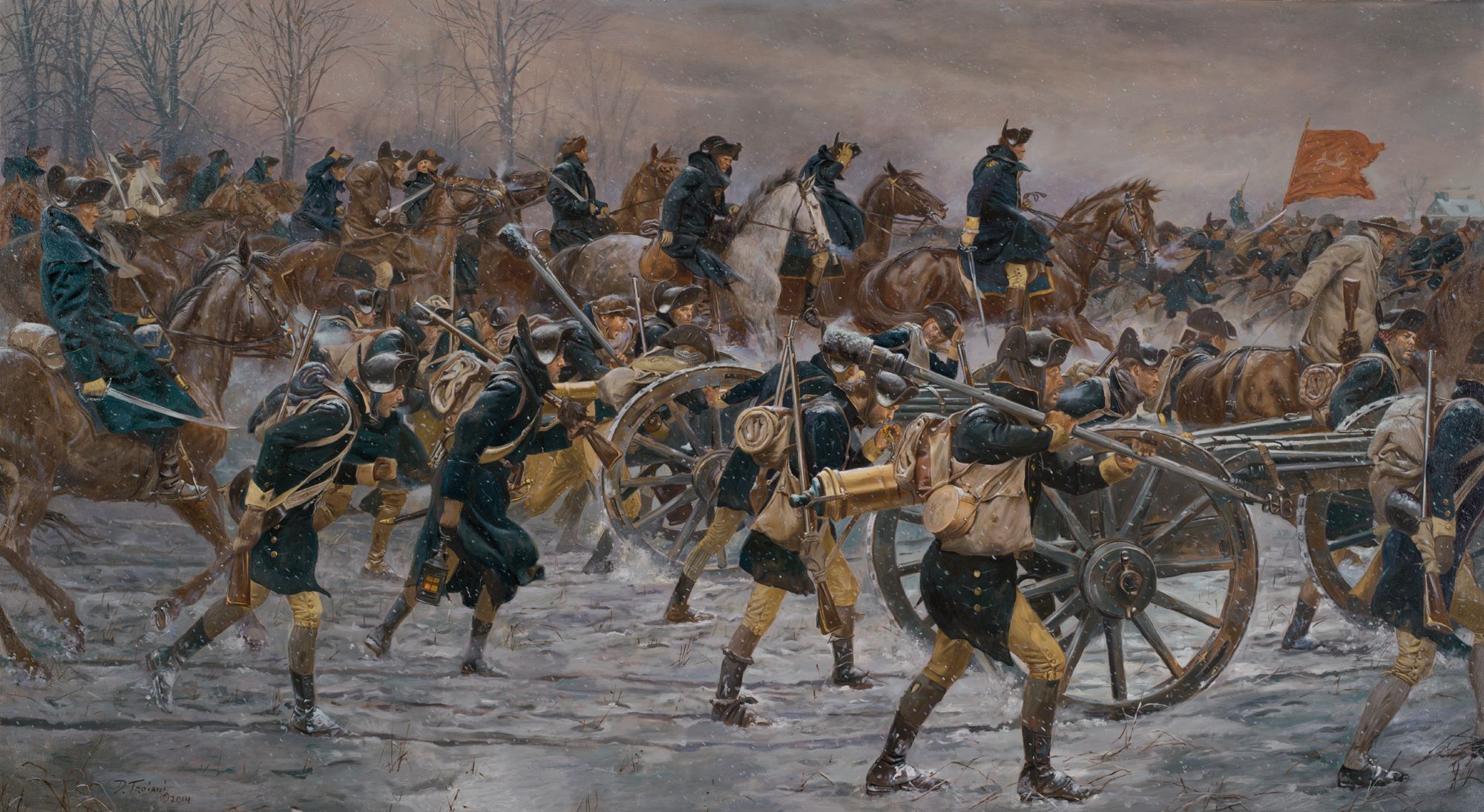
Night March of the Continentals on Trenton, by Don Troiani.


Fife and Drum Continentals on the March to Trenton 


I am writing this blog post at 12:08AM on the morning of December 26th. On the same day and time in 1776 the Continental Army commanded by George Washington was crossing the Delaware River and marching on the town of Trenton, New Jersey. The Americans hoped to surprise the Hessian garrison in Trenton by crossing the river and launching an early morning attack.


In December 2016 I played a Wargame of Trenton as a solo game. In fact I played it twice and the Americans won both times. Here are several pictures of the game.