Sunday, May 8, 2016

Itzenplitz Regiment Painted


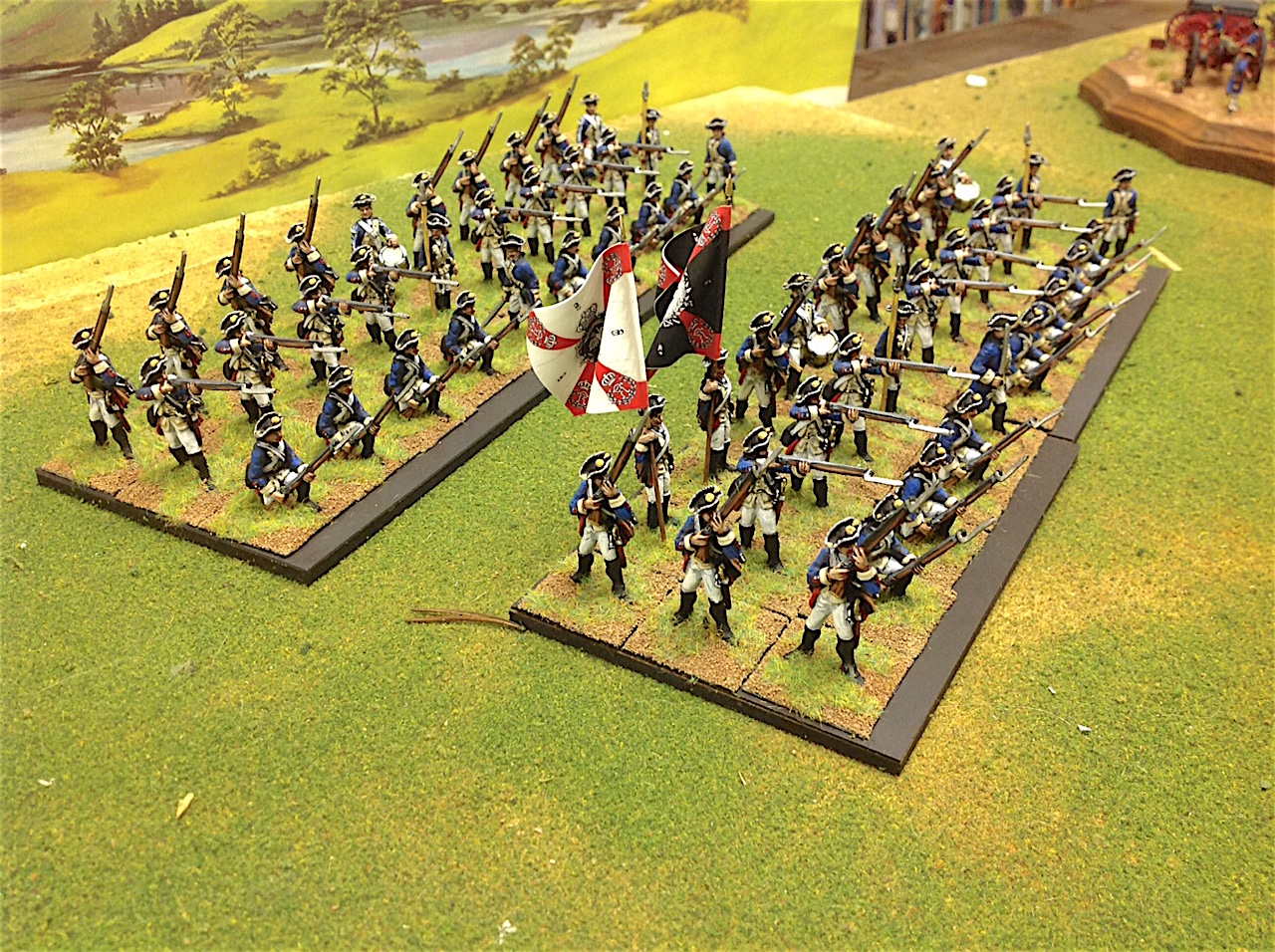
IR13 Itzenplitz Regiment. click pictures to enlarge the view


I finished the Prussian regiment Itzenplitz (IR13) today for our upcoming Big Battalion Game next weekend. The regiment, 60 figures strong, uses my own 30mm Potsdam Prussian infantry figures.

When I was doing an inventory of my Prussian Big Battalion army for the BAR rules (Batailles dans l'Ancien Regime), I found that I only had 11 formed infantry battalions and one Jager unit of unformed troops. I used to have around 18-20 battalions, but a number of them had been sold off over the years and I think that I overdid it on the Defense Departement cutbacks in Hesse Seewald. So I resolved to paint one more 60-figure battalion before the game, and so here it is.


Ground level view of the command stand. GMB Designs flags and Potsdam 30mm figures.

z

Saturday, May 7, 2016

Setting The Table for the Huge SYW Game

We are bringing back an old tradition, the annual huge giant humongous Big Battalion SYW game done in the grand manner. The game will be played next Saturday May 14th at Kieth L.'s home (he of the three 6ft by 28ft tables in his basement).

A differnt game from 2010, same venue, but different era (Napoleonics) and rules (In The Grand Manner).
Here are a couple pictures of our last truly huge Big BAR game at Kieth's house from several years ago. This gives you an idea of what we are trying to accomplish. This is one of my favorite buildings in my collection, made by Herb Gundt.

Lots of figures are used in our BAR games. The French Army is on the move.


I have come up with an idea for the scenario, borrowing a battle from a different historical era and adapting it to the SYW, and so Bill P. and I met at Kieth's home at the crack of dawn to start laying out the table and terrain. Here is a picture of the game tables before we start setting up  terrain:

The game room prior to the setting up of the terrain.

With so much table area to play with, we first did a preliminary set up of some representative buildings in order to check on the spacing of villages and natural terrain objects. This starts by setting a sheet of writing paper on a spot of the table where there will be a village. We set up a couple of buildings on each sheet of paper to get a general feel for the distances involved. Then out comes a tape measure and we measure the distance between several villages to get a sense of how many battalions can fit into that area. Our Batailes de l'Ancien Regime ("BAR") rules use 60 figure infantry battalions (three ranks with each figure having a one-inch frontage), so the battalion has a 20 inch frontage (rounding up to 24 inches to allow for space between two side by side battalions).

Once we are satisfied with the spacing, then a length of rope is used to indicate where streams, rivers or roads might be placed. After that, we are ready to begin setting up the terrain.

Actually, we will come back on Wednesday of this week and set up the terrain because Kieth recently made some new board sections that still require a coating of green paint. However, we now have a general idea of how the layout will look.

It looks like we will have ten players in the game and each player will command a brigade of 5 or 6 battalions or cavalry regiments, plus some artillery.

There are several clues as to what the scenario is (ignore the model of the Hougoumont in the background, it is just resting there and will not be used in the game), but I doubt that anyone has enough information to make a correct guess. I will post more pictures Wednesday evening as we set up the terrain and forces.

Until then, may the dice be with you.

Friday, May 6, 2016

Battle of Prague May 6, 1757


Today is the anniversary of the Battle of Prague fought between Frederick the Greats's Prussians and the Austrian army commanded by (officially) the hapless Prince Charles of Lorraine ( bless him :) ), although von Browne was the actual person running command of the battle until he was mortally wounded.

It was a bad day to be a Prussian general, with the likes of Marshal Schwerin and Lt. General Hautcharmoy biting the dust, while Hans von Winterfeld was severely wounded. A couple of these guys might have come in handy at Kolin a month later.


The death of Schwerin as illustrated by Rochling:


Prince Henry wades into the Rokitnitzerwasser to lead his men out of the boggy fish ponds and into a gap that was about to open in the Austrian battle line.


D


Sunday, May 1, 2016

Little War Convention Pix

I visited the annual Little Wars convention, hosted by HMGS-Midwest, yesterday in Lombard, IL. The weather was horrible, raining buckets of water all day, so it was a good day to be indoors playing a game. The convention moved to a new venue this year at the Westin Lombard Hotel at Yorktown shopping center. This is where Adepticon used to be. This looks to be a great improvement in venue over the previous ones at the DuPage County fairgrounds.

Admission for just one day of sightseeing was a hefty $25.00 but it goes to a good cause. They should have a one day Visitor's Pass at a slighly lower price as $25 seems a bit steep to visit the dealer area and stroll through the game hall for an hour or two (non-playing).

The game hall was well lighted and is a big improvement over the old venue. My one little nit pik is that they should take out a few tables and have a central aisle leading from the front door to the back of the game hall. This would ease access to the games. The tables seemed very cramped and crowded in amongst each other. There were only 2-3 feet of open area between game tables. I was there at about 1PM on Saturday afternoon and about half the tables seemed to be empty, so it would be easy to remove a few of them to create some aisles.

The quality of the games seemed to be rather good, so that was encouraging. I didn't play in any games as it was my intent to just stroll around and socialize with old friends and take pictures. I also did a little bit of shopping in the dealer area, purchasing some nifty book translations from George Nafziger that covered the WAS and SYW eras. The dealer area seemed to be a bit smaller than normal, but a count of names in the convention brochure indicates 22 dealers. Old Glory Blue Moon was the largest dealer and it was nice to see Old Glory supporting a convention so far away from their home base.

I will let the picture captions tell the rest of the story.


Re-enactment groups for Ancients, WW1 and French Napoleonic eras set up their recruiting stations outside the main hall.

Some kind of painting seminar or "how to" setup outside the main hall.

Walking through the front door and this is what I saw. Nice view of the cramped game area.
The Isandlhwana game display was well done - lots of information about the game.

The British set up outside of their camp at Isandlhwana, unaware of what is about to hit them.


A large 15mm Napoleonic game (Master of the World rules by The Wargaming Company).

Very large and attractive WW2 game set in the Pacific. This game probably had the largest crowd around it so that immediately caught my camera's eye.

ACW Battle of Jenk's Ferry. I liked the innovative trees that the game judge used.

Uncle Duke Seifried's Ancient Mythology game. Amazons vs Greeks.

Pat LeBeau's 28mm AWI Battle of Eutaw Springs - best looking game in my humble opinion.

Another view of the Eutaw Springs game. I heard Pat say that he had received 10 game tickets for a game that is supposed to have 6 players. Uh oh!

Winter WW2 Game, I think. I liked the train.

More of the Winter WW2 game, opposite end of the table. I like the use of mesh wire to make the fence.

All Quiet on the Martian Front game. Too little too late perhaps?

Pagusus Bridge game - best looking terrain that I saw. So very life like.

Another view of the Pegasus Bridge game showing the British gliders.

This WW1 Dogfight Aeriel Game is always fun for the players.


ttttttt


bbbb

Monday, April 25, 2016

Itzenplitz - Back to the Big Battalions


IR13 Itzenplitz regiment, work in progress, of Potsdam Miniatures 30mm figures. Click pix to enlarge.

We are staging a large BAR (Batailles dans l"Ancien Regime) game on Saturday May 14, 2016 in Woodstock, IL at a friend's house - he who has three 6ft by 28ft long tables (lucky guy) and quite frankly, we could use a few more players in the game. So if you care to spend a full day of gaming with big 60-figure battalions of infantry and similar sized cavalry regiments, and further, if you are the sociable gentleman gamer type of person, then drop me an e-mail and I can give you more of the details.

So a week or two ago, I was taking an inventory of my Big Battalion Austrian and Prussian armies and discovered to my horror that my Prussian army had dwindled down to a mere 12 battalions, of which one was a fairly useless battalion of jagers. A few years ago, I had as many as 20 60-figure big battalions in my Prussian army. I had sold off eight battalions to raise funds for Fife & Drum Miniatures, but also to cull down the herd to a manageable size of battalions that I could actually store in the trunk (boot) of my car. If I could only travel with 12 battalions, what was the point of owning 20 battalions?

Side view showing the three ranks of the firing line.


The upshot of all of this is that I decided that I needed to rebuild some of the Prussian BAR battalions that I had previously sold. My first choice was to add IR13 von Itzenplitz, which was considered one of the best regiments in the Prussian army. I had a few of my own Potsdam Miniatures - 30mm tall and Stadden compatible - so I started the painting of 60 musketeers last week. As of today, I have 30 figures painted and plan on having the second batch of 30 figures completed by this time next Sunday. I think that I have enough figures left to also paint IR1 von Winterfeld regiment.

As long as I'm adding more big battalions to the herd, why not order some Staddens as well and plan on rebuilding the Prussian forces up to 16 battalions. That works out to four brigades of four battalions. I like the symmetry of FOUR, there is something so very Eighteenth Century about even numbers and four of anything. So with two more Potsdamers and two more Stadden units, I will eventually get my BAR Prussian army back to 16 battalions.

I have enough cavalry.

Sort of.

I have 120 Prussian dragoons from Elite Miniatures. At a figure to man (horse) ratio of 1:10, would anyone care to guess which Prussian dragoon regiment I have in mind? You only get one guess, and if you guess wrong, then you are simply not an aficionado of anything Prussian. The rest of you will know exactly what I mean.

And no, I am not going to have 4 x 60 = 240 foot and 120 dragoons painted by May 14th. Probably just Itzenplitz before the game, with the remaining figures to be painted in the future.

Fritz likes big big war-game tables. It is a sickness that I caught many years ago during my first visit to the original War-game Holiday Centre in Scarboro, UK when it was owned by the late Mike Ingham. So my friend has three 6x28ft tables which would be like one table that was 18 feet deep by 28 feet long. Imagine having all of that room to maneuver your forces.

For the scenario for the May 14th game, I have selected an historical battle from another era of history and have adapted it to the Seven Years War. Back in about 2010, we staged a similar game at the same house and I used the battle of Austerlitz for the SYW scenario. It was quite a cracker of a game. I have added a label to this article at the bottom of the page "Big Battalion Game". If you click on that label, Blogger will take you back into my archives for the previous Big Battalion Games and there you can see the pictures and read the tales of the Austerlitz SYW game.

More later about the game and the Itzenplitz regiment to follow.


Sunday, April 17, 2016

Russian Thingamajig


Russian ceremonial artillery kettle drum carriage - Russian artillery museum in St. Petersburg.


Ed Phillips made this model of a Russian ceremonial artillery wagon, see the real thing in the picture above, and I purchased it from him at this year's Seven Years War Association Convention in South Bend, Indiana. Each year, Ed brings a large number of scratch built terrain pieces and wagon models to the convention and they sell out like hotcakes. So when I walked into the convention hall on Saturday morning, I was surprised to see that this little beauty was the last item that had not been sold. Mrs. Fritz didn't raise a stupid son, so I snapped it up for $30.00 and added it to my collection. Since I am building a Russian SYW army this year, this is just the thing I need to trick out my growing Russian army.

Russian kettle drum wagon - scratch built by Ed Phillips. Click pix to enlarge.

Note the partially melted down cannon barrels that were attached onto the wagon.

The amount of detail that Ed put into this model is downright ridiculous   and I fear that my pictures do the craftsmanship no justice. Suffice to say, I am very happy to add this to my collection.


Monday, April 11, 2016

Kuhstall Part II

The Croats retire to the second line of defense

I completed the solo game of the Battle of Kuhstall on Thursday evening last week and the scenario was a real stem winder with lots of unexpected twists and turns throughout the game. The following battle report focuses on the key fighting that occured on the Prussian right flank, for it was here that the battle was won or lost, depending on one's point of view.

Follow the rest of the action by reading the picture captions, and be sure to click or double click each picture so that you can enlarge the view.


The Winterfeld musketeer regiment follows the Croats and attacks the second line.


The Prussian Black Hussars move forward to protect the right flank of the Winterfeld musketeers. A few Croats pepper the hussars with a few shots from the protective woods.


The second squadron of the Black Hussars peels off to deal with the Croats in the woods while the first squadron continues to move toward the third Austrian line.
Winterfeld musketeers (left) close in on the Austrian grenadier battalion (right) which is supported by a 3-pound battalion gun.

At this point in the game, the regular Austrian and Prussian infantry were finally coming to grips and it was likely that the outcome of the battle would soon be settled. The first big break occurred in the Austrians' favor as the second battalion of the Winterfeld musketeer regiment routed from the close up musketry and canister fire of the Austrians.

But then, the second battalion of the Winterfeld musketeer routs! This leaves the right flank of the first battalion of Winterfeld potentially exposure to flanking fire from the Austrian grenadiers.

Zieten still had a couple of aces up his sleave, so he ordered his Black Hussars to charge into the Austrian grenadier battalion to prevent it from wheeling right into the now exposed right flank of the first battalion of Winterfeld musketeers. His second ace was to commit his infantry reserve: the Kremzow (17/22) Grenadier Battalion into the battle (see below).

The Black Hussar now charge into the Austrian grenadiers to fill in the gap caused by the routing Prussian musketeers. Meanwhile, the Prussian reserve - the Kremzow Grenadier Battalion (17/22) sends three companies to extend the Prussian right flank of infantry, while the other two companies of Kremzow veer off to the left to protect that flank from the swarm of Croats in the woods (upper part of the picture).
Two companies of the grenadiers hived off to cover the left flank of the infantry battle line, while the other three companies extended the infantry line to the right, just in case the Black Hussars failed to drive off the Austrian grenadiers.


The two companies of the Kremzow grenadiers cross bayonets with the Croats. It is no contest as the Croats flee to the rear.


Back on the Prussian right, the cavalry versus grenadier melee is in full swing.

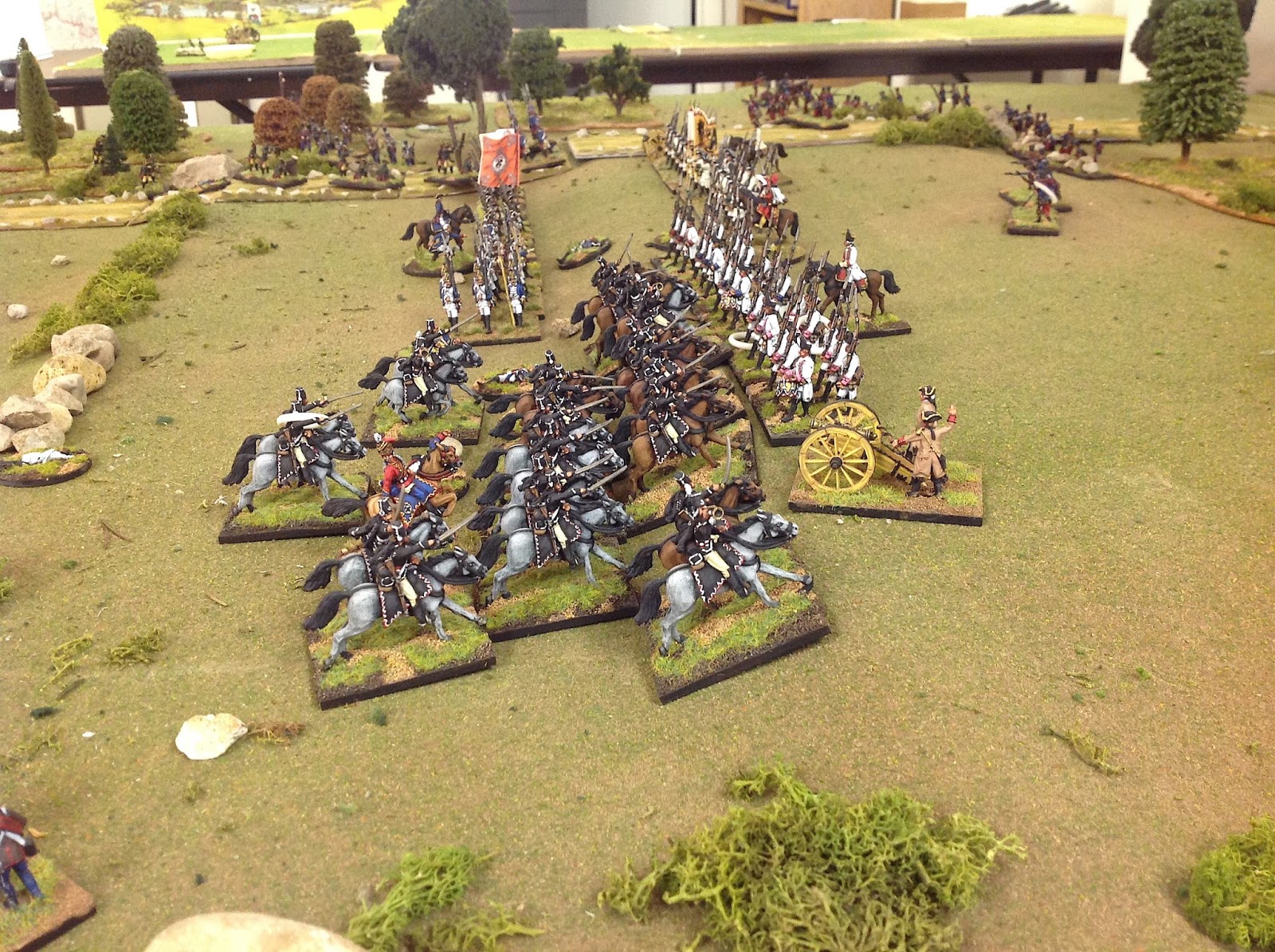
A closer view of the bloody melee.

Austrian commander Hadik hurls a squadron of the Baranyai Hussars into the melee to support the Austrian grenadiers.


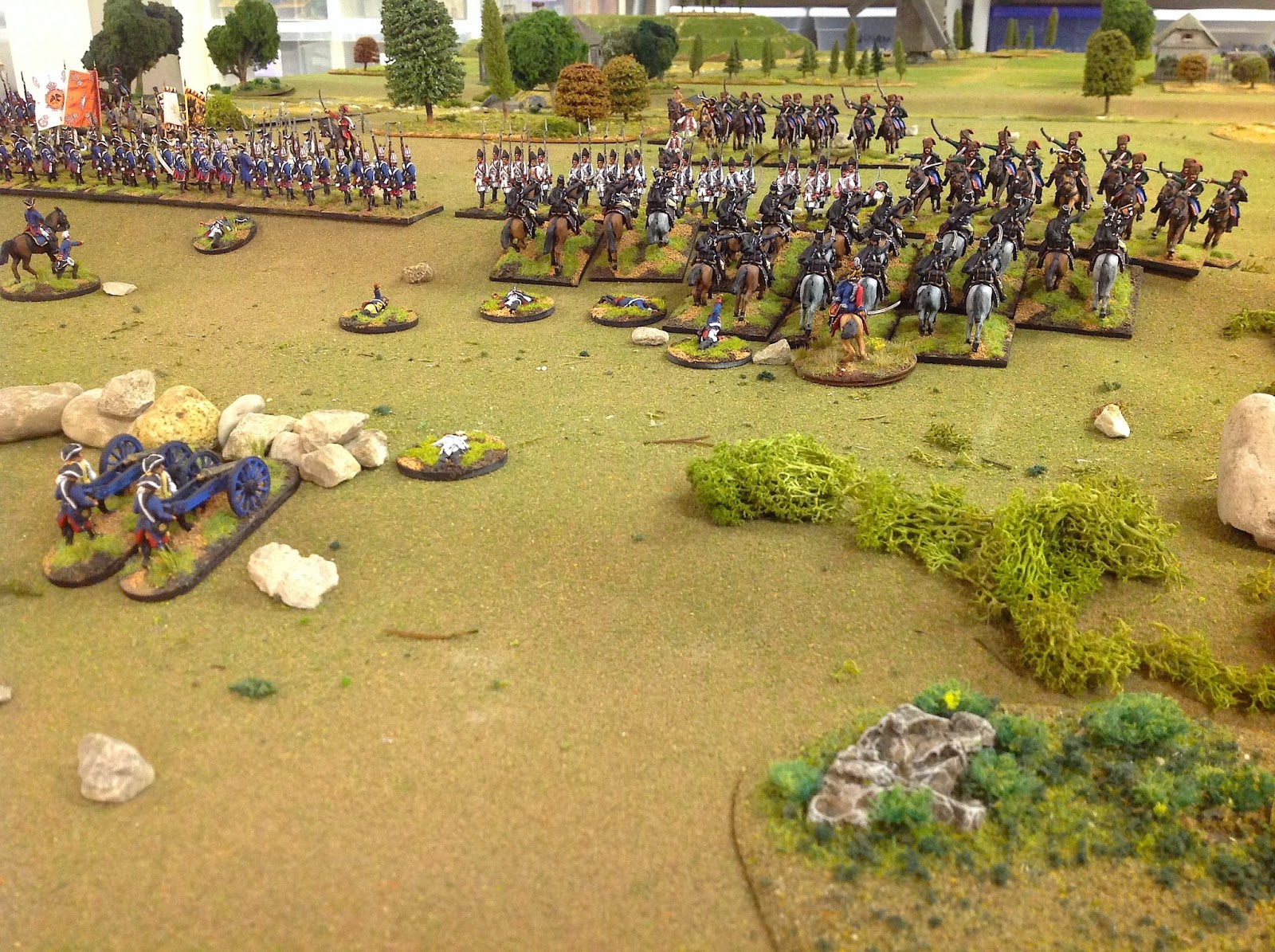
The colorful Baranyai Hussars (green pelisse and red breeches and dolman) clash with the Black Hussars. Prussian casualties begin to mount. Can the Black Hussars prevail and win the battle?


Then the Black Hussars fail a morale test and rout! Von Zieten himself tries to stem the rout, but to no avail.  It is not all bad news though, as the second battalion of the Winterfeld musketeers has rallied (see background next to the artillery pieces ).
At this point of the game, on Turn 11, it looked as though Hadik's Austrians would win the battle because the Black Hussars, having suffered nearly 50% casualties, routed. This followed on top of the second battalion of the Winterfeld musketeers failing to rally from a previous rout. Things were looking good for the Austrians.

The next sequence in the turn (movement, melees and finally firing) was the musketry and with effectively two battalions of Prussian infantry blazing away at the lone Austrian battalion of Wied musketeers, the high rate of casualties caused Wied to rout into the woods. In one brief moment, the apparent Austrian victory evaporated along with the flight of the Wied musketeers from the Austrian battle line. There were still two full battalions of Croats in the woods (on the left flank of the Prussians), but since they are not allowed to "form", they stood little chance of standing up to the Prussian regular infantry.

Now Hadik sends the second squadron of the Baranyai Hussars forward to finish off the Prussian Black Hussars.  But wait a minute, EGADS, the Austrian Wied musketeer regiment also routs and runs into the woods to hopefully recover and reform.


Hadik orders his Austrian forces to break off the action and retire towards the  Vachewasser and the windmill on the horizon. The Austrians have plenty of light cavalry and Croats that Hadik can put to good use as his little army retires back towards Saxony. Note how the battlefield is littered with fallen soldiers. We place a round casualty stand in every place where a unit losses a stand or wherever a cavalry melee has taken place. This allows us to follow the course of the battle.

 At this point in the game, it seemed logical to me that the Austrians would attempt to break off of the action and retire back towards their base in Saxony. They had a huge advantage in cavalry at this point, which could cover the army's withdrawal, whereas the Prussians had no cavalry left, making it difficult to follow and harass the Austrian retirement.


 As I stated at the beginning, the ebb and flow of the battle was simply amazing. Through the first 8 or 9 turns, it seemed like the Austrian light infantry could do nothing to stop the blue wall of Prussians from advancing up the ridge and claiming victory. All of the routs were going in Austria's favor. First  a company of jagers on the left flank, followed by a battalion of musketeers, and finally by all of the remaining Black Hussars.

But then Hadik could only watch in disbelief as the Wied musketeer battalion on his right flank routed, leaving his right center completely open to the two relatively fresh Prussian battalions to advance forward. His Austrian grenadiers were pretty beat up from the melee, so Hadik had little in the way of reliable regulars to fight the Prussian infantry.

This was a fun action to fight. It worked very well as a solo game what with only 5 or so units per side. It could very easily be a 2 to 4 player convention game that would play to a conclusion in a couple of hours.

In retrospect, I would make a few tweaks to the order of battle for both sides. I would replace one of the Prussian musketeer battalions with a lower grade fusilier battalion, or even a garrison or freikorps battalion. Concurrently, I would replace one of the three Croat light infantry battalions with a low quality unit of regulars - maybe Reichsarmee troops or a unit such as the Grune Loudon regiment. And finally, I would tweak the ranges on the 3-pound cannon, extending their long range from a maximum of 18-inches to about 30-inches so that they could inflict a few casualties on the attackers. The Croats would also be given a longer musket range than the regulars so as to make them more annoying and potent versus the Prussian infantry.