Saturday, March 23, 2024

It's Time To Base My Figures - Ick!


Pettigrew's North Carolina brigade (recently based)

Click on the pictures to enlarge the view

It happens to all of us, we accumulate our painted figures but we do not get around to putting them on bases and adding all of the terrain, static grass and tufts, etc. The unhappy consequence is that we finally reach the point where the dreaded basing of figures task can no longer be ignored so we just have to pitch in and do it. This happens to me frequently.

So this time I had accumulated 49 stands of figures that needed to be based and I knew that I couldn't put the task off any longer. It helped that I have another play test of my Pickett's Charge game coming up, so I wanted the newest units off of the assembly line to get their terrained bases.

I had finished painting 6 Confederate regiments of 30 figures each (5 stands per regiment), 2 Union regiments, 7 skirmisher stands of U.S Sharpshooters, and 2 brigadier general command stands. The amount of figures painted was done over the past month or so, although I had painted two Union regiments and the sharpshooters this past week in anticipation of the play test game. The play test game was originally scheduled for last Friday (yesterday in blog time), but the weather forecast was for six inches of snow at Keith's home town so we thought it prudent to reschedule the game for this coming Monday.

A week's worth of figure basing.

The US Sharpshooters:


US Sharpshooters have been attached to bases, the bases have been terrained,
but still require static grass and tufts to finish them. These figures are made
by Armies In Plastic.


I received another batch of seven Cigar Box Battle Mats a couple of weeks ago and I am keen to lay these out on top of Keith's three 6ft by 32ft tables (although we are "only" using 24ft of table length on the three tables) and get a better idea of what the terrain will look like for my convention games this year. Here is a link to the web store of Cigar Box Battle Mats. Highly recommended!

Cigar Box Battles


Here is a picture of a Confederate brigade (3 regiments) treading across a game mat by Cigar Box Battle Mats. I like the way that the mat and the figure bases blend in together.

A North Carolina regiment in Pettygrew's Brigade

So let's see what Old Fritz based this past week. First the two new Union regiments:


The 14th Brooklyn Regiment of the First Corps


A Union regiment. I forget which one, but they all look the same. It's probably 
a unit from the First Corps, which was shattered during the battle of Day One
on July 1, 1863. Some elements of the First Corps were deployed on
Cemetery Ridge at the time of Pickett's Charge on Day Three.


Buster Kilrain figure. You just know that some company would make a figure of the fictional character in the movie "Gettysburg". Buster reminds me of the Black Knight in "Monty Python and the Holy Grail" in that in each scene of the movie, Buster gets wounded in a different part of his body and then he doesn't have the good sense to hurry up and die so that we don't have to hear him called Colonel Chamberlain "Colonel Darlin' " one more time.


Oh no, it's Buster Kilrain!

Buster Kilrain, as played by Kevin Conway in the movie "Gettysburg" which 
was based on the book "The Killer Angles".


Now before I get skewered with criticism, yes, I do know that the 14th Brooklyn regiment was not on Cemetery Ridge during Pickett's Charge on Day Three of the battle of Gettysburg. However, it is such a colorful looking unit that I just had to paint the regiment and add it to my Union forces. No company makes such a figure in 1/32 scale (54mm) as far as I know so I simply took some ordinary Union figures and painted them with red trousers and red kepis. I'm assuming that my version of the 14th Brooklyn is not wearing its gaiters. 

And now for some of the Confederates:


I really like the animation of these plastic toy soldiers from Classic Toy Soldier Company,
or "CTS" figures. That running/right shoulder shift pose is simply Fab.

Pettygrew's North Carolina brigade. They did not carry the state flag, but I 
wanted a little bit of variety in my Confederate regiments and I didn't 
want to have all of them carrying ANV Confederate battle flags.


Project Update

I believe that I am nearly finished with the painting of regiments for my Pickett's Charge war game. I have six Confederate brigades of three regiments each; and six Union brigades of three regiments each. That works out to 1,080 painted figures. This doesn't include the various mounted officer figures and extra artillery crewmen that I have painted thus far.

Upcoming Little Wars Convention

The lads will get their first "official" workout at this year's Little Wars convention April 18 - 21. 2024 at the Weston Lombard Hotel in Lombard, Illinois. See link below:


Figures that I have commissioned from Speira


I have commissioned Speira Miniatures in Sweden to make these three Confederate prisoners in the iconic photograph after the battle of Gettysburg. I don't think that they will be ready in time to appear at Little Wars, but they should be ready and painted and on my game table at Historicon in July 2024. Presumably, the figures will be made available to the public on the company's web store in the near future. You can order Speira figures printed in almost any scale or size, including 15mm, 28mm, Perry scale, 1/32 scale and more.

Play testing the scenario

We have been play testing the Pickett's Charge scenario and purpose-made rules at the expansive man cave of Keith L. A lot of progress has been made on the rules that I will use at the conventions. The rules will be on one sheet (both sides) of a standard letter size paper and are designed to be easy to learn and fast to play in a convention setting. I don't like to have complicated rules for convention games because I want the players to be able to understand them quickly and get on to the task of moving figures and rolling dice. This way the players can focus on their tactics rather than trying to figure out the rules.

Our next play test on March 25th will have all 18 of my Cigar Box Battle Mats laid out on the tables so that I can get a better feel of what the game will look like at the conventions. I will post pictures of the game probably several days after the play test game.

Wednesday, March 20, 2024

Fife & Drum AWI British Guards


British flank company soldiers from Fife and Drum  Miniatures.


Some people seem to overlook the fact that Fife & Drum Miniatures has the British Guards figures in its product range. Well we do and in fact the Guards were the very first figures that kicked off the company back in 2010. I started the range with Guards figures because no other company offered Guards figures in the 28mm world. Click link to the Fife & Drum Miniatures web store to check out the details.

British Guards


BA-004 British Guards Command Pack

BA-005 Guards Center Companies Marching

BA-006  Guards Skirmishing

BA-007  Guards Flank Company Marching

The Command and Center Company figures are wearing a brimmed hat with the left side turned up so that the musket doesn’t knock one’s hat off his head. The flank company figures are wearing a cap that sort of resembles a baseball cap that has a vertical plate in the front. These hats were actually fashioned from cut down tricorn hats. All figures wear the short cut down cut worn in North America.


So whenever  you are on social media and someone asks about the availability of AWI Guards figures I’d be grateful if you could point them towards Fife & Drum Miniatures.

Wednesday, March 13, 2024

Speira 3D Printed Figures


Spear ACW surgeon and casualties

There is a company based in Sweden called Speira Miniatures that makes 3D printed figures for wargamers and toy soldier collectors. One can order the figures in a variety of sizes from 15mm to 152mm (1/12 scale) in height and scale. The company manufactures the figures to your order and then prints and ships them to your in a 3 to 5 week period. You can make adjustments to the figures for an extra charge, such as changing the hat style, adding a back pack, making the figure thin or fat, mirror image of the original, or you could even put your own face on the figure.

Speira covers a variety of historical eras including the American Civil War, the Wild West, French & Indian War, Napoleonics. Ancients, WW2 and the modern era from the Cold War to the present.

Speira Miniatures link

I was looking for some casualty figures to use as morale markers. I couldn't find any Confederates from other plastic soldier manufacturers and the figure poses were rather limited for the Union figures. I had been painting Union soldiers in kepis as Confederates. When I visited the Speira web site, I was amazed at  the vast variety of just the casualty figures, let alone other ACW action figures. So I purchased approximately 40 individual casualties.


Assorted Confederate casualty figures that I have painted/

I also purchased some vignette figures and a Whitworth breechloading rifled cannon in 1/32 scale.

(L to R: Confederate prisoner, James Longstreet, and Matthew Brady.


Whitworth breechloading cannon in 1/32 scale

Whitworth breech loading rifled cannon, shown with BMC figures for size comparison .

The Whitworth shown without artillery crew figures.

The famous illustrator Alfred Waud, made by Barszo.

The material is some kind of plastic resin, I assume, and it can be a little bit brittle so I generally selected figures that were in relaxed poses that didn't have arms or equipment waving around away from the torso. This minimizes the opportunity for breakage. I probably wouldn't want to buy charging poses, for example, due to my concerns about breakage.

I am a little concerned about the strength of the axle on the Whitworth cannon. The axle itself is solid, but each end has a slender peg that fits through the hub of the wheel. I will bore out the hole in the wheel hub so that the axle pin slips in without resistance. My fear is that the pegs might break off if I try to force the peg into the hub piece.

Speira's artillery pieces are terrific looking models and I have already ordered another Whitworth so that I can have a battery of two guns. I am going to use BMC/Americana artillery crew with the model. See picture above.

Some of the Speira figures come with no plastic base, so you have to order your figure model with a base, at a modest extra cost. Some of the figures come with bases so this won't be a problem with the vast majority of the figures.

A single figure in 54mm, or 1/32 scale, costs around EUR3.0 to EUR 5.0 while a 28mm figure sized to fit in with Perry figures (this is actually an available option) can cost around EUR3.0. So these are not inexpensive figures and it would be very expensive to create a 20 to 30 figure regiment, however, for vignettes I think the prices are reasonable. My Whitworth model cost me EUR14.80 so it ain't cheap. On the other hand, some of the ACW cannon models are not made by other companies, so Speira is a good choice for your mainstream and exotic (e.g. James Rifles and Wiard Rifles) artillery pieces.

In the not too distant future I will paint the Whitworth and post pictures on this blog.


Thursday, March 7, 2024

We Had A Great Play Test of ACW Game


Cemetery Ridge with Union defenders on the left and Confederate attackers on the right.

CLICK ON PHOTOS TO ENLARGE


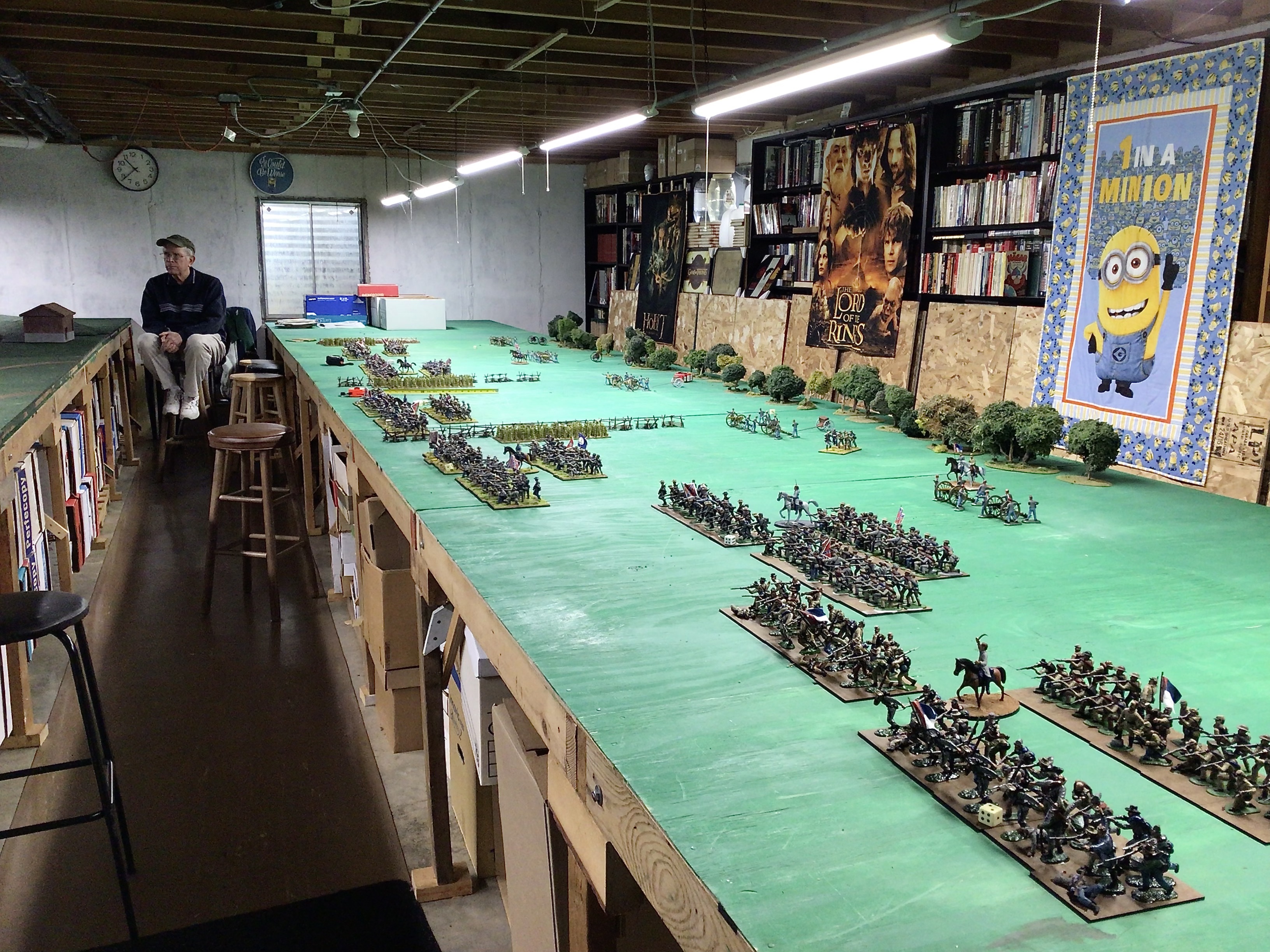
Several days ago four of us convened at the home of Keith L. -- yes, that Keith L, the one with the huge basement that holds three 6ft by 32ft game tables. Our previous play test games established the need for 24 feet long tables in order to hold six brigades of 54mm for Pickett's Charge.

This game largely focused on the rules that we will use in our game. They are based on, mechanically, the Sudan rules that I used last year, but obviously needing some modifications for the American Civil War. The rules are printed on two sides of one sheet of standard 8-1/2" by 11" sheet of paper, they are easy to figure out and learn, and they worked well in a convention game setting.

Musket fire:  Our previous play test revealed that the musketry fire was too devastating resulting in none of the Confederate regiments getting remotely close to the stone wall defended by the Union soldiers. For this game test, I reduced the number of D6 dice thrown per stand of infantry from 4 dice per stand down to 2 dice per stand. This still thinned down the Confederate ranks after they crossed the Emmitsburg Road, but the Rebs were able to hurl a fair number of regiments at the stone walls. This time we had a number of Confederate regiments advance far enough to get into a melee with the Union regiments.

Artillery Fire:  The artillery rules did not need any adjustment so we let well enough alone. We began the game with the Confederate artillery getting a free turn of firing at the Union positions prior to the start of the game. Thereafter, the Confederate artillery could continue to fire at Cemetery Ridge until their infantry reached the Emmitsburg Road.

Melees:  There were no particular problems with the melee rules in the previous play test game (other than the key fact that there were no melees in that game). This game established that artillery crew do not melee, They can either evade the charge and fall back, or they could make one last fire at the oncoming attackers, and if the attackers passed their morale test, then it is assumed that the Confederates got in among the artillery crew and cut them down.

Armistead's brigade engages a Union regiment in the Angle atop of Cemetery Ridge


Cushing's battery is about to get over run by one of Armistead's Virginia regiments.


Morale Tests: My play test gamers had a little trouble getting their heads around the mechanics of the morale test. A regiment has a morale number that it must attain, with a limited number of modifiers, and then it rolls two D6 dice. If they roll their morale number or LESS with their two D6 then the unit passes its morale test. My play testers seemed to want to reverse the test so that a higher number was passing and a low number was a fail. For example, if a Confederate regiment of infantry has a basic morale number of "7" then it must roll a 7 or less on the roll of two D6 dice..

I over ruled my players arguing that it makes more intuitive sense for a gamer to understand that the target number or less made more sense. I like the way that the modifiers can move the morale number up (+1 for defending the wall. +1 for having a leader attached, etc) or down (-1 for each stand lost due to casualties or for losing a melee. For example, if the Confederates need a score of 7 or less, they lose -1 for each stand that is lost; so as they lose more stands, the morale number that they need to roll gets lower and lower. In our example, if the Confederates have lost one stand then they would need a 6 to pass; if they lose two stands then they need a five to pass, lose three stands and need a 4 to pass. The attrition of lost stands makes it more difficult to pass a morale test.

Leader killed when attached to a regiment: we added this rule in order to put some value or use for the leader figures in the game. They already added a +1 to morale, but we decided that there was a chance that the leader might be shot when his regiment was fired upon. So we had a player roll one D6 and a roll of snake eyes ("1") resulted in the leader being killed. So this puts a little bit of risk into your decision to attach your brigade or division commander to a unit for morale purposes.


General Lew Armistead could become a casualty since he is attached to a 
regiment that has taken fire and lost figures.


Crossing the Emmitsburg Road: Historically, this post and rail fences along each side of the Emmitsburg Road proved to be a major obstacle to the Confederate advance. We simulate this by requiring a unit to cross a fence (and nothing more even if the unit has more movement left over after fence crossing) on one turn. Then it could cross the second fence on the next turn, but not move any further so that the regiment could dress ranks and prepare to move out on the following turn. The result is that it takes a regiment two turns to cross the road (double fences) and subjects them to musket fire from the Union defenders.

Kemper's brigade crosses the fences of the Emmitsburg Road. The two regiments on the road
arrived there this turn. They will be able to cross the fence to the other side of the road,
stop to dress lines, and then be allowed to fire at half effect. A third regiment has to wait its turn
to cross the fences.

Removal of stands from the game: we don't want our regiments fighting to the last man so I had a rule that the regiment has to be removed once it is down to two stands, An infantry regiment has five stands with each stand representing 20% of the regiment's strength. So when a unit has lost three stands it has actually taken 60% casualties. This number is higher than what a typical infantry unit could sustain before being rendered ineffective. In our next play test, I might experiment with removing the unit when it is down to its last stand of figures. We had a situation where there was an infantry melee and the Confederate unit won the melee; however, the casualties that it sustained in the melee pushed its strength down to two stands. Should the winning unit get to hold its hard won ground or should it be removed from the game?

A Union artillery battery is about to get over run by a Confederate regiment.

Here are a few more pictures of the play test game:


The middle table (of three tables) is the site of the Emmitsburg Road. Confederate
forces can be seen moving towards the road.

The Confederates of Pettygrew's division (foreground) and Pickett's Division (far end of the table)
descend from Seminary Ridge and advance across that open deadly ground.


Division commander Johnson Pettygrew command stand.

We are planning another play test game in two weeks so that we can implement the new rules changes and see how they perform under actual game conditions. I will also have all of the tables covered with game mats from Cigar Box Battle Mats. This will give us a better idea of how the game will look at the upcoming Little Wars convention in April.

Friday, March 1, 2024

The Washington Artillery


The Washington Artillery deploys a pair of 12-pound Napoleons.


54mm plastic figures from BMC and Americana.


I recently finished painting a crew of 10 figures to man two 12 pound Napoleon guns for my Confederate army in the Pickett's Charge game. The Washington Artillery was formed in New Orleans in 1838 and was considered an elite organization prior to the start of the Civil War. It formed five companies, of which the first four fought with the Army of Northern Virginia in the East, while the fifth company fought with the Army of the Tennessee in the West.

Washington Artillery History

The Washington Artillery was organized as an artillery battalion at Gettysburg, commanded by Major Benjamin Eschleman, comprised of companies 1, 2, 3 and 4. It was part of the corps artillery reserve in Longstreet's corps. The battalion had 8 Napoleons and 2 12-pound Howitzers at Gettysburg.

I organize my ACW artillery into batteries of two cannon models and crewed by 5 figures per cannon, thus 10 figures are in the battery. Each cannon will have its own limber, deployed without the horse teams.

The cannon models and limbers were purchased at Hobby Lobby. I am contemplating leaving the cannons and limbers unpainted, or I might paint only the barrels in a bronze color and leave the carriage unpainted.

Saturday, February 24, 2024

Ask Fritz: Q & A Mailbag


I get a lot of questions from my followers on this blog, Facebook and other social media, so I thought that I would open up the old mailbag and answer some of the questions therein

1.  How did you make the blue sky back drop that we see in your photographs?

I use a piece of sky blue light colored felt and spray random cloud patterns on the felt with white spray paint. Caution, do the spray painting outdoors rather than in the confines of your basement. Trust me on this one.

2.  Where did you get the game mats that are on your table

 I now purchase all of my table mats from Cigar Box Battle Mats. These are my go-to game and table mat for every period of war gaming that I do. You can fold the mats up into a compact rectangle and transport it to the convention site - very easy to do. I now longer mess around with terrain boards or canvas mats. You have to roll up the canvas mat and then you end up with a 6ft long tube of canvas that does not easily transport. Finally, the Cigar Box mats look better than anything that I could do on my own. I simple overlay the mat with buildings and terrain pieces, or place books or pieces of pink insulation foam under the mat to create hills and contours.

 3. What types of materials do you use for basing your figures?

I recently did a tutorial on how to make fences and roads and I used the same mixture of goop on the road sections as I do on figure bases. Basically, I buy a tub of pre-mixed wall board paste (also known as Spackle) and mix brown paint into the tub. Then I stir the paint until it looks like chocolate icing or pudding. It later dawned on me that I could go to the hardware store and buy a tin of brown acrylic household paint at a more economical price.

I use a small artist's trowel and work the goop around the figure bases and between the legs. If your goop starts to get too thick from being in the air, simply add a little bit of water to your container of goop and stir it in. Next, I sprinkle some "fine" railroad ballast material from Woodland Scenics and shake off the excess material. Let the base dry overnight and then start dry brushing highlight colors over the base. After this, I glue on some tufts and static grass and set the base aside for about an hour. You are now finished basing!

4. How do you prime your plastic figures so that the primer and/or paint does not flake off?

After experimenting with various brands, I have found that Army Painter primer is the best for plastic figures. The primer leaves a sort of shiny color on the surface that is really hard fasting, almost like the effect of gloss spray coating. Some of the basic auto paint primer work well too. The only primer brand that I would avoid for plastic figures is the Vallejo brand. I had big chunks of primer or painted figure surfaces flake off. Vallejo may be ok for metal figures, but definitely not for plastic figures.

On a related topic, how do I prepare the plastic figures before I prime them? I wash them in the sink with hot water and liquid dish washing detergent. I sometimes, but not always, give them a good scrubbing with one of those dish washing sponges that has a sponge on one side and a plastic scrub brush on the other side. After this, I rinse the soap off of the figure with warm water. I shake each figure dry to get the water out of some of the deep cuts / crevasses on the figure and then set them on a towel to air dry.

5. How do you organize your AWI and SYW armies?

I use a 1 to 20 ratio of figures to men for most of my armies. Thus my infantry figures are largely 30-figure  infantry regiments. I organize my cavalry into squadrons of 12 figures and have 2 or 3 squadrons per regiment. For the AWI, tend to go with a 1 to 10 ratio since the regimental strengths in that conflict were very small.

6. What or who has influenced your war games the most?

I started war gaming around 1986 when I went to the Little Wars convention in the Chicago area and got acquainted with Dennis Smail of RSM miniatures. Dennis had put on a fabulous looking SYW game with RSM figures (his own company). I fell in love with the RSM figures and was a regular orderer of figures from RSM. One day Dennis invited me to come to Lexington, KY to play in a couple of games over the weekend. Dennis always had great looking terrain and was very good at designing scenarios.

Duke Seifried was certainly an influence for me. Oftentimes our war games would be set up next to each other at a convention, so I'd talk with Duke about all things related to war gaming. I was also attracted to Duke's sense of the epic spectacle of a game. You know where that led me today.

Peter Gilder and his Wargame Holiday Centre had a huge influence on how I looked at war gaming. I visited the WHC when Mike Ingham was running the business and I was mesmerized by the huge tables (3 table of 6ft by 32ft, although one of the table was actually 2ft by 32ft) and the large battalions of figures used in Peter's In The Grand Manner rules.

So from these titans in the hobby, I like to put great looking terrain on the table, run a game that tends toward the spectacle, and I like to use multiple large and parallel game tables to provide depth and wide open flanks.

Friday, February 23, 2024

A SYW All-cavalry Game


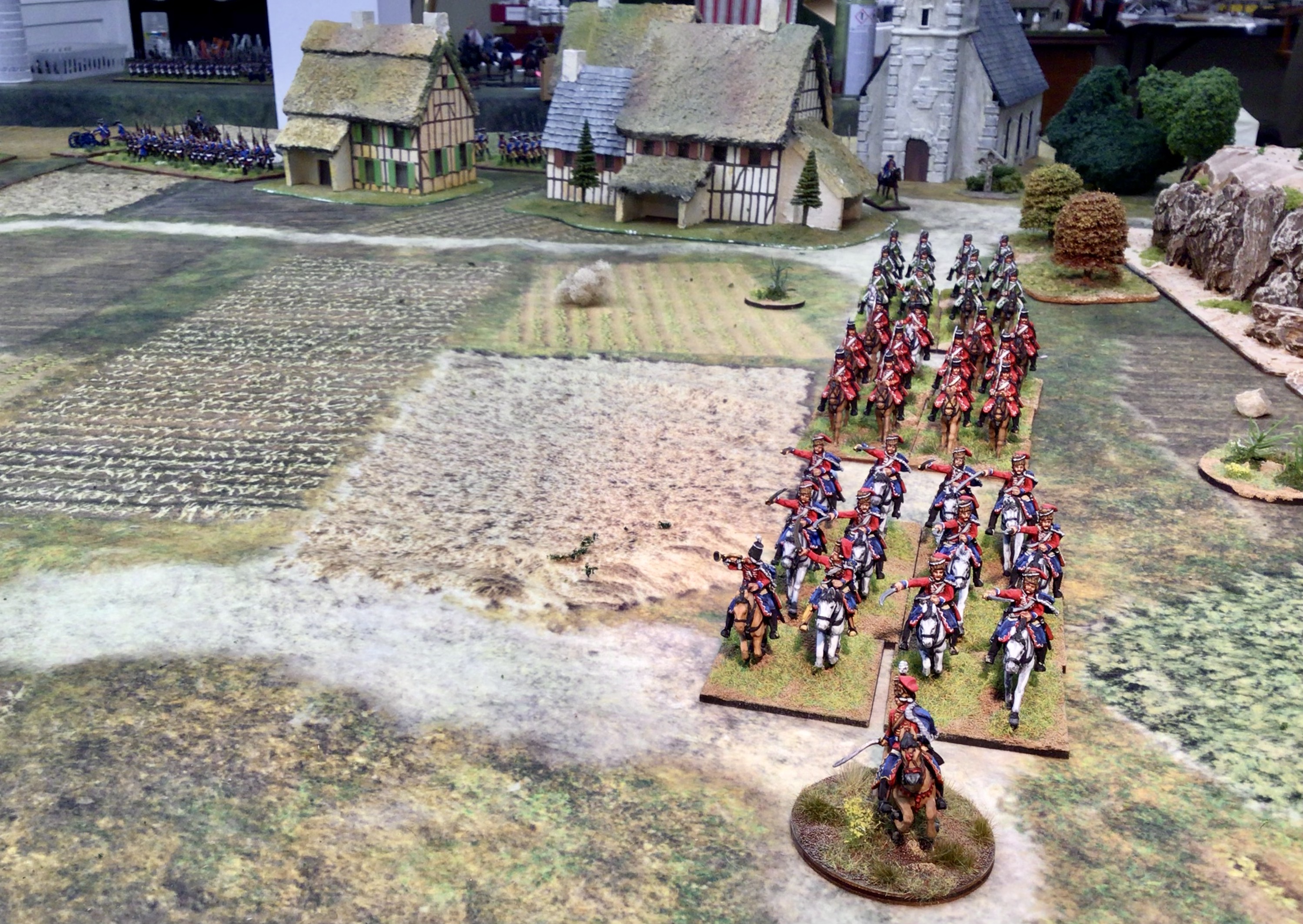
Prussian Hussar brigade of three 12-figure squadrons

Now that all of my Civil War terrain and troops have been cleared off of the game table, I decided that this would be a good time to revisit the Seven Years War with my 28mm Minden Miniatures figures. For a long time I have been intrigued by the idea of staging a game battle that only has cavalry forces on each side. This idea was simulated by the large cavalry Battle of Liebertwolkwitz fought during the 1813 Leipzig Campaign of the Napoleonic Wars. Imagine a game on a large table with enough space to entertain several hundred horsies per side.

So I decided to work on a cavalry scenario that might also include a small number of infantry to support the cavalry. Further inspiration is inspired by some of the Russian raids into Silesia and some large counter-raids conducted by the Prussians in 1761 First Prussian raid into Greater Poland and 2nd Prussian Raid into Greater Poland or Pommerania. The first "raid" was conducted by Ziethen with nearly 20,000 troops while the second "raid" was led by Platen into Pommerania with 10,000 troops. While the two Prussian raids were conducted with fairly large numbers of troops, the general idea of either a Russian or a Prussian raid appeals to me.

The general idea is that it is the year 1760 and things have not been going well for Frederick of Prussia. As a result, the lumbering Russian army decided to leave the comforts of the city of Posen in Poland and march towards the Oder River and create some havoc for Frederick. I also hark back to stories of Russian sponsored Cossacks burning down the village of Zorndorf and other small towns in East Prussia. With little regard for the lives and welfare of the people in the eastern side of the Oder River (let's call it the Trans Oder Region), the Russian light troops pillage and burn their way across Prussian territory (sound familiar these days in Ukraine?).

Frederick doesn't like the Russians in the first place and so once he receives news of this latest Russian incursion, he finally decides that he has had enough of this and is determined to surprise the Russians and give them a bit of a bloody nose.

The Russians are sending a raiding force consisting of Cossacks and Hussars in the vanguard, followed by a main body of infantry (largely grenadiers and some light infantry) and regular cavalry (some dragoons, horse grenadiers and cuirassiers) to the town of Trachenburg. The Russians are not expecting any resistance and expect to have free rein in looting this prosperous little town and then burning it down so as to deprive the Prussians of its value.

Frederick has caught wind of this scheme and so he has decided to lure the Russian raiders into a trap. He will deploy a sizable force of light cavalry hussars and lancers near the defiles that lead into Trachenburg, fall back, and then lure the Russians into Trachenburg, which is occupied by some Prussian grenadiers. Meanwhile, the heavier Prussian dragoons and cuirassiers are waiting further down the road behind Trachenburg. They will attack the Russians after the latter attempt to move into the town. There the Russians will be caught between Prussian infantry in the town and Prussian cavalry to their flank and front.


Russian (R) and Prussian (L) light cavalry troops arrive on the game table near the
peaceful (?) Silesian town of Trachenburg.


Prussian brigade of Black Hussars and Bosniaken lancers await the advancing 
Russian Cossacks and Hussars.

Prussian light cavalry brigade provide a road block in front of a defile.


Russian Cossacks were expecting easy pickings on their raid and were not expecting 
to find any Prussian resistance in the area.


zzz