Monday, December 8, 2008

Kleine Krieg December 6, 1758


Von Kliest Grun Kroaten figures from Wargames Foundry (click the picture to enlarge)

I haven't had much in the way of free time to blog over the past several weeks, because I've been a paintin' fool feverishly trying to get my Von Kliest Freikorps finished in time for our winter kleine krieg game this past weekend, on December 6th. I will post more pictures over the next couple of days, both of our game on Saturday, and of my freikorps additions and more of Milady de Winter's Black Legion.

I was able to field a mixed force of 36 horse grenadiers, 12 hussars, 60 Grun Kroaten infantry, 12 jagers and two sections of 6-pounder von Kliest artillery and 10 crew. I also bumped the Black Legion up from 23 figures to 45 figures within the past week, as well as an assortment of mounted officers. Mrs. Fritz hinted that I should hide my paint brushes after Saturday's game, because I probably wasn't going to be doing much painting for the rest of the month. Fair enough, given that I admittedly overdid the painting blitz in order to get ready for the game.
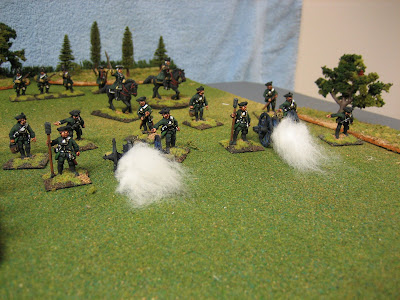

Von Kliest artillery, using Foundry Prussian gunners and artillery pieces from Berlin Zinnfiguren.

Eventually, I will add a couple more squadrons of horse grenadiers to get the unit up to 48 or 60 figures, add another squadron of hussars to get that unit up to 24 figures, and maybe down the road, I might add some von Kliest uhlans.
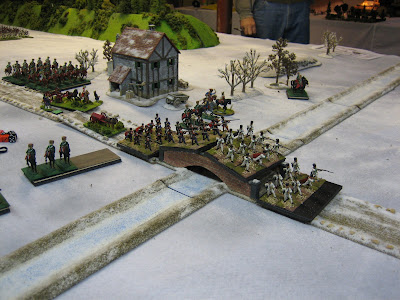

Here is a preview of the kleine krieg game that we played on Saturday December 6th at Brown Deer, Wisconsin. Here we see a hoard of RSM Croats crossing the Apfelwasser spanned by an HG Walls bridge. Mr. Walls also built the road and frozen river sections, the winter trees, and the snow covered building in the background.
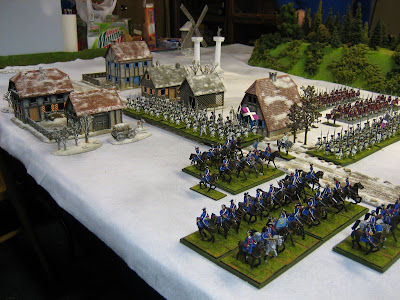


A view of the French army as it marches through the town of Bettendorf towards the Apfelwasser. They could only cross over the bridge or at one of the two fords over the stream. These served as choke points that were well defended by the Prussian frei battalions. Virtually all of the troops in this game were low quality trained or poor troops, albeit with a smattering of veteran grenadiers and the elite Black Hussars (whose eliteness did little to prevent them from being shot out of their saddles by the Fischer light infantry of the French).

Wednesday, November 26, 2008

Fritz Goes Shopping - Again

Today I received a pleasant surprised when I opened the mail box -- there was a packet of books and magazines from On Military Matters. I subscribe to the French publications "Vae Victus" and "Tradition" as well as "Wargames, Soldiers & Strategy" through OMM. It's an easy way to subscribe to international publications.

The Wargame Companion - A Review
At any rate, the packet also included my copy of "The Wargame Companion" by Charles S. Grant, so my excitement level was running very high. Let me start by saying that the book is even better than I had imagined. The anecdotal stories about CS Grant playing in wargames with his father, Charles Grant, and Peter Young, are worth the price of the book alone. Grant provides a lot of the "back story" to the hows and whys of the rules, the fictional 18th century armies that they all used, and much, much more.

Here is a summary of the table of contents:

Part 1 - The Early Years and the ACW
Providing background on the Grant family's introduction to wargaming and the birth of the rules, for ACW use, that eventual evolved into The Wargame rules.

Part 2- The Wargame Revisited
This chapter covers the personalities, both real and fictional; plus background on the armies of the Grand Duchy of Lorraine, the Vereinigte Frei Stadt, and Teutoburg-Althaufen.

Part 3 - Campaigns
Covers the designing of campaigns, easy record keeping systems, and the designing of armies.

Part 4- Scenarios
Sawmill Village, the Wagon Train, and Lobositz original accounts from The Wargame Digest, followed by CS Grant's recent refight of the same scenarios. He also adds a new Guilford Courthouse scenario for the readers. I'm particularly looking forward to trying out the Lobositz scenario, because it can be played on a 6ft by 9ft table with lots of big battalions, such as those that we use in our BAR rules.

Part 5-Bits and Pieces
This chapter discusses how to construct buildings in the manner of those seen in The Wargame, with the lift-off buildings/ruined buildings underneath, a recounting of rules not included in the original The Wargame rules, how to write Tabletop Teasers, how to use random events, and a section on sieges. Included in this section is a piece by Phil Olley, of Old School Wargaming fame, on how he makes his famous cloth/linen standards for his wargame units.

Other Items - there is set of The Wargame rules in easy to read chart form, done by Henry Hyde, a listing of miniatures suppliers of 18th Century wargame figures. Henry has also taken color pictures of the flags and standard bearers for each unit in the Grant family's Vereingte Freistadt army along with pictures from the collections of John Ray, Phil Olley, Angus Konstamm and others.

Finally, in the endpiece, Mr. Grant laments that time and age have taken a toll on his plastic Spencer Smith figures. As they are damaged and the venerable units are retired, they are in the process of being replaced by new metal armies os Staddens, Surens, Mindens and others. Some tantalizing pictures of some new Minden Miniatures battalions are depicted within the final pages.

This is certainly a must have book for any wargamer. I give it my highest recommendation.

A New Book On Fontenoy is Now Available
One of the Vae Victus issues (No. 83 Nov-Dec 2008) has an advertisement for a new Fontenoy book that has me very excited. It looks like it is done in the same format as the Hourtaille Napoleonic books, i.e. lots of color uniform plates, maps galore and tons of useful information. The book is available in both French and English text versions.

The book is titled, "Fontenoy, La France domine l'Europe". It has 80 pages, numerous color plates, maps in 3-D and much more. The cost is Euro 16.50 plus shipping. Contact the publisher at www.vaevictusmag.fr for more information. They also have a similar book on the battle of Essling in 1809.

Monday, November 24, 2008

ACW Bibliography


Dave Alsop original Old Glory Confederates in line formation, with assorted skirmishers covering the wall (Dixon, Connoisseur, Eagle, Connoisseur, Dixon -prone, and Connoisseur).

Last evening's Civil War posting was done at one in the morning and I was unable to provide better information on the books that I mentioned. Here then, is a more complete ACW bibliography with sufficient information to help you order any of these books.

"Champion Hill, Decisive Battle for Vicksburg," by Timothy B. Smith. Savas Beatie LLC, 2008.

"Shenandoah 1862, Stonewall Jackson's Valley Campaign," by Peter Cozzens. University of North Carolina Press, 2008.

"Chancellorsville," by Stephen W. Sears. Houghton Mifflin Co. 1996.

"The Battle of the Wilderness, May 5-6, 1864" by Gordon Rhea. Louisiana State University Press (hereafter: "LSU Press"), Baton Rouge, 1994.

"The Battles for Spotsylvania Court House and the Road to Yellow Tavern, May 7-12, 1864." by Gordon Rhea. LSU Press. 1997.

"To the North Anna River, Grant and Lee, May 13-25, 1864." by Gordon Rhea, LSU Press, 2000.

"Cold Harbor, Grant and Lee, May 26-June 3, 1864." by Gordon Rhea. LSU Press, 2002.

I should note that Mr. Rhea will be publishing his next book in the Overland Campaign of 1864, called "Crossing the James" as the tentative title. Look for this during the first half of 2009.

As you can see from the list above, I have been doing quite a lot of reading on the ACW over the past year and I look forward to following Gordon Rhea's series and then diving into Hennessy's book on the 2nd Bull Run (Return to Bull Run, I believe it is called). All of this will come after I finish my current book on McClellan's Peninsula campaign, by Stephen Sears. After that, I will finally read the two Michael Priest books, "Before Antietem, the Battle for South Mountain", and his book on Antietem.

ACW Rules
Several readers asked me which set of rules I use for my Civil War wargames. The answer is, a house set of rules that are a variant of "Rusty's Rules for Horse & Musket Warfare". My old gang of wargaming friends in Lexington, Kentucky developed this set in the late 1980s and early 1990s and we must have played a hundred wargames with them over the years.

The rules are used for brigade level games. By "brigade level", I mean that each player commands a brigade of 3 to 6 infantry regiments and a battery of artillery; or a cavalry brigade of 2 to 3 regiments with a battery of horse artillery. The figure ratio used in the pictures is 1 to 10, or one figure represents ten real men, although we initially used a 1 to 30, then later, a 1 to 20 figure ratio. We settled on 1 to 10 because it looks terrific, yet doesn't require too many figures to build up a battalion. By mid war, the average infantry regiment might have had 300 to 400 men, so that is 30 or 40 figures per regiment. I even have several 50 and 60 figure regiments and one 80 figure regiment.

Each regiment is based with ten stands of figures, so that everything is easily divisible by 10. Morale takes a basic morale rating of 1st class - 100%, 2nd class - 80%, 3rd class - 60% and 4th class - 40%. You deduct 10% from the total for each 10% of figures that are casualties. So for example, if you had a 40 figure regiment, you would base the figures 4 per stand on 10 stands. Once you lost a stand of figures, you would deduct 10% from your morale score, or 20% off if you lost two stands, etc. You roll a D100 and modify the score to determine whether or not morale is passed. I could probably cite all of the modifiers from memory without even having to look at the rules sheet.

I truly believe that ACW wargames should be fought at the brigade level, with the basic units being the infantry regiments. Read any ACW book, particularly the ones listed above, and you will quickly see that the action is all about the individual regiments and how they perform on the battlefield. The main concern in ACW battles, is being overlapped by the opposing brigade and thus getting outflanked. You see this time and again in various ACW battles.

Somewhere on my list of projects to do is a reprinting of the Lexington House Rules variant of Rusty's Rules. I have all of the play sheets etc, it is just a matter of sitting down at the computer for several weeks and putting it all together again.

Ah yes, this brings back memories of many happy days of wargaming for me.

A Little ACW Interlude


1st Tennessee and 7th Tennessee of Archer's Brigade (Heth's Division) circa June 1863. Figures are a hodge-podge of everything from Dave Alsop Old Glory figures, to Eagle, Connoisseur and one Dixon chap who's chucking rocks from the skirmish line.

Over the past several months I have been reading American Civil War books during my hour long train commute into the office everyday. Earlier in the year, I worked my way through Grant's Overland Campaign of 1864, courtesy of the four volume set by Gordon Rhea. Mr. Rhea's books are a pleasure to read and are well augmented by plenty of maps and orders of battle in the appendices. The series is highly recommended.

Next on the list was a new book about Champion Hill, a battle fought between Grant and Pemberton during the Vicksburg Campaign. Then Peter Cozzens recently published his new book on Jackson's Valley Campaign of 1862. If Cozzens wrote a book about the history of wall papering kitchens and bathrooms, I think that I would buy it sight unseen because he is such a good story teller.

Last week, I completed my reading of Stephen Sears' book "Chancellorsville" and found that it gave me a very good understanding of a complicated battle. It also dashed a lot of misconceptions that I had about the battle and Fighting Joe Hooker. I was rather surprised to discover how good Hooker's intelligence network was. He had Lee's army strength spot on, within a couple of thousand men and he knew where every brigade was deployed. This gave him a tremendous advantage at the beginning of his campaign. I left the book with a feeling that Chancellorsville was actually a winnable battle for the Army of the Potomac, after the first day when Howard's corps was obliterated by Jackson's flank attack. Days Two and Three were quite a different story.


Harry Heth and his staff consider their next attack at Chancellorsville.

I am now reading Sears' book on the 1862 Peninsula Campaign, called "To the Gates of Richmond. More on this later.


A Confederate regiment deployed in open order, with skirmishers in front. Building and fences by H.G. Walls; figures an assortment of everything, but mostly Dave Alsop's original Old Glory figures. Flag and basing done by Dennis Smail.

Tonight, I set up my wargame table with my ACW terrain and set up a small battle with two brigades per side. I am playing it as a solo game, so it takes awhile to get several turns in. I was up to the start of Turn Six when I retired to bed this evening. I will provide some updates as the battle continues over the next several days. Oh, and there will be a few more pictures as well.

Monday, November 17, 2008

Friedrich Hears The News


Couriers arrive at the King Friedrich's headquarters with news of the Electoral Army's defeat at Streinkriesdorf.

Bad Tidings Arrive at Frankfurt
A courier rides breathlessly and at full speed to the headquarters of King Friedrich at the Germanian army headquarters outside of Frankfurt am Main. He brings news of the defeat of the auxiliary Electoral army of allies at the town of Streinkriesdorf, at the hands of those perfidious Gallians commanded by that rascal Chevert.

"Your Excellency, I bring news from Landgraf Bogey of Hesse Fedora," gasps the young courier, "the Electoral Army has been defeated by the Gallian-Reichsarmee forces at Steinkriesdorf!"

A look of horror spreads over the faces of some of Friedrich's staff as they digest the news of this defeat. A low murmur echoes around the collection of senior officers. Finally, King Friedrich raises his hand to call a halt to the panic.

"Gentlemen," says Friedrich in an authoritative voice, "let us not lose our heads. You will be needing them in the next battle."

The officers all nod their heads in agreement. The panic subsides. They look to their king for their orders. King Friedrich turns around and points to the collection of troops assembled in the field behind them:


"The Gallians still must contend with this lot!" exclaims King Friedrich.

The officers begin to cheer, their confidence has returned.

"And if that isn't enough," says the King, "then they still have to fight my Gardes."


"Now gentlemen. We have work to do and a campaign to complete. We will open the seige of Frankfurt tomorrow. The Marquis de Granby has brought his Britannian army down from Minden. And he happened to bring a considerable amount of seige artillery that just happened to be lying about unused."

"I am sure that Lord Granby will put his artillery to good use, Excellency," said General Alberti, "there will be a hot time in the old town tomorrow night."

"Gentlemen, while the Britannians conduct the seige operations, we shall march east and search for some Gallians to put in the stew pot," intoned the King.

Painting Update
It has been awhile since I have posted any news so I thought that I would provide a brief update on the activities at Schloss Seewald over the past several weeks. It looks as though they had a terrific BAR wargame down in Austin, Texas over the weekend. I wish that I could have attended with my brigade of the Gardes. That might have made all of the difference in the outcome.

I have been busy painting von Kleist Freikorps figures for our big Kleine Krieg game in December (how is that for an oxymoron?). Pictures will follow later in the week once I get the forces up to critical mass.

So far, I have completed two squadrons of 12 horse grenadiers and as 12 figure squadron of von Kleist hussars. A third squadron of the horse grenadiers are sitting on my painting table, partially completed. The riders are finished, but I still have to paint the horses. I really do not enjoy painting horses for some reason, but there you have it.

With only three weeks to go until our Kleine Krieg game, I still have much work to do. I plan on building the von Kleist horse grenadiers up to four squadrons, or a total of 48 figures, paint 60 Grun Kroaten infantry, and two 6-pound foot artillery sections. I also have a handful of Milady de Winter's Black Legion to complete and there should be a surprise or two in that unit as we near the game deadline.

Friday, October 31, 2008

All Hallows Eve


A group of Prussian grenadiers from the IR12 Alt Darmstadt Regiment enjoy a little down time for cooking, hunting and maybe a little bit of figure painting.

It is All Hallows Eve and all of the little monsters are done with their trick or treating, so things are quieting down a little bit and I have a little bit of time to paint. Except that I didn't do any painting. I couldn't quite get my painting mojo going this evening, so instead, I cleaned and primed another squadron of von Kleist horse grenadiers so that I can start painting them over the weekend. I also applied the finishing touches to the bases for 7 more of the Black Legion de Winter and 6 von Kleist dismounted horse grenadiers.

I had a decent painting output this month, consisting of the following figures:

12 x CR10 Prussian Gendarmes - Crusader Miniatures (24 pts.)
12 x von Kleist Horse Grenadiers - Foundry figures (24 pts.)
19 x Black Scorpion Pirates and Marines (19 pts.)
6 x Foundry dismounted von Kleist horse grenadiers (6 pts.)

So that results in 73 Olley Painting Points for the month of October. Not bad, considering that the first two weeks of October were devoted largely to preparation work for my Big Battalion Old School Wargame on October 11th. That was quite a big production, and well worth the effort. And then last weekend, Bill, Randy and I hosted a BAR SYW wargame at the Rock Con convention in Rockford, Illinois. So it has been an active month for me.

Now that all of the big games are over, my thoughts turn to getting units ready for the Winter skirmish game that we will play the first weekend in December, up in Brown Deer, Wisconsin. So I am busy painting freikorps and jagers and other types of figures that one does not normally see on a wargame table. I like the Foundry von Kleist horse grenadiers, which is really saying something since I am not normally a big fan of the Foundry style of figures. Somehow, though, they work for me. So I primed another squadron this evening with the hope of getting them done over the weekend. That would give me two squadrons of the eventual three or four that I plan to have in the skirmish game.

As of now, my planned von Kleist Freikorps will consist of the following:

4 sqds x 12 Horse Grenadiers
2 sqds x 12 Hussars
2 sqds x 12 Uhlans
Total Cavalry = 8 squadrons x 12 figures or 96 figures.

1 btn x 60 Green Croat infantry
1 btn x 30 Jager
1 btn x 30 dismounted horse grenadiers
Total Foot = 120 figures

2 x 6 pound light horse artillery (10 crew/2 guns/2 limber teams)

1 x mounted infantry commander
1 x mounted cavalry commander

Now historically, there were 8 squadrons of the horse grenadiers and 10 squadrons of the uhlans and 5 squadrons of the hussars; but I have no intention of painting that many freikorps figures. Hmm, 10 squadrons of uhlans would be an impressive sight, don't you think?

Monday, October 27, 2008

Freikorps von Kleist (FC12)


Von Kleist Dragoons from Foundry, painted by Der Alte Fritz

"Triple blue and three times damned to the Devil (Dreimal blau und dreimal des Teufels)," is allegedly what Frederick the Great said about his various frei-battalion troops. The phrase refers to their typical blue coat with light blue facings and light blue waistcoat.

One frei korps unit that performed better than Frederick's low estimation of the troops in general, was the legion of infantry, cavalry and artillery recruited and organized by Colonel Friedrich Wilhelm von Kleist in 1759. These were the best of the best in Christopher Duffy's estimation and the eventually grew into a corps of 6,000 men of all troop types.

The unit began its service with Prussian with the formation of a squadron of hussars in 1759 and was gradually augmented with a regiment of Croat styled infantry, a regiment of dragoons wearing a sort of horse grenadier hat, some more hussars, and ten squadrons of uhlans. Finally, a battery of horse artillery decked out in green uniforms and some jagers filled out the corps.


Von Kleist jaegers prowl the woods, directed by Colonel von Kleist and his aide on horseback.

I had thought that my days of painting Prussians had come to an end, seeing as how I had everything that I could possibly need and being limited by the number of boxes of figures that I could transport in my car. But then, our little group came up with the idea of painting figures so that we could do a game featuring light troops, or Kleine Krieg. I happened to have a batch of the von Kleist dragoons in storage. I had acquired these Foundry figures from the old Standing Order days, when I would automatically receive a box of sample SYW figures on a regular basis.

I tried painting a couple of test figures first, and found that I rather enjoyed working with these particular Foundry figures. They have a lot of personality and character to them, and they aren't the misshapen dwarves that seem to pass as Foundry figures these days. And being largely green in color, they are not that hard to paint. The other night, I finished two figures in about two hours of nonstop painting.

I plan to build a corps comprising of a regiment of dragoons (36 to 48 figures), some dismounted dragoons (maybe 24 at most), a battalion of the Green Croat infantry (60 figures), some of the jaegers (30 figures), a squadron of hussars (12 figures), and maybe two squadrons of the uhlans (24 figures). Finally, I will add two 6 pound horse artillery guns with five crew each.

I have a good start on this project, having painted a dozen each of the dragoons and jaegers with another 24 Croats on the painting table. I bet though, that when the resupply of Foundry figures arrives in a few more days, that I will want to switch back to painting the von Kleist dragoons (that look like horse grenadiers). Anticipation makes it all worth while.