Friday, October 26, 2007

Suren Kettledrummer & Other New Toys


Top: Suren 30mm Trumpeter with Kettledrum conversion
Middle: Comparison of Suren with Elite Trumpeter
Bottom: Same figures, other side


I finished up a couple of squadrons of 30mm Suren SYW Prussian cuirassiers last night, including the trumpeters and the kettledrummer mention in my previous posting. Please click on the pictures above for a close up view of the work.

The first picture shows the Suren Prussian cuirassier trumpeter painted as a kettledrummer and as a cuirassier trumpeter. Note that Prussian cuirassier musicians did not wear the iron cuirasse. I used the Foundry Prussian kettledrums and attached them to the Suren figure by simply drilling a hole into the pistol holders and gluing on the drum. As you can see from the picture of the trumpeter, it is then only a matter of bending the right arm a little bit higher and the left arm a little bit lower. Then I cut off a small piece of brass wire and added a little ball of green putty to form the drum sticks. These were then glued into the hands of the trumpeter (no easy feat was that, I must say). I added a little bit more putty to make the right hand larger and also cover the gap over the drum stick. I probably used a little too much putty on the hand, but all in all, it's not a bad job for someone who has little experience with conversions. I have a lot of respect for sculptors and their ability to work with epoxy putty. It isn't easy.

Results of the Painting Blitz
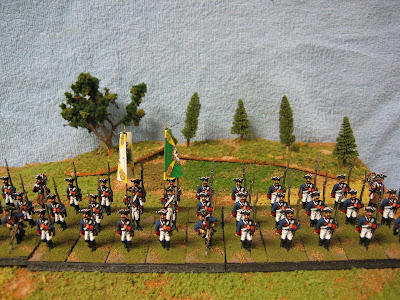
IR25 von Kalckstein Regiment - Elite Miniatures
Here at last, are a couple of pictures of IR25 Kalckstein, in Prussian service, that I painted over the course of 20 hours and 6 days prior to the OSW Big Game on October 13, 2007. These are the new Elite Miniatures "march attack" pose that Pete Morbey sculpted last summer and recently added to his catalog. This is a nice serviceable pose and I found it fairly easy going to do a blitz paint job in six days. How does this differ from my normal painting style? It is not too different, other than I did not bother to paint the gaitor buttons or do a third highlight shade on some of the colors. I am happy to report that Kalckstein performed very well during the game and did not rout, as so often happens with newly painted wargame units. The flags are GMB Designs and the flag poles were made from wire spears that I purchased from North Star Miniatues, in the UK. The flag cords are florist's wire twisted together and glued onto the flag staff.

Some New Austrians Have Arrived As Well
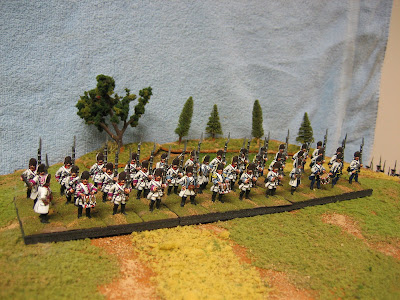
Converged Austrian Grenadiers - Crusader Miniatures (painted by Dennis Smail)

Here is a picture of some Crusader SYW Austrian grenadiers that I recently added to my growing collection of Austrians. They had their baptism of fire in the OSW Big Game and handled themselves very well. The figures were painted by my long time friend and eminence gris Dennis Smail, of Lexington, Kentucky. I think that he did a fine job on the grenadiers. While only three stands are shown, Dennis painted five stands of 12 grenadiers, each stand representing a different regiment. The Austrians converged their grenadiers together on an ad hoc basis prior to the battle. Thus there were no permanent grenadier battalions as there were in the Prussian army. My Austrian army is only at half the size of my Prussian forces, so there is much work to be done before the Austrians can take on King Frederick in Silesia. Thankfully, Dennis is going to help me with a few more Austrian units. I officially declare that November will be "Austrian Painting Month" in Hesse Seewald.

Monday, October 22, 2007

Kettledrummers & Knick Knacks


Piepp 45mm Prussian Cuirassiers

I feel another painting surge coming on and look forward to seeing what I can turn out from the Potsdam Production Line. With another Big Battalion game lined up for the Rock Con convention on November 3, 2007, I have no doubt that some interesting additions will be made to Der Alte Fritz's SYW Prussian army over the next two weeks. Let's just say that the little setback at Preisserstadt has given me plenty of motivation to paint.

Last night I did some conversion work on a Suren 30mm cuirassier trumpeter and turned him into a kettledrummer, sort of like the one pictured above. The casting's right hand is raised over its head as if getting ready to strike the kettledrum. So I cut off a section of brass rod for the drumstick, placed a tiny wad of green putty on the tip, and glued it onto the hands of the musician. For the kettledrums, I used the drums that come with the Foundry Prussian kettledrummer and merely drilled a hole into the each side of the neck on the horse. The Foundry figure is too large and cartoonish looking to use with the slender Surens, but the kettle drum is nearly perfect. The figure is still drying so I don't have any pictures yet. Tonight, I will prime the kettledrummer and then start the painting process later in the week. With only two weeks to go before Rock Con, I ought to be able to add one more musician to my cavalry contingent.


The 45mm Piepp casting pictures above, come from Germany, via the Berlin Zinnfiguren store and I used a picture of one of these fellows as a stand-in for my own creation. I am curious to see how it will paint up.

Speaking of Berlin Zinnfiguren, some of my artillery back orders arrived over the weekend. I can now add a 12 pounder and a 7 pound howitzer to my artillery park. And as I walked into my house this evening, I saw a large box from Berlin Zinnfiguren on the front hall table, perhaps an indication that the rest of the artillery park has arrived. Oh boy!

UPDATE: Yes, the rest of my Prussian artillery arrived today, so now I have three 12-pounders, a 10-pound howitzer, a 7-pound howitzer, and a 6-pounder. The Euro 30 price includes both the limber and the gun and both pieces come pre-assembled. I counted 11 different components in the 12-pounder, so when you stop to consider the amount of time that goes into the assembly of these models, the price seems more reasonable.

My plan is to upgrade all of my regimental guns from 3-pounders to 6-pounders and 7-pound howitzers. I have no choice in this matter, because the French insist that their 4-pounders are really 6-pounders and thus I am outgunned. Now I understand that there was a difference in the French pound and the English pound weight, but in an imaginary world with fictional countries, a pound is a pound is a pound. Period.

Friday, October 19, 2007

Preisserstadt Summary

My how the time flies -- this time last week we were setting up the wargame table for the Big Game and everything seemed to harried and hectic. Now that a week has passed, I'm starting to recover from the inevitable post-game depression or burnout that often seems to accompany such games. I cleaned and primed a new batch of figures last night and will probably make my way back to the painting table over the weekend - I can't tell you what is next on the painting schedule because there are Gallian spies lurking everywhere. I want to have a few surprises for them at the next battle on November 3rd at the Rock Con convention.

So how did the battle of Preisserstadt turn out, you might ask. Regretfully, I had to award a victory to the Gallians (French) on victory points. It seems that Milady de Winter's spy network furnished Der Erbprinz with the wrong set of maps, and as a result, he made no effort to defend the Jungwald on the left flank or contest the Heydewald on the right flank. Hesse Seewald troops were within inches of both terrain objects but had departed them on the last turn. I was working off of an old map and didn't realize that the newer map assigned terrain points to these woods. That turned out to be the difference in the points. The Gallians lost more men, roughly 40% of their forces compared to 35% for the Hesse Seewald army. However, the Gallians had 2 captured flags compared to 1 for the Good Guys so that gave the fleur de lys an extra point. They also had one less route during the game. So Gallia ended up winning by one point. Congratulations to the Gallians, Russie, Imperiums and other Allies and players. Well done!


Both Chevert and Der Erbprinz agreed that Preisserstadt had a sort of Zorndorf feel to it, with both sides battered bloody and senseless while neither side had any tactical advantage at the end of the game. So Der Erbprinz is falling back towards Hesse Kassel via Paderborn and Marburg, where he will regroup and refit his army for the next battle. The Gallians were last seen retiring towards their supply depot at Cologne. More later...

Monday, October 15, 2007

Battle of Preisserstadt (Part II)

Here is the second part of the pictures that I took at the OSW Big Game on Saturday October 13th in the Chicago suburbs. As with all of the photographs, please click on the picture in order to enlarge it to its full size.


Prussian Cuirassier Regiment No. 2 "Prinz von Preussen" crashes into one of the French regiments as a prelude to the ultimate show down of the cavalry forces. The 60-figure French Carabiniers await the outcome of this melee in the second line. To the left of this action, the Mestre-de-camp regiment of the French cavalry arm is about to run off the Prussian Lieb Cuirassiers. At the top of the picture, the Prussian Brown Hussars clash with some Saxon Cheveau-legers. The French seemed to have done a better job of massing larger forces of cavalry whenever they engaged in a horse melee. This and some unfortunate dice rolling put the Prussian horse at a disadvantage. As the game progressed, the Prussian cavalry commanders learned their lesson and began to fight the French with equal numbers, achieving some successes late in the game.


This is the fight that we've all been waiting for: the French Carabiniers (aka "The Thundering Herd") versus the Prussian CR2 Prinz von Preussen (aka "Death by Cavalry"). There are 60 French and 45 Prussians in this grand melee. Next left, we see the CR1 Buddenbrock Cuirassier Regiment of Prussian cuirassiers advancing into some Spencer Smith dragoons. In the background, remnants of the French regiment that meleed with the Prussian cuirassiers are seen fleeing for thier lives. Meanwhile, the French cavalry regiment Royal lurks behind the Carabiniers, ready to add their weight to the second round of melee. How did this all turn out? I can't recall. We may have called the game before this melee could be concluded. I will have to ask my French colleagues what happened.


The Prussian Garde Brigade (III/15 in the foreground and IR6 at the top) form the last line of defense on the Prussian right flank, guarding Schloss Heyde, which was one of the terrain victory points that the French needed to capture. A battalion of Prussian fusiliers was billeted inside the Schloss, but the French didn't know that. A battery of horse artillery supports another brigade of Prussian cuirassiers and two squadrons of hussars to further buttress the right flank. Papa didn't raise no fool when he brought Der Alte Fritz into the world. There was no way that I was going to allow the French to turn our flank, at least not without defeating my best infantry first.

Some other points of note are that all of the buildings were constructed by Herb Gundt, of H.G. Walls. The white monuments that you see near the Schloss Heyde are the victory columns that we earn whenever we first win a battle. So each player brings his own victory column, which is placed on some "victory hill" somewhere on the battlefield. The larger white crypt-like monument is given to the army commander for each side. It is a traveling trophy that goes to the person who commanded the army in its most recent victory.

You may have also noticed an ammunition cart in the lower left portion of the picture (Front Rank Miniatures) and the little green tag. The tag depicts the number of ammo rounds that each gun has, or in the case of an ammo wagon, the number of rounds that are in the supply wagon. A little "bomb" symbol denotes round shot while a square denotes cannister. Each cannon starts the game with 4 round shot and 2 cannister rounds.


Meanwhile, back at the other end of the table, the Austrians were finally making a determined push to capture the Preisser Heights on the Prussian left (Allied/Austrian right). The Prussians appear to be using a "rear slope" defense of the heights. The Austrian hussars in the middle of the picture charged up the hill and were repulsed by the infantry battalion in the center of the picture. While this was going one, the Croats were pushing the dismounted Prussian hussars (Foundry figures) back through the Jungwald towards their supporting Prussian infantry.

Sunday, October 14, 2007

Battle of Preisserstadt (Part I)

Here is a batch of photos from our Old School Wargamer's Big Game that took place on Saturday October 13, 2007. We had twenty players gaming on two parallel 6ft by 28ft tables, with approximately 4,500 miniatures. Please click on the pictures to enlarge them for ease of viewing.


The "Good Guys" - The Prussian Team (der Alte Fritz shown kneeling in the front row)


The "Bad Guys" - The French Team. Monsieur le General de Chevert shown kneeling in the front row.


View of the Prussian table and their initial deployment.


View of the French-Austrian table and their initial deployment.

The Austrians advance on the Allied right flank to begin the game. Their orders appear to have been to capture the village of Lineolstadt in the center and refuse the right wing, because they did not advance much beyond the table edge throughout the course of the game, despite outnumbering the Prussians in this sector of the table.


Prussian left wing (facing the Austrian) occupy the Preisser Heights, while their light cavalry advance to secure the Jungwald woods. The Prussians were likewise ordered to refuse their left wing. Much of the Prussian infantry shown on the hill would eventually be wiped out in a fierce fire fight with the Austrians.


The French decided to make their main attack on their left wing, where the open ground favored the deployment of their heavy cavalry. Here we see the advance guard of 8 battalions moving forward at the beginning of the game. What we don't see is the mass of French cavalry and more infantry hidden off-table, behind this fearsome lot.


A view of the Prussian right wing, with only four battalions, but a fair amount of cuirassiers awaiting the French onslaught. The Prussian infantry would advance to the stream on the right hand side of the picture while the cavalry brigade would secure the right flank. The only problem was that the cavalry were staring down the gun barrels of too many French muskets and cannons, so they had to fall back behind the cover of the infantry.


In the center of the battlefield, the Prussian Brigade Barta occuppied the important village of Preisserstadt and sent a detachment of jagers into the Hekkiwald, in front of the village. The Prussian plan was to hold a strong reserve in the center (off-table in this picture) and then send assistance to sectors where the French were strong, or to launch a counter attack up the middle if conditions seemed to favor such a move.


The Austrians advance towards the left-center in support of the French main attack on their left. To the right of the Austrians was a brigade of Russians. Both brigades were converging on the village of Schleich in the Prussian center. So, with two French brigades, one Austrian brigade and one Russian brigade moving in unison towards the Prussian right and right-center, there was no longer any doubt about the French strategy. Der Erbprinz thus committed his brigade of guards to anchor the Prussian right and also sent in his reserve brigade of cavalry. The battle would be decided in this sector, while the Prussian center and left were left to their own defenses in their sectors.


Von Seydlitz sent in a small squadron of the Black Hussars, as a forlorn hope, to delay the French cavalry until he could bring up the rest of his heavy cuirassiers to contest the French horse. One squadron of hussars against three squadrons of heavy cavalry, with three more squadrons in reserve, are not a fair matchup, regardless of the rules used.


Due to the shortage of infantry in this sector, the Prussians had little choice but to use their cuirassiers as battering rams against solid French infantry, albeit with notable success. The French battalion engaged in melee with the Prussian cuirassiers, in the picture above, routed. Meanwhile, the savy French cavalry commander held back his 60-figure Carabinier Regiment hoping for some easy pickings against depleted Prussian cavalry regiments. To the right, we see the Prussian Lieb Cuirassiers matched off against the French Mestre-de-camp cavalry regiment.

I will have to post the rest of the pictures tomorrow. The Blogspot software seems to have gone on the fritz and I can't down load anymore pictures for awhile. Darn it! And you should have seen the picture of the big honkin cavalry melee that I was going to show you.

Friday, October 12, 2007

What The French Are About To Recieve


I found this inspirational picture of the French infantry on the short end of an encounter with some Prussian cavalry. Presumably this scene takes place during the Battle of Rossbach, as I can not recall any other French vs Prussian battles during the Seven Years War.
****************************************
It is Friday evening on October 12th of 1757 (2007) and the army of Hesse Seewald is holding a strong position near the town of Preisserstadt, about half way between Minden and Hamm. The armies of Gallia and Hesse Seewald have done their tactical minuet as they maneuvered their way over the past week and into the positions that they now hold. Der Erbprinz Friedrich von Hesse Seewald makes his final rounds and inspections of his army, as it awaits the battle that is certain to happen on the morrow. The Gallian (France) army of Marshal de Broglie lies stretched across the fields below the Preisser Heights. Their campfires glow like thousands of fireflies. The arrogant Gallians make no attempt to hide their numbers. They will have to pay for that tomorrow.

Der Erbprinz rides along the lines, stopping here and there to talk to his men as they huddle around their warm campfires. His army holds the high ground, so the men can safely light campfires in the dead ground without being seen by Gallian pickets. Their spirits are high and Der Erbprinz is confident of victory tomorrow. He stops to talk to Colonel von Kalckstein, whose regiment has recently joined Der Erbprinz's army. The men come from such places as Minnesota, Ohio, Nova Scotia, Indiana, Illinois and Wisconsin and other lands far and wide. They are well trained. They will do well tomorrow. Satisfied that all the preparations have been executed to exact standards, Der Erbprinz retires to his quarters for a brief night's rest. He will be early, before the sun rises. Tomorrow will be a big day - the Battle of Preisserstadt.

Thursday, October 11, 2007

Paint Blitz Update


IR12 Re-enactors (not painted by Der Alte Fritz)

As of last evening I had completed and based 58 of the 60 figures that comprise my IR25 Kalckstein battalion (using the Elite Miniatures SYW Prussians in march attack pose). In all of my haste, I had forgotten to assemble and prime the standard bearers. These latter were primed last night and I will finish them off this evening. As always, I will use the GMB Designs flags for the unit to finish it off. So it looks like I have reached my goal of painting 60 figures in 6 days. I'm estimating that the entire project will have taken me 20 hours to complete. This breaks down to approximately 20 minutes per figure, from start to finish, rather than the projected 60 minutes per figure. I will try to post some pictures of Kalckstein on friday.


Tonight, I will be busy terraining the bases of two new Austrian units. One is a battalion of Warrior Miniatures British that were painted as Austrians. The figures were purchased in the flea market at Historicon, circa 1992 and someone else did the initial painting of the figures as Austrians. I did a "repaint" of two smaller battalions and converted them into one larger 60 figure battalion to use in our BAR games. I left the faces and cross belts "as is" but repainted the coats, muskets, tricornes and gaitors.


The second Austrian unit is a 60 figure battalion of Crusader Miniatures Austrian grenadiers. I received these in the mail on Tuesday from Dennis Smail, who painted them for me. I will post a picture of the grenadiers tomorrow, and I think that you will like them as much as I do. Dennis painted the grenadiers in groups of 12 figures. Thus, each stand of 12 grenadiers represents a different regiment. This results in a rather colorful looking battalion. Gosh, I almost wish that I could play the Austrians in our Big Game this weekend just so that I could command these fellows on the table top.