Showing posts with label Kunersdorf. Show all posts

Monday, December 17, 2018

The Battle of Kunersdorf Game Preparation


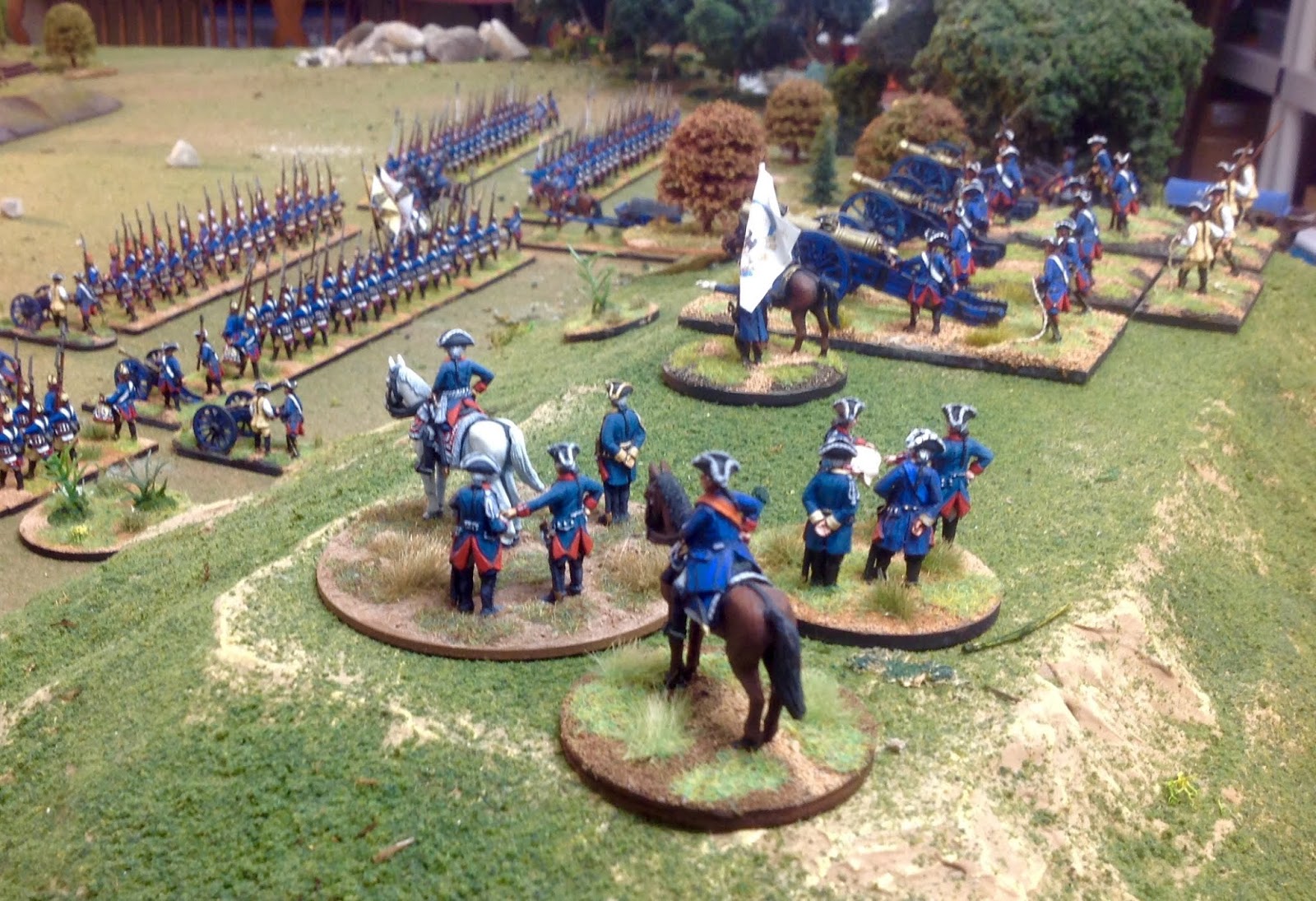
Frederick surveys the deployment of his advance guard from the Walke Berg heights


I decided to go ahead and do a Kunersdorf-Lite game before going off for the holiday. I will be posting the pictures and game report on this blog using the scheduled post feature in Blogger so that the posts will be placed on the blog while I'm away.

Prussian advance guard of 3 grenadier battalions.

Advance guard prepares to assault the Russians deployed on the Muhl Berg.


Here are some of my thoughts about the organization and composition of Allied and Prussian forces that fought at Kunersdorf. First, I wanted to remove the detached troops from the order of battle. These lucky units were left behind to guard bridges or the baggage park while the fighting was going on.

How many soldiers were at Kunersdorf? The numbers vary greatly using a number of sources such as Christopher Duffy, Kronoskaf (German General Staff Histories) and Alfred Rambaud. So you have to sort of pick one and just go with it. I decided to use Rambaud as my source noting that some of his figures are identical to what Christopher Duffy has in Russia's Military Way to the West.

Prussian Army at Kunersdorf
Rambaud and Duffy present the total Prussian army at 49,000 soldiers comprised of 35,000 infantry, 13,000 cavalry and 1,000 artilllery crew. With detachments of 9 battalions guarding the bridges near Goritz and 13 squadrons of hussars guarding the left bank of the Oder River, I come up with a number of 6,700 soldiers not present at the Battle of Kunersdorf.

7 btns of regulars and 2 btns of Freikorps--assuming 600 per battalion = 5,400
13 squadrons of hussars --assuming 100 cavalry per squadron              = 1,300
                       Total Detachments:                                                           = 6,700

After deducting the detachments I estimate that the Prussian army on the battlefield had 29,600 infantry, plus 11,700 cavalry and 1,000 artillery crew for a total force of 42,300 men.

Russian and Austrian Armies at Kunersdorf
Rambaud and Duffy cite the Russian strength at 43,000 infantry plus 4,650 battle cavalry and 7,200 light and irregular cavalry (Cossacks). With 4 battalions of foot protecting the baggage park and removing the Cossacks from consideration as likely troops on the battlefield I generate an estimated force of 41,000 infantry plus 4,650 cavalry and 1,700 hussars for a total force of 47,350 men.

The Austrians are thought to have brought around 18,000 troops to the game including 7,000 regular infantry plus 6,000 cavalry and 5,000 Croats. The Croat light infantry were largely guarding bridges across the Oder and some were at the south end of the battlefield well out of the way of the fighting to the north. So all the Croat battalions were eliminated for consideration. In addition there were two regiments of Austrian hussars (Kolnaki and Nadasdy) that were deployed near Frankfort  and were not engaged in the fighting. Removing all the Croats and the two hussar regiments I estimate the Austrian army at 7,000 infantry and 5,000 cavalry for a total battlefield force of 12,000 men.

Total Forces in the field
So after deducting all of the detachments and combing the Austrians and Russians into one "allied" force, the comparisons of soldiers engaged in fighting are as follows:

Infantry:            Allies - 48,000 versus 29,600 Prussians

Battle Cavalry:  Allies - 9,650 versus 11,700 Prussians

Total Forces:     Allies - 59,300 versus 42,300 Prussians

Ratio of Allies to Prussians is 1.4x
Ratio of Allied Infantry to Prussians is 1.6x
Ratio of Prussian Cavalry versus Allies is 1.2x

I am not going to get into the artillery arm of the two sides, but after deducting lighter battalion guns the Prussians had 114 heavy cannon (largely 12-pounders) versus 200 Russian field guns that were mostly in the 6-pounder size along with a considerable number of Shuvulov Howitzers. The Austrians had 48 cannon of various sizes, but none of the sources seem to be able to break out the light cannon from the heavy field guns.

Perhaps one of my readers can do some research on the artillery arm of both sides at Kunersdorf.

The Wargame Armies

As I often do, I start with the number of infantry that I want to field for the Prussian army and then multiply that by the ratio advantage of the allies in order to estimate the allied total of battalions. I decided on 8 Prussian battalions and 1.6x that number equals 12-13 allied. If I decided on 9 Prussian battalions then the allies increase to 14 battalions.

For the cavalry, I gave the allies 3 cavalry regiments times 1.2 to equal 3.6 Prussian regiments, rounded up to 4 regiments. I used 5 heavy cannon per side on the table.

Let the Game Begin

Russian battery on the Grosser Spitzberg

Another view of the Grosser Spitzberg, packed full of red coated Russians.


Prussian cavalry deployed next to Kunersdorf, guarding the left wing of the army.
The cavalry is actually starting off-table so they aren't really there at the start of the game.


I will start the game as a solo play on December 17th and hopefully finish it by December 18th.

Monday, December 10, 2018

Kunersdorf Project - Muhlberg earthworks WIP


The Muhlberg hill at Kunersdorf. Click all pictures to enlarge the view.

With the 260th anniversary of the Battle of Kunersdorf, in the Seven Years War, arriving in 2019 I have been working on creating a table top scenario to refight the battle. One of the great terrain needs is to build the Muhlberg hill that anchored the left flank of the Russian defensive position. The Russian Observation Corps troops occupied the hill and dug in behind a wall of gabions, fascines and cheveau de frises. Accordingly, I will need a lot of earth works pieces to fight this battle.

This weekend I started work on the Muhlberg hill, constructing it out of 2-inch pink foam insulation board that you can purchase at any DIY store. I used a hot wire knife to sculpt the board into a passable looking rise in the ground.

Once the sculpting and terraforming was done, I sprayed a dark brown coat of Krylon paint over the surface and let it dry for an hour or two. Then I followed up with another spray coating of a lighter shade of Krylon brown paint, working from a dark layer to successive layers of lighter brown paint.

The next step was to break out some of my old Howard Hues acrylic paints, notably Geo Hex Brown and do some extensive dry brushing over the surface of the hill. 

Eventually I will lay down some Woodland Scenics green flock and seal it with Dull Kote or watered down PVA glue. I did an experiment with the flock and some static grass, just sprinkling some of each over the surface, without gluing. I find the static grass to be too bright, so I am going to go with the grass colored flock going forward.

View of the rear of the Muhlberg position. The low area behind the position is the Kuh Grund.

My plan is to make some earthworks/gabion modules affixed to a cork board that measures 8-inches by 16-inches, cut from a cork-backed table mat that I bought at Target Stores in their kitchen wares section.

The edges of the cork section will be filed down to achieve a tighter fit to the adjacent module. The boards will also be spray painted with the dark brown undercoat, but then I will glue down the gabions and fascines and then trowel over some wall board paste that is mixed with brown paint. Another name for the paste is Spackle Compound. After that, more dry brushing over the ground part of the module and then it should be nearly finished.


The front elevation of the earthworks.


Front left corner gun position.

Front right corner gun position.

Close up view of the left side of the Muhlberg.


 Stay tuned in the future for more reports on the progress of this terrain project over the next several weeks.


Wednesday, November 28, 2018

Gabions for Kunersdorf Scenario


Russian redoubt in the Seven Years War

CLICK THE PIX TO ENLARGE

I am working on a game scenario for the Battle of Kunersdorf - August 1759 - that I may run at the 2019 Seven Years War Association convention. The battle features Frederick the Great's Prussian army versus a combined Austrian and Russian army. One of the features of the battle is the extensive defensive earthworks that the Russians built. The Prussians had the unenviable task of assaulting these works.


The left corner of the redoubt covered by a Shuvulov Howitzer.


The Battle of Kunersdorf starts with the Prussian advance guard attacking the Russian Observation Corps, which was hunkered down on the Muhlberg behind some field works similar to the ones shown in the various pictures on this blog thread. To make a long story short, I need gabions. Lots of gabions. And other field works bits and pieces such as cheveau de frises and fascines bundles.

After doing a lot of searching for suppliers of resin and metal gabions, I settled on items from Warfare Miniatures extensive selection of field works components and the large metal gabions that RSM95 makes.


The picture below shows how all of the siege equipment pieces can come together in sections of earthworks, using the Warfare Miniatures accessories. Barry Hilton has done an impressive job on this diorama.

Barry uses cork backed dinner table place mats for the bases of his earthworks. I went to my local Target Stores location and found some cork table mats in the kitchenwares section of the store. The mats measure 16-inches by 8-inches and I cut mine in half, scoring the cork backside with a heavy duty box cutter.

Once I have come up with combinations of gabions and fascines to use on my mats, I will spray paint them a dark brown color, then glue the painted pieces onto the base, add my mix of spackle compound + brown paint goop, and spread it across the mat. While the spackle goop is still wet i will sprinkle fine railroad ballast over the surface and wait for it to dry. Finally, when the spackle dries, I will do a little bit of dry brushing with a lighter color (tan?), followed by some tufts and grass to finish the mat.
Barry Hilton's defensive works with pieces from his Warfare Miniatures range of figures.

Field works "work in progress" by Barry Hilton.
Click the picture to enlarge and get a better view of the gabions and fascines.


Here is a picture of a potential gabion redoubt that I will use in my Kunersdorf game. I still have a lot more pieces on order from Warfare Miniatures so I don't want to finalize my configuration until I have painted the reinforcments.

The right corner work in progress.
The gabions, fascines and cheveau de frise pieces are easy to paint. I prime them with black primer and then dry brush a dark brown across the surface of the piece. I continue to dry brush consecutive layers of ever lighter colors until I get the look that I want. I finished off 50 gabions and 20 cheveau de frise over a weekend, so the work goes relatively fast.

RSM95 minatures has some nice large gabions that I will place around the gun battery positions. RSM does not have an on-line ordering system on their web site and so getting your order involves getting ahold of proprietor Richard Masse via email and then working out a way of charging your credit card. I'd suggest mailing your credit card info in an envolope or call Richard, but do not email your credit card information as your data is not secure using convention email. Most of you already know that, but I thought that I would mention it anyway.

Wednesday, May 16, 2018

Notes on Zorndorf & Kunersdorf - Duffy Tour of 2016


Battlefield marker at Zorndorf


I found the notebook that I carried with me when I was visiting Frederician battlefields in October 2016 with Christopher Duffy and a group of 20 other battlefield trekkers. I thought that some of my readers would find my notes of small interest, given that they are my own first hand account, if you will.

Moving up the Learning Curve - the Campaigns of 1757 and 1758

The source of Russian resentment towards Frederick II and Prussia lie in two things; first that Frederick had penned a number of "rude poems" about the Empress Elizabeth of Russia, which earned him the ire of the Russian Tsarina; and second that Elizabeth recognized the threat that Prussian aggrandisement would pose to Russia in the future. 

Duffy cites several factors that put the Russian army at a disadvantage to that of the Prussian army:

  1. The Russian army had not fought a modern European army in a number of years. Its familiarity was more with how to fight against the Turks.
  2. The Russians adopted clumsy tactical formations, particularly the large "army square" that was protected on all sides - front, flanks and rear - against an enemy attack.
  3. The long supply tail that the Russians had to endure. Since they lacked forward bases close to Prussia, the Russian army had to begin every campaign in Russia or eastern Poland and move men, material and supplies hundreds of miles towards the theater of war astride the Oder River. As a result, it took the Russians a long time to wind up their war machine at the start of the campaign year and it usually did not come into contact with the Russians until late Summer, thereby shortening the campaign season and giving them a small window to win the campaign.
  4. The senior Russian army commanders, Apraxin in 1757 and Fermor in 1758, were not particularly enterprising (probably for a variety of good reasons relative to the politics around the court back in St. Petersburg)

Given all of the above considerations, it really took the Russians two campaigning seasons to move up the learning curve with respect to fighting a war with the Prussians. Thus by 1759 (the third campaign of the war), the Russians were finally able to solve many of the problems that had hindered their performance over the first two years of the war.

  1. By the start of the 1759 campaign, the Russian military had become familiar with the tactics of Frederick the Great and they had begun to fashion effective counter-measures to the Oblique Order system of attack. General Willum Fermor (leader of the army at Zorndorf) had written a training manual for the Russian army, one that recognized that they could not expect to out maneuver the Prussians prior to the start of the battle.
  2. Russian counter-measures to Frederick's tactics built on their familiarity and strong suit in being able to quickly construct field works. So rather than out march the Prussians, they would dig in and wait for the inevitable Prussian attack on their flank or rear. Artillery batteries were now sited at key  points to break up the Prussian attack as it developed. The use of the Shuvulov (Secret Howitzer) Howitzer provided the Russians with effective short range infantry support that could offset the Prussian prowess in musketry.
  3. Starting in 1759, the Russians now deployed in formations of depth with adequate reserves that were ready to move to where the attack was developing.
  4. Logistics: the Russian quartermasters were now required to carry out orderly requistions of supplies from the local civilian populace, including payment for the requisitioned supplies. Forward supply depots were now set up in Poland (Thorn and Posen) as well as in East Prussia, which significantly shortened the supply tail of the Russian army, moving the supplies and the starting point of the campaign ever closer to the Prussian homeland.
  5. The Russians broke their army down into smaller, self-sufficient columns that were more flexible instead of marching towards the Oder River in one large column of march.
  6. More capable leaders were rising to the top of the Russian army by 1759 - its commander, Saltykov, was a very reliable general that got along very well with the Austrians, and more importantly, he got along well with his own generals. During the 1758 Zorndorf campaign, the Russian army commander, Fermor, did not get along very well with his own generals.

Notes on Zorndorf

Frederick marched north of Kustrin to find a place to cross the Oder River and interpose his army between Fermor's main army and the detached corps of Rumynatsev down river at Schwedt. Thus neither segment of the Russian army were in a position to help the other.

Frederick does a reconnaissance of the Russian position near Zicher and decides on his usual tactic of marching around the flank of the Russian army. He had an opportunity to destroy the Russian baggage train ("wagonburg") at Kamien and had he done so then the Russians would have had to retire back into Poland without so much as a fight. Frederick had no experience fighting the Russians and so he had no idea what it was like to fight them - in hindsight, Frederick might have done things different and focused on cutting off the Russian lines of supply and communications.

Frederick decides to attack the Russians with his left wing and refuse his right wing. He thought that he was attacking the rear of the Russian position, but the Russian army was used to being attacked from any direction as a result of having fought the Turks in the past. So it was an easy matter for Fermor to turn his army around and face the new line of attack of the Prussians.

The battle commences with the attack of Manteuffel's Advance Guard on the Russian right wing. Kanitz was to support this attack with his left wing, while Dohna's right wing became the refused wing of the army. Things quickly go astray as Kanitz's troops veer off towards the right and away from Manteuffel and the battle devolves into a frontal assault much like at Kolin.


Zorndorf: the Zabern-Grund hollow.

Zorndorf village

Zorndorf - the site where Manteuffel's Advance Guard attacked.


What made the Russian soldier such a stalwart fighter?
  1. the peasant stock of the common soldier made them readily adaptable to militiary discipline. because they were used to being beaten.
  2. peasant structure - help each other, self-sufficient characteristics.
  3. Orthodox religion - made it a battle/war of ideology to the soldiers

Seydlitz's cavalry wing is deployed on the Prussian left. He waits until he senses a weakness in the Russian line and then feeds his horses across the Zabern-Grund in small groups.

Dohna commits the refused right wing of the Prussian army and the battle now becomes a general battle that proves to be bloody and indecisive.

Fermor withdraws towards his supply routes and thus the campaign of 1758 is effectively over.

Duffy mentions that the East Prussian regiments in the army were no good for the remainder of the war because they had been through a most horrible battle.


Notes on Kunersdorf

Since this post is getting rather long, I will continue my Kunersdorf notes and information about Kunersdorf battlefield archeology in my next post.


Tuesday, May 15, 2018

My Next Big Project: Kunersdorf


My Pomeranian Army, so far. Four of the 15 battalions have been painted.

For the rest of 2018, I plan on working on a new wargame project that is centered around the battle of Kunersdorf in 1759. The goal is to have the game ready for the 2019 SYW Association Convention at the end of March 2019.

The Kunersdorf Project (there, it is official now that it has a name) will require the building of a Prussian Pomeranian theater army and adding the Russian Observation Corps to my existing Russian army. Fortunately, Minden Miniatures has recently added the Observation Corps musketeers and grenadiers to its range of SYW Russians, so I have the correct figures to use for that part of the project.

The Prussians, on the otherhand, require a bit of an overhaul in order to field an army that is appropriate for the battles of Paltzig and Kunersdorf in 1759. The same army could also be used for Zieten's raid into Poland in 1760 and Platen's raid into Poland in 1761.


Prussian Army of Pomerania
This will be an entirely new army of Minden figures consisting of regiments that fought in the Kunersdorf campaign. It will allow me to use my new basing system of 32 figures for the Prussians. My existing Prussian army of 30-figure battalions will continue to fight the Austrians in Silesia. However, going forward, all new regiments of infantry will be based in the new manner. I can't pry the old figures off of their wood bases because I used cyanoacrylate (Super Glue/Krazy Glue) glue and metal to glue bonds just don't separate.

Front to back: IR46 von Bulow, next two battalions are IR35 Prinz Heinrich, GAR V  Jung Sydow.


My Prussian Pomeranian army will be comprised of the following:

Garrison Regt. V (Jung Sydow) - 2 btns
IR2  Kanitz (2 btns)
IR14  Lehwaldt  (2btns)
IR16  Dohna (2btns)
IR35  Prinz Heinrich Fusiliers (2 btns)
IR46  von Bulow Fusiliers (2 btns)
2/G-II Nesse Grenadier Battalion (1 btn)
Standing Grenadier Btn von Lossow (1 btn)
11/14 Bayer Grenadier Battalion (1 btn)

Total Battalions = 15

In general, the infantry will be divided into three brigades of 5 battalions each.

I do not have to change the basing for my Prussian cavalry (2 per stand and 6 stands per squadron) so there is no additional work involved in the cavalry component of the Pomeranian army.

Russian Army
I already have 12 battalions of Russians that I used in my Zorndorf game this year, so I am in fairly good shape with respect to the Russians I need for Paltzig and Kunersdorf. I need to paint at least four Observation Corps battalions, 3 Musketeers and 1 Grenadier.

New Basing Scheme
I will follow up in a future post about the new basing system that I am using for the Russians and Prussians. So stay tuned for later this week.