Showing posts with label Fortresses. Show all posts

Thursday, July 8, 2021

Fort Ligonier Artillery Collection


Fort Ligonier in Pennsylvania

Click or double click on all pictures to enlarge.

On the last day of our trip to visit battlefields in the Eastern United States, Lelia and I stopped in at Fort Ligonier in western Pennsylvania.  Click on the link here for the fort web page: Fort Ligonier Site

The fort is a privately held nonprofit organization. It's website offers this short historical blurb about the history of Fort Ligonier:


As summer waned in 1758, the site of a new fortification was chosen by the British army that overlooked the Loyalhanna Creek. It was the last in a string of fortifications along the newly cut Forbes Road that would ultimately stretch from Philadelphia to the site of French Fort Duquesne, the ultimate objective of the Forbes Campaign. When Fort Duquesne fell to the British army in late November of 1758, construction of a new fort, Fort Pitt, began, and the land on which it rose was named Pittsburgh. Find out more about how Fort Ligonier made Pittsburgh possible as you explore the grounds of the finest reconstructed fortification from the French and Indian War.


The museum has an awesome collection of 18th British artillery equipment and wagons, as well as a rather nice (and surprising) collection of historical artifacts from the Seven Years War in Europe. Here is a sampling of some of the Prussian SYW military artifacts in the museum:

Prussian artifacts from the Seven Years War. The cuirassier sabretache and cuirass are of particular note.  The image also shows an officer's pontoon, a grenadier mitre, musketeer and grenadier leather cartridge boxes, among other items.


Prussian grenadier mitre.


Prussian grenadier cartridge box.


Prussian musketeer cartridge box.


Let us move along to pictures of the collection of British artillery and artillery equipment wagons.


British 6-pound cannon and limber.


A closer view of the British limber.


Did you ever wonder how an artillery wheel stayed on the axle of the gun carriage?
You pull out the pin from the axle and off slides the wheel.


A tampion placed in the mouth of the barrel keeps water and dust
out of the barrel when the gun is on the move with its limber.


A small British Howitzer

Some of the detail on the howitzer barrel.

A wall mounted swivel gun. Every fort should have one of these.

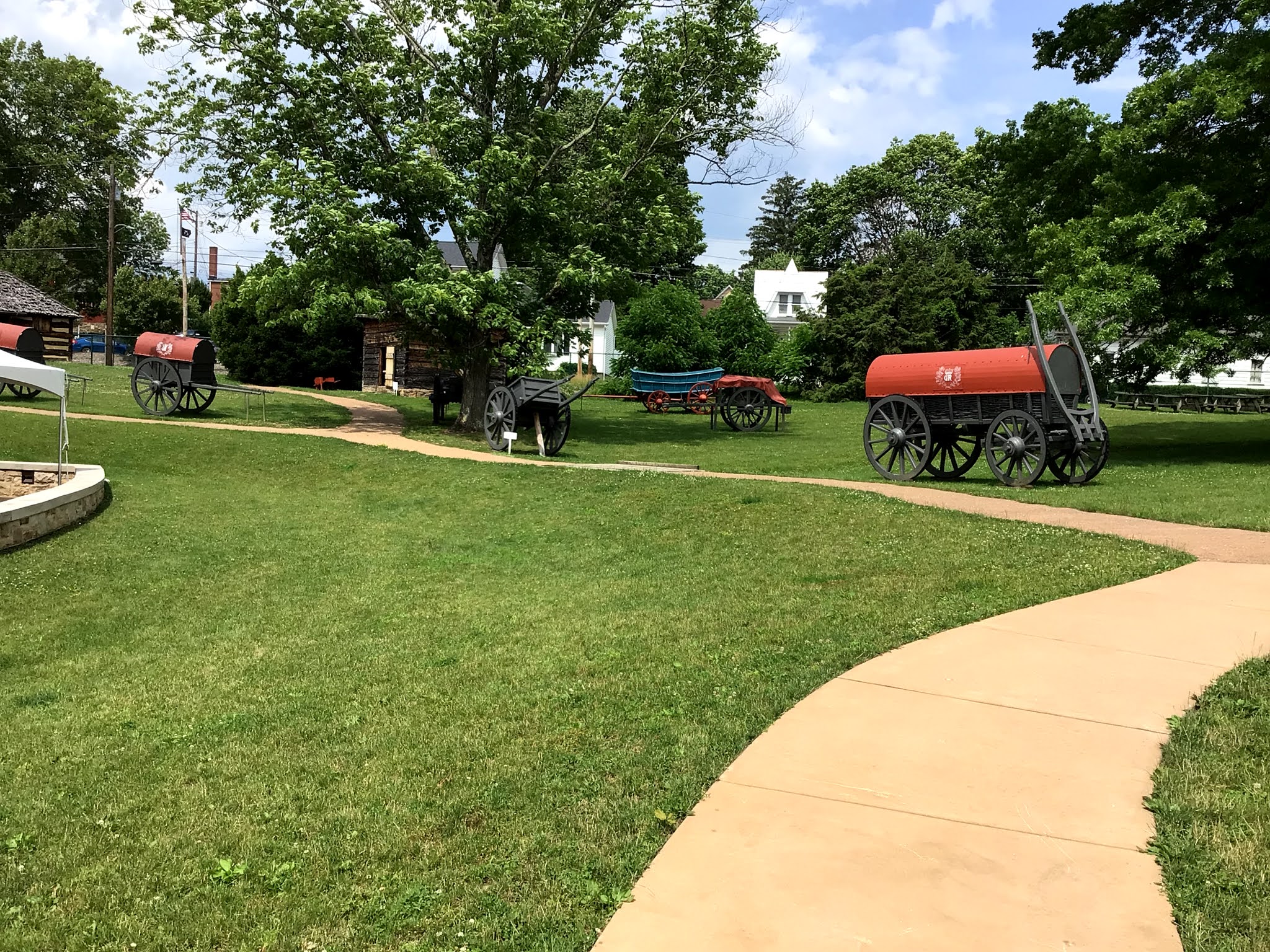
Supporting artillery equipment, from left to right:
2-wheel powder wagon, 2-wheel tumbrel, Conestoga Wagon (blue), f
ield forge wagon, and 4-wheel munitions wagon.


British artillery limbers

From left to right: light 12-pounder, mortar, small Coehorn mortar, some Olde Coote, and  a 6-pounder.

Close up view of the British 6-pounder.


The business end of the British light 12-pounder.


British light 12-pound cannon.


The royal cypher engraved on the barrel of the 12-pounder.


British 8-inch howitzer capable of firing exploding shell and canister or grape shot.

British 4.5-inch Coehorn Mortar

Here are some additional pictures of the fort's defenses:


Moat supporter by fascines, cheveau-de-frise, and other sharp pointy sticks.

Inside the fort. left to right: 8-inch howitzer, 12-pound gun, and 4.5-inch Coehorn Mortar.


Fort Ligonier is DEFINITELY worth stopping to see if you are near Pittsburgh, Pennsylvania. It is just off of the Pennsylvania Turnpike, about a 20-minute drive, and is open every day of the week from 10 AM to 5PM.

Exit the turnpike at the Donegal exit and drive north on highway 711 to Ligonier, Pennsylvania.

I like to stop in for a visit every time a pass through this part of the country, usually while driving to Historicon convention in the summer. 

Monday, April 20, 2020

Fort Kandahar


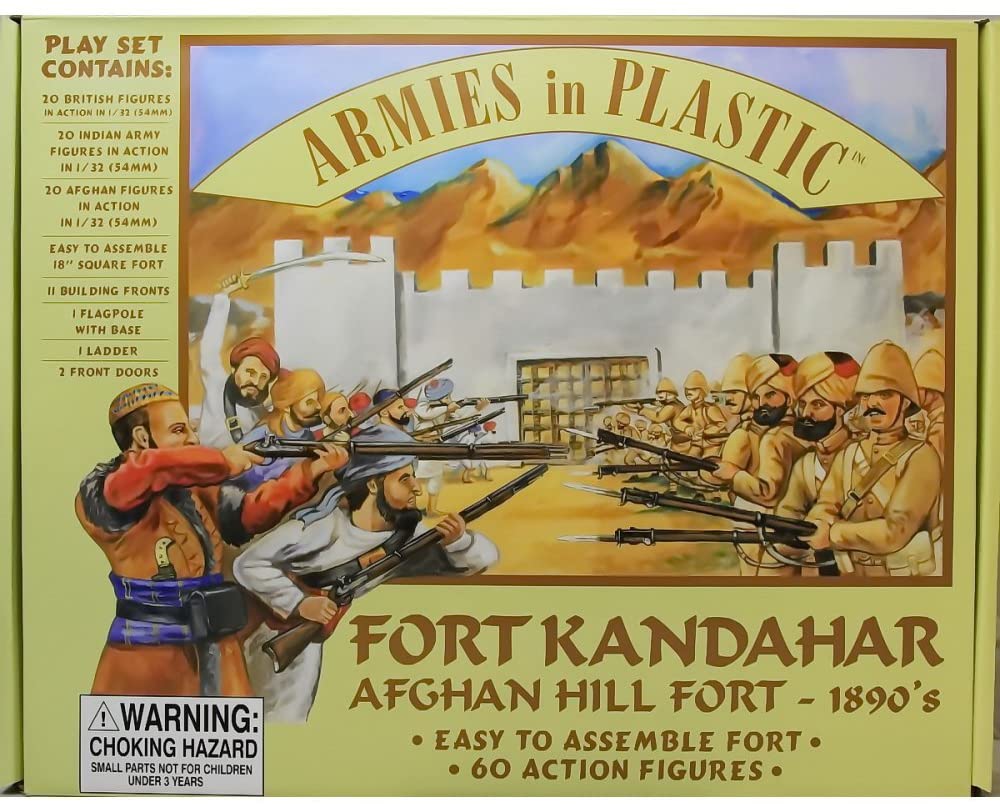
Fort Kandahar
(Armies In Plastic)


I found a nifty looking 54mm toy soldier sized desert fort on eBay recently, and bought it, of course. It is now in transit and should be arriving this week, so I am really excited by this acquisition.

Major General Pettygree and I were planning on running a huge 54mm toy soldier Sudan game at this year's Little Wars convention, which was cancelled due to the COVID-19 pandemic. My original plan called for the construction of a scratch-built desert fort, to be called Fort Kefir. I bought all of the construction materials: foam core board, bass wood, balsa wood, coffee stir sticks from Starbucks and some pieces of very thick corrugated card board that I had saved from a shipment of various household items.

The fort construction is going to take a lot of time and I've been torn between spending my time building the fort or painting Ansar and Dervish foot figures. My discovery of the Fort Kandahar toy set from Armies In Plastic rather solved this dilemna for me.

While the model is ostensibly made as an Afghan Hill Fort of the British Colonial period in the 19th Century, there is no reason why the model can't be used in the Sudan. Case in point, AIP also sells the same model as a French Foreign Legion Desert Fort:

French Foreign Legion fort from AIP

The pictures above and below indicate that the fort model is the same for Afghanistan and the Sahara Desert, so why not make it a fort in the Sudan as well?

The packaging indicates that the model has a footprint of 18-inches square, which is about half the size of my intended Fort Kefir idea. However, this will be more than adequate for use on my 12ft by 6ft game table in my basement. I will prime and paint the model and trick it out with various bits and bobs, and then affix it to a wood base.

The set includes 20 British army figures, 20 Indian army figures, and 20 Afghan tribesmen. Initially, I probably won't paint any of the soldier figures because I won't need them for my Sudan games.


Rear side of the box that shows all of the pieces in the set.

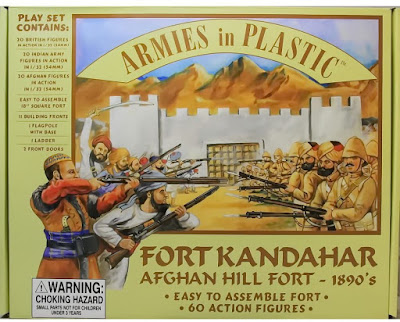
Front view of the box.

The bottom line: Fort Kandahar will save me a lot of time that I can use on painting hoards of Dervish figures.

Saturday, December 20, 2008

Vauban 28mm Fortress


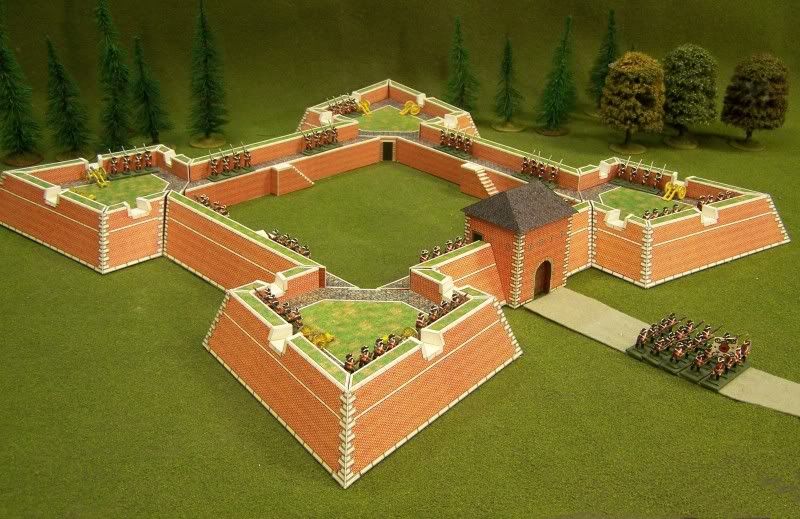
A splendid looking 25/28mm Vauban Fortress from Paper Terrain (photo from their web site). Click on the picture to see the full picture (part of it is clipped off on this page, but a click enlarges it so that the rest of the photo can be viewed)

The other day on The Miniatures Page ("TMP"), a company called Paper Terrain announced that it was now offering paper Vauban Fortress models in 6mm, 10/12mm, 15mm and 25/28mm scales. Some of you may already be familiar with this company as they offer a wide range of paper/cardstock terrain items and buildings. But I have to say that I am truly stunned at how good looking this model is, priced at $70.00 for the 25/28mm version. In addition to its good looks and attractive price, the model has a relatively small "footprint" at 30" square, so it will not engulf the 6ft by 24ft table that we play on at Brown Deer, WI at Chez Protz.

Proprietor Scott Washburn presented the following press release with information about this exciting new product:

PaperTerrain is pleased to announce the release of its Vauban Fortress Kit. The Vauban-style fortresses were built all over Europe and the world and saw action in many wars, even as late as World War II. The kit allows you to build a 4-sided fort. Included are 4 bastions, connecting walls and a gatehouse. The 10/12mm kit is approximately 14" x 14", the 15mm kit is 19" x 19", the 20mm kit is 24" x 24" and the 25/28mm kit is 30" x 30". A 6mm kit will be available VERY soon (really!). Check it out at paperterrain.com

The link to the company's web site is www.paperterrain.com

I am really excited about this product and I can foresee a lot of applications to the informal wargame campaign between Hesse Seewald and Gallia. We recently saw the Hesse Seewald army win a battle near Frankfurt and then move into seige position to take the town. Alas, we had no fort to battle over so we decided that the Erbprinz would probably withdraw his army back towards his base for the winter.

I plan to buy one of these beauties soon and hopefully assemble it and embellish it a little bit with a fixed base and a glacis or revelin or two. For rules, I would recommend the ones that Michael Lowry used in his game at the Seven Years War Association. These might be available through The London War Room store.