Tuesday, November 26, 2024

Roman Marching Encampment in 1/32 Scale


1/32 scale (54mm) Roman marching encampment.
The manufacturer is TSSD (Toy Soldiers of San Diego)

I want to have a Roman marching camp fort in my Historicon game in 2025. One of the games might feature a Roman assault on a Carthaginian city. The Romans would typically construct a fortress made of dirt and timber where ever they made an encampment while on the march. I wasn't looking forward to making my own camp walls out of pink insulation foam board and the one made by John Jenkins Designs is prohibitively expensive. I was pleased to find this fort model from Toy Soldiers of San Diego (TSSD) for a reasonable cost, relative to the other options. The model pieces come preprinted, but I think that they might need a different color of paint plus some dry brushing to finish it off.

The following two pictures provide a view of the interior of the camp:


My plan is to set the fort up on the back edge of the table and only represent the front and sides of the fort. The interior will have some Roman camp tents and vignettes and, of course, some soldiers to man the walls of the fort. The idea is that some of the game players will be attacking the Carthaginian city on one table while others are involved in attacking the Roman camp (which comes under attack from a Carthaginian relief force.

Both the Carthaginians and Romans set up walled camps while on the march so each side could have a fort on their back table. They march out of the camp and then deploy for battle. I will run multiple convention games at Little Wars and Historicon, so one day might have an assault on the city walls game, an assault on a marching camp, or some conventional set piece battles. Then, a second game on the day will have the reverse of the morning game, i.e. a set piece battle in the evening and a city assault in the morning game. Rinse and repeat for Friday and Saturday.

The front gate of the walled camp

Some of the soldiers' tents inside the camp.

Roman engineers use a groma device to survey the ground so that they can set up 
the location of the tents. These figures are from John Jenkins Designs.


I have a 32-figure unit of Celts/Gauls on the painting table right now and hope to have these finished within the next week. Hopefully the Thanksgiving holiday will give me some spare time to devote to figure painting.


Thursday, November 21, 2024

Roman Quincunx

Roman 54mm Project Update

Three 54mm Roman legions formed up in the Quincunx formation

I have been busy basing a lot of the 54mm Punic Wars figures that I painted so that I would not face the day when I would have to base hundreds of figures. In other words, it was time to stop putting off the unpleasant part of painting and assembling war game armies: the basing of figures. Doing a few at a time is no big deal, but when I let the number of unbased figures accumulate, then an easy task turns into drudgery. Yuck!

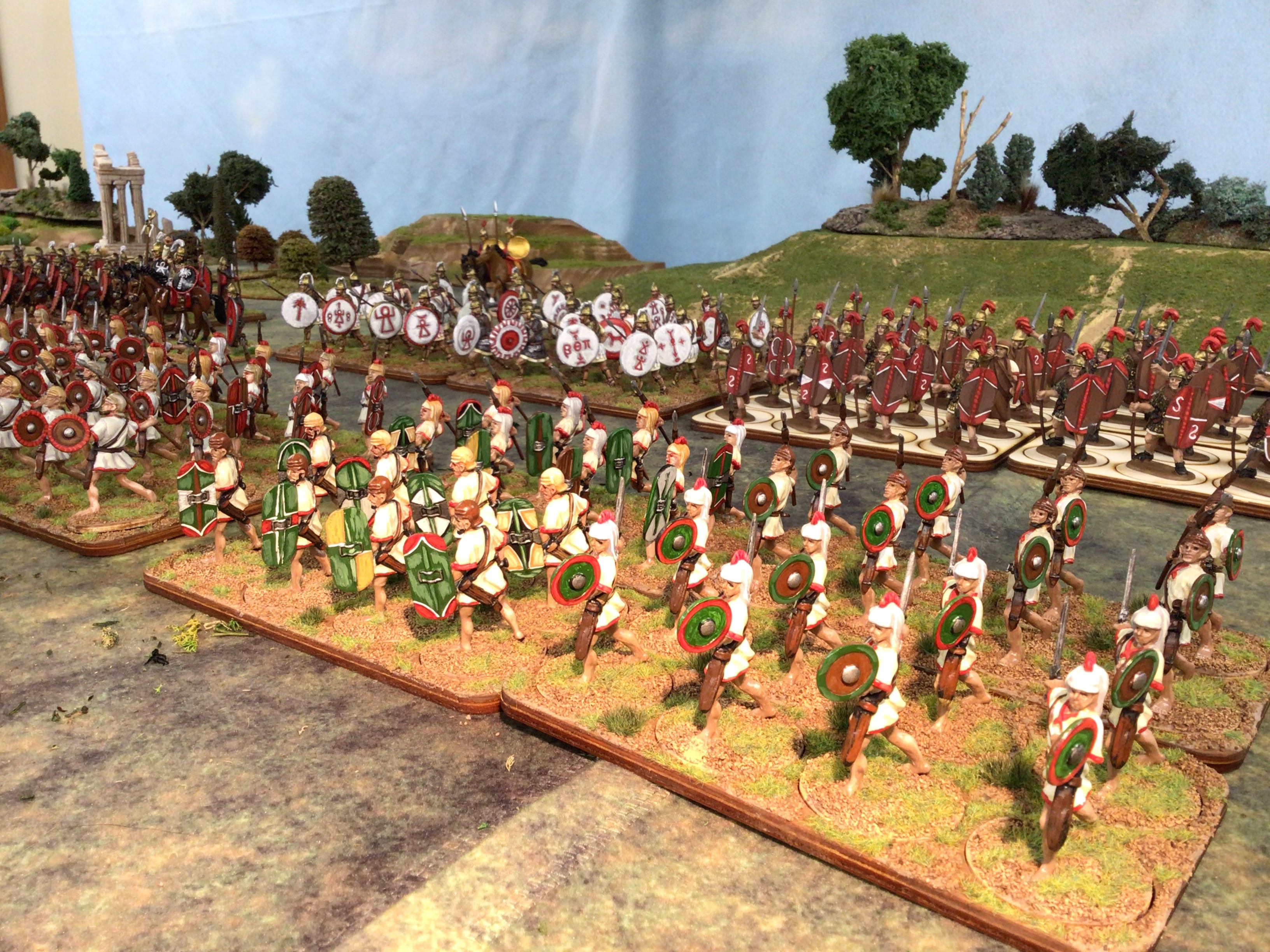
So I have painted three Republican Roman legions so far. I finished the third legion last week. My legions consists of 32-figure Hastatii, Princeps, Triarii and 16-figure Velites (light skirmishers). That adds up to 112 figures per legion and they all needed to be based. I put the figures on 40mm round bases and then use movement trays from Litko (4 figures wide by 2 rows deep = 8 figures per stand). Four movement trays of 8 figures equal the 32 figures in the principal units in the legion.

The Romans would often deploy their maniples into staggered formations of three battle lines. I do not subdivide my units into maniples because this is too granular for the type of game and rules that I intend to use in my convention games next year. The Velites (light troops) would be out in front of the main mass of formed units with Hastatii in the front row, the Princeps in the second row, and the veteran Triarii forming the third and final row in the formation.

Apparently this formation must have worked for the Romans, but it seems that the open lanes in the battle lines would be a major weakness as it would allow enemy troops to move into the gaps of the battle line. I suppose that the Velites would retire through the gaps and maybe the Hastatii, etc would close ranks to form a continuous battle line. In a war game, I would not want to leave gaps in my battle line. My version of the Quincunx formation is depicted below:


Velites in front on the left, Hastatii in the second row, Princeps in the third line, and Triarii in the last line (shown on the left center of this picture next to the command tent).


Here are some pictures of the Princeps figures that I finished two weeks ago


Princeps troops

Hastatii troops in the mid-ground and some Velites in the foreground.

Triarii wearing chain mail.

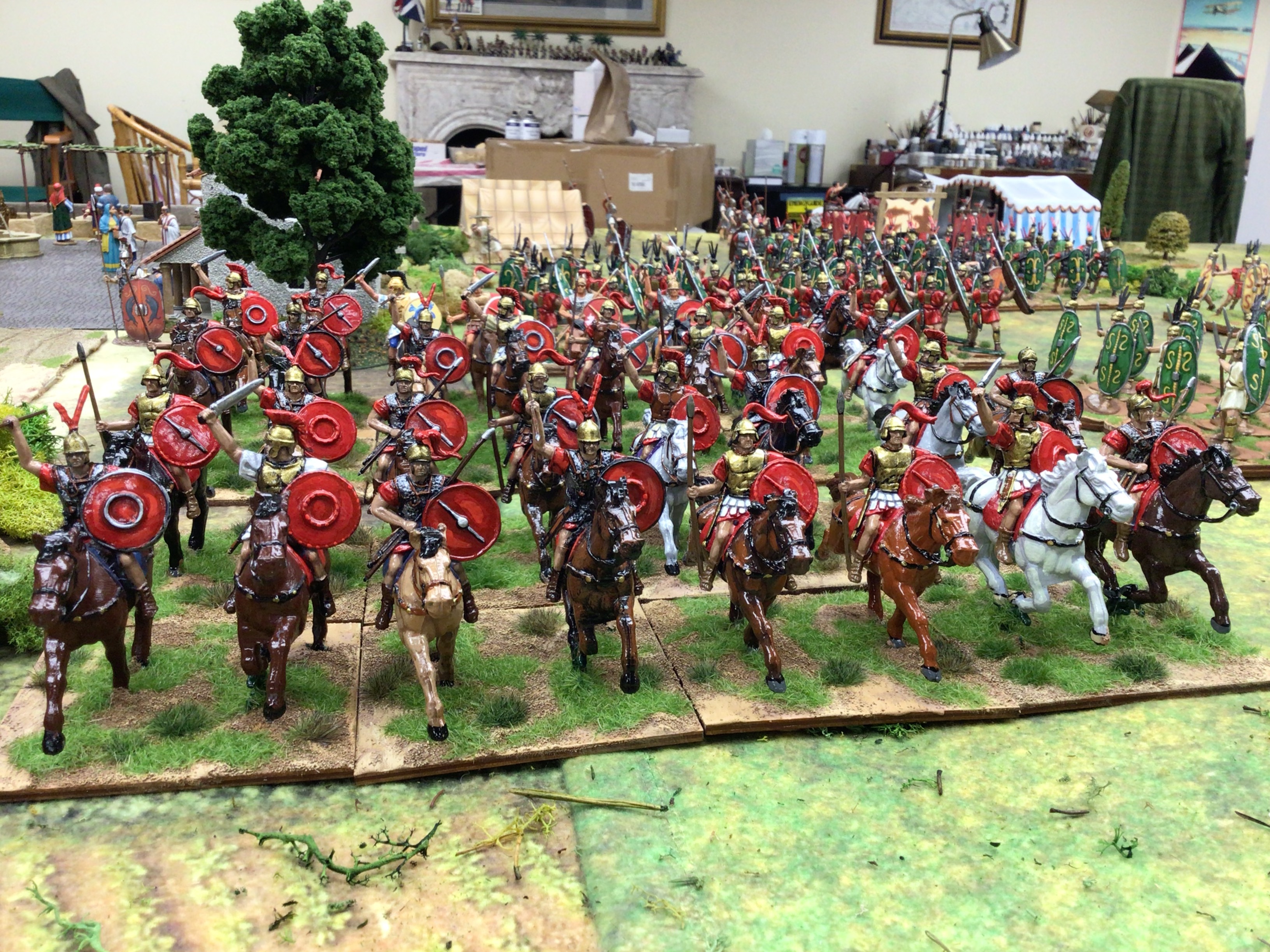
I also painted 16 more Roman cavalry figures, bringing their contingent up to 32 Roman and 32 Italian allies cavalry figures, or 64 total figures. My Carthaginian army has 96 cavalry, half of which are Numidian light cavalry.

Roman cavalry organized into two 16-figure units:


I am slowly catching up on my figure basing. I have all of the Velites to base and 16 Celt-Iberians in the Carthaginian army.

Next up on the painting table: 16 Celt-Iberians and 32 Celts.

After all of that it will be time to start making Roman buildings for my town. One of my convention game scenarios will feature a Roman assault on a Carthaginian fortified city.


cc 

Sunday, October 27, 2024

Carthaginian Army in 54mm - Progress So Far


A portion of my 54mm Carthaginian army shown above.

Click on pictures to enlarge


Well now that I seem to have jumped into the Second Punic War Project with both feet, I thought that it might be time to post some pictures of my 54mm Carthaginian army. If you follow me on Facebook or are a member of The Virtual Wargames Club then you have probably seen these pictures, but for everyone else, here is a preview of what I have.

Note that I commenced painting 54mm Romans and Carthaginians back in September 2022 with the plan to run a Hannibal game at Historicon in 2024. However, a side trip to Gettysburg on the way home sidetracked this project as I shifted my focus to the ACW and Pickett's Charge game for 2024. Now that all of that is in the rear view mirror I am refocused on the 54mm Hannibal project.

Hannibal's army of the Second Punic War was largely of a mercenary nature comprised of "allies" from Gaul (Celts), Spain (Celt-Iberians), Numidians and Lybo-Phoenicians (Lybians). There were very few actual Carthaginian citizens in any Carthaginian army.

Hannibal army commander command stand.

John Jenkins Designs 60mm Hannibal and Carthaginian infantry.

My Hasdrubal command stand. The two figures on the stand indicate that
he is one command level below the army commander.


The Celts

I use infantry units of 32 figures and cavalry units of 16 figures in my armies. All of the figures are plastic figures made by HaT Industries ("HaT"). I copied some of the shield patterns off of pictures that I found on Pinterest.


Celtic infantry


Celtic cavalry

The Spanish

My Spanish contingent consists of two infantry units of medium/unarmored troops and some heavier Celt-Iberians wearing chain mail.


Celt-Iberian heavy infantry


Spanish infantry - Caetratii with small round sheilds.

Spanish Scutarii

Balearic slingers. These are metal figures made by HaT


Spanish Cavalry. These figures are out of production and very hard to find, but
I was able to find another box of 8 cavalry on eBay from a seller in Australia.

Libo-Phoenicians (Libyans or Africans)

The heavy infantry core of Hannibal's army came from the countryside around the City of Carthage. While they were not deemed to be citizens, they had a close connection to Carthage and I would not rate them as "mercenary troops." 

African infantry in Hannibal's army.


African heavy infantry - the backbone of the army.


HaT also makes figures that it calls "Carthaginian Cavalry", but I don't know what their origin would be, but they appear to be small in numbers in the various subjective orders of battle that I have seen for Hannibal's army.


HaT Carthaginian Cavalry. I bought these painted figures on eBay. Decently painted
and look better once they are based (see the second rank).

Libyan light infantry


Numidian Cavalry

These light cavalrymen from North Africa were perhaps the finest cavalry in Hannibal's army. They also defected during the final Zama campaign, which tipped the scales in the Roman army of Scipio's favor. Had they all stayed with Hannibal, then he might well have won the battle of Zama.


Elephants

The elephant contingent in Hannibal's army. Each elephant also has one stand of light infantry.

A pair of war elephants and their supporting light infantry. The infantry
serve to protect the elephants from Roman Velites (light infantry).
All figures shown above are 54mm HaT plastic figures.

So there you have it, all of the components of my 54mm Carthaginian army. Most of the figures were painted two years ago. Recently I added a 32-figure unit of Celt-Iberian infantry and five elephants.

My plan is to add two more Celtic/Gallic infantry units and another Celt-Iberian heavy infantry unit. I will also add another African heavy infantry unit. The idea is that each player will have four elements of foot or cavalry or elephants to command in the game.

More on the Romans at a later day.


ccc 

Friday, October 25, 2024

More Carthaginian Elephants


HaT 54mm Carthaginian war elephants


Click the pictures to enlarge


The past couple of days have seen me working on repainting a pair of HaT 1/32 scale (54mm) Carthaginian war elephants and getting them based. I also assembled three more elephants that are still on the painting table.

The following two pictures provide close ups of the individual elephants after they have been based on MDF board. Note the Carthaginian light infantry skirmishers protecting the elephants from attack by the Roman light Velites.


Roman elite plans on chucking a spear into the hyde of the elephant.
Some Carthaginian skirmishers have a different idea. The elephant and Romans
are HaT figures and the two Carthaginian soldiers are from John Jenkins Designs.


Close up view of the elephant being defended on the ground and from
the howdah (the wooden tower) where the soldier has a very long spear
that is capable of reaching any Romans on the ground level.


There is nothing like a bunch of elephants that identifies a war game as one from the Punic Wars of Rome versus Carthage. The beasts are fun to paint, add some color to the overall look of the game, and I imagine that they will cause a lot of interesting situations and tales on the war game table top.

I will have five elephants once I finish the remaining ones on my painting table, however, I would imagine that four would be enough in a game.

Does anyone care to share some rules ideas on how to use elephants in an Ancients game? I'd appreciate some input because I have no idea of how to write rules ideas for them. I plan on writing my own rules for my Punic Wars Project, something along the lines of what I used in my Khartoum game for hand to hand combat. The rules have to be easy to learn so that they can be used in a convention setting.


ccc

Tuesday, October 22, 2024

Whoa Nellie!


HaT plastic 54mm Carthaginian war elephant and Roman Elite. The Carthaginian 
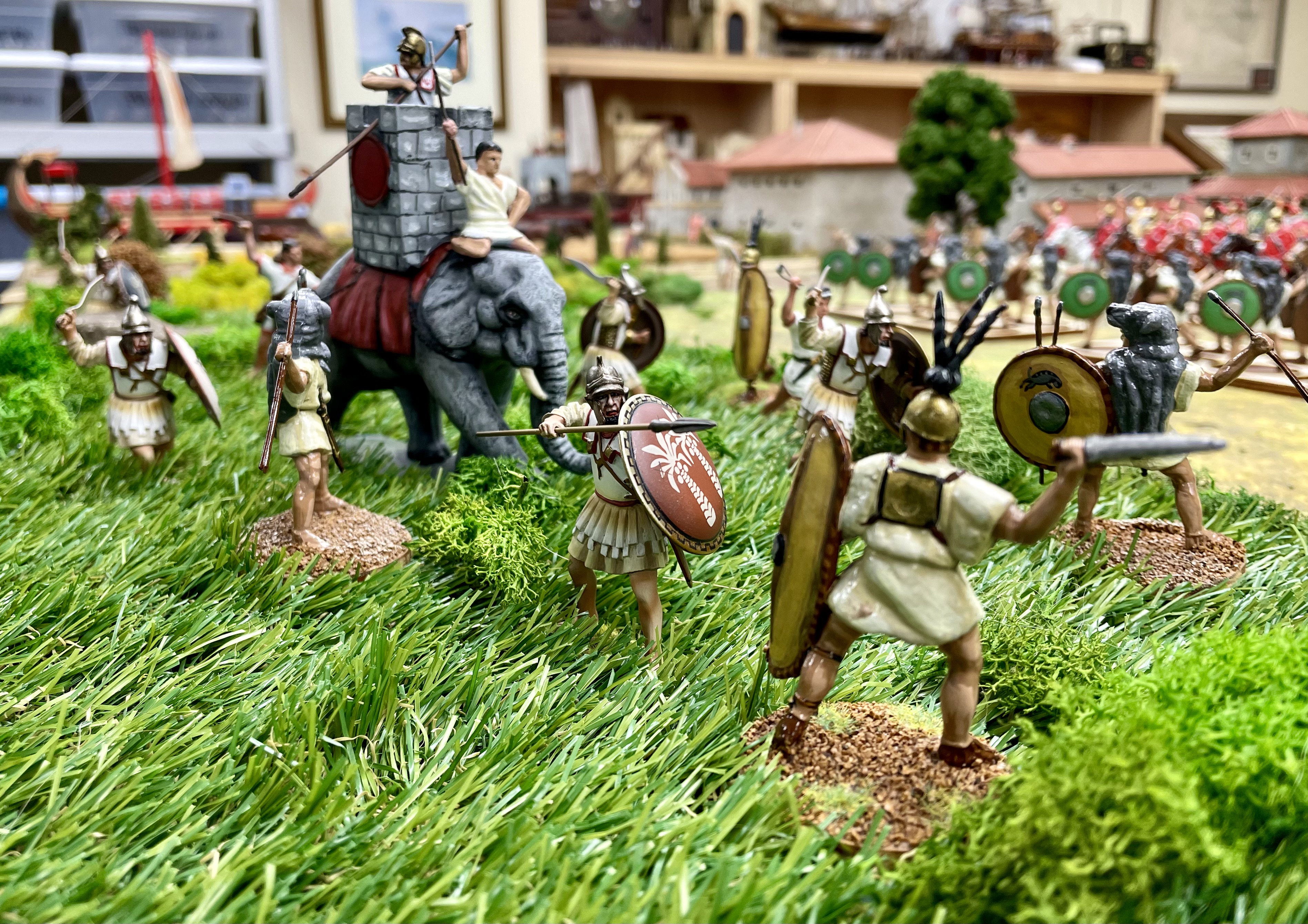
figures are 60mm metal John Jenkins Designs figures.


Click on the pictures to enlarge

I had purchased three already-painted Punic Wars elephants on eBay back in 2022 and I decided that it was finally time to repaint them and add them to my 54mm Carthaginian army. These figures are fun to paint, so much so that I assembled and primed two more new elephants, from the box, and will be working on them this week. This will give me a total of five elephants which should be enough relative to the size of my planned Carthaginian army. I have a sixth elephant that I could paint and add to the armada of elephants. I am thinking of "brigading" two elephants together plus twelve light skirmishers into one game "command" for one player. But for now, I think that four elephants is sufficient.

One of the weaknesses of elephants is that they are vulnerable to attack by light infantry skirmishers who are nimble enough to "hit and run" attack the beasts. As a counter-measure, the Carthaginians would usually surround their elephants with their own light skirmishers who would engage the Roman infantry, thereby enabling the elephant to advance into the formations of heavier Roman infantry.

The elephants proved to be rather ineffective because once the Romans got over their initial fear of the elephants, they were able to develop tactics that effectively neutralized the elephants as a threat. These included attacking the elephant with light infantry rather than waiting for the elephant to close with the regular infantry, and opening up gaps or lanes between the Roman cohorts and herd them through the Roman line where they could be eliminated by the regular soldiers. Also, in some cases, the Romans were able to panic the elephants and cause them to run amok in every direction.

Hannibal brought something like 30 elephants with him from Spain, but all but one elephant died while crossing the Alps. Elephants seem to have been used more often in the battles fought in Spain. Hannibal is reported to have had some 80 elephants at the battle of Zama, but these were largely untrained animals that were easily scared in battle and rendered ineffective by the Roman army.


Carthaginian light infantry protect the elephant from the attacking Roman
light infantry Velites.

Here is a "before" and "after" comparison of the elephants:


Elephants, as purchased on the left, and after repainting on the right.

The elephant, as purchased, had a basic war gaming standard paint job.

The same elephant after I repainted it.

I still have a little bit more work to do on the repainted elephant, namely painting a design on the red shield on the side of the tower and painting the metallic color on the chains that hold the howdah onto the back of the elephant.

I have two more "repaint" elephants on the painting table and two more new out of the box elephants are in primer and are ready to be painted. I am looking forward to getting all of the elephants painted and based. They should look spectacular.


ccc


Thursday, October 17, 2024

Roman Civilians in 54mm

A Roman farm in th Italian countryside

Click on the pictures to enlarge your view

Last year I was going to run a Roman vs Carthaginians game at Historicon 2024, but that project was superceded by Pickett's Charge from the American Civil War. I had already painted a large number of 54mm plastic Romans and Carthaginians in 2022 and so I have more than a good start on building the forces for a Hannibal game at Historicon 2025. I will be posting a lot of other pictures about the military side of the project, but today I want to present some of the civilians and vignettes that are likely to be seen "roaming" around the table (see what I did?).

I like to position villages, forts and farms in the corners of my game tables. There they are out of the way of the battle and allow me to present various vignettes of the eye candy variety. First we have a farm in the Italian countryside. The farmer is not rich by any means, but he has enough resources to work a small farm and have a few slaves to help with the hard labor.

The Italian Farm

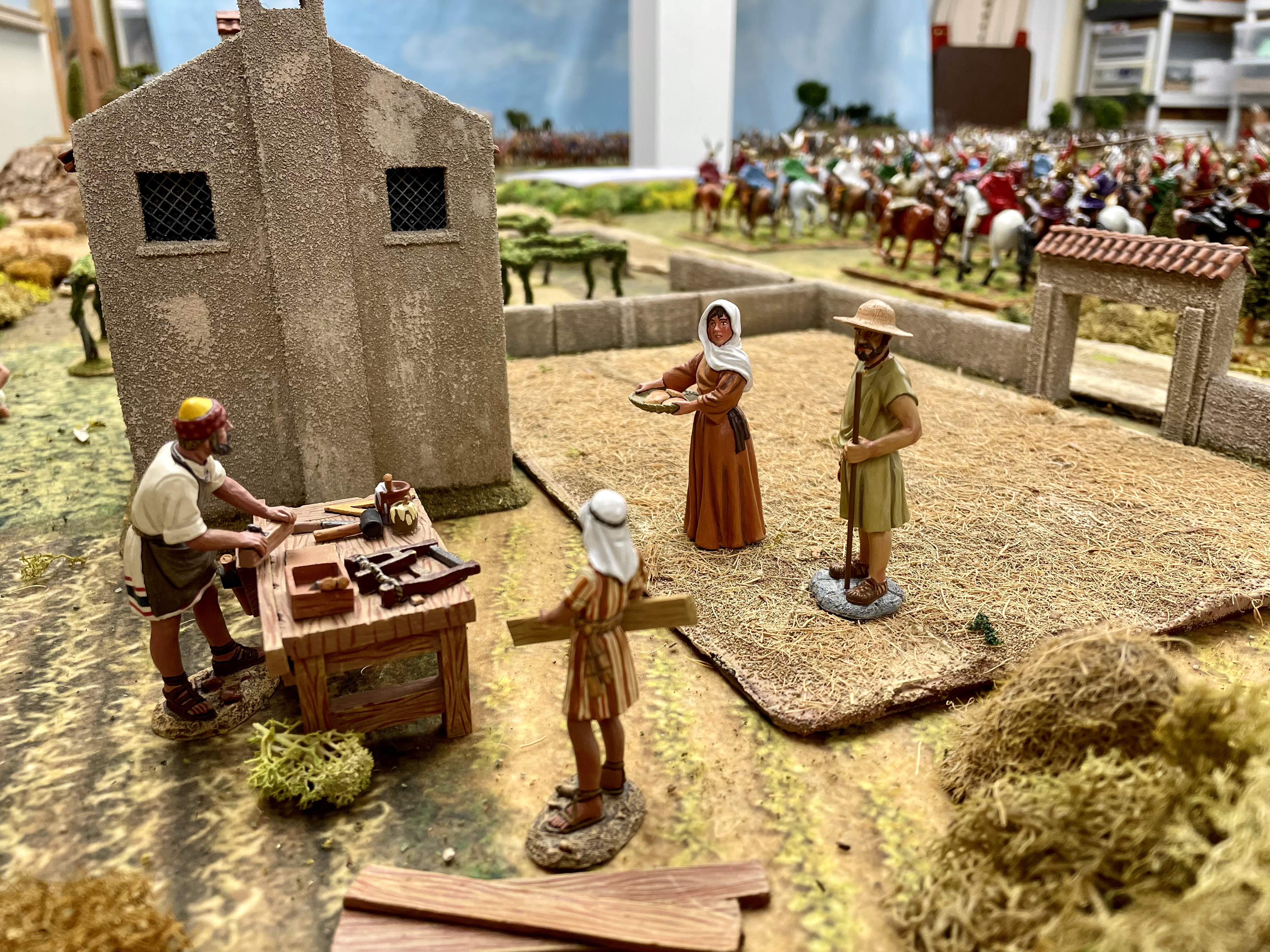
The farmer and his wife converse with the carpenter in his employ . 
These are 60mm King & Country figures.

The farmer inspects that harvesting of the hay or wheat crop in his fields.
 He also has a grape vineyard, shown in the background.

The farmer takes some of his harvest to a nearby town market.

Overhead view of out Italian farm,

Another view of the farm,

The Italian Town

Another corner of my game table depicts a midsize town that has a river port from which the farmers in the area can ship their grain to Rome.

A view of the town with a ship floating into the dock area.
Roman soldiers do their drills on a nearby parade ground.


The boat turns out to be a Roman warship.


Wide angle view of the town  central plaza or forum, and the dockside area.

The Dock Area
I have collected a number of Playmobile Roman Greek warships and will eventually paint and covert all of them. The first converted ship is shown getting ready to land at the dock, but a small cargo vessel appears to be blocking access to the docks.


A small cargo boat unloads some fruit and grain as well as something
that looks like contraband. Roman soldiers keep an eye on things.

An entrepreneur sets up a market stall along the docks.


Here are more pictures of the activity quayside,


We can see some of the farmer's grain stacked up on the dock awaiting transport to Rome.


Roman soldiers guard the warehouses where the valuable merchandise is stored.
An antiquities trader seems to have attracted a lot of attention.


A Roman Centurian is interested in what is going on with the cargo ship.
He wants it to heave off so that his warship can land at the dock.

The Town

The farmer has delivered his goods to the dock, gotten a receipt from one of the traders, and now his is looking to quench his thirst at the local Tabaran.

The local wine tavern.

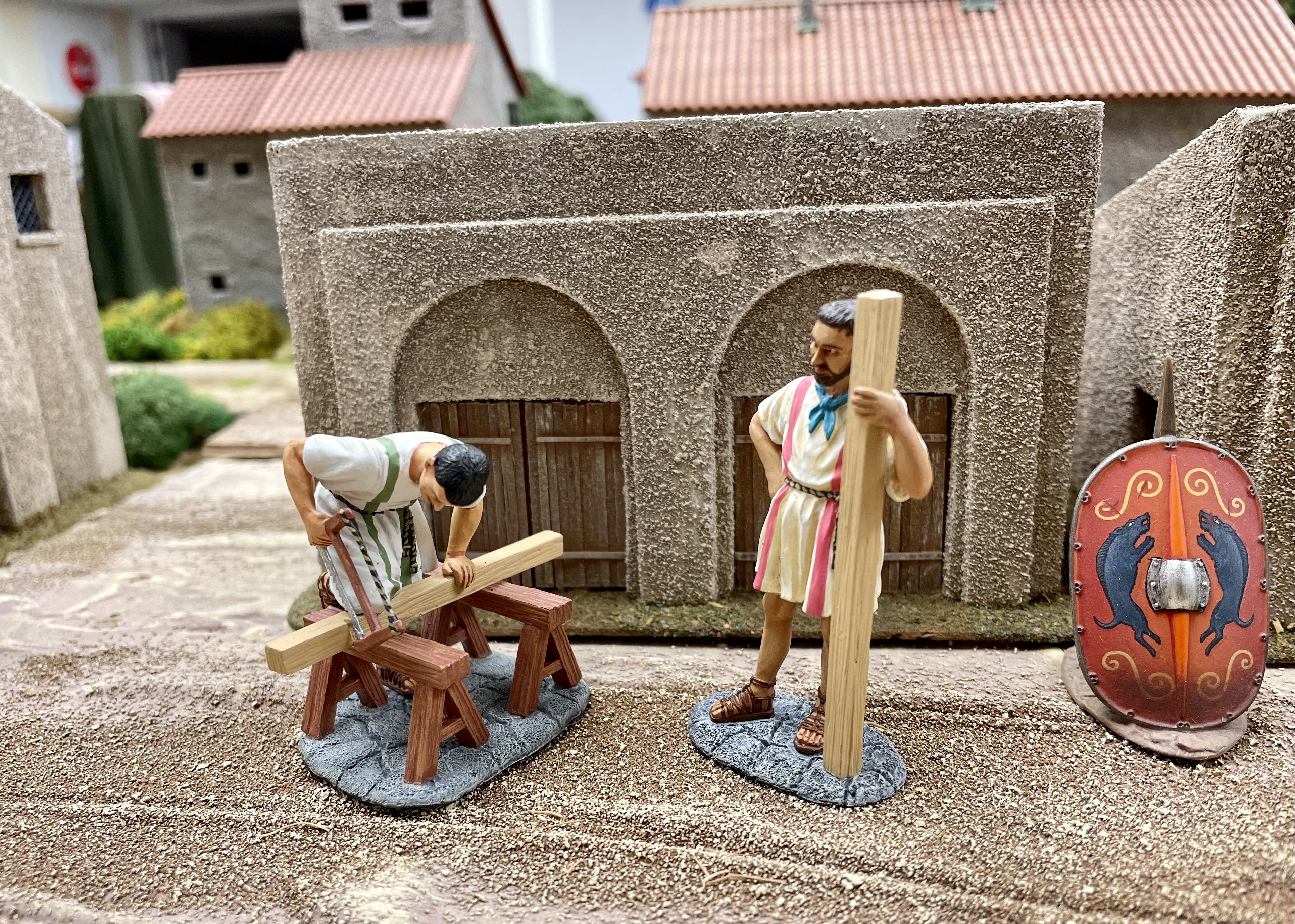
Some carpenters ply their trade in the town.

A rich landowner rides in style into the town. The wagon driver has to stop
at a checkpoint before he can enter the town.

A view of the town's forum, the center of life and activity in the region. A 
visiting Senator, with military escort for his safety, roams the forum stopping
to speak to some of the citizens to catch up with the local scuttlebutt.

The Military Post 
The town is large enough to merit the establishment of a military post to protect the citizens and ensure the free flow of commerce.

A very important person arrives at the camp.

The legatus legionis waits at his tent. He wants to finish his business so 
that he can take up other pursuits.

It is good to be a legatus in the Roman army.


---but trouble looms on the horizon as some of the Unfriendlies appear.


Most of the civilian figures in these pictures are made by King & Country and the soldiers are largely from John Jenkins Designs. Both ranges are 60mm in size.

I will be posting pictures of the Roman and Carthaginian armies in the near future.

ccc