Sunday, December 28, 2008

Hesse Seewald Army Uniforms


Uniforms of regiments (L-R) Holstein, Charlottenburg, Glasenap, and The Royal Foresters. (click all pix to enlarge the views)

I spent some time over the weekend experimenting with possible uniform combinations for the Hesse Seewald army. I had a couple of extra Foundry SYW Prussian figures laying around, already primed, so they were drafted by the Elector's tailors to model some of the new uniforms. I have not decided which figures to use for the Hesse Seewald army, but I am leaning towards the Minden Miniatures range, since this is rather comprehensive and will eventually provide all three of the major combat arms: infantry, cavalry and artillery. Crusader is another possibility, although these are chunkier than I generally prefer, their height fits in well with my existing figures. I plan to prime a few Minden samples this week and see how they look in green uniforms. My guess is that they will look fine and dandy.

Hesse Seewald regiments will have 48 rank and file and maybe 3 or 4 extra officers positioned behind the battalion as file closers. Hmm, this sounds like the Charles Grant model, doesn't it? Recall that Grant's The Wargame Companion is the inspiration for this project. Of course, this is subject to change, if for example, they get mowed down by the larger 60 man French battalions of Monsieur Chevert. That may cause me to strengthen the battalion to 60, but for now, that is my plan. I may also attach a regiment 3 or 4 pounder to EACH battalion to act as a bit of an equalizer.

A note about the pictures here: they were photographed on my Macro setting for closeup pictures, so when you click on the picture to enlarge the view, the figures will be somewhat distorted as you are enlarging them to three or four times their actual size. Remember that they are really only 28mm high. They actually look pretty good in the flesh.


Another view of Holstein (red facings), Charlottenburg (pink), Glasenap (straw) and the Royal Foresters (red facings with buff small clothes). All figures are from the Foundry SYW range of Prussians, painted by Der Alte Fritz.

I have included another photo of the figures at a slight angle. The uniform coat is Reaper Elven Green and the facings are an assortment of various Reaper colors on the facings and small clothes. From left to right (above) we have IR4 Holstein Musketeer Regt. in red facings and white small clothes; IR3 the Charlottenburg Musketeer Regt. in pink facings and white small clothes; IR3 the Glasenap Musketeer Regiment in straw facings and small clothes; and finally, the Royal Foresters Regiment with red facings and straw or buff small clothes. Regiments that have white small clothes will have silver buttons on the uniform coat and silver cartouche plate on the cartridge box. Regiments in straw or buff will have gold buttons and a gold cartouche plate. All regiments will have brass gaitor buttons.


Colonel von Kleist, himself, from the Foundry range of Prussian freikorps officers.


Von Kleist freikorps officer's uniform provides a hint of what the official Hesse Seewald officers' uniforms will look like.

The two officers shown above will provide a glimpse at what the Hesse Seewald officers will look like. They sport green coats, wear regimental facings and small clothes (they are inhabers of one of the five regiments in the H-S army), and wear silver waist sashes.

Saturday, December 27, 2008

New Clothes For Old Veterans


Hinchcliffe SYW Austrian cuirassiers in rather sorry condition. Eeepppp!!!!

I acquired twenty of the old Hinchcliffe Austrian SYW cuirassiers at a flea market (that's a Bring and Buy for those of you in the UK) about five or six years ago, with the intention of touching them up with paint and improving their appearance. As you can see in the picture above, the paint job is not up to standard and the figures needed a lot of work. When I bought them, I thought that maybe I could repaint the faces and leave them at that.

But you know how that usually turns out, right? First I touched up the faces, then the black equipment, then the shabraques, and so on and so forth. Before I knew it, I had repainted everything except the horse color on the figure. A side by side comparison of the "before" and "after" figures is shown below.


Side by side comparison of my repaint (left) and the original (right)

I tried to keep the original horse painting intact, although in the figure above, I repainted the white blaze on the horse's nose and painted all the tack equipment black. This brought the horse up to an average "wargaming standard". The trooper and shabraque has been completely repainted in this example.

After examing the rest of the regiment, I decided that the horses were so bad that I had do a total repaint. And so what started out as merely "touching up the figure" turned into a total repaint of the horse and figure. So basically, the figures amounted to nothing more than a "primed" figure. I had to completely cover the horse and rider with black acrylic paint and start all over. I worked on these over the weekend and have the troopers done, but the horses need to be painted. I will post a picture of the first dozen riders within the next couple of days.

I like the Hinchcliffe cavalry figures, the riders more so than the horses, but they look nice in an Old School sort of way. Besides, I was getting tired of painting the nicer Crusader Austrians after recently bringing the regiment up to 60 figures. So going forward, I will have one 60-figure cuirassier regiment of Crusader figures, and one 36-figure Hinchcliffe regiment in my army. Eventually I plan to add another Crusader Austrian cuirassier regiment. But for now, I sort of like the variety and the challenge of painting different figures.

Thursday, December 25, 2008

Merry Christmas From Hesse Seewald


The Elector's Ursine Guard (Eureka Teddy Bears)

The Herzog Georg Ludwig of Hesse Seewald and his family wish you and yours a Merry Christmas and a Happy 2009.

For 2009, we may see the beginnings of an official Hesse Seewald army that would be apart from the traditional Prussians that I use as stand-ins. I'm not going to promise that I will get it done, but after reading Charles S. Grant's The Wargame Companion , the idea of at least a brigade of imaginery forces holds some appeal with me.


Baron von Doppelganger (left) is a Foundry freikorps officer wearing the uniform of the Royal Foresters Regiment in the Hesse Seewald Army. The Austrian chap on the right is a Foundry Russian officer painted in Austrian mufti.

I am contemplating four or five battalions of infantry, a company of foot artillery, and eight squadrons of cavalry (Garde du Corps, line cuirassiers, dragoons and hussars).

IR1 The Riesengarde
IR2 The Royal Foresters
IR3 von Glasenap Musketeers
IR4 The Charlottenburg Musketeers
IR5 von Holstein Musketeers or Grenadiers

FA1 Foot artillery company comprising 2 x 12-pdrs and 2 x 4-pdrs

CR1 Garde du Corps (1 x 12)
CR2 Gotha Cuirassiers (2 x 12)
DR1 Munchausen Dragoons (3 x 12)
HR1 von Luckner's Hussars (2 x 12)

I will be working on some sample uniforms over the next several weeks, but I think that the uniforms will be Prussian in style, only with green coats, straw small-clothes and facing colors or red, straw, pink and white (sort of like French Napoleonic dragoons). The artillery will wear green coats/straw clothes/red facing similar to the Saxon artillery. The Garde du Corp will wear red coats and blue facing. the line cuirassiers will have buff coats and the dragoons will be either red or blue. The hussars will be the actual Luckner's Hussars.

Tuesday, December 23, 2008

Von Kleist Frei-husaren


Von Kleist freikorps Hussars, Foundry figures painted by Der Alte Fritz. (click to enlarge)


Another view of the hussars. They had a plume in their fur busbies, but in my army, they have packed them away for the vigorous campaigning that they are engaged in.

This past summer at Historicon 2008, the triumvirate of Graf Frey von Freyberg, Monsieur le general de Chevert, and Der Alte Fritz decided that it would be fun to have a game that featured nothing but light infantry and cavalry of a decidedly shabby nature, i.e. freikorps and similar such troops. We set a goal of having our new troops ready and painted by early December. With that in mind, I procrastinated and kept painting Gensdarmes cuirassiers for the Big OSW Game in October. However, once that event had come and gone, I was free to paint lousy freikorps troops.

I decided to build a portion of the all-arms von Kleist freikorps because, well, it had some of everything: light infantry (Grun Kroaten), artillery (some 6 pounders and 3 pounders), light dragoons (horse grenadiers), uhlans (10 squadrons in fact) and hussars. Not only were they a diverse lot, they were also very colorful. They were designated as Freikorps No. 12 in the Prussian military establishment, although I believe that the numbering system was applied well after the Seven Years War had concluded.

By the time December rolled around, I had completed three squadrons (36 figures) of the horse grenadiers, one squadron of the hussars (12 figures), a battalion of Kroats (60 infantry), a company of jagers (12 figures) and two sections of 6-pounders. Time prevented me from painted dismounted cavalry and horse holders for each cavalryman, but that is a goal for the future. Messers Frey and Chevert have elected to paint the Fischer freikorps in French service and they have all of their mounts and dismounted figures completed. I have a bit of catching up to do, to say the least.

Historical Overview
According to George Nafziger:

"The freikorps consisted of the Volontair-Regiment Husaren formed in 1759, the Freidragoner Regiment formed in 1760, the Croaten , formed in 1761, and the jager formed in 1761. It was the largest and most effective of the freitruppen. The hussars executed raids into Franconia and fought at Kunersdorf. Both the hussars and dragoons were at Torgau, while the hussars, Croats and Jager were at Freiberg." (The Prussian Army of Frederick the Great, Vol 2)

************
One of the unique distinctions of the von Kleist Freikorps is that they are the only unit of that type that carried colours or flags. None of the other frei regiments had flags. You can find very nice examples in the Hans Bleckwenn booklet.

Christopher Duffy is of the opinion that the von Kleist was incomparably the best of the frei troops in Prussian service. They were organized by Colonel Friedrich Wilhelm von Kleist (Green Kleist) in 1759 with the formation of a single squadron of hussars and eventually grew into a combined arms force of 6,000 men by the end of the SYW. It fought as a whole formation at Freiberg in 1762, but more often was employed on raids into Bohemia against the Austrians or into Franconia against the Reichs-armee.

Von Kleist was noted for his discipline, as Duffy indicates:

"After a successful action it was his habit to gather the officers of the corps together, and point out the various mistakes which had been made by the two parties, with the associated causes and results, and the lessons as to how the blunders could be avoided in the future. " ( Army of Frederick the Great, page 137).

End Note
I used the Foundry figures to create my version of the von Kleist freikorps, because Foundry has all of the necessary elements, including the rarely-made uhlans and uhlan bandsmen in their Turkish style uniforms. Hinchcliffe also makes very nice Grun Kroaten infantry and the horse grenadiers (dragoons) and I strongly considered using these figures as well. RSM makes the horse grenadier figure.

Eventually I hope to have time to paint a couple more squadrons of von Kleist hussars, for these are rather spectacular looking uniforms, with the red dolman and breeches, and green pelise, and green and red shabraque with van dyking. I also intend to add maybe three squadrons (36 figures) of the uhlans and dismounted dragoons and hussars. In our Batailles de l'Ancien Regime (or "BAR") rules, I rate all of these sub units as Trained. I think that it was quite gentlemanly of me to paint low quality troops when my brushes could have been spinning out more cuirassiers or something spectacular such as ten squadrons of Bayreuth Dragoons.

Sunday, December 21, 2008

Austrian Update II


Charles of Lorraine, noted for his string of losses included Chotusitz, Hohenfriedberg, Rocoux, Prague and Leuthen. He was retired after Leuthen and replaced by Leopold Daun as the principal commander of Maria Theresa's Austrian armies. A handsome, if unlucky, fellow.

There is much work going on in the Habsburg hinterlands as Marshal Leopold von Daun prepares his army for the upcoming campaign of 1759. The recruits are coming in by droves from Crusader, Front Rank, Foundry and Minden Miniatures. Now it just becomes a matter of whether or not the royal tailors can complete so many uniforms before the winter snows melt and spring abounds in Bohemia and Silesia.

I hope to have the 5th squadron of cuirassier regiment Birkenfeld completed by this evening. I just have to finish the horses and then they are done. I have also started work on two squadrons of the Paul Anton Esterhazy ("Damn Their Eyes") Hussars and the first couple of painted samples show some promise. That should get me through the end of the month, at which time I will have 14 squadrons of Austrian cavalry. That sounds like a lot, but it pales in comparison with the 32 squadrons of Prussian cavalry that I already have. As you can see, there is much work to be done.

I may have mentioned before that I can painted approximately a squadron of 12 figures per week or a half battalion of 30 figures in a week, on average. So if I was really cranking out the production, that would work out to two battalions (120 figures) or one regiment (48 figures) per month. One gets tired of painting nothing but horses, so I will probably switch back and forth between infantry and cavalry. I'm kind of on a cavalry binge right now, so after the hussars are completed, I think that I will add another infantry battalion for a change of pace. That would bring the infantry up to 10 battalions (versus 18 btns of Prussians).

Thankfully, Marshal von Daun has Saxon allies (2 regiments of 48 dragoons) and a small force of Austrians led by Graf Frey of Freyberg (3 battalions and 2 sqds of cuirassiers and 2 sqds of hussars). Otherwise he would need to hunker down in one of those Vauban fortresses that I mentioned the other day.

Daun would like to increase his army to a size sufficient to warrant an invasion of Silesia in 1759, or perhaps recapture Dresden from the Prussians.

Saturday, December 20, 2008

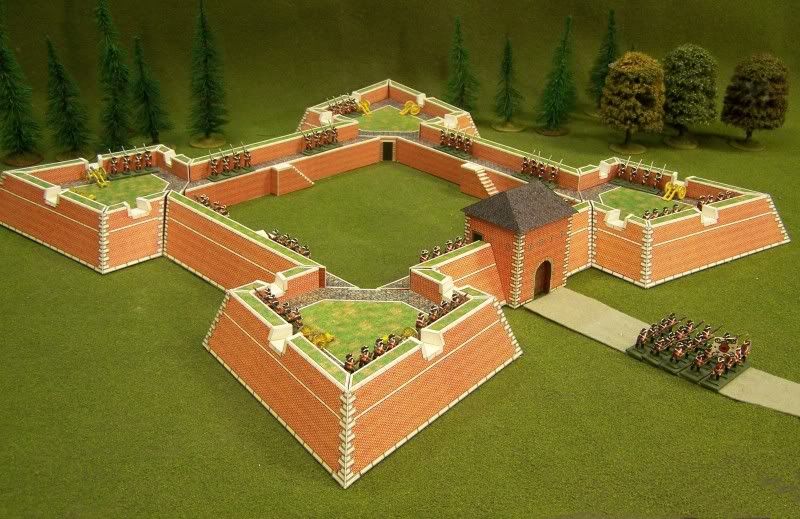
Vauban 28mm Fortress


A splendid looking 25/28mm Vauban Fortress from Paper Terrain (photo from their web site). Click on the picture to see the full picture (part of it is clipped off on this page, but a click enlarges it so that the rest of the photo can be viewed)

The other day on The Miniatures Page ("TMP"), a company called Paper Terrain announced that it was now offering paper Vauban Fortress models in 6mm, 10/12mm, 15mm and 25/28mm scales. Some of you may already be familiar with this company as they offer a wide range of paper/cardstock terrain items and buildings. But I have to say that I am truly stunned at how good looking this model is, priced at $70.00 for the 25/28mm version. In addition to its good looks and attractive price, the model has a relatively small "footprint" at 30" square, so it will not engulf the 6ft by 24ft table that we play on at Brown Deer, WI at Chez Protz.

Proprietor Scott Washburn presented the following press release with information about this exciting new product:

PaperTerrain is pleased to announce the release of its Vauban Fortress Kit. The Vauban-style fortresses were built all over Europe and the world and saw action in many wars, even as late as World War II. The kit allows you to build a 4-sided fort. Included are 4 bastions, connecting walls and a gatehouse. The 10/12mm kit is approximately 14" x 14", the 15mm kit is 19" x 19", the 20mm kit is 24" x 24" and the 25/28mm kit is 30" x 30". A 6mm kit will be available VERY soon (really!). Check it out at paperterrain.com

The link to the company's web site is www.paperterrain.com

I am really excited about this product and I can foresee a lot of applications to the informal wargame campaign between Hesse Seewald and Gallia. We recently saw the Hesse Seewald army win a battle near Frankfurt and then move into seige position to take the town. Alas, we had no fort to battle over so we decided that the Erbprinz would probably withdraw his army back towards his base for the winter.

I plan to buy one of these beauties soon and hopefully assemble it and embellish it a little bit with a fixed base and a glacis or revelin or two. For rules, I would recommend the ones that Michael Lowry used in his game at the Seven Years War Association. These might be available through The London War Room store.

Friday, December 19, 2008

How High Are Artillery Wheels?


Prussian Horse Artillery 6-pound cannon stands around shoulder height on this crew man.


ACW Napoleon at Gettysburg indicates that the wheels are about shoulder height on Der Alte Fritz.

The other day on TMP, some one was asking how high the wheels of artillery pieces should be in relation with the crew figures. I thought that some pictoral evidence of the real deal would be sufficient to answer the question. As you can see in the Knotel drawing of Prussian gunners and in the picture of Der Alte Fritz, standing next to a gen-u-ine ACW Napoleon cannon at Gettysburg, I would have to say that shoulder height is the correct height.


The two battalions of the Hesse Seewald Garde turned out to celebrate the birthday of the Erbprinz.

Yesterday (December 18th) was my birthday, so Der Alte Fritz was a little bit "alter" this morning (I'm typing this at 11 Pm on thursday evening, but posting it on the 19th). We had a quiet celebration at Schloss Seewald with the princess Lady Emma Cuddleston-Smythe and the Duchess Anne giving me some presents and a celebratory dinner at Del Rios' Italian restaurant nearby.

It was quite a treat as the restaurant had hired a group of opera singers to perform for their annual Christmas dinner. They warmed up with a selection of show tunes from Rogers and Hammerstein and then followed up with a few Mozart operettas, and then closed with some traditional Christmas songs. When we returned home, I walked the royal hounds, Dave and Katie, for a couple of miles in the cold night air. There is a huge snow storm headed our way so it may be awhile before we can go walking again. All in all, a nice birthday.