Showing posts with label British AWI Army. Show all posts

Wednesday, June 16, 2021

The Freeman's Farm Table Top Is Set And Ready To Go


Battle of Freeman's Farm table top. Two British commands enter the table in the center.
Morgan's riflemen await in the woods.

Click on all pictures to enlarge.

After quite a few adjustments to my Freeman's Farm table top terrain, I have finally settled on what looks right to me. This is the game that I will be hosting at the upcoming Seven Years War Association Convention on August 5th through 7th, 2021 in South Bend, Indiana.

I usually make a first pass at setting up my game terrain and lay out the troops to make sure that the terrain is playable - that is, it has sufficient room to maneuver the troops without causing traffic jams. I might find that there is not enough flank space to move the figures or there might be too many building or terrain obstacles to use in a game. Sometimes what looks good in a static display does not translate very well into a playable game. Playability is important in any wargame, but it is even more so when one is designing a game to host at a wargame convention.

One key element to consider: if you plan on having some troops arrive on the table several turns down the road, you want to make sure that the movement rates in the rules allow enough time for the troops to actually close with the enemy and have it on the table top. It does not make for a good game experience for a player. 

Another consideration is that there are enough troops to spread around for each player to game with. Freeman's Farm is a relatively small battle. For example, if there are 10 units per side it will be difficult to divide the units into four commands on one side. In this example, I would divide the troops into three commands consisting of one command with four units and two more commands of 3 units plus one cannon.

You may recall my theorem called "Jim's Rule of Fours" which states that the maximum number of combat units that a wargamer can comfortably handle is four. An experienced player can probably handle more, but if one player has six units in his command and the other players have four elements, then the game pace will slow down because the one player is moving more stuff each game turn than the other players. So I try to keep wargame player commands at no more than four combat elements. Elements are regiments of infantry, cavalry and batteries of artillery.

With all of this in mind, let's take a look at the British commands in my Freeman's Farm game.

The center of Burgoyne's army at Freeman's Farm was commanded by Brigadier General Hamilton and consisted of four British regiments: 9th, 20th, 21st and 62nd; two batteries of Royal Artillery, and some small groups of chosen men to act as sort of skirmishers to scout ahead of the brigade. 

The British left wing of the army consisted of ALL of the elite troops in Burgoyne's army: converged grenadiers and light infantry from the British regiments, converged Brunswick grenadiers and a light battalion, and various units of scouts or chosen men.

I could probably divide the entire British army into two commands for the game: Fraser's and Hamilton's brigades, but then I end up with a game that has a 12 foot long table  and only four or five players in the game (2 British and 3 American players). However, I am sure that the convention manager would not appreciate allocating a 12 foot by 6 foot table to a game that only allows for four players,

So some adjustments are necessary for this convention game.

I decided to divide Hamilton's brigade into two regiments of British infantry (larage 40 figure units) and a cannon model and a handful of light infantry scouts. That gets me to four elements for the two players that command Hamilton's brigade. 

Simon Fraser's Advance Guard has two large elite battalions of 48 figures each: British grenadiers and light infantry that were converged from their parent regiments. Both battalions are large enough to be divided into two sections of 24 figures, thus giving this player 4 elements. There were also some Indians and Canadian light troops that I could add to each command, but I am running out of space on this flank to employ all of those troops. This means that I will have to shift the terrain in the center to the British left which will create more space for Fraser's brigade on the right side of the British army.

This gives me three players on the British side, so far. There were also some Brunswick troops involved in the battle, but they were late arrivals to the battlefield and I wouldn't want to give the Brunswick command to one player, and then have that player sit around for something like six turns before he could start moving troops.  One thought is to feed some of the Brunswick regiments into the battle when the British players start losing regiments due to battle attrition. This isn't quite how Freeman's Farm was fought, but the idea makes for a more playable wargame.


Simon Fraser's advance guard of grenadiers and light infantry arrive on the table on the left flank of the British army.

A part of Hamilton's British Brigade

The other half of Hamilton's British Brigade


The American army has some similar problems with regard to breaking it up into "wargamer commands" and I will dwell on this in another blog post, shortly.

I will likely end up with six players in the game, three per side, and then feed in fresh units to players whose commands get all shot up and depleted, or rout. I might be able to stretch it out to four players per side, but this would be difficult to pull off and still give each player 3 to 4 command elements.


What do you think? Comments are appreciated.S

Thursday, May 13, 2021

British Pickets at Saratoga


British flank company pickets in the Saratoga Campaign

I have been working on some two-figure stands of British pickets to use in my Saratoga Campaign war games. I paint two stands of two figures for each British regiment that I paint, my plan being to converge all of the stands into one collection of converged light infantry pickets. I can also keep the figures with their parent regiment, thus adding four more figures to the British regiments.

At the battle of Freeman's Farm on September 19, 1777, Hamilton's Brigade of British regiments were located in the center of the British deployment. An advance guard commanded by Simon Fraser was deployed as the right wing of the army. 

Hamilton sent a picket detail of 100 men ahead of his brigade's advance towards Freeman's Farm. The pickets were commanded by Major Forbes (9th Regiment) and they quickly occupied the ground around Freeman's Farm. Daniel Morgan's riflemen emerged from the woods and surprised Forbes' picket and cut down the majority of them with their fire, killing all but one of their officers.

There was another small picket of approximately 100 men that was attached to Fraser's advance guard. These were under the command of a Captain Alexander Fraser.

The figures are Fife and Drum Miniatures (of course) British flank company figures for the Saratoga army.


A close up view of the British pickets.

Next in the painting queue are some more Brunswick grenadiers and maybe some Loyalist troops.

Tuesday, April 6, 2021

Painting A Campaign Appearance On You Miniature


Fife & Drum Miniatures Saratoga British Flank Company Figures
Faded coats on the right, normal red coats on the left.


CLICK ON ALL PIX TO ENLARGE

In the past I have painted several units to look like they have been “in the field” for a long campaign season. Basically this involves painting the coats in a washed out color to reflect the sun fading of the cloth and painting some patches on the knees and elbows. A little bit of dirt around the ankles works too. I haven’t figured out out how to paint unshaven faces, like Barry Hilton carries off with fine effect.


The other day I was painting a company of British Light Infantry for the Saratoga campaign and by happenstance my first coat of red on the uniform coat looked a bit washed out. The undercoat of white-Grey primer made it kind of bleed through the red. Hmm, thinks I, their coats will look sun faded if I don’t add another coat of red and then do the usual highlights bits on the coat.


Faded Campaign uniforms on the righthand stand. 
Normal red coats on the lefthand stand.


Rear view: campaign figures on the right, normal figures on the left.


Instead I went in reverse, starting with a washed out red and then highlighting with a pinkish red color. For this I took the base red color and mixed in a tiny bit of white to perfect the sun faded look. Next, I used a creamy tan color on the overalls rather than my usual grey and white combination. 

The final step was to paint patches on the areas of the uniform that are likely to wear out from hard usage on the campaign. We are talking knees, elbow and the seat of the pants. This starts with a tiny square of black painted on the knee, for example, and then painting a color such as brown cut from local spun cloth, or some red that might have been cut from excess material on the coat. You can experiment with other color schemes such as a white patch with some polka dots or stripes that contrast with the knee patch color.

I need to experiment with mud and dirt effects on the ankles, but this would really enhance the campaign look of the figure. Oh, and I dress the officer in brighter, non faded red on the assumption that the officer would have the financial means to purchase better quality cloth for his uniform.

At any rate, I thought that the faded red coats looked kind of cool and I will definitely consider painting a full regiment in a like manner.

What do you think? Comments appreciated.


Sunday, March 21, 2021

British Brigade of the Guards in the AWI


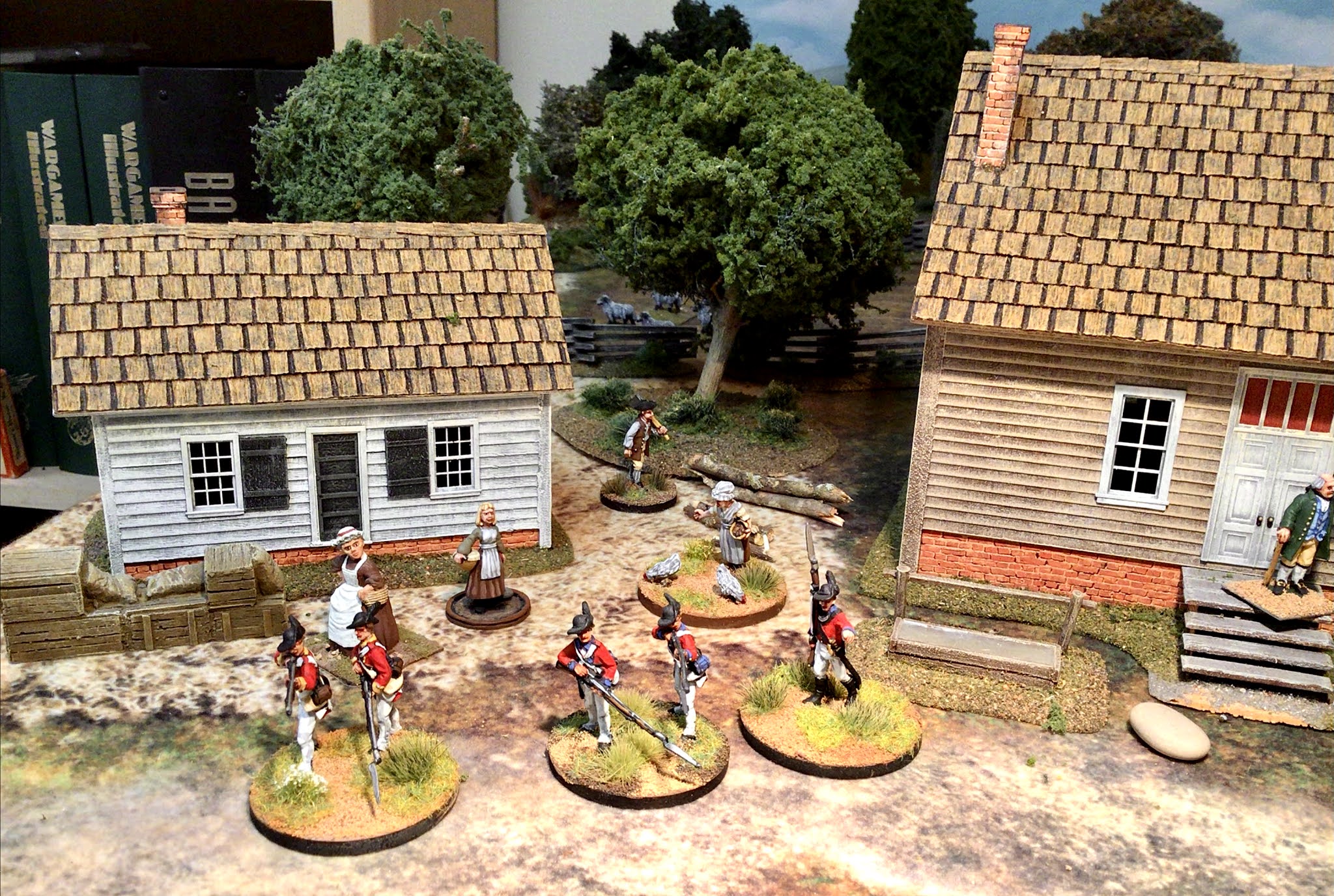
The flank companies of the British Brigade of Guards, circa 1777.
Fife and Drum Miniatures

Flank companies of the Guards form up in front of the Savage Swan public house
somewhere in Pennsylvania in 1777.


On November 22, 2010 I announced the formation of a new figure range of American Revolution miniatures done in 1/56 scale, sculpted by Richard Ansell. On December 2, 2010 the venture was formally name Fife and Drum Miniatures.

The very first figures in the F&D range were the British Brigade of Guards because at that time, no other company made such figures in 1/56 scale (suitable for 28mm and 30mm miniatures). 

British Guards Announcement

Announcement of the Establishment of Fife & Drum Miniatures

Over the years a couple of other companies have added the British Brigade of Guards to their product ranges (notably the recent announcement by Perry Miniatures). However, since the FD Guards figures are now nearly ten years old, they have been forgotten by some of our customers and I thought that it would be a good time to remind people of the Fife and Drum Miniatures British Guards.

Fife and Drum Miniatures web store


The two pictures at the top of this page depict the flank companies of the British Guard. These men wore a cap with a front plate and front brim. The center company men wore a round hat turned up on the right side.

Brigade of Guards center company soldiers on the march.

The British Guards packs available include the following:


BA-004  Guards Command (6 figures)  $12.00

BA-005  Guards Center Company Marching (8 figures)  $16.00

BA-006  Guards Skirmishers in Round Hats (8 figures)  $16.00

BA-007  Guards Flank Company Marching  (8 figures)  $16.00

BR-003  Guards Regimental Pack (30 figures)     $52.00 (13% discount)

Guards skirmishers, firing and cocking musket.
The officer figure is from the Light Infantry  set of figures.

Overhead view of the Brigade of British Guards marching into a Loyalist village.

Beware of women wearing a bucket yoke. Advance at your own peril.

Screen Credits

This episode of my blog features a very nice table mat from  Cigar Box Battle Mats. These pictures feature the New Europe mat ( New Europe Battle Mat ) #510. This is a really useful mat for smaller skirmish games or you can pair it up with some of the other European battle maps in the Cigar Box product range. I use the "New Europe 2" mat #660 for many of my games and the road on this mat matches up perfectly to any of the roads in mat #510.

The water well is made by Grand Manner in the UK, but alas, the company appears to no longer sell unpainted resin products and so you have to purchase their products painted, which makes them a bit dear to one's wargaming budget.

Herb Gundt made all of the trees, snake rail fences and buildings that you see in these pictures.

Some of the civilians are from Blue Moon and Perry Miniatures, as well as from the Fife and Drum / Minden range of Civilian Figures. I believe that Bucket Woman is a Blue Moon figure from their Sleepy Hollow box.

Custumes were provided from the painting brush of Himself, der Alte Fritz.


Saturday, June 27, 2020

Saratoga Project Kicks Off


Four British regiments and a brigade commander


Since the Covid-19 lockdown began in March 2020, I have been focused on building up a Dervish army using 54mm plastic figures. I have painted approximately 250 Dervish and 100 Egyptians and British figures. Eventually, I will reach burnout on painting these figures and will need to paint something else for awhile.

I have the perfect candidate.

The Fife and Drum Miniatures "Saratoga Range" has been available for about six months now and so I decided that it is time to start painting a British army for the Saratoga Campaign in 1777. 


The first order of business was to identify the regiments that I would have in the army and for that I turned to an excellent article about this army, written by Brendan Morrissey, which you can find on the Perry Miniatures web site. See the link below, as well as links to Brendan's other articles on the German troops and Continental troops at Saratoga. (all three links take you to the Perry Miniatures web site - lots of good information there).


The second item is to determine how many figures per regiment and how to base them. Using Brendan's article as my guide, it appears that the average strength of British regiments in the campaign was  between 380 and 390 officers and rankers. I think that these might be unit strengths at the beginning of the campaign. These figures do not include the grenadier and light companies, which were hived off and converged with other similar companies from the other regiments to form a converged Grenadier Battalion and Light Battalion.

Basing Options, from top to bottom: #1, #2, #3 and #4.
Compare these to the basing that I use for my Philadelphia Campaign British regiments (the painted unit at the top of the picture).

Looking at the picture above, the painted unit is a British regiment from my Philadelphia Campaign army of General Howe. There are 32 figures on four bases (8 per base). The only problem with this arrangement is that the colours will always be a little bit off-center when the regiment is deployed into line formation.

Base system #1 shows the same four stands of 8 figures, but with the addition of a command stand that holds 6 figures. I have turned the command stand on its verticle axis so that the front juts out a bit in front of the rest of the regiment's bases. This is a 38-figure arrangement.

Base system #2 shows the same arrangement as #1 except that the command stand is placed on its horizontal axis. This places the colours in the middle of the regiment when it is deployed into line. This is also a 38-figure configuration.

Base system #3 shows six stands, each with 6 figures, or 36 figures in total.

Base system #4 has five stands, of which 8 figures are crammed onto four stands, plus there is a command stand of 6 figures, for a total of 38 figures. The purpose of this arrangement is to place the figures shoulder-to-shoulder, rather than in a more open file system that are shown in the first three options.  Knowing my readers, a lot of you will prefer system #4 because you like the shoulder-to-shoulder look. I think that this might be fine for infantry regiments operating in Europe during the SYW, but not so much for the loose files used by the British in North America.

My inclination is to use Base System #2. However, I will entertain your thoughts, ideas and comments about the basing system that you think looks best. Please leave your comments in the comment section at the end of this blog post.

Tuesday, October 22, 2019

NEW Saratoga British Range will be added to Fife and Drum Miniatures


British infantry in action at the Battle of Freeman's Farm
Osprey Saratoga Campaign book.


CLICK ON ALL IMAGES TO ENLARGE

I am very pleased to announce that a new AWI figure range is being added to the Fife and Drum Miniatures collection. The Saratoga Campaign of 1777 is the new figure range and Richard Ansell has already sculpted the first of the figure range: British infantry wearing the Saratoga Campaign uniform.

As you can see in the pictures below, Richard has completed the greens for the British infantry, and they are ready to go to Griffin Moulds where the master and production moulds will be made. Once the moulds are made then we can start spinning out castings, probably by January 2020, but hopefully a little sooner so that they can go into your Christmas stockings.


British Flank Company Figures
The new range will include flank company figures in both marching and action poses, the latter perfect for use as skirmishers. The British converged all of the light companies into one Light Battalion and the same was done with all of the Grenadier companies.

British Flank Company skirmishers, sculpted by Richard Ansell

British Flank Company soldiers marching. These figures can be used for with the Light companies or the Grenadier companies.
Flank company soldier advancing (left) and NCO (right) pointing,
probably directing his skirmishers to fire at a rebel target.


British Flank Company soldier wearing the Saratoga Campaign uniform.
Don Troiani artwork.


British Center Company Soldiers


British Center Company soldiers marching.

British Center Company Command.


Center Company soldier wearing the Saratoga Campaign uniform.
Don Troiani artwork.

Mounted British Officer in Campaign Uniform


British officer on campaign wearing a round hat turned up on the left side.
This figure can be used in all theaters of war: Philadelphia Campaign, Southern Campaigns and the Saratoga Campaign.

Fife and Drum Miniatures will also be adding the Brunswick troops and some other bits and bobs in the near future, making this a complete range.

Wednesday, March 27, 2019

Fife & Drum News Update, Bits and Pieces

The British battle line at the start of the Battle of Guilford Courthouse.

CLICK ALL PIX TO ENLARGE


I have a lot of information about the new products, SYWA convention dealer booth, and my participation games that I will be hosting at the convention.

New AWI Highlanders (in overalls)
The Highlander marching figures arrived from Griffin Moulds the other day and I've been busy bagging them for retail product codes in the web store, and also to offer for sale at the upcoming Seven Years War Association Convention. The convention information can be found HERE .

The new product codes for the AWI Highlander figures are as follows:

BA-018 Highland Foot Command

BA-019 Highlanders Marching (3 each of 3 poses)

BA-020  Highlanders Advancing with musket at the trail (1 NCO and 7 soldiers)

BA-021  Highlanders, Center Co., Skirmishers (2 each of standing firing and biting cartridge)

BC-007 Mounted Highlander Officer

The 71st Highland Regiment depicted deployed in a firing line. This unit was built using
the BA-018 Command , BA-020 Advancing at the trail, and the BA-021 skirmisher packs.


New Personality Figures
BC-005  Lord William Howe

(His Lordship was a late arrival on the boat from England. He made a stop along the way to visit Mrs. Loring and was, ahem, detained. His picture will be posted here as an update as soon as I can get the figure painted)


BC-006  Lord Charles Cornwallis

Lord Cornwallis


BC-007 Mounted Highland Officer (could be used as Simon Fraser)

Highland regiment mounted officer. He could be used to represent Simon Fraser.


AC-005  George Washington

George Washington


AC-006  Nathaniel Greene

General Nathaniel Greene on a command stand along with a standard bearer from the 1st  Dragoons regiment.
The flag is a variation of the Brandywine flag, cut down to size for a cavalry standard.


SYWA Convention News
All of the AWI figures will be available at the convention at the Fife & Drum Miniatures booth. I will also be bringing most of the Minden SYW figure range EXCEPT the British and Hanoverians.  If you want to pre-order some British and Hanoverians then send me an email and I will bring your order to the show with me. You will not be charged until you pick up your figures.

My Convention Games
I will be hosting two participation games in addition to running the Fife and Drum dealer booth. On Friday afternoon, it will be the Battle of Guilford Courthouse for 4-6 players. On Saturday afternoon (I'm a glutton for punishment, don't you agree?) it will be the Battle of Cheraw from my AWI South Carolina 1780 Campaign. This is the final battle of the campaign and could likely determine which side wins the campaign as right now the score in points is very close.

I have the Guilford Courthouse game table set up in my basement so that I can view the spacing of the terrain and make sure that the British can move across the full length of the table within a manageable number of game turns. For example, I have to measure the movement rate of the British and see if it is mathematically possible for them to fight their way to the thir line of Continentals. Of course, engaging the Americans in fire fights and melees would add game turns and might make it impossible for the British to accomplish the task of fighting Greene's Continentals after slogging their way through the militia lines.

Fife and Drum Miniatures Pipeline
Richard is currently working on the AWI Hessian jagers (7 poses) and will be adding 8 more Highlander flank company figures to the Highlander range. There will also be a piper to add to the command packs.

There will likely be more AWI figures going into production this year, but I am very happy with the latest additions to the figure range: personality figures and Highlanders, and this has ramped up my interest in going into more depth for future releases. Some of the items that the range needs include American riflemen and Continentals in round hats and peaked caps.

Minden Miniatures Pipeline
There are currently no SYW figures on the work bench as the focus is on the AWI figures at the moment. I do have a lot of ideas for the expansion of the range and I am fairly certain that we will work on the Gendarmerie de France cavalry - they fought at the Battle of Minden, and since the figure range is called Minden Miniatures, it would be remiss to not have these figures in the lineup, especially since 2019 is an anniversary year for the battle, which was fought in 1759

Your Comments
I know it is as hard as pulling teeth to coax some comments our of my readers, but I hope that you will come through this time and let me know what you think about all of the news that is going on with Minden, Fife and Drum and the convention scene. Simply click on the "Comment" button at the bottom of this page and fire away.

Friday, March 15, 2019

New AWI Highlanders


An ad hoc skirmish vignette of Highlanders.

I have been busy painting samples of the 12 new Highlander figures that have joined the Fife and Drum Miniatures AWI figure range. I have to say that these may well be my favorite figures in the whole Minden/F&D figure ranges. I am partial to Highlanders in the first place, but I also think that the campaign uniform that they wore in North America is one of the niftiest I've ever seen. The bonnet hat of course is different from all of the other troops type that sport tricorn hats. The overalls (the pants) and the shortened coat look nice together.

Or maybe it is the animation that the figures have (see below). I particularly like the firing and biting cartridge poses. And now for something completely different, we are adding Highlanders carrying their muskets at the trail. This was actually the most common way that the soldiers carried their weapons as they advanced.

The Highlander Skirmishers (the two figures on the left) BA021 and
Highlanders Advancing at the Trail (the two figues on the right) BA020

Highlander Command Set (BA-018)

After working on all of these samples for the catalog photo shoot, I decided to gin up a battalion of 32 figures using the firing and command figures. They are being painted as the 71st Highland Regiment, a well travelled outfit that fought nearly everywhere in North America. Their record in the Southern Theater is particularly notable: Charleston, Stono Ferry, capture of Savannah, siege of Savannah, Cowpens (oops!), Guilford Court House and Yorktown.


Close-up picture of the 71st Highanders - work in progress.

71st Highlanders battalion work in progress.

View of the whole battalion - 32 figures.

My plan is to have the 71st ready for my game at this year's Seven Years War Association convention on April 4-6, 2019 in South Bend, Indiana.

Tuesday, February 21, 2017

I'm Doing Cowpens!


Tarleton's British Legion figures from Fife & Drum Miniatures. Click pix to enlarge.

Last night it was fish or cut bait time as I had to choose a couple of scenarios for my games at this year's Seven Years War Association Convention. The Convention will be held in South Bend, Indiana again on March 30, 31 and April 1st, 2017.

So after a little bit of noodling about the convention games, I decided that it was time to change up the usual games and get back to running some AWI games, using the Fife & Drum Miniatures for the American Revolution.

 I settled on running Cowpens all day on Friday and then my Winter Trenton scenario on Saturday.

Cowpens is a small game scenario that should realistically accomodate no more than four player in the game. The downside is that this does not allow many convention goers to participate in the game. So I decided to run the Cowpens game virtually all day Friday in one continuos stream.  One of the versions of the Cowpens game might be to run it as a SYW small action between the Austrians and Prussians at a little place called "Kuhstahl" (do you get it?).

Cowpens features the destruction and demise of Banastre Tarleton's independent command at the hands of Daniel Morgan and his mixed force of militia and Continentals plus a handfull of cavalry. Tarleton's army of about 1,000 men included the vaunted and feared British Legion.

The one problem for me is that I don't have any painted British Legion figures on hand, other than some samples mounted on single bases. The obvious solution is to paint the British Legion ahead of the convention. With about five weeks or so to go, I think that I can complete 24 cavalrymen divided into two squadrons of twelve figures.

So last evening I spent some time gluing the arms to the British Legion figures and cleaning up the horses just a tad. Most of the BL cavalrymen have a separate weapon arm (swords of pistols). It doesn't take too much time to do the assembly work: this consists of drilling out the existing hole in the torso, just to ensure a clean bonding, placing a small bit of epoxy putty into the hole, and then finally gluing on the arm. Then I let this sit overnight to let the expoxy putty harden.

Below are pictures of some of these bad boys: 24 figures to be exact.

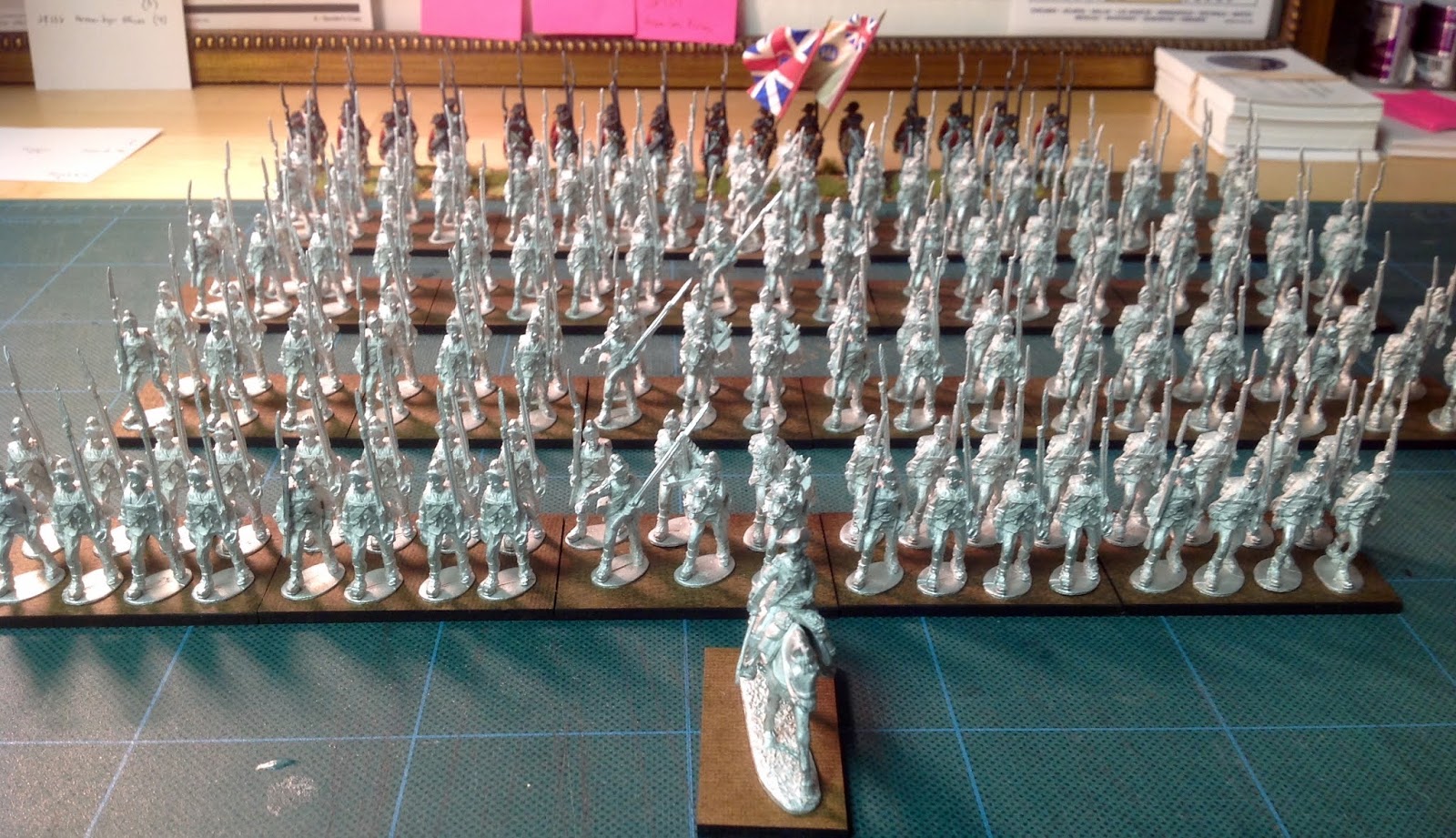
British Legion (24 figures in two squadrons) castings are prepared and ready to be primed with grey primer.
One of the squadrons will consist of walking horses with the riders either hacking or shooting pistols at some unfortunate Americans.

The "Charging Squadron"
The second squadron consists of 12 figures charging at the full gallop. Tarleton's favorite tactic seemed to be just charging into the enemy and then hacking them down if the broke and ran.

The "Hacking & Shooting Squadron" for close in work.
Today, I glued the riders to the horses, adding a small ball of epoxy putty to the underside of the rider to create a stronger bond between rider and horse. I will let the figures harden overnight and give them a coat of grey primer tomorrow. Then two days hence, I can start painting the first squadron.

I will post updates through each stage of the operation so that you can follow the progress of the British Legion.

I will also need to add six to ten Continental 3rd Dragoons commanded by William Washington. Fortunately, six of them are partially painted already, which gives me a bit of a head start on the unit.


Monday, March 10, 2014

New 17th Light Dragoons Greens

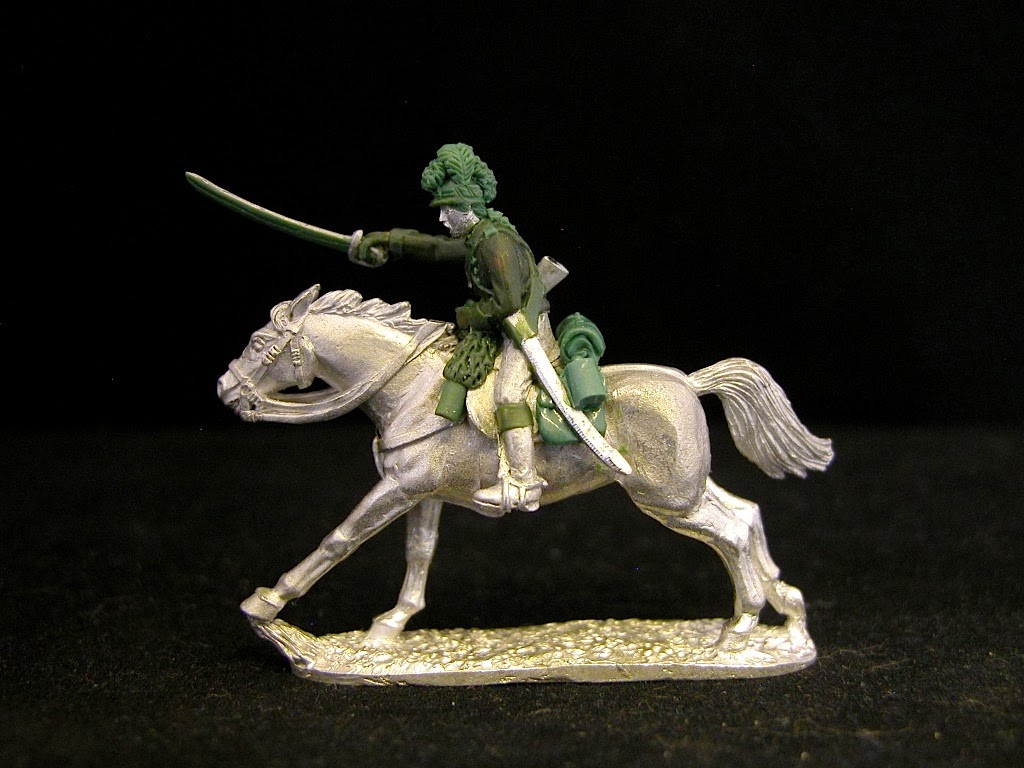
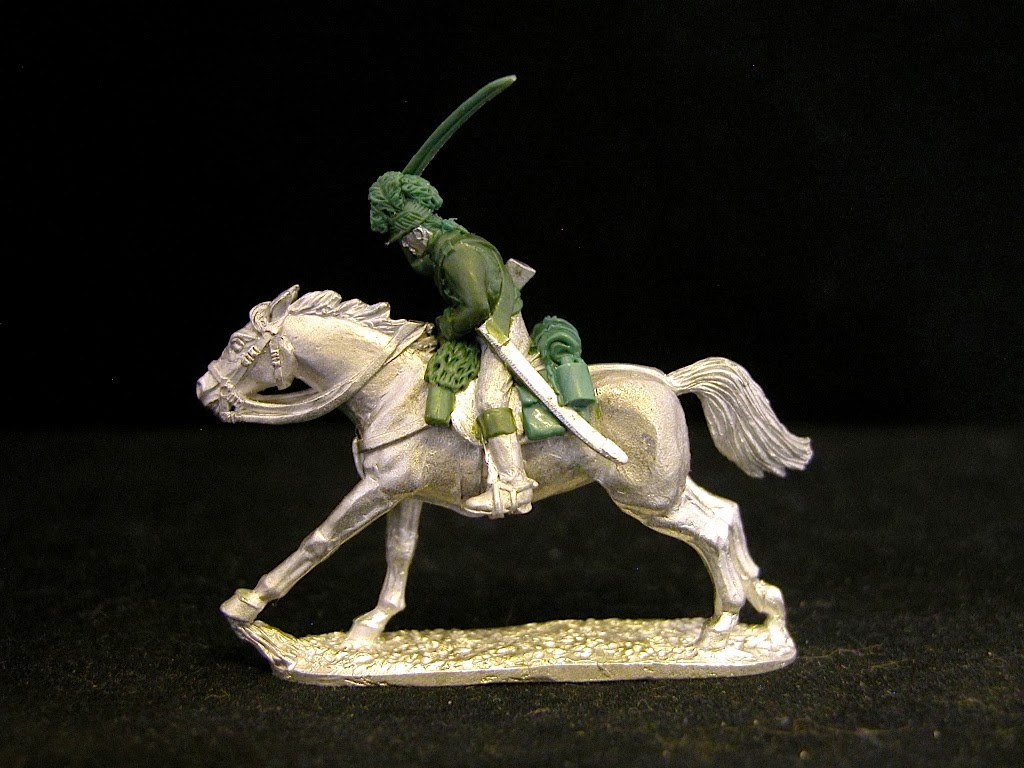
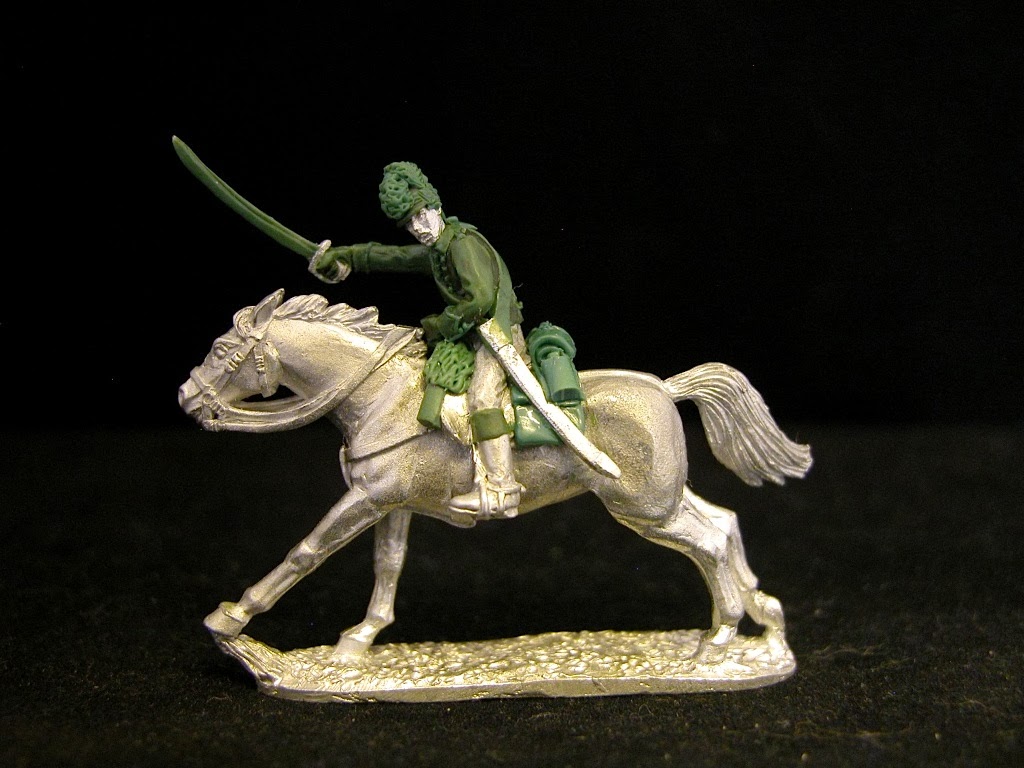
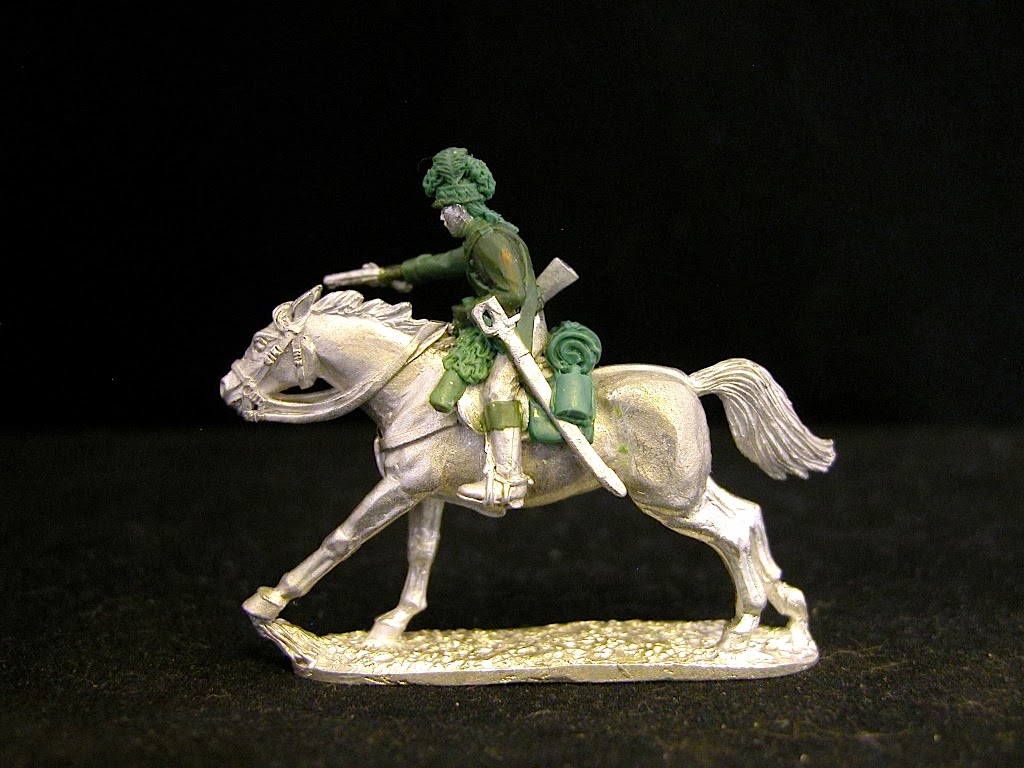
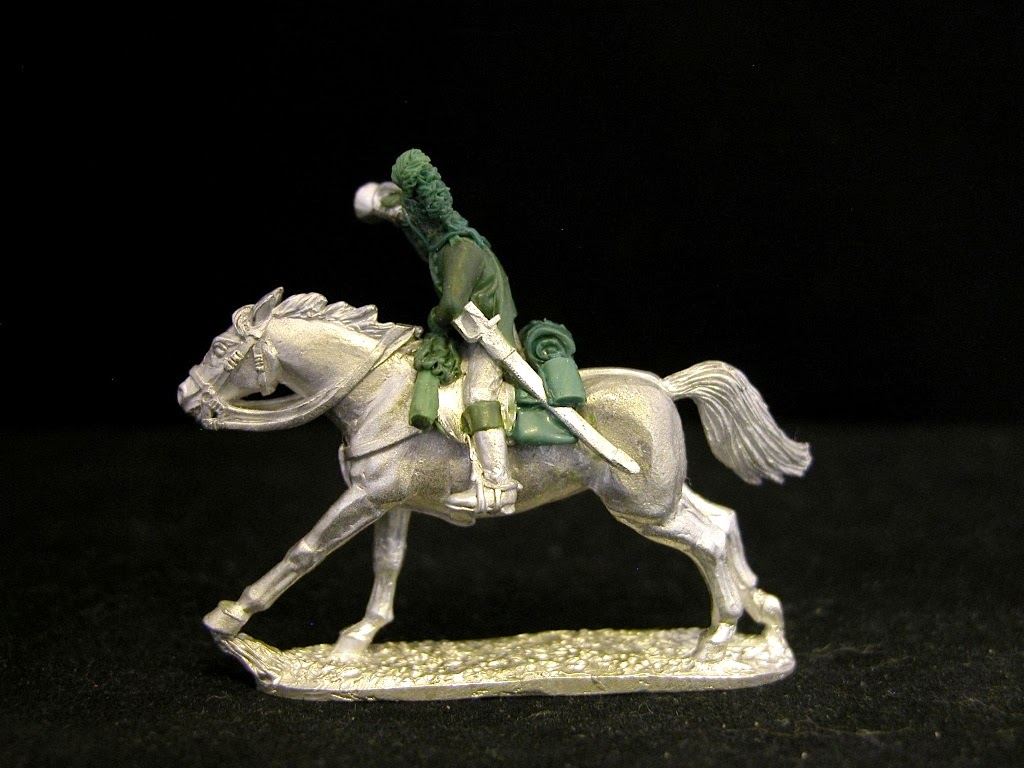
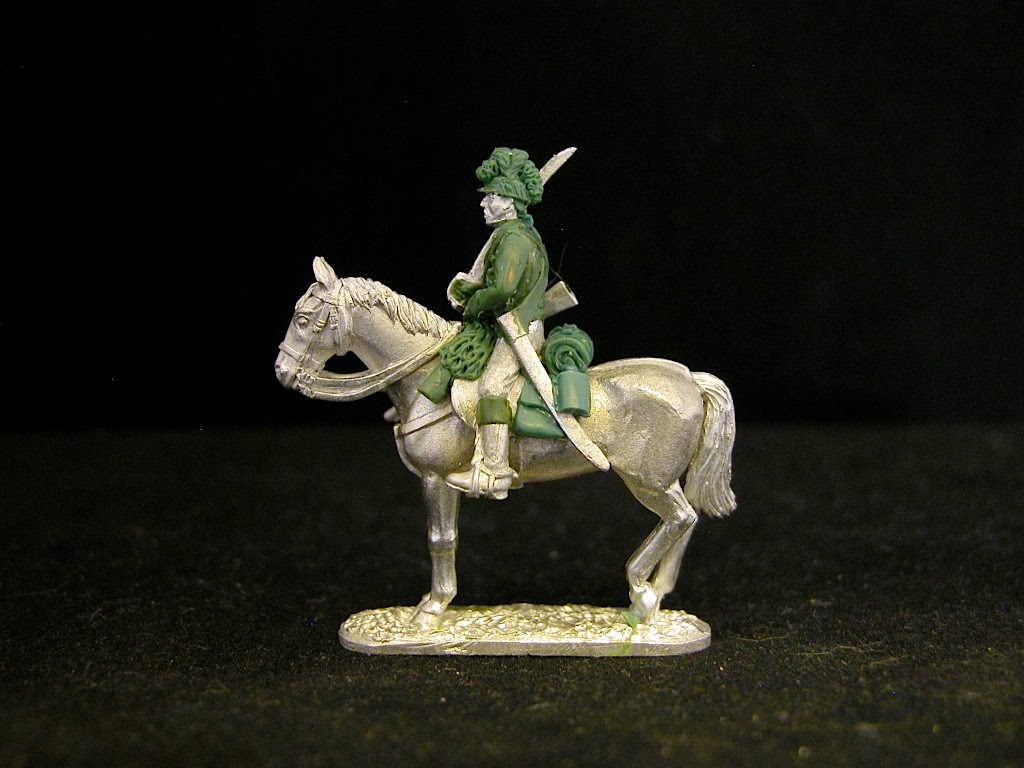
Here are some pictures of the 17th Light Dragoons (4 poses) sculpted by Richard Ansell for the Fife & Drum AWI figure range. The variants, shown in order below, are officer, trumpeter, trooper firing pistol, and trooper charging. The whole set is meant to depict the regiment at the charge .

17th Light Dragoon Officer

Saturday, March 8, 2014

British Legion Greens Have Arrived!

British Legion Trooper Charging.
(Click All Pictures to Enlarge)

 The other day I received a file full of pictures of the latest AWI dragoons that Richard Ansell recently completed. These include the 3rd Continental Dragoons (5 poses), the 17th Light Dragoons (4 poses) and Tarleton's British Legion cavalry (7 poses). All three sets are in energetic charging poses in contrast with the earlier 1st Continental Dragoons and 16th Light Dragoons which were done in skirmishing and shouldered sword poses.

So if you want a traditional "marching with shouldered sword" or "skirmishing" poses, you would select the 1st Continental and the 16th Light Dragoons. However, if you prefer the more energetic "charging" poses, then the 3rd Continental, 17th Light Dragoons and the British Legion are would you will be looking for.

The greens have been sent on to Griffin Moulds to have the master and production moulds made, and then to cast the finished pieces. So allowing for some extra lead time, I would estimate that all of the new figures will be produced and in stock sometime in May 2014.

I will post pictures of the British 17th Light Dragoons and the 3rd Continental Dragoons later next week, so as to spread things out a little bit.


British Legion Trooper, Hacking

The British Legion trooper hacking downward with his sword (see above photo) is one of my favorite poses. You can really get a lot of variety in your regiment using the five charging poses shown on these pages.


British Legion Officer, Charging

British Legion Trooper Charging & Firing Pistol
British Legion Trumpeter, Charging

British Legion Trooper, with Shouldered Sword


British Legion Trooper Firing Carbine