Showing posts with label Big Battalion Game. Show all posts

Thursday, December 7, 2023

Christmas Game Pix, Must see!


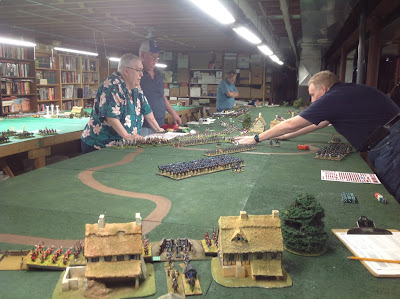
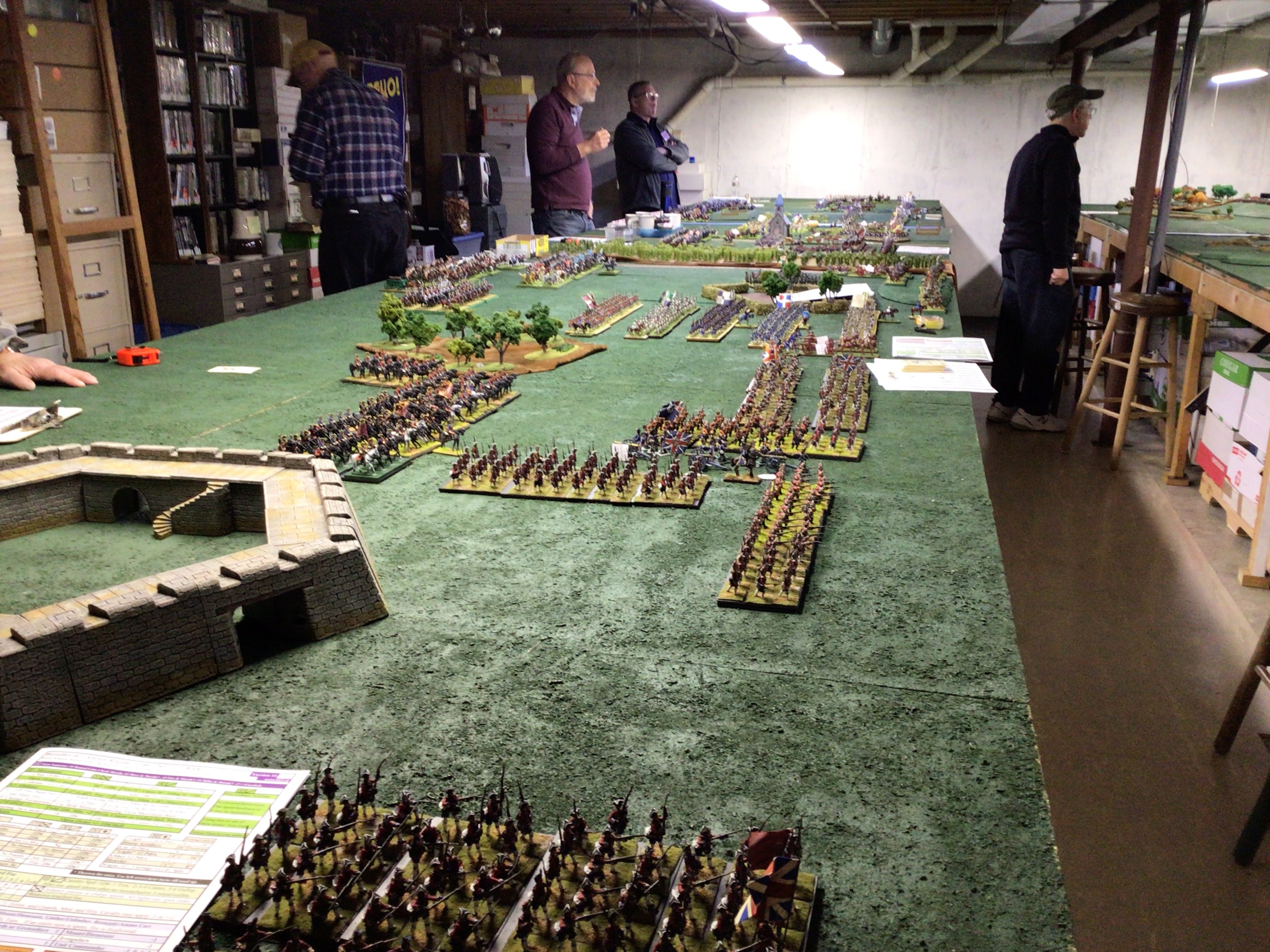
A view of my Austrian brigade in the foreground, looking across the field
at the Anglo-Franco army and players. Note the use of three tables.


On Saturday December 2, 2023 our group of 11 players convened to play our annual Christmas war game. We usually hold the game on the first weekend of December so that holiday plans don't get in the way of having the game. We had players traveling from Iowa, Minnesota, Wisconsin and Illinois for the game. Our host, Kieth L., provided the venue and plenty of drinks, snacks and a mid-day lunch. Kieth's wonderful wife, Donna, made two different types of chili and backed lots of tasty treats such as corn bread, brownies, cookies and lemon bars. Thank you Kieth and Donna for your hospitality.


The Band of Brothers gather for a post-game picture. That's me in the red hoodie.

The Game Parameters 

The rules; We used Bill Protz's Batailles dans l'Ancien Regime (or BAR for short) which are designed for easy and quick games with lots and lots of figures. We have been playing games with these rules since about 2010 so most of the players were well-familiar with the rules.

The figures: We played with big battalions and cavalry regiments of 60 figures, or a ratio of 1:10 man to figures. The figures were largely 30mm Stadden, Suren, Elite, Potsdam and some large 28mm figures such as Front Rank. There were probably even a few Minifigs sneaking into the ranks.

Table size: We played on a game table sized  at three tables measuring 6ft wide by 32ft long with aisles in between the table. The aisles don't exist in terms of table top space, but rather, when a unit approaches the edge of one table, it hops over the aisle and continues its normal movement on the next table. This provides us with a game table that is actually 18ft wide by 32ft long. And trust me, we needed every inch/foot of these tables for the game.

Game Management: We divided the table into three zones (right, center and left) and each sector had its own deck of cards for initiative card draws. This way, one section of the table didn't have to wait for other sections of the table to finish their turn before moving on to the next turn. This speeded up the game.

The game opponents: The game was an unhistorical alliance of the French and British versus the central European powers of Austria and Prussia. The main victory condition was the control of a large town placed in the middle of the battlefield. Sadly, for my team, the French captured the town on Turn 3 and never yielded ground for the rest of the game. As a result, the game ended in a French victory.


The right flank of the Austro-Prussian battle line. The Prussians placed a 
ridiculous number of cannon on top of a ridge, forcing the French to avoid 
the area and attack the woods. Unbeknownst to the French, most of the 
Prussian guns only had one or two rounds of ammunition.


A huge Prussian cavalry brigade in reserve behind the daunting ridge line
of Prussian artillery.


The town in the center of the table was the main objective of both armies.


The central table zone, looking at the Austrian forces.

The British army facing the Austro-Prussian left flank.

The Fritz Bits

Yours truly was assigned a brigade of 4 Austrian musketeer regiments, 1 Croat light infantry regiment, 2 Austrian cuirassier regiments, and a couple of 12-pound cannon. I was posted on the far left flank of the Austro-Prussian army (in my own playing zone), with two Austrian brigades to my right in the center zone of the table. The Prussian army held down the right flank and deployed behind a sizable ridge with their infantry and powerful cavalry contingent.

My opponent, directly across from me, was the powerful British army with 7 regiments of infantry (including one guard and one grenadier regiment) and two smaller 36-figure cavalry regiments of Horse. Counting noses, it was readily apparent that the British outnumbered my infantry 7 to 5 while I had the slight edge in cavalry (96 Austrian cavalry versus 72 British cavalry). Knowing that infantry are more significant and powerful than cavalry in our BAR rules (Batailles dans l'Ancien Regime), I knew that I had my work cut out for me.

There were two enclosures placed on the middle of the table, between my brigade and that of my British opponent. The lefthand enclosure was close enough to the table edge to restrict movement; then there was some open ground in the center, and finally, there was another enclosure and farmhouse on the my front right. I reasoned that if I could advance to the edge of the two enclosures I stood a good chance of forcing the British army to attack through the bottleneck of the open middle ground. Thus, the British would not be able to take advantage of their superior numbers of infantry. I placed three of my musketeer battalions and the Croat light infantry on my front line, and deployed my fourth musketeer line behind the front to provide a support reserve force. My cuirassiers were placed behind the main battle line where they might be able to take advantage of any worn down British infantry regiments to their front.

Let the Game Begin

Given that we were playing on a 32ft long table, it was nearly impossible to have any idea of what was going on at the far end of the table. As a matter of fact, I wasn't able to pay much attention to the goings on in the middle zone of the table. I had my hands full in my zone. Who needs a fog of war rule in this situation?


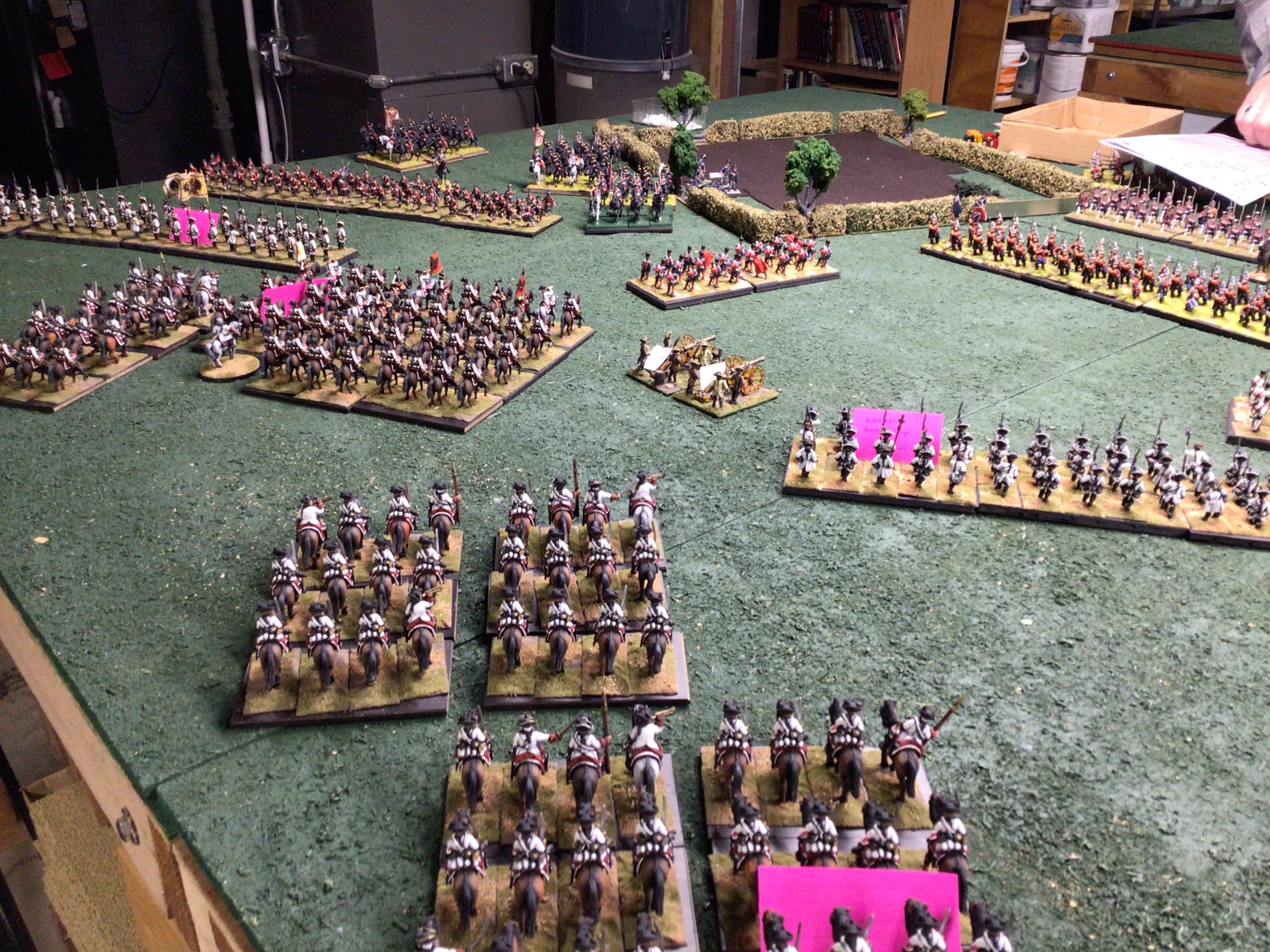
My Austrian battle line deploys and advances towards the enclosure on my right.
Note my Austrian cuirassiers held in reserve.

My Croats lead the advance of my brigade (in columns) to the enclosure.


A view of the left flank of my brigade. The British have gained control of the
lefthand enclosure and advance in line in the center.

My Austrian musketeers face off against the Highland Black Watch regiment.
Note the small gap along the table edge which restricted the movement of
the British cavalry.

My cavalry brigade outnumbers the British cavalry by a large amount, so
it is time for my Austrians to charge.
Cavalry melee in my sector. Austrian cuirassiers on the right and British Horse regiment
 (The Blues) on the left. The game was declared over at this 
time, but my opponent and I played out the cavalry melee. The Austrian cuirassiers prevailed.

The End Result in my Sector

I was able to hold off the advance of the British infantry in my sector. I had one of my musketeer battalions rout due to their accumulated losses. One of my other regiments was pretty well shot up, but hadn't reached the magic 50% casualties number  and thus didn't have to check morale (yet). I recall that at least two British regiments routed and a couple more were severely shot up. Somehow the stalwart Highlanders were able to pass their morale despite losing nearly 2/3rds of their numbers.

Some pictures of the action elsewhere

As I said earlier, I wasn't able to follow the action in the center and right game zones, but from time to time I took a stroll over there and snapped a couple of pictures. Of note, Randy F. sent his French light cavalry into the important town on the first or second turn and held the town for the rest of the game, thus meeting the victory condition for the French army. Well done Randy; that was a great tactic; very clever use of light cavalry.

Bill Protz lords over the French army of his left flank. The cavalry reserve of both sides
was not engaged in the battle due to the preponderance of infantry on the field.

Randy F. is very happy about capturing the town early in the game.

Game action on the center game table.

The overall result: a French victory

Austrian-Prussian right flank: the French bypassed the 13-gun battery of Prussian artillery and pushed their way through the woods at the end of the table. The French were starting to effect a break through when the game was called and it looked like the French would successfully press their advantage had the game continued.

Austrians in the center zone: The French captured the important town, and thus won the game through the victory condition of holding the town at the end of the game. Other than that, the infantry on both sides appeared to be fighting at a stalemate.

Austrians on the left flank: my Austrians appeared to have stopped the British attack.


All in all, this was a very fun game to play. We hadn't attempted to play a game of this size since 2019, the year before the Covid shutdown so it was great to be able to toss lots of dice and move big battalions across the battle table top. And finally, it was great to see many old friends whom I had not seen in about three years.

Thanks again to Kieth and Donna L. for hosting the game, and thanks to Bill Protz for taking the initiative to organize the game, recruit the players, and create fun game scenario.

Sunday, May 31, 2020

Khartoum Tabletop Layout


A preliminary mock up of the walls of Khartoum.


This year's Big Battalion Game will feature a game in the Sudan at the opening of the Mahdi's rebellion. The game will be played over three 6ft by 30ft tables running parallel to each other. We will be using large 54mm toy soldiers for the game. I have sketched a rough map that shows the three game tables and the location of various towns and objectives. The tables run parallel to each other with an aisle gap between each table, in the manner of Peter Gilder's original Wargame Holiday Center set up. The gaps do not exist and so the action carries over from table to table.


Map of tables for the big Sudan game.
There are three parallel tables measuring 6ft wide by 30ft  long.

Sudan Campaign Overview

The British forces will have General Graham based at Suakin (on the Red Sea -rightside table edge), General Gordon in Khartoum (upper left position on the map), and the main British forces at the Korti on the Nile staging area. General Earle's River Column will move up the right bank of the Nile while General Stewart's Camel Corps will move up the left bank of the Nile. The British will also have two river boats at Korti and one boat at Khartoum. There might also be a modest Egyptian garrison at El Teb (I have actually renamed this town Trinkatat since it is a sea port).

The Mahdi's army will be organized under flag commands: Black Flag near Khartoum, Red Flag near Berber, Green Flag at who knows where, and Osman Digna's Beja and Hadendowa tribes near Suakin. If there is a fifth command it will be The Raisuli's Arab/Bedouin tribes at an unkown place. We don't want the British players to know where every Dervish command will be.

The British objective will be to close in on Khartoum and rescue Gordon (major victory), or capture Berber (minor victory) or destroy Osman Digna's army (minor victory). The Dervish objective is to capture Khartoum and fend off any British columns that try to either rescue Gordon or retake the town.

There will be approximately 1,000 Dervish and 300+ British and Egyptian allies in the game.

The game will be played in one full day on a Saturday, hopefully in September, if Covid-19 concerns diminish to a safe level. Otherwise, the game could be deferred into 2021 or as soon as it is considered safe for ten gamers to congregate at close quarters.


The Khartoum Model

One of the terrain features will be the city of Khartoum and part of the scenario will be the relief of Gordon in Khartoum. Accordingly, I am going to need models to create Khartoum on the tabletop.

I created a mockup of the table that features the town so that I can visualize the size of the city and to figure out how many walls, fortifications and buildings will be needed for the game. It also gives me an idea of how many houses can fit inside the area that I have chosen to represent Khartoum.

The following map is from the Osprey Campaign Series book about Khartoum in 1885. The map depicts the town of Khartoum located at the confluence of the Blue Nile (on the right in the map) and the White Nile (on the left in the map) where they form the main Nile River. The rivers provide some natural protection for the town. At the open end of the peninsula formed by the two rivers a long wall runs between the two rivers. The town of Khartoum appears to be well distanced from the defensive walls, unlike those depicted in the movie "Khartoum" with Charleton Heston.

Map of the Dervish assault on Khartoum. Osprey Campaign "Khartoum 1885 General Gordon's Last Stand"

Thus Khartoum can be modeled inside a triangular shaped area of the wargame table. The Blue Nile will be the horizontal edge of the table while the White Nile is the vertical edge of the table.

So refer back to the Big Game Map near the top of the page where you will see Khartoum in the upper left corner. That corner will have a right-riangle area measureing 5ft on the Blue Nile edge, 6ft on the White Nile edge, and approximately 7 to 8 feet on the land side perimeter facing the Dervish.


View of the Khartoum mock up.

I set up some pieces of plywood boards (6" high by 12" long) to make mock walls. This gives me a good idea of the table space needed for the city as well as the positioning of the defensive walls. You can see one wall segment in the picture that is made by King and Country for toy soldier collectors. I have the main gate and another wall section on order and these components will represent the center and gateway of the defenses. The other needed sections will have to be scratch built. I will use either plywood and bass wood to make the walls, or I might use 1/2" thick foam core with bass wood skeleton for support. Both types of material will take to using wallboard paste (Spackle compound) so that I can give the walls some texture and break up the monolithic look of the plain wood. Wood buttresses will be made to cover up the joins between the wall segments.

The walls will need firing platforms for the infantry and probably two artillery positions. Artillery would seem to be an advantage for the Egyptians, but when you look at the model, you can see that the artillery position is probably the weakest portion of the wall because it has fewer men in that space with which to employ as defenders once the Dervish start pushing ladders up the walls. There will also be plenty of buildings inside the city from which the defenders can hole up in should (when) the Dervish pour over the walls.


The long view of my home table (6ft by 12ft) showing the corner position of Khartoum.  The picture also shows all of the plastic Dervish and Egyptians that I have painted since the Covid-19 lockdown began in March 2020.

I am making good progress on the painting of my Dervish army using Armies In Plastic 54mm plastic toy soldiers. Similar AIP figures have been painted for the Egyptian army, which will defend Khartoum.

As of today, I have the following Dervish plastic units:

Beja #1          60 figures
Beja #2          30 figures of 60

Ansar #1        60 figures
Ansar #2        24 figurs of 60     (round shield    - swordsmen)
Ansar #3        24 figures of 60   (wicker shields -  swordsmen)
Ansar #4        24 figures of 60   (spearmen )

Riflemen        20 figures of 60

Total figures painted :  238 foot plus 5 standard bearers


The following Egyptians and British have been painted:

Egyptians      48 figures 64 (organized into "companies" of 16 figures)

Naval Brigade   16 sailors (one company)
Infantry              16 men    (one company)

Camel Corps       6 mounted on camels (of 48 in total)

 Royal Artillery: 2 Gatling Guns, 1 12-pounder, and 1 7 poun mountain screw gun


The majority of the armies for both sides will be metal figures, but I'm using plastic figures to bulk out the armies to be more economical.

Last week my custom made bases from Litko arrived - these are for the Egyptians and British - and so I spent more time basing figures than I did painting figures. I used standard "off the shelf" Litko bases for the Dervish army. They are mounted ten figures per movement tray, on 40mm round bases.

Sunday, August 4, 2019

Battle of Minden AAR


The Coldstream Guards stop the charge of the French Carabiniers cold.
(the Guards were played as regular line infantry in this game rather than as Guard class)


Yesterday nine gamers convened in Woodstock, IL to play a tabletop re-enactment of the Battle of Minden. Approximately 3,000 figures of 25mm. 28mm and 30mm size were used in the game. The figure to men ratio was 1:10, meaning that each miniature represented 10 men.

The game was played using the rules Batailles dans l'Ancient Regime ("B.A.R." noted hereafter) and they produced a very easy to play and logistically manageable game for such a large game. Generally, our figures are individually based and placed on magnetized movement trays. As casualties are taken, the individual figures are removed. However, for this large game, we decided to use a roster to track unit casualties - if a battalion has 60 figures, then there are 60 boxes to check off whenever one of our Little Men have fallen in battle. I know that some people are averse to using the roster system, but this worked very well and I am tempted to use rosters in all of my games going forward. Casualty tracking is much easier, it is easy to tell when a unit is below half strength or when it has used its first fire, it is easier to pick up the figures at the end of the game and pack them away. And finally, the visual impact is superior to using white rings of death or furry colored pipe cleaners.

The game was played on three parallel 6 feet by 36 feet tables. The aisles between the tables don't actually exist in terms of the battlefield ground. So for example, if a battalion of infantry is on the edge of the center table, it is actually inches away from the edge of the opposite table. This can sometimes create a fog of war when one or both of the players do not realize that there soldiers are just inches apart rather than six feet away.

Here are a couple of pictures of the tables to give you an idea of the size of the tabletop area of play:


The left hand table is where the Allies deployed.

This picture depicts all three of the tables used in the game. The table closest to the camera is the left table, upon which the Allies deployed at the beginning of the game. The center of the table features the village of Malbergen, which was occupied by the French. Off in the distance was the right table where much of the French army was deployed. In the far corner of the right table was where the Allied left flank extended and anchored on the table edge.


We divided the table top into two "zones" for purpose of the drawing of cards from the action deck of playing cards. Movement is first determined by the draw of a card (Black = French and Red = Allies) and then another card is drawn to determine which side gets to fire first. Because the action often runs at a different pace in different areas of the table, dividing the table into two playing card zones speeds up the pace of the play. In this game, the center support pole shown in the picture above was the partition line.


Much of my report centers around the action of the British/Allied right flank (French left flank) because this is where I was playing. With the other side of the battlefield so far away in both ground scale and the actually distance from where I played, I really had little idea of what was going on at the other flank during the course of the game.


Lord Sackville's British cavalry brigade would not come into action until Turn 6.


Another view of Sackville's British cavalry. I painted 48 of these figures over the past 3-4 weeks and not a single one of them crossed swords with the French

A Bit of Quick Historical Background
Those of you familiar with the Battle of Minden will know that the terrain forced the French to deploy their army in a most unusual manner - most of their cavalry was in the center rather than stationed on the French flank. Students of the battle will likewise know that due to an unusual set of circumstances a lone brigade of six British and two Hanoverian infantry battalions marched, on their own and with no support, straight into the maw of the French cavalry position. 

Because cavalry generally do not use firearms on the battlefield, the French cavalry must have viewed the approaching column of redcoated infantry in much the same manner as a battleship might have viewed incoming torpedoes - there was nothing that they could do to defend themselves. Thus the French cavalry had no choice but to charge the British column or else be shot down by the redcoats' musket fire.

Three different waves of French cavalry charged the British in succession. The first wave charged and were repulsed, as was the second wave of cavalry. The third wave of French cavalry had some moderate success of breaking through the thin red line, but the second line of British regiments shot them out of their saddles.

The French infantry of the left flank, commanded by Guerchy and Prinz Xavier, then marched forward to contest the British with musket fire, but like their cavalry bretheran, the French infantry were repulsed by British muskets and artillery fire. That effectively ended the battle as the French were now in full retreat. The British cavalry on the right wing (commanded by Lord Sackville - boo, hiss!) was in a perfect position to charge into the retreating French army and turn a defeat into a total disaster. However, Lord Sackville refused to commit his cavalry to the battle, and repeated orders sent by the army commander, Prince Ferdinand of Brunswick, failed to spur Sackville into action. Lord Sackville was ultimately court marshalled and kicked out of the army.

My Report of the Battle as Commander of the British Column of Infantry

The first line of French cavalry was required to charge into the British infantry column as part of the game scenario. The French cavalry commander, le duc de Fitzjames, was in the process of turning his cavalry around and retiring to the back table when he was reminded by the game judge that that was a no-no.
Captain Philips' British battery of 12-pounders dropped quite a few French and Saxons f
rom their saddles as they charged into the British infantry.

The First French Cavalry Charge
Sufficiently chastised, the French cavalry spurred into a charge and the first line of the Royal Regiment, the Graf von Bruhl Saxon cavalry and the French Commissair-Generale cavalry crashed into the British front line, from left to right, the 8th (King's) Regiment, the 11th (Sowle's) Regiment, and the 23rd (Royal Welch Fusiliers) Regiment.


The British 11th (Sowles') try to fend off the Royals and Graf von Bruhl cavalry regiments,
which they did with great efficiency.


The horse grenadier squadron of the von Bruhl dragoons steers into the flank of Sowles' regiment. That seems a little bit dodgey given that a straight charge forward would find them crashing into the Royal Welch Fusiliers, but what the hey, it's just a game.

Lots and lots of horsies contest the fight with lots and lots of redcoated infantry. The 8th (King's) Regiment in the foreground dispatched the French Royal Regiment to its front, latter routing away.

Another view of the first wave of the cavalry fight.

The blue-coated Royals flee, the white-coated Commissaire-General waits in support, and the von Bruhl dragoons are pushed back.


The British fended off the first wave of French cavalry with relative ease. Infantry get a first fire firing bonus of +5 and since the British hadn't used their first fire yet, that increased the number of French cavalry casualties. I should add that I was having some rediculously good saving throws during the melee. Casualties get a chance to be saved if they roll a 4, 5 or 6 on a D6 die. I had one saving roll for 10 figures and 9 of them lived to fight another day. I was beginning to feel a little bit sorry for the French player opposite me. You try your best to stab stab stab at those redcoats and then the Big Guy in the sky decides that nearly all of them had incredible luck on the saving throw.

The French Cavalry Rebound
The French Royal regiment was out of action and the von Bruhl dragoons were "disordered" after being in the melee with Sowles' infantry. Von Bruhl charged again, this time with the fresh Commissaire-General regiment at their sides. Note to self: hmm, we should not allow disordered cavalry to charge until they are back in good order - it doesn't make a lot of sense to me. How do the officers compell a milling mass of horsies to form up and charge again? They don't.


This time the French had better luck than on the first try. They no longer had to deal with the dreaded "first fire" bonus of +5 because th 8th and 11th regiments had already fired at them in the previous charge.

It was a desperate struggle as Sowles' infantry gave as good as they got, but they lost one more man than their cavalry opponents and so they had to take a morale test before the French had to roll some bones. Sowles' rolled a 1 and a  2 - you need a total score of 6 on two D6 dice. So they routed back 24-inches. Would the French pursue? Yes. They pursued for, get ready, 24-inches! This meant that they caught the redcoats and cut them down. The picture below shows the moment of the French cavalry break throw in the center of the British formation.

The Graf von Bruhl charge again, this time with the Commissaire-General and successfully break through the British infantry line, Sowles' regiment having broken and routed.
For those of you keeping score at home, a break through is not a good thing.

The Duc de Fitzjames then pulled a nifty little tactic out of his bag of tricks: rather than throw the two regiments back in the fray, they milled about in the rear area of the Allied deployment ground. This ended up tying up a good part of the Hanoverian and British infantry because they had to turn about and face this cavalry so that it would not charge unannounced into their rear. This meant that there were two or three fewer infantry regiments that the French cavalry would have to deal with as the battle went on. Quite clever when you think about it. The act of just being in the rear caused more trouble than it would if they had charged back into the battle.

The French cavalry that broke through mill about in the rear area of the Allies' lines.
Here They Come Again!

The second wave of French cavalry was still on the back table (right table), so the British battalions had time enough to go into a number of strange formation contortions as they tried to make ready for threats to their front and rear. Meanwhile, Prince Ferdinand of Brunswick, the commander of the Allied army, pulled two regiments of Hanoverian cavalry and one regiment of Prussian Black Hussars from the battle on the left-center near Malbergen, and sent them in the direction of the British brigade to help them out.

Hey, don't look now, but here comes the cavalry to save us! These are the white coated
Hanoverian dragoons and the Prussian Black Hussars on their way to help in the center.

A good idea and a timely order, but with the table being 36 feet long, the Allied cavalry reinforcements didn't arrive in time to help out in the center.


There is trouble a brewin' and its headed our way. The elite Gendarmerie de France cavalry and the Saxon Rutowski Dragoons advance toward the British infantry line.

The British infantry was sorted out as best it could with the Coldstream Guards moving into the front line (they had not fired yet, mwha ha ha!). The Royal Welch Fusiliers (also hadn't fired yet) were to the right of the Guards, and the remainder of those jaunty and plucky lads of the 8th (King's) Regiment formed up on the left of the Guards. The 3rd (Howard's) Regiment was in a supporting second line, but they were faced to the rear just in case the French cavalry milling about in the rear decided to charge.

The next wave of French cavalry included the cream of its cavalry, the vaunted and awesome Gendarmerie de France cavalry, and another fine regiment of Saxon cavalry - the Rutowski Dragoons.

The 8th (King's) Regiment are now the Diehards

The 8th Regiment had previously fended off the French Royals and had joined the neighboring Hanoverian brigade of von Scheel in its attack on French-held Malbergen. They were engaged in a firefight with the French Regiment d'Eu (doh!) when the Rutowski Dragoons arrived and announced themselves.

"Tut, tut, nothing to worry about," said the men of the King's Regiment. With half the regiment shooting it out with the d'Eu Regiment, the other half of the King's Regiment fended off the Rutowski Dragoons. The 8th had prevailed again against overwhelming odds.

The Saxon Rutowski Dragoons pile into the King's Regiment, which is partially
engaged in a firefight with the French d'Eu regiment.

An overhead aerial view of the action in the center of the table,
taken just as the third French cavalry attack is launched.
Le Duc de Fitzjames can be seen taking a few snapshots of the scenery.
The men of the King's Regiment, perhaps now they should be known as The Diehards, reloaded their muskets, tightened up their bayonets and then waited for the next attack. This time, the Rutowskis returned with the Gendarmerie de France, no less! Sheesh, what do we have to do to get a little respect around here?


The Gendarms, on the right, join the Rutowski Dragoons.
The weight of numbers proved too much even for The Diehards, who broke and routed.

The King's Regiment was now down to one figure over half strength (they would have had to take a morale check to stand up to the charge if they had less than half their original strength) - 31 figures out of the original 60 figures in the regiment. However, the weight of numbers was with the French-Saxon cavalry and the men of the King's Regiment were finally broken in the melee.

Sometimes in a wargame, a particular unit stands out and does something heroic that will be talked about in future games to come. Die hard men of the King's Regiment, die hard!

And Now For Something Completely Different - Action in Other Areas

OK, so in other areas of  three 36 foot long tables, some stuff was going on in one area, and some people were doing things in another area. Who knows what; I'm up to my eyeballs in horse flesh and I have no idea of what else is going on. Fortunately, I was able to take a few photographs of the Allied attack on Malbergen.

Hanoverian troops (I know, British flag - stand ins for Hanoverian troops)
attack the village of Malbergen, which is stoughly held by the Irish Bulkely Regiment.

On the left side of Malbergen, the Hessian brigade of von Imhoff attacks Nicolai's French brigade, which is supporting the defense of Malbergen. In the foreground, von Wangenheim's super brigade of British, Hanoverian and Prussian grenadiers sit idly by and watch the action.


Ah, who cares? Let go back to the cavalry action in the center of the battlefield. You know, the place where legends are made.


The French Third Wave of Cavalry. Don't these guys ever give up?

Now the large (5 squadrons) 60-figure regiment of French Carabiniers decided to join in the fun and they decided to charge into anything wearing redcoats. 

The French Carabiniers close with the Coldstream Guards. The Royal Welch Fusiliers are to the right, en potence. The Howards' are in the rear facing the other way.

In the middle background you can see the French Gendarmes attack, described elsewhere in this report.

My goodness, that's a lot of French cavalry!

Not anymore

Present, fire!


Oh, By the Way, Lord Sackville Finally Stirs.

At the start of Turn Six, the British cavalry brigade of Lord Sackville finally saw fit to earn their pay today and they advanced forward in two lines.

A French general is amused by the sight of Sackville's cavalry finally beginning to stir.

And Then Time Ran Out

It was now about 3:30Pm in the afternoon and we had been fighting since about 9:30AM in the morning, with a one hour lunch break.

Way way off in the far corner on the Allied left flank, von Wangenheim had stopped de Broglie's attack against some earthworks. Wangenheim also had a secure hold on Kutenhausen, so the left flank of the Allies was totally in their favor.

In the center, the French maintained a death grip on Malbergen and it didn't look like they were going to be dislodged any time soon. They had repulsed von Scheel's Hanoverian brigade and von Imhoff had lots of fresh troops, but it was going to take several more hours of game time to play this out.

On the Allied right, Lord Sackville was now taking his brigade on an afternoon's trot, but they were looking at three fresh French battalions in Guerchy's brigade and three more battalions from Prince Xavier's Saxon brigade was advancing in the center to support the cavalry attack.

Counting noses, it looked like the battle was going in the French favor in the Allied center and right flank areas. And those dang Commissaire-General cavalry were prancing about in the rear areas of the Allied lines.

We all agreed that the French had won the Battle of Minden 2019.

The Minden Theatrical Players
FRONT (L-R) Gary, Rolf, Brent, Jim and General Pettygree (in hat)
BACK ROW (L-R) Der Alte Fritz, Chuck the Lucky, Kieth (our host) and John  the Formidable.

My thanks go out to the other eight players, four of whom had travelled from Minneapolis, MN to play in the game. They are a great group of guys with a great sense of humor and the sense that we are here for a social gathering as much as it is for a wargame. Thanks also must go to our host, Kieth L. for providing a magnificent playing venue, and to his wonderful wife, Donna, for cooking a very tasty mid-day meal and never-ending plates of home-baked sweets and snacks.

Undoubtedly there will be more gala big battalion games in the future. Next time I hope that we can   gather in more travelers from far and wide to join us in our game.


Friday, August 2, 2019

Final Minden Game Preparations


The village of Kutenhausen is occupied by von Wangenheim's grenadier brigade.

I spent most of the afternoon today "walking the Minden battlefield" and getting the game table and the logistical pieces all set and locked into place.

Each player will have a command of infantry or cavalry and so I put together all of the player aids on clipboards for each command. The clipboards will include a roster sheet of the units in the command, a set of rules, a pencil and 20 D6 dice. There will be four Allied players and five French players.

Player game aids are all found on a clipboard for each command.


Tape measures will be provided to all of the players.
When the player finds his designated command he will see a hand written set of orders, done in calligraphy, next to his clipboard. The orders are written on parchment paper, then they are folded in half, and then folded in half again. A sticky seal is placed on the envelope to hold the paper folds in place. This is done in lieu of using an envelope because this is probably how a dispatch or a set of orders delivered from the commander would have looked.


An example of the individual game orders for each player.
Shown is Lord Sackville's orders, for all the good that it will do for him.

The troops are all deployed in their assigned positions, the orders for the day are given, and the game is ready to play on Saturday morning. The following two pictures provide a sense of the vast amount of table space that is available for the game. There are plenty of open flank areas and room for movement. Note that there are three 6ft by 36ft tables, but only two of them are shown in the pictures.


We use cards drawn from a deck to determine movement and fire initiatives. Given the vast amount of table space, we will probably divide the tables into three different zones and  have card decks for each zone. This will speed up the game and allow the players in the particular zones to play at their own pace. For example, if Zone 1 has an extensive melee going on and Zone 3 has finished everything in its turn, then the players in Zone 3 can start a new turn while the Zone 1 players are still hashing out their melee.