Showing posts with label Russian Army SYW. Show all posts

Sunday, September 1, 2024

Cossacks!


Cossacks doing what they do best: burn and pillage an East Prussian village.
RSM figures mounted on Minden horses.

Click on pictures to enlarge

If one is going to have a Russian army for Seven Years War games then one of the key components of that army is the irregular light cavalry soldiers known as Cossacks. And while the Minden Miniatures figure range does not have Cossacks (at least not yet, but a likely addition), I have found that the RSM Cossacks are a perfect fit with Minden Miniatures cavalry. My force of Cossacks are RSM figures that I have mounted on my own Minden/Fife and Drum horses.

Cossacks are useful for screening infantry or cavalry movements of the main Russian army as well as causing havoc on the flanks and rear of the Prussian army. They can be a real nuisance but they are not particularly effective as battle field cavalry. In my rules, Cossacks can only be "unformed" troops and so they would fight "formed" regular trained cavalry at a great disadvantage. In fact, in my rules when a formed unit makes contact with an unformed unit, the latter is vaporized and removed from the table top. 

On the other hand, Cossacks move at a faster rate than regular cavalry hussars and so they can outrun them if need be. Cossacks are not allowed to charge formed units from the front, but they may charge into the flanks or rear of formed troops. 

Cossacks ride into town. The bits of kapok on the tips of some of the spears 
represent flaming torches that will be used to set fire to the town.


A Prussian field bakery provides a juicy target for the Cossacks. Here they set fire 
to the ovens and related equipment.


Here the Cossacks are burning potential forage to deprive the Prussian food for their horses.


ccc 

Tuesday, August 27, 2024

Hand Painted Flag: Russian 3rd Cuirassier Regiment


Flag of the 3rd Cuirassier Regiment in Russian service.

Kronoskaf image of the 3rd Cuirassiers flag

I am almost finished with a new 24-figure regiment of Russian (boo, hiss) cuirassiers and so it was time to find a flag for it.  Usually I would look for the appropriate flag from GMB Designs, but this particular regiment was not available.

My backup plan was to download the flag from the Kronoskaf website. After the download, I put the image into Word and manipulate the size of the image until it is just the right size, and then I print it out. Sometimes this is all that is needed, but this time I decided to paint over the flag image with my own brush strokes. I use the image as a sort of "paint by numbers" template and repaint the flag over the image. 

Remember those old Paint By Numbers art kits? You would get a canvas in the box and the image of the painting would be printed on the canvas. Each area of the canvas had a number assigned to it and each number represented a particular color of paint. If the color "Blue" was number "6" then you would paint blue in all of the areas that had the number "6" on them.

I am not a professional flag painter, but I am rather pleased with the way the flag turned out. The actual flag is smaller than what you see in the first picture so there is some distortion to the images.

I was spreading terrain goop all over the bases of the Russian cuirassiers earlier today. I will let them dry overnight and then dry brush the surface and add some static grass and tufts to the bases.

cc

Monday, August 5, 2024

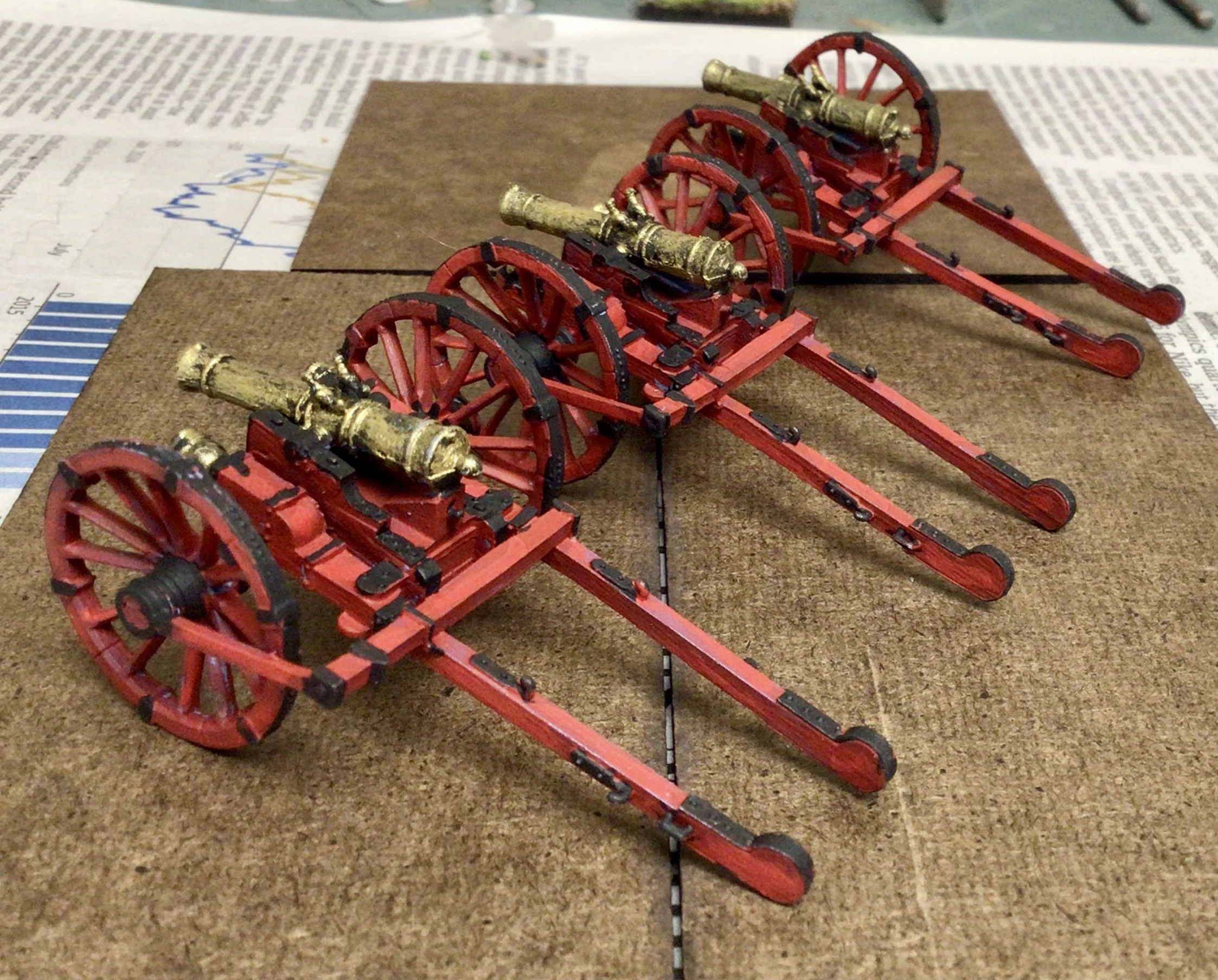
Claymore Castings Russian 3-pound Cannon


Russian light 3-pound cannon from Claymore Castings

I was very excited to hear that Claymore Castings (David Imrie - see Saxon Dog blog) decided to add that unique Russian 3-pound field artillery piece that featured the regular gun tube plus two small coehorn style mortars attached to the gun carriage. I had only ever seen one model of this gun ever made, that in HO scale (20mm) by Zvezda. I had also heard about a metal model made by some obscure company in Austria, but I had never seen a picture of it.

Here is Christopher Duffy's take on the Russian 3-pounder, or more specifically, the mortars:

The Blizniatki were tiny field mortars, cast two-and-two together, designed by the artillery officer Mikhail Vasilevich Danilov after he had read Saint-Remy's "Memories d'Artillery". Great quantities were sent to the army in 1757, but they were soon discarded as useless.

That may be, but if you have a Russian SYW war game army you have to have these models in your army.

Christian Rogge has an excellent blog in which he covers his own scratch built SYW artillery models. Christian details his work on Russian artillery models in the following link:

Christian Rogge's SYW Blog

As you can see from the pictures that I am posting, the 3-pounder has a forked gun trail that allows it to be pulled by a team of two horses without using a limber. This presumably would have given the piece more mobility than, say, an Austrian or Prussian 3-pounder that would need their own limbers.

A front view of the Russian 3-pounder shows the two small mortars mounted on the gun carriage near the axle.

The Claymore Castings model with a Minden limber horse. The Minden officer figure
is shown for comparative purpose.

The Claymore Castings model is nicely done and the castings are clean and do not require any clean up work prior to priming and painting. They seem a tad large relative to Minden Miniatures figures, but then David has sized these pieces to fit with his own SYW Russian and Prussian figures. The company makes two versions of the Russian 3-pounder: large and small. I believe that models that I bought were the large versions and I have one small version on order so that I can compared the sizes of the two versions. I would point out that from my experience in standing next to cannon wheels from a variety of historical figures, my shoulders are approximately the same height as the wheel on 3/6/12 pound artillery pieces. So I believe that the scale of the Claymore Castings model is appropriate for any 28mm figure.

Here is a link to the Claymore web site. Click on the SYW pull down menu to look at the various offerings for the Russian and Prussian armies. They are very nice figures and look to be "Perry size" in style and height. I am very appreciative of David adding these Russian cannon to his figure range as they fill a definite need in the 28mm SYW universe. I am not planning on adding the Russian 3-pounder to the Minden Miniatures range because the Claymore Castings model is a good one and you might as well purchase their cannon model rather than me offering a redundant model.

Claymore Castings

My opinion: I give my highest recommendation to the Claymore Castings artillery models.


Here are a couple pictures of the Claymore Casting Russian 3-pounder model  with some Minden Russian artillery crew. To my eye the two should fit together quite nicely.


Here are a pair of artillery munitions wagons, made for me by Mr. Ed Phillips.
The painted scene on the 4-wheel lid depicts a blacksmith at his forge, so maybe
this version was used by the army's blacksmiths and field forge units.

I am currently working on the painting of 24 of the new Minden Miniatures Russian Cuirassiers and I should have them ready for photography later this week. They will come in handy when I play Phase 3 of the all-cavalry battle, as the heavy cavalry of both sides enters the battle.

Click on the link below if you have an interest in adding Minden Russian cuirassiers to your Russian armies.

Minden Miniatures Russians


My plan is to add some Cossacks to the Minden range in the near future. Steve Barber, who sculpted the entire Minden Russian army set of figures, will be the sculptor for the Cossacks. There will likely be mounted and dismounted versions of the Cossacks. I will post more information on this new project as it develops.


Tuesday, July 12, 2022

Picture of the Week : SYW Russian Cossacks


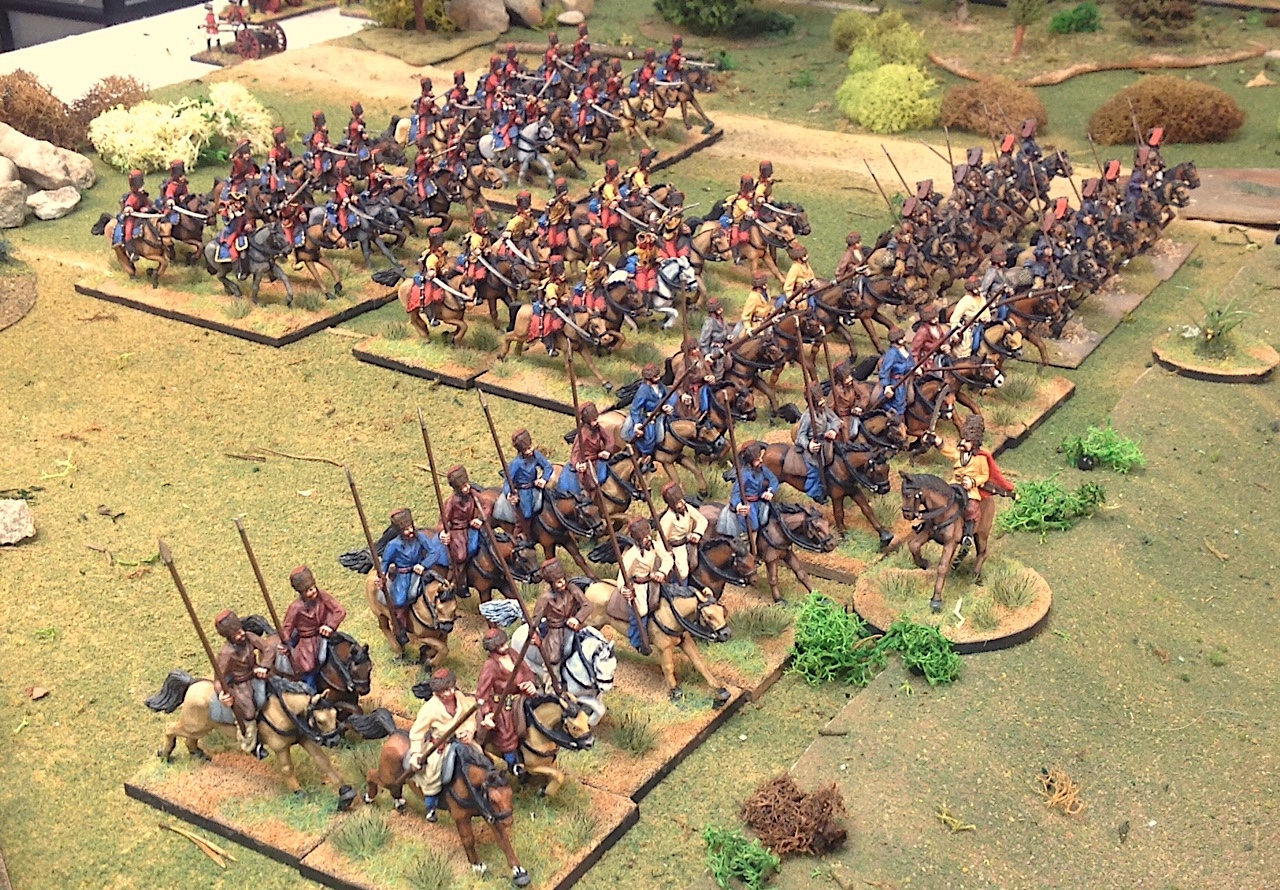
Russian Cossacks (RSM figures on Minden horses) supported
 by Russian Hussars (Minden Miniatures).

Click photo enlarge

This is one of my favorite pictures in my SYW photo album. It depicts a vast hoard of 36 Russian Cossacks and a second line of Russian Hussars to back them up in the fight.

The Cossacks are RSM Miniatures that I have place on the more dynamic Minden light cavalry horse and there are probably a few Fife and Drum Miniatures AWI horses in the mix. I really like the way that the Cossacks turned out after painting them. The figures aren't encumbered with much equipment so they paint rather quickly. About the only thing that I had to do to prepare them was to cut lances (from North Star) and attach them to the hands. I place a tiny ball of green stuff putty in the hand prior to gluing the lance to the hand.

I separated the Cossacks into smaller groups of about 9 figures and paint each batch with similar colors. For example, all 9 might get blue caftans and another 9 will get brown caftans, etc. Then I go back and paint the trousers in random colors across all batches of painted figures. When I am finished, then it is a simple matter of mixing the different colored figures onto two figure stands which produces an irregular appearance to the unit. For example, a tan caftan and maroon caftan dressed pair of figures are placed on the same stand. Theoretically, no two stands should look the same.

There are plans in the works to add Cossacks to the Minden range of Russian cavalry figures. Stay tuned for more information.

The Russian Hussars are actually Austrian Hussars that I've "converted with paint" which amounts to nothing more than not painting edging and insignia on the horse furniture. Sometimes the uniform differences between one nation and another is indecipherable so your paint brush will make the distinction fo you.


The rest of this week will see me making preparations for my trip to Historicon next week. I will be running my "Bread and Croats" SYW skirmish game on Friday night and Saturday afternoon.


So far I have just layed out the terrain mats on my table. I will add all of the buildings and terrain, next,
and then figure out how to pack all of the terrain into the minimum number of boxes
so that I can maximize cargo space in my car.


Thursday, September 24, 2020

Minden Russians On Parade Review


Minden SYW Russian Musketeers on parade.
(click all pictures to enlarge )


The Sudan Project is winding down and I wanted to get some SYW troops onto the game table. So the table was cleared of Khartoum (which was actually moved to its own 6ft by 7.5ft table) and Dervish figures; and then I set out all of the figures in my Minden Miniatures SYW Russian army.


Russian generals and staff are trying to figure out which road to take.


Russian musketeer brigade with its ammo wagon.

Minden SYW Russian artillery crew and cannons.


Minden Russian Musketeers wearing their green coats (front battalion only).

Minden Russian grenadiers wearing their green coats.

Minden Russian Horse Grenadiers in Summer waistcoat
order (right) and in regular uniform coat (left)

Close up view of the Russian Horse Grenadiers wearing just their waistcoats.
Their blue coats would have been left with the baggage train. Officers, however, continued
to wear the blue uniform coat.


Russian Cuirassiers. These are actually Minden Austrians painted in Russian colors.

One good reason to display all of the units in a particular army in your collection is to see what might be missing and require painting. The Russian parade made it apparent to me that I needed to add 1 to 2 Observation Corps musketeer battalions, one battalion of Russian grenadiers in summer waistcoats, 1 to 2 more battalions of line musketeers wearing waistcoats and a similar number wearing green coats. And finally, the cavalry inspection revealed that the second squadron of the Yellow Hussars needed to be painted. A few more 3-pound battalion guns would look nice too.


It looks like I have my work cut out for me over the next several months.

Thursday, December 12, 2019

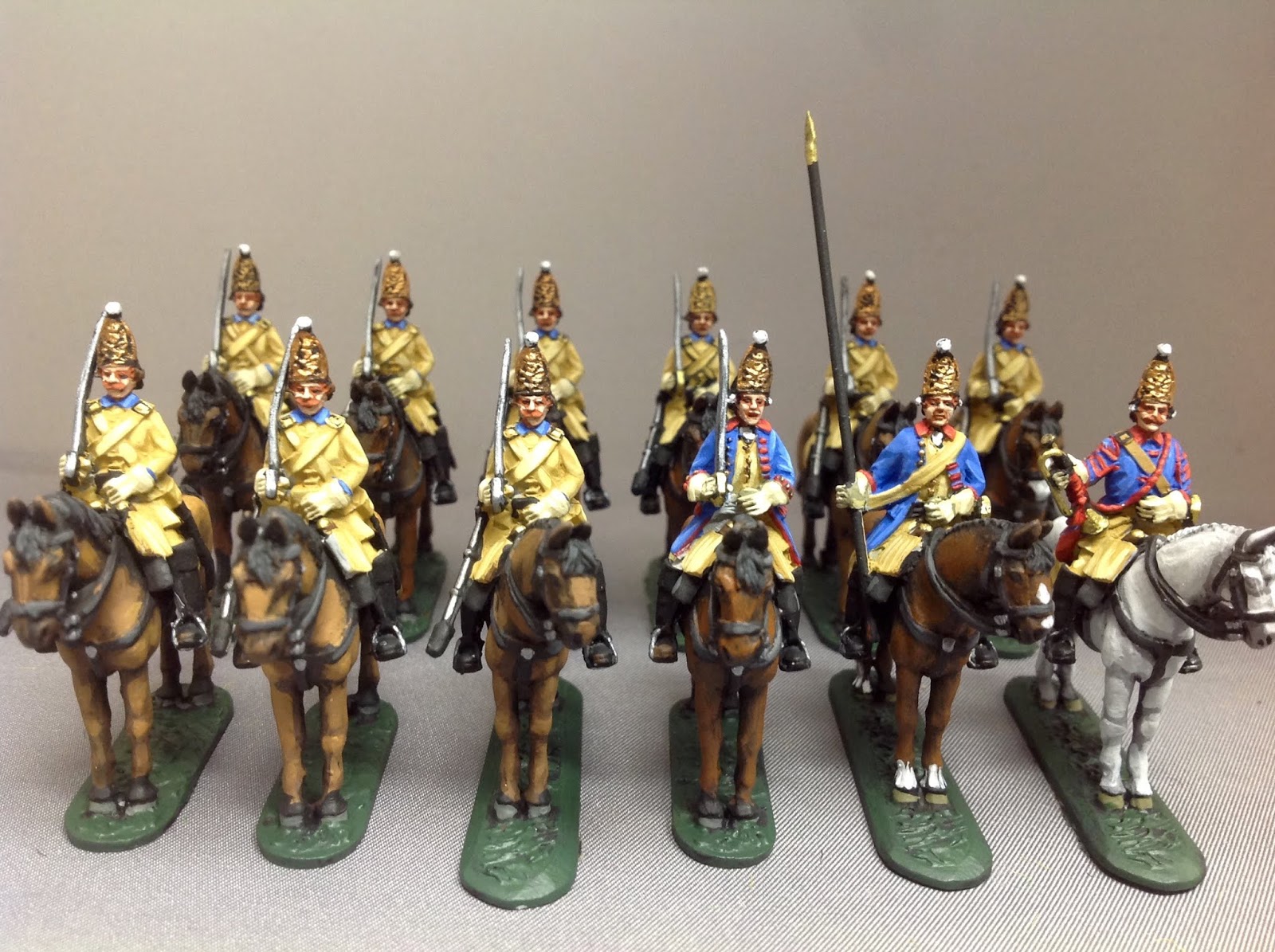
Russian Horse Grenadiers in Summer Waistcoats


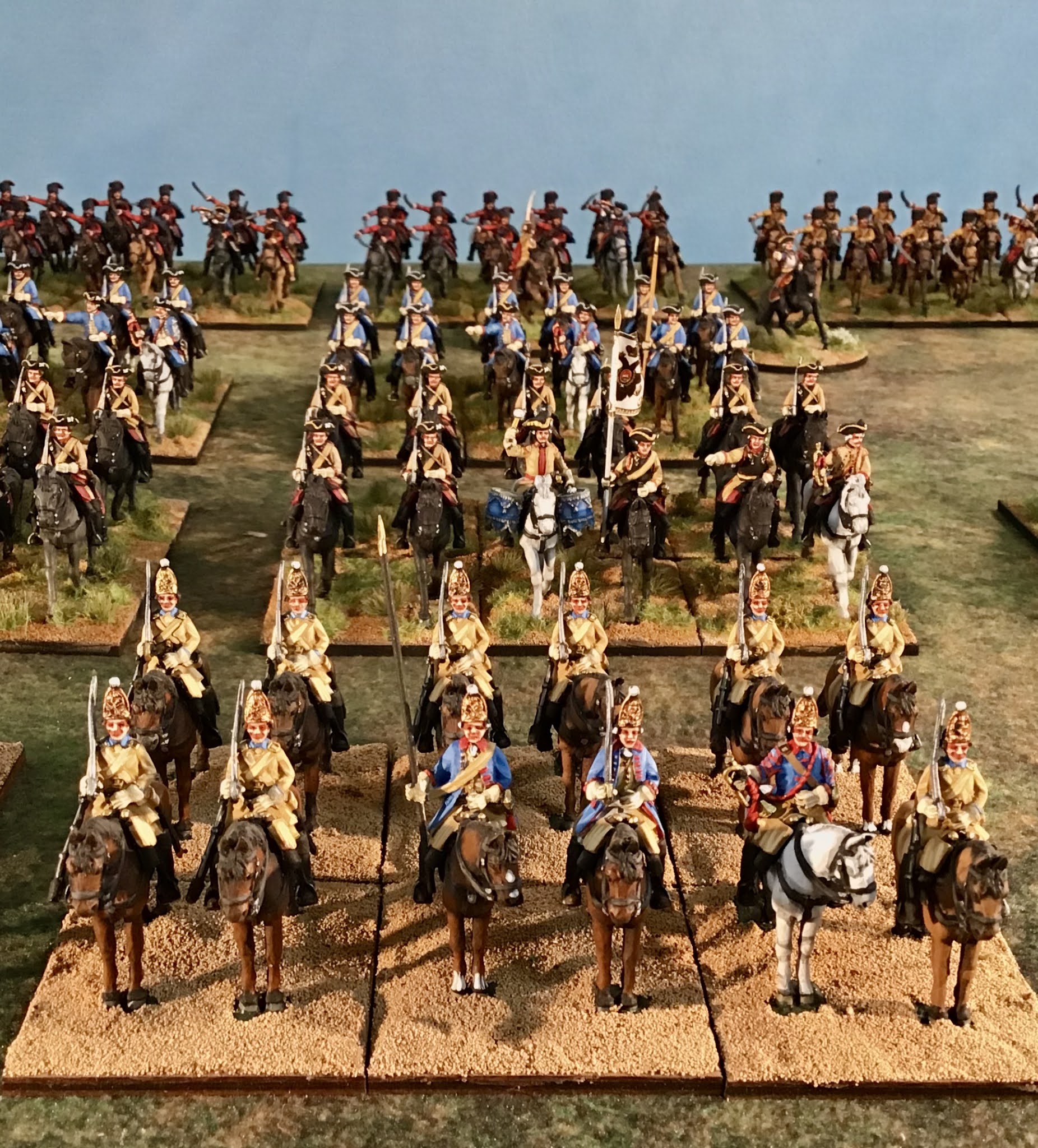
Russian Horse Grenadiers in Waistcoats. The officers always wore their blue coats.
I finished painting a 12-figure squadron of the new Minden Russian Horse Grenadiers in Summer waistcoats. The regiment can be made using one pack of MRC-006 Horse Grenadier Command (officer, standard bearer and musician) and three packs of MRC-008 Horse Grenadiers in Waistcoats (3 per pack). If you are more interested in the rank and file wearing blue coats, then select MRC-007 Horse Grenadiers to fill out your unit.

The buff colored waistcoat with blue cuffs and collar is an attractive uniform and provides a nice contrast to the regular blue coats worn by the horse grenadiers and dragoons. During the Summer campaign season all of the cavalry shed their coats and fought wearing the sleeved waistcoat, even the cuirassiers.

The officers and musicians always wore their regular blue coats regardless of the season, I suppose to make them easier to see by the rank and file cavalrymen.


I ordered some 2-inch square bases from Litko and will have to wait until they arrive before I can attach the horse grenadiers to the bases, two horse per base, or a 1-inch frontage per horse.

So which regiment are these fellow? It doesn't matter, they can be any regiment because all horse grenadiers wore the same uniforms and there were no regimental distinctions.


Sunday, November 3, 2019

New Minden Russian Horse Grenadiers


New Minden Russian Horse Grenadiers Samples


I have been busy painting samples of all of the new Minden Miniatures SYW figures that were recently added to the range. Today I present pictures of the Russian Horse Grenadiers. The new product codes for the figures are as follows:

MRC-006     Russian Horse Grenadier Command (3 figures w/ horses)             $18.00

MRC-007    Russian Horse Grenadiers in Regular Dress (3 figures w/ horses)   $18.00

MRC-008    Russian Horse Grenadiers in Waistcoats (3 figures w/ horses)        $18.00


The three figures on the left comprise the command pack MRC-006, the second figure from the right in waistcoat comprises the MRC-008 pack of three figures, and the figure on the far right is the MRC-007 pack.


Information about the organization and formation of the Russian Horse Grenadiers can be found on the ever-reliable Kronoskaf web site:


The horse grenadier regiments were formed in 1756, just before the start of the Seven Years War. Six former dragoon regiments were converted to horse grenadier regiments. Five of the six regiments fought in the SYW. While the regiments had a nominal organization of 5 squadrons, typically only 3 squadrons were "at the front" while the other 2 remained at the depot as garrison troops.

Kronoskaf notes that the horse grenadier regiments had two 3-pound cannon that were served by men from the Russian artillery, but usually fielded one cannon on campaign.

In late 1758 (sometime after the battle of Kunersdorf) the horse grenadiers replaced their helmets for tricorn hats, thus resembling Russian dragoons save for the color of the horse furniture -- fawn yellow or buff for horse grenadiers and blue for dragoon regiments


The first picture, below, shows the command pack for the horse grenadiers. The officers and musicians in the regiment always wore their regulation cornflower blue coats, in Summer as well as the rest of the year. The rank and file horse grenadiers would shed their blue coats during the Summer campaign season and wear the long-sleeved waistcoat.

Russian Horse Grenadier Command Pack - Product Code  MRC-006

The next picture depicts the standard horse grenadier uniform with the cornflower blue coat. There are three figures with horses in the pack (despite there being only one figure in the picture - I haven't painted the others yet, but will soon). The product code for these figures is MRC-007.


The third pack of Russian Horse Grenadiers (MRC-008) contains three rank and file horse grenadiers wearing just their long sleeved waistcoats. The waistcoats were a buff color and were adorned with blue collars and blue cuffs. The waistcoat opened down the center and was secured by eye-hooks rather than buttons.


The horse grenadier figure in just the waistcoat is not commonly seen in other SYW Russian figure ranges. Wargame Foundry is the only range that comes to mind with regard to having the Summer kit figure in its range. I think that the figure is rather handsome and will look very nice in a unit with buff troopers and cornflower blue officer, standard bearer and musician.


I use 12-figure squadrons in my SYW armies, so in the coming weeks I will paint one squadron wearing the regulation blue coat and a second squadron wearing the summer waistcoat.

Cuirassiers and Cossacks are in our plans in the not too distant future.


Friday, December 14, 2018

New Picture Found - Russian Raid on Berlin in 1760


Russian raid on Berlin in 1760 - Alexander Kotzebue (1849)


This morning I was googling my way about the internet looking for some information about a SYW era Russian officer by the name of Tottleben, who commanded the Russian light cavalry (hussars and Cossacks) during the 1760 campaign.

Russian Cossacks - RSM Miniatures mounted on Minden Miniatures light cavalry horses.
Click picture to enlarge.


My search revealed a new painting/image, at least for me, of the Russian raid on Berlin in 1760 by an artist named Alexander Kotzebue, called "Einnahme von Berlin (1760)". See the top of this page for a copy of the picture and then click on the picture to enlarge the view.

The painting depicts what appears to be several formations of Russian cavalry on a grand plaza in central Berlin. The painting was done in 1849 so it appears that some of the buildings in the background are of the mid 19th Century architecture, so some artistic license is used in the picture.

In any event, I have seen a lot of paintings of the events and people of the Seven Years War, but never this painting. So I was rather pleased to have made its discovery. 

I also found a colorful map, in Russian, of Berlin at the time of the 1760 raid, I think. It could be a map of the 1757 raid by the Austrian general Hadik.

Berlin, circa 1760

Engraving of the Russian raid on Berlin in 1760.
I refer you to the Kronoskaf account of the raid, which took place on October 7, 1760 with the temporary capture of Berlin on that date, for detailed information about the raid.


v

Friday, October 5, 2018

Types of the SYW Russian Army


Russians (left) versus Prussians (right) at the Battle of Zorndorf.
This scenario was fought at the Seven Years War Association convention in March 2018.

Click on all pictures to enlarge the view.

I
 suppose that a number of my blog readers are getting tired of me posting pictures of SYW Russians on the blog, but because they are a new figure range under the Minden Miniatures umbrella, I am going to be "Russia Oriented" for quite awhile. So please bear with me.

Why I like the Russian Army
I can think of a number of reasons to like the Russian army, starting with the fact that the Russians were one of Frederick the Great's primary opponents - and Frederick never defeated the Russians. That in its own right should be enough to have a Russian army in your SYW figure collection.

Second, the battles versus the Russians generate some very good wargaming scenarios: Gross Jagersdorf in 1757, Zorndorf in 1758, and Kunersdorf in 1759. Paltzig (or Kay) does not make for a very even scenario unless you simply enjoy slaughtering the Prussians. As an added bonus, you could even have the Russians switching sides and joining the Prussian army in a Silesian scenario. For a brief period of time, during the reign of Peter III, Prussia and Russia were allies.

Third, the great variety and diversity of troop types that were in the Russian army. And might I add, they had some colorful, if not downright gorgeous, uniforms that are fun to paint. You can have an army that includes grenadiers and musketeers wearing either their green coats or their summer uniforms that consisted of the long sleeved red waistcoat. You can add the Observation Corps - infantry that wear cavalry boots. The Russian cavalry establishment has cuirassiers, horse grenadiers, dragoons, hussars and COSSACKS! My favorite cavalry are the horse grenadiers with their grenadier mitres. And of course, anytime you think about a Russian army, you have to include the exotic Cossacks into the equation.

Fourth, in a word: artillery, artillery, artillery and even more artillery. I really like the variety of cannon in the Russian artillery establishment. You have the Shuvulov ("Secret") howitzers with thei rconical bore, you have the unicorns in various sizes and weights, common variety smooth bore 3/6/12 pounders, and finally, a wide variety of huge howitzers of the regular variety. If you like artillery, then you've got to have a SYW Russian army.

Russian Musketeers

Russian Musketeers in regulation green coats.

Russian Musketeers in Summer Waistcoats


Russian mounted infantry officer

Russian line grenadiers and musketeers in summer waistcoats
Note that the Russian officers, NCOs and musicians wore their green coat in all seasons. So in the Summer, a battalion of musketeers would have the rank and file wearing red waistcoats, but the officers, standard bearers, NCOs and drummers would be wearing green coats.


Russian Grenadiers

The Russian army had both regular standing grenadier regiments and sometimes there were ad hoc grenadier battalions created by drawing off the grenadier companies of the line musketeer regiments and converging them into battalions.

Russian Grenadiers in regulation green coats


Russian Grenadiers in Summer waistcoats.


Russian grenadiers are particularly spectacular to look at with their brass-copper miter plates and the unusual rear flap that covered their necks. Think of them as the first people to turn their caps around in hip hop style, well ahead of their time.


Russian Observation Corps

Peter Shuvulov created his own personal army called the Observation Corps, whose original function was to provide a guard for the artillery. The rank and file were recruited from the garrison regiments, supposedly the best of the worst troops. The OC grew into an establishment of 4 musketeer regiments and one grenadier regiment, so it was quite large. The OC battalions were often supported by the exotic Shuvulov howitzers, which were employed as battalion guns.

Like the regular line infantry, the Observation Corps rank and file fought all of their battles during the Summer campaign season, so they discarded their heavy green coats, leaving them at the baggage park, and then fighting in their red long sleeved waistcoats.


Observation Corps Grenadiers

Observation Corps musketeers

Russian Artillery


Russian artillery battery with limbers and munitions wagons.
Russian 6-lb (left) and 12-pd (right) cannon with artillery crew in either firing or loading poses.

Russian howitzers: 10-pd unicorn (left) and Shuvulov Howitzer (right)

Russian Line Cavalry

The Russian regular cavalry was probably the weak link in the army, able to mount only 7,000 men across 14 regiments ( 5 cuirassier, 5 horse grenadier, and 4 dragoon ). While the regiments in theory had 5 squadrons, the number of squadrons per regiment was usually 2 or 3 squadrons. The cavalry was further handicapped by its lack of suitable horses. Indeed, three of the five cuirassier regiments were not issued with cuirasses and the dragoon regiments were generally just bad. The hussar regiments were considered "irregular cavalry" but they were deemed to be superior to the regular cavalry regiments.
Russian Horse Grenadiers
(RSM heads on Minden torsos, with Minden horses)

Russian Cuirassiers (Minden conversions)

Russian Dragoons (Minden conversions)

Russian Hussars (using Minden Austrian hussars)
Horvath Hussars (left) and Gruzinski Hussars (right)

Cossacks

Russian Cossacks (RSM miniatures on Minden horses)

Russian/Cossack supply wagon (Perry Miniatures)

Russian Generals

Russian General Fermor and his division officers.

Russian officer vignette
(various Minden figures simply painted green to convert into Russians)
Conclusion
I hope that reading this blog post will encourage SYW wargamers to take another look at the Russian army and give due consideration to painting and collecting their own armies. I have included pictures of some of the Minden Russian army figures so as to give readers a visual idea of what the Russian soldiers looked like.