Showing posts with label Basing Figures. Show all posts

Saturday, June 11, 2022

Painting & Basing Methods Tutorial


Newly painted third battalion of the Prussian Guards, wearing mitre hats.
The second battalion wore tricorn hats.


CLICK OR DOUBLE CLICK ON ALL PICTURES TO ENLARGE


Yesterday I finished painting a 42-figure unit of the 15/III third battalion of the Prussian Guards for my Seven Years War army. The unit had been sitting on the painting table for several months now and I just couldn't find the gumption to finish them off. So I decided that enough was enough and it was time to finally get them finished and on the game table. 


Front view of the Guards unit.


Rear view of the Guards. The officers and NCOs form a third rank to the line.

I had previously painted the second battalion of the Guards - they wore tricorn hats whilst the third battalion wore grenadier miters. The first battalion was the ceremonial guard unit that only saw action at the Battle of Kolin during the Seven Years War. The second and third battalions saw a lot of action over the course of the war. All of the figures, both second and third battalions, are Minden Miniatures figures that are specifically sculpted to the uniform details of the guards battalions.

I really had to power through the project at first, but eventually momentum kicked in and I started to make progress on the final 20 figures that I needed. The early stages of my painting method gets very tedious, especially when it comes around to painting all of the black bits on the figure. Here is step by step list of how I paint my figures:

1. prime the figures with a light grey color of spray primer. The Vallejo "Wolf Grey" is my favorite.

2. paint the skin areas an undercoating of red brown

3. paint the uniform coat a dark navy blue

4. paint the small clothes next (waistcoat and breeches) a dark yellow

5. paint the red facings (cuffs, lapels, turnbacks and collars)

Now comes the hard part, painting the equipment a black undercoat

6. paint black to all of the equipment such as cross belts, bread bags, knap sacks, water bottles, muskets, scabbards, gaitors, and headgear. This stage takes about 5 minutes per figure, but it becomes extremely tedious after the first couple of figures. I use black as an undercoat for anything that I paint brown or white.

At this point, most of the major colors are "blocked in" and cover the entire figure with various paint colors. Now I advance to applying highlights and details such as buttons and facial features .

7. paint a tan skin or ruddy flesh color over the red brown skin areas, leaving the red brown undercoat showing in the eye sockets and mustache.

8. paint the knapsack and musket dark brown.

9. block in the cross belts and bread bag with a light grey color

10. apply highlight colors on the blue coat, red facings and yellow small clothes.

11. apply white to the cross belts and bread bag.

12. paint the mitre plate on the grenadier mitre silver, paint the cartridge box emblem silver and paint the buttons and lace silver. Anything that has a metallic color must always have a black undercoat in order to make the metallic color be noticeable and have a "pop".

13. paint the musket barrel and water bottle a pewter color. I really do not like painting musket barrels and bayonets for some reason, so this stage is rather tedious for me.

14. paint the buckles, musket butt, sword hilts and scabbard tips Old Gold or brass.

15. (optional) paint all of the leg gaitor buttons with the Old Gold color. Again, this is a tedious step.

16. Add a skin color highlight, touching a small dot on the chin, bridge of the nose and cheeks. Hands get two stripes of highlight on the broad part of the hand. I generally do not paint knuckles. That is borderline ridiculous. 

17. (optional) add another highlight red color. This is generally not necessary but it sometimes provides a color "pop" to the lapels.

18. paint the base dark green

The figure is finished at this point. Note that I do not paint eyes anymore, other than to put a black dot in the eye socket sometimes, nor do I highlight anything that I've painted black. I mean, black is black and it doesn't really lend itself to highlighting. My one exception to the "no black highlighting" rule is horse manes/tails and black horses. I mix a bit of flesh color to a basic black which produces a very dark grey color, which I use sparingly.

And that's how I paint my wargame figures. Once I have passed Step 12 then things seem to speed up and the feeling of tedium passes. I like painting the details on my figures because these seem to bring the figures alive.

Once all of the painting is completed then I move on to basing the figures. I use either MDF bases or buy thin plywood bases from Litko Bases. I glue the figures to the wood using white "Elmer's Glue" and let the glue dry overnight.

Next, I trowel in the "mud", which is a goop made of premixed wallboard paste (get the light paste and not the heavy paste - you can tell the difference just by picking up the quart container by hand). I like the Red Devil Pre-mixed Spackle Compound brand the best. I stir in a dark brown acrylic paint to the Spackle and stir it up until all of the white Spackle color is gone, with the final mix looking like chocolate pudding (but don't eat it!). I use a tiny artists' palette knife or scalpel to trowel the goop between the figures. Sometimes a toothpick or an old paint brush are used to get the goop between the feet of the figures.

While the goop is still wet, I dunk the base into a tray of extra fine railroad ballast made by Woodland Scenics. Then I let the base dry over night.

The next day I stir up some highlight colors and dry brush the paint over the bases. I might use two or three different highlight colors until I get something that looks right to my eye.

Now comes the foliage. I glue on pieces of tufts, which are long clumps of grass. Army Painter makes a nice variety of tuft colors. I use Swamp Grass tufts for the most part. I let the white glue dry for about an hour and then add static grass to the base. Let the tufts dry before you glue on the static grass, otherwise some of the static grass will adhere to the glue on the tufts and, well you won't like how that looks so it's better to let the tufts dry for a short while. You can also add flowers tufts and bits of ground clutter at this stage, if you like.

Now I paint white glue randomly on the base of the figures and dip the base into a tray of static grass, or I sprinkle the static grass onto the base. Then I turn the base sideways and tap the back of the base to remove excess static grass. Then I blow on the top of the base to make the static grass stand up.

The bases are now finished and the final step is to give everything a spritz spray of matte finish (Dull Kote or similar brands). Actually, oftentimes I spray the figures before I start adding the goop to the bases. One note of caution - if you are using GMB Designs flags or similar brands of pre-printed flags, I'd recommend spraying the flag bearer(s) separately, then all of the other figures get sprayed, and then you glue your flags to the flag poles. Then you glue the figures to the bases and then trowel on the goop. Some people like to spray the matte finish to the grassed bases but I don't find this to be a necessary step. Do be careful though to NOT SPRAY YOUR FLAGS with matte or gloss spray because the sprays make the ink colors run.


With the completion of the third battalion of the guards I now have seven units for my War of Austrian Succession Prussian army consisting of the following units:

IR1 Winterfeldt musketeers - 2 battalions

IR18 Prinz von Preussen musketeers - 2 battalions

IR15/II second battalion of the Guards - 1 battalion

IR15/III third battalion of the Guards - 1 battalion

Bornstadt Grenadier Battalion (5/20) - battalion

Plus the 36-figure Bayreuth Dragoons in white coats cavalry regiment.


Next on the painting table: Austrian Grenadier Battalion with 32 to 36 figures.

Sunday, April 18, 2021

Round or Rectangular Bases - Help Me Decide


Round (left) versus Rectangle (right) bases.


I am working on a regiment of 30 American riflemen to represent Morgan's Rifles at the battles of Saratoga in 1777. The regiment did not fight in close order formation like other Continental regulars, so I am considering using a round base for the unformed riflemen and a rectangular base for formed troops. Thus Indians and Jagers would also be placed on round bases. 

Note that I plan on placing five figures on six stands for a total of 30 riflemen in the regiment.


Five riflemen placed on an 80mm diameter round base.


I have found some rounds that are 80mm in diameter, which is similar to the 80mm frontage that I am using for the formed troops.

I have not yet decided which form of basing to use for the riflemen, so I thought that my regular blog followers could help me decide by offering up comments and suggestions in the Comments section at the end of this blog post. This is sort of like a poll, except that I don't have the ability to use a poll in Blogger, so your votes will have to be made in the comment section.

Simply type in Round or Rectangle in the Comments to record your vote. Of course, feel free to add any other comments or state your reason for liking one shape of base over the other.

Sunday, July 26, 2020

Minden Miniatures Prussian Guards

IR15/II - musketeers of the second battalion of the Prussian Guard


I recently finished painting and basing a battalion of the second battalion of the Prussian Guard (musketeers in tricorn hats). The actual figures had been painted several months ago, but I was awaiting the arrival of the GMB Designs flags to finish the unit and do the basing and terraining. Flags arrived and were immediately affixed to their staffs and are now ready for service.


The figures are the Prussian Guard Musketeers that were added to the Minden SYW figure range in late 2019. I decided to change my basing system from 2 ranks on a 60mm wide by 40mm deep base to three ranks on a 60mm wide by 80mm deep base. The third rank consists of the officer, NCOs and drummers. The end stands have the drummer on the outside flank standing next to an NCO. The other stands have one officer or one NCO.

The figure configuration per stand is:

8/9/8/9/8 = 42 figures

The old system has six figures per stand on five stands = 30 figures.

View of the third rank of officers, NCOs and drummers.

I kind of stumbled into this basing concept when I decided to paint some AWI Hessians (in a firing line) as Austrian musketeers. I added Minden SYW drummers, officers, standard bearers and NCOs to the Hessian figures to make the unit look more "Minden-like". I used the conversion by paint method to turn the Hessians into Austrians.

Because the front rank of my firing line has the muskets in firing poses, I was a bit concerned about having the musket and bayonet extending over the front edge of the stand, thus making it susceptible to breakage from rough handling. So I decided to keep the same 60mm frontage, but double the depth from 40mm to 80mm. in order to provide the base depth that would protect the muskets and bayonets.

I immediately noticed that I had lots of extra real estate on the bigger stands, so this allowed me to do two new things to the battalion: cram at least 8 figures onto the stand instead of 6, and add a third rank of file closers. Each stand has a third rank of either drummers (only on the two end stands), NCOs or officers. Bigger stands and more figures means that the size of the battalion would suddenly increase from 30 figures to as much as 42 figures. I have the flexibility to remove one of the stands (8 or 9 figures) to reduce the size of the unit more in keeping with my existing battalions of 30 figures. If I removed an 8-figure stand, that reduces the strength from 42 figures to 34 figures. Using a 1:20 ratio, this results in a battalion of 680 men, which is closer to the theoretical strength of 720 men in a typical Prussian infantry battalion.

However, removing one stand leaves me with four stands, of which the command stand flags are now slightly off-center when the battalion is deployed into a line formation. My solution was to add a stand representing the 3-pound battalion gun and crew and place it on one of the flanks. This would give me a configuration of:

8/9/8F/9/battalion gun. 8F represents the command stand with the battalion's flags.

I prefer the symmetry of a battalion that has its flags in the center of the battalion frontage.

I like the new look and this will likely lead me to paint a whole new Prussian and Austrian army for the infantry service branch. I don't have to change the cavalry basing, but I will have to increase cavalry strengths from 24 to 36 figures, by adding 12 more figures per regiment.

And so I will end up with two Prussian infantry contingents and two Austrian infantry contingents; however I will likely sell off the old 30-figure battalions as I paint more 3-rank battalions. I have the one Prussian Guard battalion compared to six Austrian battalions already painted.


Here are several pictures that compare the new (three ranks) basing system versus my original (two ranks) basing system

New basing system (top) versus the original basing system (bottom).

The battalion frontages are the same, but the new system has the files much closer. There are 30 figures in the original battalion and 42 figures in the new battalion.

New system (left) has three ranks compared to two ranks for the original system (right).


Friday, December 13, 2019

Litko Bases and a Dice Tower Too!


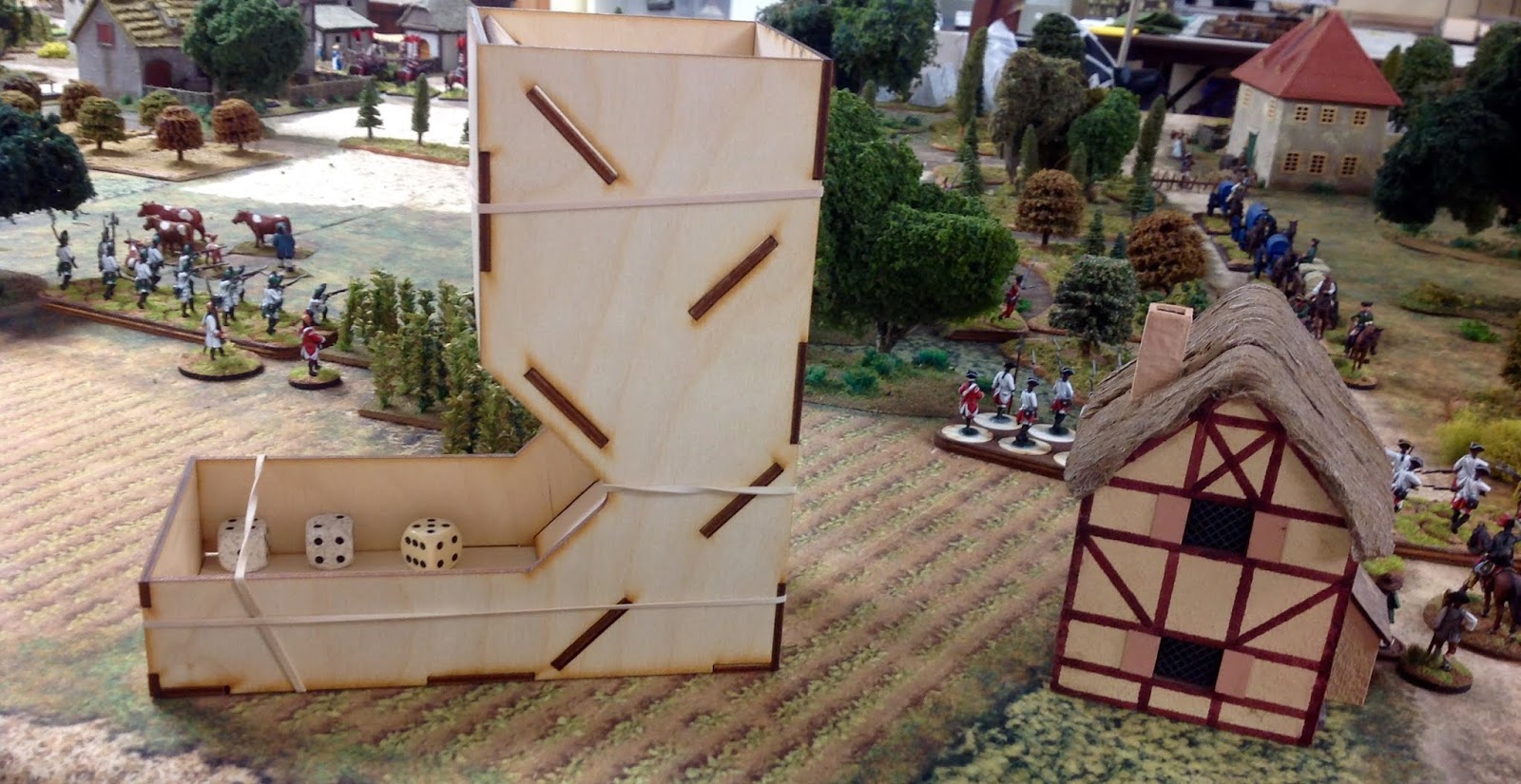
Litko dice tower


I ran out of my regular 2-inch square MDF bases that I use for my cavalry figures and my local FLGS did not have in stock. So what to do? I ordered what I needed from Litko Bases. For good measure, I also ordered a dice tower.

I could attach a house next to the tower and make a little vignette out of it.

My order arrived today, it only took about three days from order to deliver. Litko really does a good job on the delivery end of the business. Top notch customer service and great products make Litko hard to beat.

I want to paint and embellish the dice tower so that it looks like a building suitable for 18th Century warfare. I envision having four dice towers, one on each corner of my game table. The table rules would require that all dice be rolled in the dice tower or else the die roll does not count.

Searching for ideas on how to embellish the dice tower.
This one wouldn't work for obvious reasons.
Attaching a building to the other side of the tower might work
Not so good. It looks good but placing the add-on house next to the dice tray area
makes it hard to pick the dice out of the box.

Litko Figure Bases
I purchsed a 100-pack of 2-inch square bases to use for my cavalry units. I also needed some bases with a three inch frontage to use for small two stand cavalry units.

Two-inch square bases for my Russian Horse Grenadiers.

Three-inch frontage with a two-inch depth bases for my Gendarmerie de France cavalry.

Christmas Shopping at Target - For Terrain?
I went to the local Target Store today to buy some outdoor Christmas lights. Whilst there, I went rummaging through the Christmas ornaments section to see if I could find any potential wargame terrain items.

I found these galvanized steel towers, each with an American West style of wind mill. I won't need the windmills because these weren't used in Europe during the 18th Century. They would look nice in an 1800s farm or cowtown in the American West.

A pair of candleholders would make for a good town gate for a walled city.

The towers measure 5-inches from the base to the roof eaves, and 8-inches to the peak of the roof. The diameter of the can is 3.25 inches. The roof already has a tile pattern on it so I could just paint it without any embellishments. I don't think that I want to get too involved in geometry to try and tile the roof myself, but we shall see.

I will prime the metal black and either glue paper stone wall around the tower or slather it will Red Devil Pre-Mixed Spackle for wallboards, then paint a stucco color. I would imagine that the twin towers would be glued to a thin plywood base for starters. Then I can make a section of wall that attaches the two towers together at about the height of the second story of windows. The I could make a half round arch over the entrance.

Once the towers and gateway are made and based, then I could make sections of town walls that would abut the gateway section.


Tuesday, June 25, 2019

French Hussars Painted


French Bercheny Hussars - Minden Miniatures


I've been working on a unit of the French Bercheny Hussars lately. I painted the command set and the Hussar set so that I could take pictures and put them in the product codes in the web store. This is part of my ongoing project of having pictures of painted figures for every product code in the catalog.

French Hussar Command (MFC-005) Trumpeter and Officer.
French Hussars (MFC-006) come in two different poses.


Since this gave me a head start of four figures for a squadron of Hussars, I decided to build it up to 12 figures. I have six figures painted so far and have six more to go.

One idea that I'm mulling over is to put light cavalry onto round bases rather than square bases. I haven't gone all in yet, but I do like the look of the round bases.


Should I put light cavalry on round bases to indicate that they are not "battlefield cavalry"?

Here is how the hussars line up against another squadron when both are mounted
on 2-inch square bases. A minor amount of overlap that is not readily apparent.

This picture indicates that my round bases have a slight overlap of approximately 0ne-quarter inch.


The French hussar squadron on round bases.
I think that the overlapping bases situation when matching up round bases to square bases can be handled by just indicating that the same number of figures in the front line of the melee get to participate in that melee. This, as opposed to only allowing those figures in face to face contact fighting in the melee.

The round base idea is something that I am still mulling over. I like the look for light cavalry because it distinguishes them from the heavier battlefield cavalry of cuirassiers and dragoons. However, the Prussian hussars were trained to be battlefield cavalry so what do I do with the Prussian hussars. Where Austrian and Russian cavalry trained in the same manner? I seem to recall that the Russian Horvath Hussars played an important role in the Battle of Zorndorf in 1758.

Maybe I will just base the Bercheny Hussars on the round bases to see how the concept looks. I certainly don't want to have go back and rebase ALL of my SYW light cavalry.

What do you think? Please leave some comments with your thoughts and help me out with this idea.

Sunday, June 10, 2018

Fritz Grabs the Colours at Zorndorf - A Vignette


King Frederick II of Prussia, after Carl Rochling (picture shown on the book cover above)

CLICK PHOTOS TO ENLARGE


Over the past week or so I have been working on the famous Carl Rochling vignette of Frederick the Great grabbing the colours of the von Bulow Regiment (IR46) at Zorndorf. If you are an enthusiast of the Seven Years War then you are probably familiar with the painting.


The vignette stands in front of the painting as shown on the cover
of the Osprey book about the Zorndorf Campaign of 1758
The vignette created from converted Minden Miniatures


The rear view showing the "battlefield debris" of sorts.

A side view. The casualty is also a Minden figure and the drum is
one of the "master" equipment bits that is used to make new drummer figures.

Another front view showing the conversion of the fusilier NCO figure.

How I Converted the Minden Figures for the Vignette

The pictures below illustrate the figures used and the process by which I created the the two figures of Frederick and the Fusilier officer from Minden Miniatures figures for my vignette.

I started with the Prussian fusilier NCO figure and made a small cut underneath the left foot so that I could push it flat to the ground. The right foot was cut from the base and a small saw cut was made behind the knee so that I could bend the leg back a little bit. The back right foot will actually be raised off the ground more than is shown in the picture in order to create a natural walking stride.

The Prussian officer holding a sword was used for my Frederick figure because the figure is already holding a sword in the right hand, per the Rochling picture. I drilled a hole in the left hand so that the flag pole will fit in it. Ideally I would have lopped off the left arm at the elbow and made a new arm, raised a little bit higher, with greenstuff epoxy putty. I am not a figure sculptor so I had to make do pretty much with what was available.

I then filed off the lapels and gorget of the officer and used more epoxy putty to button over the lapels of the coat. I added a little bit more putty to the front skirt of the coat so that it would close more towards the center of the figure. I probably could have closed up the lower part of the coat below the waist a bit more.

Finally, a new officer's sash was built up with putty, front and back of the figure. Frederick usually wore his sash outside of his coat rather than underneath the coat.

On the left, the fusilier NCO figure and on the right, the Prussian officer with sword.

Side view of the fusilier illustrating the change in the legs and the repositioning of the head.
The officer figure has a new sash around the waist on the outside of the coat, rather than being worn inside the coat.
Eventually, the base of the fusilier figure broke off, having been weakened by the cuts to the base, so I had to make a new base for the figure. I drilled a hole into the left foot and inserted a flat head tack or nail into it as a pin. The flat head of the pin provided enough extra flat metal to allow me to build up a new base with putty. The new base was not particularly pretty, but you won't be able to see it once the figure is painted and based onto the stand.


You can see how the fusilier NCO's head has been removed and then repositioned so that it is looking to the right rather than straight ahead. Its legs have been altered so that the left leg is now on the ground, rather than raised; the opposite is true for the right leg with the foot off the ground rather than on the ground.

It All Comes Together Now
Now it's time to take a test pose to see how both of the figures fit together. The fusilier is now looking to his right at Frederick. The fusilier's base still needs to be flattened out a little so that there is more rise of the heel off of the ground. Frederick looks pretty good by now. I did a test of the flag by taking a flag that was already made up - this being a Saxon flag that Mark Allen painted for me several years ago for a Saxon Project that is waiting in the wings. 

A front view illustrating the conversion of the officer figure into Frederick holding the colours


A Word About Saxons
I should point out that Crann Tara Miniatures is about to release a range of Saxons in the Pirna era uniforms. In the event that you can't wait for the official Saxons, then the Minden Prussian infantry with the Swedish cuffs are a near perfect substitute for early Saxons, noting that their grenadiers wore a Prussian style mitre, truth be told.

At any rate, my delay in launching my Saxon army has been fortunate because now I can use the new Crann Tara Saxons, but I will still use some Minden figures, the cavalry in particular, for my Saxon army in the future.

Let's Get Back to the Vignette Story
Everything seems to fit into place and work nicely. I finished off the stand with a Minden casualty figure and added a drum for battlefield debris effect. So now it was time to paint the elements.

A side view of the Frederick conversion. A Saxon flag painted by Mark Allen
is held by Frederick, temporarily, to show how the figure will hold the Prussian flag.


The painting of the figures was relatively easy. I purposely made Frederick's eyes a little bit "bug eyed" to give him that steely resolve that Carl Rochling captured so well. Frederick is definitely starring intensely at the enemy to his front.

I have talked about the von Bulow flag in a previous post on this blog HERE which you can check out for more details. Basically, I use the Kronoskaf flags Kronoskaf as a template over which I repaint the entire flag.

So here is a picture of the finished vignette:

The finished vignette with the hand-painted flag (using a Kronoskaf image as a template). A casualty and a spare drum are placed on the stand to embellish the overall look.

How I Base My Figure Stands
The base was made using my usual basing technique. I use Red Devil Premixed Spackle compound (i.e. wallboard paste) and mix some brown acrylic paint into the one quart container, using a little bit of water to thin out the mix. Then I trowel the brown spackle onto the base and around the figures. If you accidentally get some spackle onto the figure, then take an old paint brush, dip it in water, and then brush the spackle off the figure. Spackle turns highly runny when it comes into contact with water, so it is easy to "wash it off" with water.

Next I dip the base, while the spackle is still wet, into a tub of extra fine railroad ballast that you can purchase from any model shop. Wargame products companies such as Gale Force 9 and a few others also sell small plastic jars of the ballast. I let the stand dry for about 4 to 8 hours, though it actually begins to harden within an hour. The reason for waiting is to give the spackle more time to set and to make it less subject to the effect of apply damp paint to the base.

I use Geo Hex Brown paint, dip my large brush into the pot, and then "stipple" the paint onto the base, leaving some of the original gravel color showing. Stippling is when you put paint on the brush and sort of punch it downwards onto the canvas, or in this case, the terrained base.

Next I glue on some tufts (grass and some field flowers) onto the base with white glue and let the glue dry before applying the static grass. Dab some white glue on the places where you want the static grass to be, but leave some bare patches of gravel for greater effect. It always brings a tear to my eye whenever I see someone apply the entire base with static grass - it just don't look good!

Sprinkle the static grass by hand over the base, applying extra grass, and then turn the stand upside down and give it a good shake. I also tap the back of the base with my index finger to shake off the excess static grass. Now turn the base upright - pucker up and just blow across the topside of the base so that the static grass will stand up. You will still see some of the white glue showing through the grass at this point, but let the glue dry for awhile and the white disappears.

von Bulow Regiment - Minden Miniatures
The von Bulow regiment, second battalion actually, is shown below. I just finished painting and basing the unit a couple of days ago. Frederick would be proud to lead these fellows into battle I think.

The second battalion of the von Bulow Fusilier Regiment

The full battalion of 32 figures. Minden Miniatures and Kronoskaf pattern flags.


Saturday, May 19, 2018

Quartermaster Saturday at Schloss Fritz


Schloss Fritz Game Room. An AWI battle is set up on the 6ft x 12ft game table.

CLICK ON ALL PIX TO ENLARGE

Yesterday I finished the first battalion of the new Minden Observation Corps Grenadiers and so I had nothing to paint today, even though I had a lot of free time. Ouch! So I decided to go down into the man cave and tinker around with basing already-painted units and getting new ones ready for the primer spray booth. 

So there was no figure painting today, but catching up on some of the behind the scenes things that I needed to do in order to get my castings turned into painted figures ready for their first tabletop battle. So in effect, I was the quartermaster today working on uniforms, supplies and other logistics for my little metal men.

I based the Russian Observation Corps grenadier battalion  and several Prussian 3-pound battalion guns, then I glued castings to cardboard in preparation for priming and painting, and made some custom flags using the Kronoskaf flags as a template.

Getting the figures ready to paint

Since I have nothing to paint, it was time to get a new regiment ready for the paint table. So this afternoon I picked out 32 of the new Minden SYW Russian Observation Corps Musketeers and glued each figure onto a piece of card using white glue (Elmer's or PVA). Having already painted the OC grenadiers, I want to have a battalion of musketeers for gaming and for marketing purposes.

In case you missed the news, Minden Miniatures recently added SYW Russian Observation Corps grenadiers and musketeers.


Minden Observation Corps Musketeers line up for their new uniforms.

Making New Flags for the Observation Corps

GMB Designs is my go-to supplier of flags for my SYW armies, but alas, they do not make the flags for the Russian Observation Corps troops. So the next best thing was to go to the Kronoskaf web site for SYW information and copy/download a set of OC Grenadier flags.

Kronoskaf Observation Corps Flags

 So the process is to click on the flag image and select "download" if you have an iMac computer (I don't know how the Windows PC system does this function, but it is probably similar.

The next step is to open the downloaded image in Preview, which allows you to futz around with the image a little bit (light exposure, color etc.). Then save the image to one of your files.

Next, open up a new Word document and insert the flag image into Word. Click on the flag image and a sort of square appears around the outer perimeter of the image. Move your cursor to the corner of the image and start pushing inwards to change the size (height and width) of the flag image. Once this is done, then click on the Edit pull-down menu and select "Copy". Finally, move your cursor next to the flag image and click to complete the copy-move function. Now you should have both sides of the flag next to each other, thus forming a single two-sided flag.

Once you are satisfied with the size of the flag, then print it out and cut it out like you would any other paper flag. Swab the backside with white glue and then fold the halves around your flag staff. While the glue is still wet, take old paint brush or pencil (something round) and curl the flag around it to create furls and bends in the flag. (see example below).

Someone once told me that flags flap in the breeze in a diagonal pattern to the flag staff. So never have your flags furled perpendicular to the flag staff.

Tricking out your new flags

The Kronoskaf flags will look to shiny and ordinary and without any depth, shadows or highlights. So my next step is to customize the flags by painting over them with acrylic paint. If you want to keep it simple, using the existing color as your highlight for a white flag, or your shadow for a dark colored regimental flag.

In the colonel's white flag below, I painted over the surface with white paint and then added shading by using a light grey color. This gives you instant depth and dimension and looks much better than using the flag straight off your printer.

For the red regimental flag I used the printer red as my shade color and added lighter reds to achieve the highlights that you see in the photos.


Front view of the Kronoskaf flags after some paint embellishment.


Rear view of the customized Kronoskaf flags.
I decided to take the alterations another step further and add shading and highlights to the decorations that are on the flag. So the sun rays were over painted with a dark yellow and then the sun rays were painted back onto the flag with a brighter yellow paint. The black double-headed eagle received a middle coloring of black mixed with some flesh colored paint = painting the wings in this new color. I decided that the first highlight of black was not distinctive enough, so I mixed up a new highlight color using the black/flesh combination and then adding a small bit of white paint to the mix. This new color is light enough that one can paint lines on the eagle's wings to give the impression of feathers. You can touch up some or all of the decorations in the flag to whatever level you fancy. The two flags above had everything repainted except for the red heraldric shield on the breast of the eagle.

By the time you are finished with all of this, it almost looks like you have a hand-painted flag. My freehand painting of flags is very ordinary to average, but having the actual design on the flag as your guide, you can create what is basically a custom painted flag for your unit.

By the way, I did all of the paint customization once the flags were glued onto the flag pole.

Friday, September 22, 2017

A Basing Solution?


Prussian fusilier regiment Prinz Heinrich - IR35 using the proposed new basing method.

Recall that a couple of weeks ago I was pondering some solutions to my basing of SYW figures, with the aim of getting the figures closer together than I have been doing with my present collection. Currently, I use five stands measuring 40mm by 60mm with the flags on the middle stand. 

Some have criticized my basing for having the individual figures a little too far apart, rather than shoulder to shoulder...and this is OK because all feedback is good.

Part of the reason for my current system is to have some space on the edges of the stand so that it can be picked up with someone's fingers haphazzardly mashing the muskets and bayonets of my figures.


Here is a unit using my existing basing system of five 40mm by 60mm stands. Admittedly the figures are not exactly shoulder to shoulder, but I like them and I don't plan on rebasing my entire Prussian and Austrian armies,.

With that in mind, I experimented with a tighter appearance for the battalion, using two 40mm by 60mm stands and two 40mm by 80mm stands. The larger stands were put on the ends of the battalion line. These stands had 8 rank and file soldiers and then one drummer who was offset from the rest of the battalion. The 40mm by 60mm stands had 8 figures on one of them and on the command stand there were 6 figures. This was done to keep the size of the battalion down, because I was now increasing the battalion from 30 to 32 figures.

One of the issues with my suggested system of four stands 40mm by 80mm was that this placed the flags a little bit off center when all of the stands were drawn up in a line. So I pondered this for awhile and hit on the idea of going back to four 40mm by 60mm stands and then one smaller stand in the center that would hold the two flags, an officer and a drummer or NCO.


This picture compares the new proposed system with the old proposed system. Note the addition of the extrea base in the center to hold the two flags, keeping them in the center of the line.

So this is where I am today. One other note, I may increase the unit size to 34 figures so as to place one more soldier on each of the two end stands, filling up a hole created by offsetting the drummer out onto the flank.

What do you think, dear readers? I would like to hear your opinions before I start gluing figures to bases. I only want to do this basing one time. LOL.

Thursday, August 31, 2017

Basing Conundrums


British 8th (King's) Regiment
8th (King's) Regiment shown with GMB Designs Flags.

NOTE: click or double click on all pictures to enlarge the view.

Like searching for the perfect set of game rules, so too is it impossible to come up with the perfect way of basing your troops. I am sure that we all want to tinker with our basing system from time to time, and horror of horrors, once in awhile this leads to the decision to rebase a whole existing army.

I finished a 32-figure unit of British SYW figures, painted as the 8th (King's) Regiment of Foot. This has caused me to rethink how I want to base my figures going forward. I like the look of the figures packed in closer together in the proposed new basing system for 32-figure battalions, taking up a frontage of eleven inches. My existing basing system has 30-figure battalions with a frontage of twelve inches.

Please inspect the pictures below that compare the old system with the proposed new system.


My current basing system places six figures on a 60mm wide base.
The complete battalion has a frontage of about 12-inches.


A proposed basing system has a frontage of about 11-inches for 32 figures.

The proposed system (top) has 32 figures with a frontage of 11-inches, compared to the existing system that has  a 12-inch frontage. So the smaller frontage of the proposed system actually holds two more figures than the existing system.

I like the basing for the Highlander battalion and so when I decided to paint another British regiment, I went for the 32-figure arrangement. I would like to use this system for all of my infantry going forward. I like the shoulder-to-shoulder look of the 32-figure units. Perhaps my favorite thing about the new system is that there is room on the end bases to place 9 figures, rather than 8, on the base and have the ninth figure being a drummer that I can place out on the flank of the battalion, where it would have been historically.


I would take the time to rebase all of my Prussian infantry battalions (7 of them) and Austrian battalions (8 of them) but for one little problem: I used Super Glue to attach the metal bases of the figures to an MDF wooden base, and as God is my witness, I cannot remove the figures from the old base. I have tried prying the figures off with a wedge shaped Exacto blade; I have tried putting the base in the freezer to help break down the glue. This trick normally works, but not on the test figures that I used.

So rather than painting just two more new figures per regiment and rebasing, the inability to remove the figures from the old bases means that  I would have to repaint and rebase 15 battalions (30 figures per battalion) or 450 new figures. Thus I would in effect be repainting both of my core SYW armies of Prussia and Austria and probably selling off all of the old figures. I don't know about that idea.

Another solution is to keep the old units based in the old manner, but paint any new units in the new format of 32-figures. I compared the frontages of the two basing systems and found that there is only a frontage difference of one-inch in the two system. So I could keep both old and new battalions because they have near-identical figures and frontages so as to be compatible on the game table.

I would like to hear your thoughts and comments on the basing conundrum, which you can post in the Comments section below.