Sunday, April 26, 2009

Dragoons Rico, Hundreds of Them!


French 20th Dragoons (Elite Miniatures) painted by Der Alte Fritz

Dragoons are a wonderfully handy thing to have on Napoleonic battlefield. They are heavy cavalry capable of driving away the light cavalry and skirmish screens of your enemy, yet they move a little bit faster than Les Gros Freres, the iron monsters of the heavy cuirassiers. There is even something about the sound of the word that I like. Dragoons; there, I said it.

A couple of weekends ago, we were playing the massive In The Grand Manner cavalry game and I was wishing that I had more dragoons and cuirassiers to use in the game. Our host, Keith Leidy, indicated that his inventory of French medium and heavy cavalry was a figures shy of a hoard, so putting two and two together, I decided that it was time to paint some French dragoons for my 1806 Project. As a bonus, I get to use them in the ITGM games by simply changing the bases and the movement trays.

Dragoons.

As you might recall, I now base everything on single metal stands, and then place the metal stands on magnetic movement trays. In this way, I can deploy my dragoons and other cavalry figures into 8 to 10 figure squadrons for ITGM, or line them up in three ranks of four figures for the 1806 variant of our SYW BAR rules.

Dragoons.

Oh, did I mention that the French dragoons also have an elite company of troopers in bearskins? And cool looking green uniforms with Roman style cavalry helmets?

Dragoons.

I have finished the first 8 figures suitable for an ITGM ("In The Grand Manner" rules) squadron, as you can see in the picture above and below. I have another 8 on the painting table and a third squadron of 8 figures that need to be primed. The fourth squadron is currently winging its way over from Elite Miniatures in the UK. So I will use 4 x 8 or 32 figures for our ITGM games, but when we start the BAR Napoleonics later this year, I will have three or four squadrons of 12 figures each, or 36 to 48 figures.


Another view of the same dragoons, this time in a single rank for ITGM, representing one of four squadrons in the regiment.

Cuirassiers. The only thing that better than dragoons.
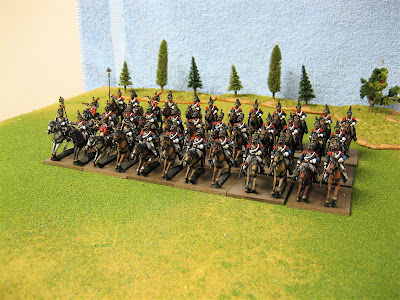

First Cuirassier Regiment -- 36 figures deployed in BAR styled three ranks. This is a hint of things to come.


Saturday, April 18, 2009

In The Grand Manner Napoleonics Game


Marshal Lannes' V Corps arrives on the table in road column, on the French right flank.

Note: click the pix to enlarge the view.

And now for something completely different: Napoleonics, played with In The Grand Manner rules by Peter Gilder. Keith Leidy played host today to another one of his super-sized 28mm Napoleonic games, played on his vast table space of three 6ft by 24ft tables. There were eight players, with Randy F., Bill P. and moi commanding the French army against an Allied contingent of Russians, Austrians and British, commanded by five players, including the well-known Uncle Duke Seifried.

The scenario was interesting in that the game began with nothing but cavalry forces entering the table from a variety of directions, all determined by dice roll. I rather enjoyed playing a game with nothing but cavalry and horse artillery and it is a concept that I would like to try with my Seven Years War armies one day.

We played 15 game turns with the infantry starting to appear on the table around Turn 11 or 12, as I recall. As commander of the French army (Monsieur Bonaparte), I was given the task of rolling the dice to see where our initial 3 or 4 cavalry corps would arrive.

Two of our initial three French cavalry divisions arrived on the same road over on the far right flank. I let Randy keep to the road and benefit from the 30" tactical move allowed to units moving along the roads, while I headed off to the left, off-road, to provide more maneuvering space and to clear the log jam of troops arriving on the same road. Sadly, I rolled for Bill's cavalry to enter from the center of the table, but they would not arrive until the second turn.

The French were pretty well bottled up on the right hand side of the table, so once Randy had control of the right flank, and Bill seemed to be doing well in the center, I sent most of my cavalry, except for a regiment of Carabiniers, off to the left flank, where I eventually ran into a lot of Russian cavalry.

Around Turn 10, our infantry began to arrive: one corps on the crowded right hand road, and the other, better placed, in the center. Eventually, Davout's large corps arrived on the French left, where it was sorely needed. I leave you with a few of the pictures that I took during the game, captioned with a description of the action. We will reconvene at Keith's house on May 30th to continue the game.


Randy (center) leads the French cuirassier brigade onto the center table and successfully drove off the British Household Cavalry early in the game. Mike (foreground) and Derek (far right) provide the opposition to the French.


Uncle Duke (beyond the metal pole) and Bill (Monsieur Protz) went head to head for control of the key town in the center of the middle table. The cardboard boxes that you see everywhere are for rolling dice. In cavalry melees, you throw a D6 for each figure and score a "hit" on a natural "6". I cannot roll roll a "6" on a D6 to save my life, which is why I prefer to command infantry in these rules.


From left to right: Uncle Duke, our game host Keith Leidy, Stan and Curt watch the progress of the Allies as they try to fend off the French heavy cavalry in the center.


A view of the French left flank. Napoleon has sent a division of dragoons and a regiment of chasseurs to protect the vital road, possession of which allowed Davout's III Corps to arrive. You can see the forward elements of Davout's corps arriving on the right hand side of the picture, about to cross the bridge. Russian cavalry (left) moves up to contest the road and bridge.


Another view of the furious fighting for the central town. Austrian horse artillery was the target of numerous French cavalry charges. Monsieur Protz was able to maintain a stubborn toehold on the center table, as he awaited the arrival of the infantry.


Thursday, April 9, 2009

Jacobite Rebellion Update


Front Rank Jacobites painted by Der Alte Fritz, about a year ago.

Last evening I completed another 30-figure clan regiment of Highlanders to use in our upcoming game on May 9, 2009. They will probably become either the MacDonnell or McDonald regiment, depending on which flag I choose to paint. The Highlanders did not wear any distinct "clan plaid" in the 18th Century, so the figures can represent any clan that I desire to rise for the King Across the Water.

I haven't painted Highlanders in quite awhile (the colonials don't really count since they all wear the same uniform), so it took me a little bit to get back up to speed with my bottles of plaid paint. What, you mean you don't own any plaid paint? A week ago friday, I pitched into the first 20 Front Rank figures, put a few bagpipe CDs on the player for inspiration, and started slopping on the paint. By Saturday afternoon, it was apparent that I would have this batch done by the end of the weekend on Sunday night. That left 10 more figures to bring the regiment up to full strength, and two more painting sessions proved to be enough to complete the job.

Now I have a Lowland regiment on the painting table ready to paint. I figured that I have a decent chance of painting three 30 figure regiments this month, so I cleaned another Highlander regiment and mounted them on their metal bases. Tomorrow night I will spray them with black primer. They will become either the Keppoch regiment or the Ogilvys. That would bring the Rebellion up to 6 regiments plus the Black Watch standing in for Clan Cameron, temporarily. Eventually, I want to have 10 or 12 regiments plus the Irish Piquets in my Jacobite Army completed in time for next year's SYW Association convention in March 2009.

Tuesday, March 31, 2009

Suren British Artillery Crew


British SYW 6-pd battery with Suren figures on the left and Stadden figures on the right. Both guns are from Elite Miniatures.

March concluded with a roar of painting output as I finished the month with 117 Olley Painting Points (97 infantry & guns at 1 point each and 10 mounted figures which count for 2 points each). This follows on totals of 100 points in January and 115 points in February.

Monday night I finished off six Suren British artillery figures and another Elite 6-pounder in order to complete the two gun battery. I rather like the Suren artillery crew and in fact prefer them over the more formal looking Stadden crew. I used an RSM rammer and officer's sword and made the trail spike from a spare piece of wire that I had in my bits box. I should have also made a linstock out of wire with florists wire wrapped around the stick, but I forgot to do this.


The full battery supports the 1st Regiment of Guards.

The battery complements the Suren Guards rather nicely, as you can see in the picture above. I also finished 9 more Guards over the past couple of days and now have 25 figures painted - almost enough for two grand divisions (30 figures). I have to add some wire cravats to the flag poles before I can prime the figures, otherwise I would have had the standard bearers done too. I am using the GMB Designs flags for this unit.


A closer view of the augmented Guards battalion, now up to 25 figures. Suren figures painted by Der Alte Fritz.

A part of me would like to keep plugging away on the Suren Guards so that I could finish the unit in April, but we have a Jacobite Rebellion game coming up on May 9th and I need to add two more clans, 30 figures each, before then, so it is on to the Highlanders next. I may dodge in a few Surens here and there to take a break from all of that plaid paint.

Sunday, March 29, 2009

Suren British Guards


Suren British Foot Guards and Mounted Officer provide support for a Stadden gun crew that is manning a 6-pounder from Elite Miniatures. Painting by Der Alte Fritz (click pix to enlarge)

I have been working on the 1st Regiment of Guards for my British WAS/SYW army over the past week and I finally have enough of them done to justify taking and posting a picture on this blog. As of Sunday evening, I had 17 figures completed and another 9 figures should be completed with one more evening's worth of painting.

The batch of figures shown in the pictures have been a work in progress that probably started in 2006. I painted a couple of the figures and started the rest, then grew tired of the project and set them aside, where they have resided in a cigar box over the past two plus years. I seem to have more enthusiasm for the figures this time around, as I am plowing through them at a fairly fast pace. I have another dozen that were primed this evening and should be hitting the painting table soon. Eventually, the battalion of Guards will have 60 hat men and 12 grenadiers.


A closer view of the British artillery crew (Staddens) and the 6-pounder from Elite Miniatures. The officer in the red coat is a Suren figure.

Last night I took a short break from the Guards and painted a gun crew of six Stadden figures and one Elite Miniatures 6-pounder. The brigade had no artillery, so I thought that I had better remedy this as soon as possible, what with the French reportedly advancing towards the British foreward base at Minden. Today, I cleaned and primed a dozen Suren British artillery crew, 8 Front Rank artillery crew, and 4 Elite Miniatures crew plus another 6-pounder. I am looking forward to seeing how the Suren artillery crew paint up because they have more active poses, in contrast to the curious marching pose that the Staddens have. The Stadden artillery crew would make for good "pioneer" figures in anyone's imagination army.


Close up picture of the Suren British mounted general and some of the Foot Guards.

The handsome gentlemen shown in the picture above will likely become my "army general" for the British contingent fighting in Germania this year. I haven't decided on a name for him yet, although I am leaning toward him being Lord Ligonier during the period of the War of the Austrian Succession. Since this is something of an imaginery campaign, I may decide that Ligonier found the Fountain of Youth and was young enough to lead the army during the SYW as well, even though that did not happen.


Another view of the Guards.


The whole brigade turned out on the Basteau Heath outside of their camp at Minden.

As of this evening, my British army in Western Germany consists of four battalions of infantry: the 3rd (Buffs) Foot, the 8th (Onslow's) Foot, the 11th (Sowle's) Foot and the 42nd (Semphill's) Foot/Black Watch. Note that I am using colonels from the WAS period rather than the SYW. This infantry brigade is supported by one section of artillery and 5 squadrons of cavalry. It is a work in progress that has many months ahead of it, but I have overcome my aversion to painting red coats and seem to be rather fired up to build the brigade as soon as possible.

So far, I have approximately 102 Olley Painting Points done for the month of March, which is a very good pace. Things should slow down a bit in April as I turn my attention to Jacobite Highlanders for our game on May 9, 2009.

Wednesday, March 25, 2009

Back to 1998


Der Alte Fritz (standing on the right) hosting a participation game at the 1998 SYW Association convention.

I was looking at some of the photos of the recent SYWA convention that were posted on the group's yahoo site and found this picture of me running a game at the convention in 1998. The fellow seated at the far left is the late Greg Nichols, who succumbed to cancer a couple of years ago. Seated next to him is an old friend, Rich Niersbach. I'm not sure who the other gentlemen are.

I haven't changed all that much other than the fact that my locks are a little bit greyer. Given the date of this picture, the game would have been Austrians versus Prussians, all of them RSM figures, and we would be using my own Alter Fritz rules. These rules are printed on a single side of an 8.25" by 11" sheet of paper. Most gamers pick up the gist of the rules and the few nuances by the end of the second turn. They would often run the game on their own and I would simply ajudicate any unusual situations. The figure ratio is 1:30 in these rules, but they would also work at 1:20. I have never tried them at my current favorite 1:10, so who knows?

Monday, March 23, 2009

The Guards

I am getting the itch to start painting fellows in tricorn hats again and now that I have actually fielded my first SYW British brigade, I'm thinking that I will want to paint some more red coats. I am actually designing my British army around the earlier period of the War of the Austrian Succession, rather than the SYW. One reason for this is the fact that the three regiments of Foot Guards took to the field and fought at Dettingen in 1743 and Fontenoy in 1745.

Sunday afternoon, the day after the SYWA convention, I was cleaning and priming some Front Rank Jacobites for our Forty Five Campaign, when I happened across a box of partially painted Suren British figures. They were in fairly bad condition, so I picked up one figure (big mistake there) and applied a lighter coat of red over the dark red undercoat that was already on the figure. I might as well touch up the blue trousers and turnbacks. And while I'm at it, the equipment could use a little bit of freshening up. Before I knew what had happened, I had nearly finished painting one of the figures. I found that I had the urge to paint some more.

So I have 17 Suren figures that I plan to paint as the 1st Guards Regiment. Why? Because I happen to have the GMB Designs flag for the 1st Guards. My plan is to work on a few of the Surens while I am painting my Jacobites. A few here and there and suddenly I will have a half battalion of 30 figures. From there it is not that much more work to get to 60 figures.

There are several problems with the Suren figures. First and foremost, they require a lot of preparation work. You have to clean out blobs of lead between the legs and under the arms because some of the molds are so bad. Then you have to glue on the weapons and hanger swords, which can be a pain in the neck to do. However, once you have reached this stage, then you get to experience the fun of painting these nicely animated and proportioned figures. I will post some pictures later in the week after I have made some progress.