


Can you please get rid of that awful Captcha verifying system in Blogger?
Captcha is that thing where you have to click on a number of images (traffic lights are the worst) before your comment can be published, done to screen out bots. Half the time I can't even see the images and after two or three attempts, I give up and fail to post my comment.
The "I Am Not A Robot" is much more user friendly. Can you please use that device instead? Or simply use your Authorization Before Publishing function in Blogger.
I implore all Bloggers to stop using Captcha so that an old codger like me can leave comments on your blog.
Friday, February 7, 2020


Wednesday, February 5, 2020
Saratoga British Now Available In the Fife and Drum webstore
I finished adding the new product codes for all of the new packs of Saratoga Campaign British infantry. The new codes are as follows:
BA-030 British Center Company Command (5 figures) -- $10.00
BA-031 British Center Company Soldiers Marching (9 figures: 3 each of 3 poses) -- $18.00
BA-032 British Flank Company Command (5 figures) -- $10.00
BA-033 British Flank Company, Marching - suitable for either grenadiers or light company (8 figures) -- $16.00
BA-034 British Flank Company Skirmishers or Firing Line (7 figures) -- $14.00
BA-035 British Flank Company Advancing at Porte Arms (8 figures) -- $16.00
BC-008 Mounted Officer wearing round hat with left side turned up (horse and rider) -- $6.00
Click on this link to go directly to the web store to place your orders:
www.fifeanddrum-minis.com
Note that we made some flank company figures in marching poses (BA-032 and BA-033) so that they can be used as both the converged light battalion and the converged grenadier battalion that fought at Saratoga under the command of Simon Frasier. The BA-033 pack of flank company soldiers advancing are also well suited for the converged battalions.
We also made a number of skirmishing flank company figures to use as, well, skirmishers in your war-games or as individual action figures in small skirmish level games.
I have just started to paint samples of all of the new pictures to post both here and in the web store. The webstore products have pictures of the unpainted castings, for now, soon to be replaced with pictures of the painted figures.
BA-030 British Center Company Command (5 figures) -- $10.00
BA-031 British Center Company Soldiers Marching (9 figures: 3 each of 3 poses) -- $18.00
BA-032 British Flank Company Command (5 figures) -- $10.00
BA-033 British Flank Company, Marching - suitable for either grenadiers or light company (8 figures) -- $16.00
BA-034 British Flank Company Skirmishers or Firing Line (7 figures) -- $14.00
BA-035 British Flank Company Advancing at Porte Arms (8 figures) -- $16.00
BC-008 Mounted Officer wearing round hat with left side turned up (horse and rider) -- $6.00
Click on this link to go directly to the web store to place your orders:
www.fifeanddrum-minis.com
Note that we made some flank company figures in marching poses (BA-032 and BA-033) so that they can be used as both the converged light battalion and the converged grenadier battalion that fought at Saratoga under the command of Simon Frasier. The BA-033 pack of flank company soldiers advancing are also well suited for the converged battalions.
We also made a number of skirmishing flank company figures to use as, well, skirmishers in your war-games or as individual action figures in small skirmish level games.
I have just started to paint samples of all of the new pictures to post both here and in the web store. The webstore products have pictures of the unpainted castings, for now, soon to be replaced with pictures of the painted figures.
Tuesday, February 4, 2020
Saratoga British Castings Pictures
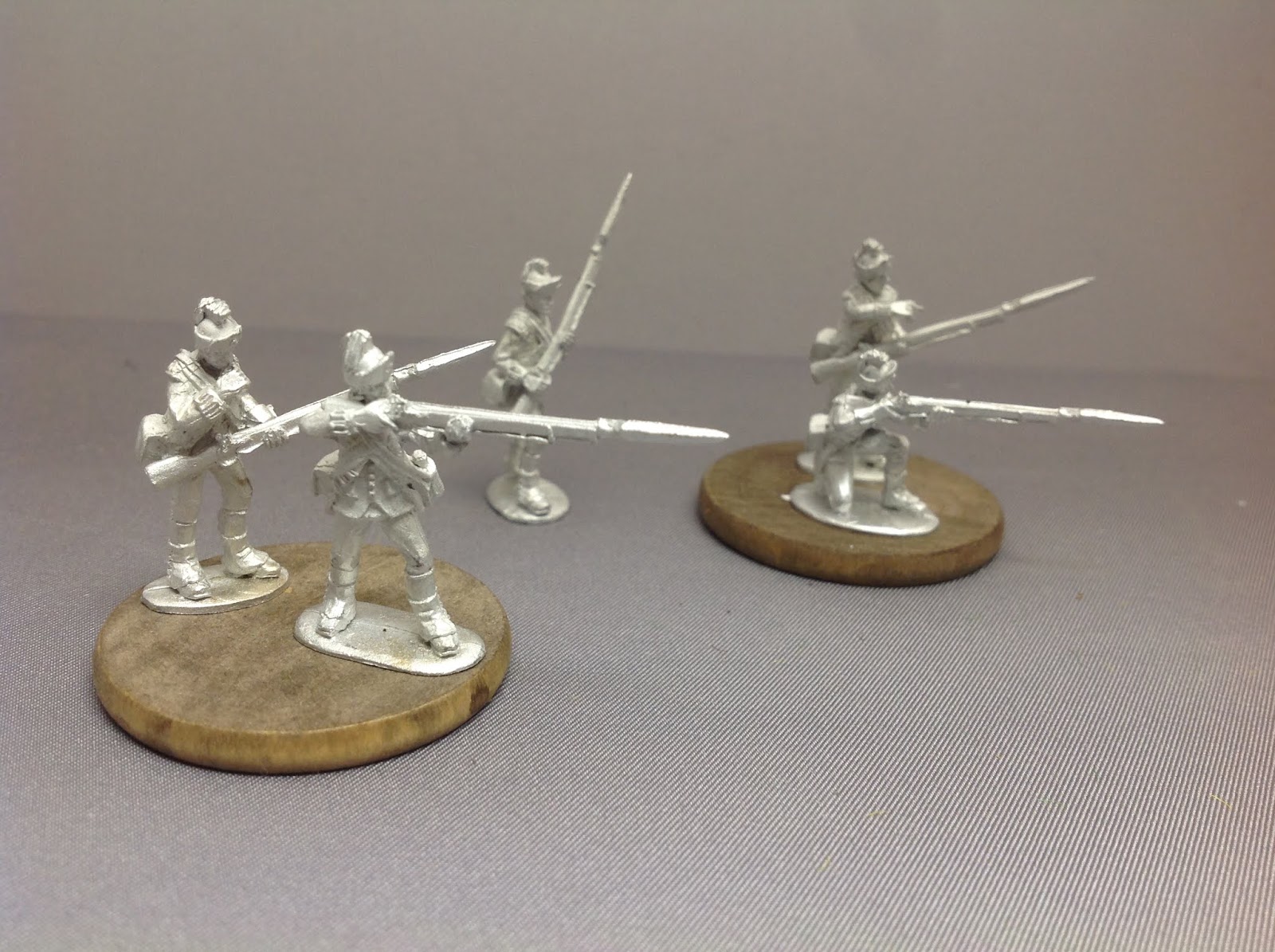 |
| Flank Company Skirmishers or firing line |
The new Saratoga Campaign British infantry have arrived and I will be sorting out the figures and creating new product SKUs and numbers to the web store over the course of this week. I should have the new product codes ready by tomorrow so that you can start planning your orders for British Saratoga figures.
Please click on all pictures to enlarge the view.
 |
| Flank company NCO directing fire and kneeling firing poses. |
 |
| New British officer wearing round hat turned up on the left side. |
 |
| Reverse view of the new mounted officer. |
 |
| Center Company NCO (left) and three rank and file marching. |
 |
| Reverse view of the center company figures. |
 |
| Center Company Command (left to right): officer, drummer, standard bearer and NCO. |
Flank Company Figures Marching
I had the flank company figures sculpted in marching poses with the idea of using them for the converged grenadier and light company battalions commanded by Simon Frasier during the battles of Freeman's Farm and Bemis Heights.
 |
| Flank company marching. These can be used for the converged grenadier battalion as well as the converged light companies. |
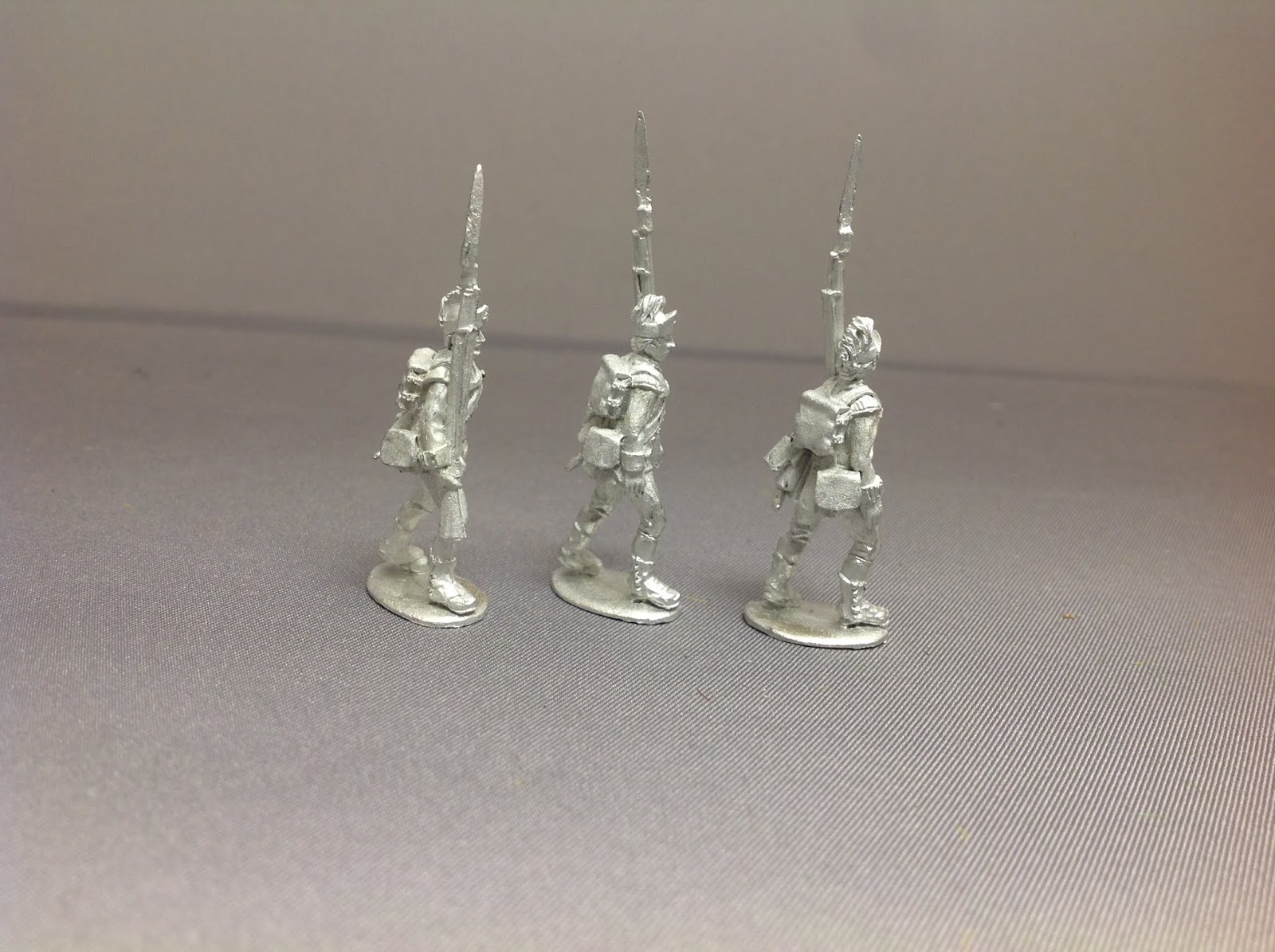 |
| Reverse view of the flank company marching figures. |
I will start painting some samples of each figure once I have the items set up in the web store.
It goes without saying that I really like these new castings and I am looking forward to building my British army for the Saratoga Campaign. As usual, Griffin Moulds produces castings that are sharp and clean of little burrs or flash on the figures. Also, the bayonets have been very strong in recent years and these are no exception. I dropped a few of them on the floor, bayonets down, to test their strength and they came through with flying colors.
Monday, February 3, 2020
Saratoga British Figures Arrive Today. Huzzah!
I am really excited to report that the Saratoga British castings will arrive from Giffin Moulds this afternoon. Delivery is promised between noon and 3PM, but it seems like the UPS deliveryman always has me last on his delivery. UPS has an app that allows one to follow the delivery truck en route to your house. It's funny, I watch a truck pass within a block of my hours as it goes to make a delivery several miles away. It does this multiple times for some reason. Very confusing.
Perhaps the packages are loaded into the truck by weight, with the heaviest items loaded onto the truck first, thus making them the last items to be delivered. I am assuming that UPS has some sort of linear programing model that selects the optimal order of delivery. With two 20kg boxes coming to my door...
I digress.
I will post some pictures of the castings later on this afternoon or evening, so make another visit to this blog later today. Then, I will quickly prime samples of each figure so that I can start painting the samples tomorrow. I will post pictures on this blog as fast as I can paint them.
The Mohawk Indians are at Griffin right now getting the production moulds made. I should have the castings available in time for this year's Seven Years War Association Convention in South Bend, Indiana, on April 2nd through 4th. I will be running three skirmish games using my new Kleine Krieg skirmish rules.
Friday, January 24, 2020
Kleine Krieg Rules Q & A
 |
| Der Alte Fritz answers questions from play testers of his new Kleine Krieg rules. (click to enlarge the picture) |
I have a number of play testers working on my Kleine Krieg skirmish rules for the Seven Years War and I am getting some good feedback that I thought that I would share with my readers. The questions and the answers are shown below:
Question 1 - Initiative: Do you dice to determine who goes first, as in your rules for larger battles, or is there a different method?
Answer: Initiative is determined by the draw of a card from a deck that you create prior to the start of the game. I make my own cards by cutting them out of cardboard. Each unit in the game will have two cards with its name on the card. All cards for all units are shuffled together and the draw of the card determines which unit gets to perform an Action first. Note that any unit can theoretically draw two consecutive cards and thus perform back to back Actions.
Question 2 - In the turn order: move, shoot, melee and morale (and when for morale). Should it be on the play sheet?
Answer: The turn order is determined by each player when one of his cards is drawn from the card deck. A player may decide that he wants to shoot on the first turn; or move first; or charge into melee, etc. There is a box on the back of the QRC sheet labeled "When to Check Morale" and such checks are taken when
1) Charging unit takes casualties during the charge
2) Defender decides to Stand to a charge
3) Melee loser tests morale
4) Officer or personality figure casualty that occurs on the current game turn
Note that units do not have to test morale when they take casualties from firing (except if taken during the charge - see event 1) above.
Question 3 - Two actions in one turn feels like a lot for a small skirmish game on a smaller 4ft by 6ft table, especially when units are within 18-inches (which is the musket range).
Answer: the rules are flexible and feel free to make changes during your play testing. On a smaller 4x6 table I would recommend using smaller units of, say, 12 figures instead of the 12 to 24 figures that I use in my skirmish game. You could also experiment with reducing all ranges and movement by half.
Question 4: I do like the idea of a reload as an Action which stops people blazing away willy nilly twice in a bound. It makes it more of a tense game in timing a charge or movement when close to an enemy - are they going to reload in time?
Answer: a "reload" Action is an interesting idea that I will consider adding to the rules. I kind of like the idea of a dastardly Croat letting the Prussians have it in the face on consecutive actions. On the other hand, if there were a "reload" Action in the rules, a unit might want to only fire half of its unit (e.g. fire 6 of 12 figures in a unit) while the other half of the unit holds its fire. Thus the other six figures can fire at an opponent and cover the other half who are reloading.
Question 5: When a unit takes a casualty how do you decide who is hit? I did a dice roll to count along the unit's line, in the manner of the Featherstone and Grant rules.
Answer: My perusal of the rules sheet indicates that the officer casualty procedure is not listed on the rules sheet. Originally, I was using a deck of regular playing cards to determine fire effects and if an Ace card was drawn, then the fire effect applied to the officer in the unit or the Personality figure if he was attached.
I think that your solution is a good idea. So roll a D6 and start counting from left to right along the line of the unit's figures. Thus a roll of "5" indicates that the fifth figure from the left would be the casualty. Or maybe roll two D6 if it is a 12-figure unit.
Question 6: It felt odd with both the winning and losing sides in a melee taking prisoners. Should the winners (sic - "losers" perhaps) just retire?
Answer: Melees are fought on a one to one basis, or up to a maximum of three figures picking on one unfortunate Joe if one of the sides has extra figures in its unit (e.g. one side has 6 figures and the other side has 9 figures - thus one side has three extra figures that it can match up with other melees in the fight. In this instance the extra figures can double up on one figure first, rather than adding two more figures , that is 3 to 1. If there are still extra figures after all figures have doubled up on the opponent, then the third figure can join the melee).
It might be a good rule change to have the losing side in the melee retreating and releasing its prisoners. Thus only melee winners retain captured prisoners.
Question 7: The melee system seems a bit fiddly. I do like the one on one combat ( as in The Sword and the Flame rules). Could the hit and casualty outcomes be shown from the difference in the initial opposed rolls rather than having to roll dice again?
Answer: There is only one dice roll in a melee. The one die roll applies to both the combat part of the melee and the melee outcome result.
The winner of a one on one melee is the figure that rolls the higher number on its combat dice roll. For example, if Player A rolls a "12" on a D20 and Player B rolls a "9" on a D20, then Player A wins the melee. Player A now consults the Melee Results Table and sees that the "12" that he rolled in the melee translates into a Kill outcome (a roll of 12 to 20 is a kill).
If we were to "net out" the opposing numbers, in this case a 12 less a 9 equals a 3 outcome which translates to "loser taken prisoner". The result can be substantially different if the die rolls are netted against each other. If you want to try netting the dice scores, the I would recommend reducing the Melee Effects by half (e.g. a 20 roll become a 10 roll and the 12 to 20 roll outcome of Kill is changed to 6 to 10 equalling a Kill outcome.
For those readers who do not have a copy of the rules in front of them, the melee results table:
On a D20, Melee Results are:
12 to 20 Kill
9 to 11 Wound inflicted on the loser
5 to 8 Flee, the loser retires 12-inches
1 to 4 Loser is taken prisoner
Halving the above table changes the outcome buckets to 6 to 10 = Kill; 4-5 = Wound; 2-3 = Flee, and a 1 = Loser taken prisoner.
I think that the play tester asked a lot of good questions and found a couple of logic holes in the rules. I appreciate all feedback from our play testers. The rules are not set in stone yet so I can still change mechanics that either don't work or produce odd results.
I welcome comments from readers who are not play testers. Just write your observations and opinions in the Comments section of this blog post.
Frederick the Great's Birthday Today
 |
| Vignette of King Frederick taking the colours of the IR48 regiment at the battle of Zorndorf. Conversion by me. |
Today is the anniversary of the birth date of King Frederick II of Prussian - January 24, 1712. Because this is the Der Alte Fritz Journal, it is appropriate to note his birthday on this blog.
Happy Birthday Fritz!
 |
| Frederick as rendered by Minden Miniatures. |
 |
| Frederick the Great reviews his troops on his birthday. Regimental ensigns parade their colors past the king. |
cc
Tuesday, January 21, 2020
Late Roman Campaign & Pix
 |
| Roman watch tower along the Danube frontier is defended by the Martenses "pseudo-comitatensis" legion. Note the pair of signal fires that are ready to be torched if the German tribes are on the move. |
It has probably never occurred to any of my blog readers that I would have an interest in the broad based "Ancients" historical period. What's this Fritz? Hey, hold on there for a second; tell me it ain't so!
Well it is in fact true. I like wargaming the Ancients (and the Medieval period too). More specifically, I like the "Late Roman" period ( circa 300AD to 407AD) because the Roman army is no longer the world beater that it was in its heyday, but it should still have an advantage over any run of the mill barbarian army. The Persians of course are a different matter, but that is a blog report for another day.
 |
| My entire 28mm Late Roman army has made its first appearance on a game table since at least 2004. |
I have recently committed to participating in a campaign set in the Mediterranean part of the world during the period of the Roman Empire. It is an opportunity for the various campaign players to get their armies out on the game table and roll some dice. As far as I know, the rivals and opponents can be from any part of the Roman era. So it is possible that an army from Julius Ceasar's time could cross swords with an army of Visigoths and Vandals from the 400AD era.
 |
| A view of the Roman battle line. The armored legio comitatensis units are deployed in the front line, supported by the unarmoured Auxillia Palatinum soldiers. |
The Campaign
Each player starts the campaign with a "homeland" consisting of three provinces or states. My domain is located in Asia Minor with the provinces of Galatia, Pontus and Cappadocia under my rule. My domain covers roughly the east half of modern day Turkey. I have Macedonians to the left of me, Persians and nomadic tribes to the right of me and here I am stuck in the middle of the Middle East. Oh, and Egyptians to the south of me.
So the campaign was the event that found me digging my Late Roman army out of storage and letting the little men see the light of day for the first time since 2004, when I moved to my present home in Hesse Seewald. I know that I played at least one game in 2001 because my nephew Alex and I played with the figures prior to his joining the U.S. Army. The Late Romans and Barbarians might have seen maybe one other battle, but certainly nothing since 2004.
Nearly all of my Late Romans are Wargame Foundry figures sculpted by the Perry brothers, before they went out on their own and started Perry Miniatures. I really like these figures. There are also a few Gripping Beast figures, but these are noticeably larger than the Perry figures. Most of my Gripping Beast figures are in the ranks of the barbarian tribes.
I had to give a list of the units in my Late Roman army to the campaign judge so that he could develop an army list for my domain as well as those of the other domains in the campaign. Accordingly, I brought out trays and boxes of figures from the catacombs of my house and set up all of my Late Romans onto my game table. I have to say that I was impressed by the spectacle of 12-13 infantry legions, auxillia and limitanei troops plus five units of cavalry. You can see them all lined up in battle array in the second picture from the top (see above).
The Infantry
The Late Roman field army was called the Comitatenses, which served behind the front line border soldiers called Limitani (which were of lower quality than the units in the Comitatenses). The Comitatenses was available to "plug the holes in the dyche" whenever a hoard of barabarians, usually Germanic tribes, broke through the border walls. Sometimes border troops were temporarily transferred to the main Comitatenses and they were called Pseudo-Comitatenses units
The senior units in the Roman army were called Palatini/Palatinae/Palatina, and this designation applied to both infantry and cavalry units. Cavalry units were called Vexillationes Palatinae (of which there were 5 such units) and infantry units were largely Legiones Palitina ( 5 units) or Auxillia Palatina (10 units - which were first raised by the emperor Constantine).
The non-senior units in the infantry were Legiones Comitatenses and the Pseudo-Comitatenses soldiers.
 |
| The Lanciarii Gallicani Honoriani legio with green and white shield are deployed on the front line and are supported by the Celtae Seniores auxilia palatinum with the red shields, and the Martenses psuedo-commitatensis unit with the plain blue shields. A pair of bolt throwers, called Scorpions, cover each flank of the legio in the front line. |
 |
| The Ioviani Seniores legio comitatensis is posted in the center of the Roman battle line. It has rear support from an auxillia unit that I can't identify. The shield design could be one that I made up or it could be that of a real regiment in the Roman army. If you know anything about the shield design then please let me know. |
 |
| Who are these guys? I really want to know. |
 |
| On the left flank of the battleline we see the Secunda Britannica legio commitatensis. Behind it, providing support, is the Petulantes Seniores auxillia palatinum regiment and behind them one can barely see some archers that provide missile support to the troops |
 |
| The Celtae Seniores auxillia palatinum unit poses in front of a frontier watch tower (made by Herb Gundt). The two haystacks in the background are actually signal fires. In the event that something dire is happening, the garrison of the watch tower will set the hay on fire to signal other watch towers. The emperor Julian the Apostate (purple cloak) is on the horse to the right of the Celtae Seniores. |
 |
| Another view of the watch tower and the right flank of the Roman army |
The Cavalry:
Late Roman cavalry were organized into Vexillationes and these were frequently broken up into smaller units and deployed in different places throughout the empire. The Roman army had both heavy battle cavalry and light cavalry (often armed horse archers or spearmen).
 |
| Scola Gentilum Seniorum - basically a "guard cavalry" unit. |
 |
| Heavily armoured cataphract cavalry holding their long lances called "kontos". Note that the horses benefit from armour too. |
 |
| The Scola on the left, and the Scutarii with their red shields are on the right. Both are heavy battle cavalry. |
 |
| Roman light cavalry includes Equites Sagitarii or horse archers, backed up by spearmen of the Equites Dalmatae Passerentiiae |
 |
| The Roman heavy cavalry protects the right flank of the army formation. Sentries posted in the watch tower keep an eye out for the barbarians. |
 |
| The formidable looking Roman right flank. |
A Typical Late Roman Army in Gaul
The army located in Gaul consisted of the following units:
4 vexillationes Palatina
8 vexillationes Comitatenses
12 total cavalry vexillationes
1 Legio Palatina
9 Legio Comitatenses
15 Auxillia Palatina
10 Pseudo-Comitatenses
35 total infantry units
My Late Roman Army
Cavalry:
Scola Gentilum Seniorum - guard cavalry
Scutarii Seniores - heavy cavalry in chain mail with spears
Cataphracts - fully armored men (and horses too!) armed with a long Kontos lance
Equites Sagitarii - horse archers
Equites Dalmatae - spear armed light cavalry
Each of my cavalry units has 12 figures.
Infantry:
Lanciarii Gallicani Honoriani - Legio Palatina
Ioviani Seniores - Legio Palatina
Secunda Britannica - Legio Comitatenses
Cornuti Seniores - Auxillium Palatinum
Brachiati Seniores - Auxillium Palatinum
Petulantes Seniores - Auxilium Palatinum
Celtae Seniores - Auxillium Palatinum
Martenses - Pseudo-Comitatenses
? unknown - Pseudo-Comitatenses
Sagitarii - Archers
So there are ten infantry units in my army. The legios have 30 figures and the auxillia have 24 figures.
There are also three bolt thrower artillery pieces called Scorpions.
Please check in to my blog over the next several months to see how the campaign is going.
Subscribe to:
Posts (Atom)